5 EvenUp Alternatives for Personal Injury Firms in 2026

- The best EvenUp alternatives depend on the workflow you are replacing: Demand drafting, medical analysis, plaintiff case intelligence, and call operations require different products.
- Supio is the closest demand-focused option in this shortlist: It generates plaintiff demands using case documents, firm templates, and source-linked facts.
- Eve is the broader plaintiff AI alternative: EveOS now spans intake, Agents, Auditor, Analyst, casework, drafting, and operational workflows.
- LitifyAI and Neos make the strongest case when your CMS is already part of the buying decision: Their demand workflows sit close to the case data already stored in those ecosystems.
- HelloCounsel belongs in the EvenUp alternatives conversation when phone operations are the problem: It handles supported inbound and outbound plaintiff-firm call workflows rather than demand drafting or legal analysis.
- Do not compare subscription prices in isolation: Compare cost with staff time removed, workflow completion, integration depth, implementation effort, software consolidation, and operational ROI.
- Use real matters and real workflows during evaluation: A polished demo tells you less than what happens when records are incomplete, the caller does not fit the script, or the first follow-up attempt fails.
Searching for EvenUp alternatives used to mean finding another personal injury demand-drafting product.
That is no longer the whole comparison.
EvenUp now spans demands, medical chronologies, case preparation, workflow automation, case intelligence, and post-retainer Communication Agents. Its current Communication Agents cover workflows such as claims initiation, coverage and liability verification, treatment monitoring, records follow-up, and balance confirmation.
So a firm comparing EvenUp alternatives first has to decide which part of EvenUp it actually wants to replace.
A demand backlog creates one shortlist. A case manager spending hours on provider and carrier calls creates another. A firm wanting broader case intelligence may be better served by a platform. A firm already running Litify or Neos may prefer to add AI inside the system it already uses.
The strongest EvenUp alternatives therefore compete by workflow, not simply by how many AI features they can list.
Our Top Picks
These EvenUp alternatives solve different buying problems.
| Best For | Option | Why It Makes the Shortlist |
|---|---|---|
| Plaintiff call operations | HelloCounsel | Focused AI voice agents for supported inbound and outbound plaintiff workflows |
| Demand drafting and case preparation | Supio | Plaintiff-specific demands built from case records, firm templates, and source-linked facts |
| Broad plaintiff AI platform | Eve | Wide casework scope across intake, agents, drafting, case review, and firm intelligence |
| Litify firms adding demand automation | LitifyAI Instant Demands | Demand generation inside the Litify environment |
| Neos firms adding embedded demand work | Neos Demands Plus | Medical chronology and demand generation using records already stored in Neos |
If you are still deciding whether you need a broad plaintiff platform or a narrower workflow product, our guide to AI tools for personal injury lawyers separates the major categories before you compare individual EvenUp alternatives.
EvenUp in 2026 Covers More Than Demand Drafting
Any useful comparison of EvenUp alternatives needs to start with EvenUp's current scope.
EvenUp still has a strong demand and drafting story, but its current platform extends into medical workflows, discovery, automation, analytics, and communications. Its public materials describe all-in-one case-based pricing rather than a simple demand-by-demand product.
That means the phrase EvenUp alternative can describe several very different purchases.
| EvenUp Area | Current Role | What to Compare Against |
|---|---|---|
| Demand drafting | AI-generated demands and other plaintiff drafting workflows | Supio, Eve, LitifyAI Instant Demands, Neos Demands Plus |
| Medical and case analysis | Chronology, treatment visibility, medical information, and case preparation | Broad plaintiff AI and CMS-native AI |
| Communication Agents | Post-retainer voice and SMS workflows | Focused plaintiff call-operation tools and broader platforms with communication agents |
| Workflow automation | Case playbooks, monitoring, and automated progression | Broad plaintiff AI platforms |
| Case intelligence | Analysis across matters, records, and workflows | Broad platforms and CMS-centered systems |
| Pricing | Case-based commercial model | Compare total scope and value rather than one headline rate |
Feature count is a weak way to choose between EvenUp alternatives.
A platform can cover more steps and still be the wrong purchase when one operational bottleneck is causing most of the cost or delay.
Which EvenUp Alternative Fits the Problem You Actually Have?
For a COO or firm owner, the more useful comparison is what changes operationally after deployment.
| Decision Variable | Question | How It Changes the Shortlist |
|---|---|---|
| Primary bottleneck | What work is taking capacity away from the team? | Drafting, calls, case intelligence, and CMS workflows lead to different vendors |
| Breadth | Do you need a broad platform or one focused workflow? | Eve and EvenUp sit toward platform breadth; HelloCounsel and drafting-specific products are narrower |
| Workflow completion | Does the tool create an output or finish a defined task? | A draft, call summary, task completion, and matter update leave different amounts of work behind |
| Case-system integration | Where does the final output land? | CMS-native products may reduce context switching; connected tools need strong write-back |
| Human review | What still requires an attorney or staff member? | Demand review and administrative escalation have different human boundaries |
| Implementation burden | How much configuration and change management are required? | A broad rollout needs broader ROI |
| Operational ROI | What staff time, delay, or software spend actually changes? | Lower price does not automatically mean better economics |
Here, HelloCounsel looks narrow next to Eve and EvenUp, but much deeper on plaintiff phone operations when the buyer is comparing voice or answering tools.
Decide What You Are Actually Replacing
Before comparing EvenUp alternatives, name the workload.
| Your Bottleneck | Category to Evaluate | Questions That Decide the Fit |
|---|---|---|
| Demand backlog | PI demand-drafting software | How complete is the draft, how traceable are the facts, and how much review remains? |
| Medical chronology and case analysis | Plaintiff case-preparation AI | How easily can staff verify the source record and correct the output? |
| Provider, insurer, records, and treatment calls | Plaintiff call operations | What calls are supported, what happens after an unsuccessful attempt, and where does the outcome land? |
| Firm-wide AI automation | Broad plaintiff AI platform | Which workflows are actually deployed, governed, and used? |
| CMS-specific AI | Embedded case-management AI | Does remaining inside the system of record remove enough integration and re-entry work? |
Replacing EvenUp with a single platform is one option. It is not necessarily the best option.
A firm that likes EvenUp's demand output but wants deeper call operations may keep the drafting layer and add a voice product. Another firm may want to leave EvenUp's communications alone and change only the demand workflow.
The best EvenUp alternatives are therefore the ones that solve the part of the stack you actually want to change.
How We Compared the EvenUp Alternatives
We evaluated these EvenUp alternatives against the same operating questions rather than giving each product its own favorable criteria.
| Criterion | What to Look For | Why It Changes the Decision |
|---|---|---|
| Primary job | Demand drafting, case intelligence, call operations, or CMS-native work | Establishes whether the tools genuinely compete |
| Plaintiff depth | PI-specific records, cases, callers, and workflows | Reduces the translation the firm must configure itself |
| Human review | Attorney approval, professional review, staff escalation, or exception handling | Defines where responsibility remains |
| System handoff | Separate workspace, inbox, CMS sync, or matter-level write-back | Reveals downstream manual work |
| Pricing model | Case-based, fixed monthly, module-based, or custom | Makes commercial comparisons more meaningful |
| Implementation | Data migration, integration, training, configuration, governance | A larger rollout has to create correspondingly larger value |
| Operational ROI | Staff capacity, software consolidation, workflow completion, and time saved | Enterprise buyers care about value relative to cost |
For the call-operation side, our AI voice-agent evaluation guide provides a useful pressure test: run real calls, inspect the resulting case record, and define the human boundary before choosing between EvenUp alternatives.
5 EvenUp Alternatives for Personal Injury Firms
The list below ranks EvenUp alternatives by the buying job.
HelloCounsel appears first because HelloCounsel publishes this comparison. The fit is intentionally narrow. If your primary issue is demand drafting, Supio or one of the embedded drafting products is a more direct comparison.
1. HelloCounsel: Best for plaintiff call operations
Best for: PI firms comparing EvenUp alternatives because the bottleneck sits in reception, provider calls, treatment follow-up, insurance workflows, or other supported phone operations.
HelloCounsel provides AI voice agents specifically for plaintiff firms. The product operates in the phone layer rather than the demand-drafting or legal-analysis layer.
The overlap with EvenUp is specific.
EvenUp's current Communication Agents cover post-retainer workflows such as claim opening, coverage or liability verification, treatment monitoring, medical-record follow-up, and balance verification.
HelloCounsel also handles supported post-retainer calls, but it adds inbound call operations and is designed specifically around the plaintiff-firm phone workflow.
It does not draft demands, generate medical chronologies, review medical records for legal analysis, value cases, recommend settlements, or replace attorney judgment.
Key features
- Inbound reception and intake: Agents answer supported calls and follow the firm's routing and intake workflows.
- Outbound administrative workflows: Supported use cases include medical-record follow-up, treatment-related calls, insurance-claim opening, and other defined administrative calls.
- Caller and matter context: Relevant matter context can support the conversation instead of treating every caller as a new lead.
- Continued follow-up: Once an agent is invoked for a supported workflow, it can continue required follow-ups under the firm's defined SOP.
- Case-management integration: HelloCounsel works alongside the firm's existing case-management environment rather than replacing it.
- Confirmed integrations: Current client-confirmed integrations include Filevine, SmartAdvocate, Litify, Lead Docket, and Clio.
- CMS write-back: Supported notes and outcomes can flow into connected case-management workflows.
- Human escalation: Legal judgment, strategy, valuation, negotiation, and sensitive exceptions stay with the firm's team.
For more on the difference between completing a phone interaction and creating another administrative handoff, see what CMS write-back means for a PI firm.
The outbound-calls guide for PI firms also explains why provider, insurer, and records follow-up should be evaluated separately from reception.
Pricing
HelloCounsel uses custom-scoped fixed monthly pricing based on expected usage and volume, with an agreed tolerance.
When comparing this with other EvenUp alternatives, the useful question is not which invoice is smallest.
Compare:
- Staff time removed: How many repetitive calls, callbacks, and documentation steps leave the team's queue?
- Workflow completion: Does the system finish the supported task or create another handoff?
- Integration value: Does the outcome reach the system your staff already uses?
- Software consolidation: Does the purchase replace another service or tool?
- Implementation effort: How much work is required before the value appears?
That produces an ROI comparison rather than a line-item-price comparison.
Pros and cons
Pros
- Focused plaintiff call operations: Best fit when the phone workflow is the bottleneck.
- Inbound and outbound scope: Covers supported calls in both directions.
- Case-management connectivity: Confirmed integrations include Filevine, SmartAdvocate, Litify, Lead Docket, and Clio.
- Follow-through: Supported workflows can continue after an unsuccessful first attempt.
Cons
- Not a demand replacement: Firms comparing EvenUp alternatives primarily for drafting should start elsewhere.
- Narrower product scope: HelloCounsel does not attempt to replace a broad plaintiff AI platform.
See the HelloCounsel product overview.
2. Supio: Best direct alternative for demand drafting
Best for: Plaintiff firms comparing EvenUp alternatives primarily because they want another approach to demand drafting and case preparation.
Supio is the closest demand-focused option in this shortlist.
Its current AI Demands product generates demand letters using case documentation and the firm's existing templates. Supio also says demand facts such as injuries, treatment, and damages are linked back to supporting sources so reviewers can verify them.
That source traceability is more useful than simply asking which product produces a prettier first draft.
Run Supio and EvenUp against the same difficult matters. Include missing documents, prior injuries, long treatment histories, and records that require judgment during review.
Key features
- AI demand drafting
- Firm-template adaptation
- Source-linked case facts
- Plaintiff-specific case preparation
- Editing within the drafting workflow
Pricing
Supio does not publish a simple universal rate card on the current demand page. Our Supio pricing guide covers how its case-based plans work.
For a fair comparison of EvenUp alternatives, price the same annual case volume, users, review requirements, implementation scope, and demand mix.
Pros and cons
Pros
- Direct demand overlap: Stronger like-for-like fit than a call-operation product.
- Plaintiff specialization: Built around plaintiff case documents and workflows.
- Source traceability: Reviewers can check generated facts against the record.
Cons
- Does not solve reception or phone workload: A firm with a provider-call problem has a different bottleneck.
- Quote required: Total commercial comparison depends on your actual deployment scope.
3. Eve: Best for a broad plaintiff AI layer
Best for: Firms comparing EvenUp alternatives because they want another broad plaintiff AI platform rather than one narrow replacement feature.
Eve now sits firmly in the platform category.
EveOS includes intake, Agents, Auditor, Analyst, and an underlying data layer intended to support plaintiff workflows across the case and firm. Eve says its Agents handle work including drafting, records follow-up, and routine calls, while Auditor continuously reviews matters and Analyst provides firm-level intelligence.
That breadth makes Eve a more direct strategic alternative to EvenUp than a focused voice or demand tool. Firms weighing Eve on its own can compare Eve Legal alternatives.
The buying risk is also broader.
A platform purchase creates value only when the firm uses enough of the platform to justify implementation, change management, governance, and commercial scope.
Key features
- Agents: Proactive casework and workflow execution.
- Auditor: Ongoing review of active matters.
- Analyst: Firm-level operational and financial insight.
- Intake: Plaintiff intake workflows.
- Drafting and casework: Broader plaintiff legal workflows.
- Case-data layer: Firm information structured across the platform.
Pricing
Eve uses sales-led pricing rather than a simple public dollar rate card. Our Eve Legal pricing guide explains what the contract says about price.
Compare Eve with other EvenUp alternatives using the exact workflows, users, matters, implementation requirements, and integrations your firm expects to deploy.
Pros and cons
Pros
- Broad plaintiff workflow coverage
- Platform-level case and firm intelligence
- Meaningful overlap with EvenUp across more than demand drafting
Cons
- Larger rollout: More surface area means more implementation and governance.
- Potential overbuying: A firm with one narrow problem may not need the whole platform.
4. LitifyAI Instant Demands: Best for Litify firms
Best for: Firms already using Litify and comparing EvenUp alternatives for demand generation.
Litify launched LitifyAI Instant Demands in June 2026 through its partnership with Supio. The capability is designed to generate submission-ready demand packets within the Litify environment.
The advantage is architectural.
If the matter, documents, and workflow already live in Litify, moving demand generation closer to that case-management environment can reduce context switching and separate data movement.
For a firm that does not use Litify, the decision is much larger because it combines a CMS decision with a demand-software decision.
Key features
- Demand generation inside Litify
- Supio-powered plaintiff drafting
- Case-data proximity
- Embedded workflow rather than a separate drafting environment
Pricing
Commercial terms depend on the firm's Litify environment and agreement.
Ask for the incremental demand-AI cost separately from the underlying platform when comparing EvenUp alternatives.
Pros and cons
Pros
- Strong fit for current Litify firms
- Less context switching
- Demand work closer to the system of record
Cons
- Limited relevance outside Litify
- Only replaces part of EvenUp's broader platform scope
5. Neos Demands Plus: Best for Neos firms
Best for: Neos firms comparing EvenUp alternatives for medical chronology and demand generation.
Demands Plus is currently marked Early Access by Assembly Software and requires NeosAI Platinum. It builds medical chronologies and demands letters from records already stored in Neos, without requiring an export to another drafting environment.
That makes it an ecosystem choice.
If your case data is already in Neos, the proximity of the records and drafting workflow may carry more value than adopting another standalone platform.
The early-access status should remain part of the decision. Ask what is production-ready today, how review works, what implementation support is included, and whether commercial terms may change as the product matures.
Key features
- Medical chronology
- Demand drafting
- Records already stored inside Neos
- NeosAI Platinum requirement
- Early-access deployment
Pricing
Assembly publicly shows the prerequisite platform structure but does not publish a simple standalone Demands Plus price.
Price the full required Neos configuration when comparing EvenUp alternatives, not the feature in isolation.
Which EvenUp Alternatives Make Sense if Demands Are the Problem?
If demand production is the bottleneck, keep the EvenUp alternatives comparison in the drafting and case-preparation category.
HelloCounsel is irrelevant to that decision.
The useful test is how much work remains between the generated draft and something an attorney is comfortable sending.
Measure:
- Source accuracy: Can reviewers trace important factual assertions to the underlying records?
- First-draft completeness: How much material is missing?
- Template fidelity: Does the product follow your firm's structure and drafting expectations?
- Review time: How many minutes or hours does attorney or paralegal cleanup require?
- Difficult-record performance: How does the product behave with incomplete, inconsistent, or unusual records?
- Commercial model: What does the same annual demand volume actually cost?
The best EvenUp alternatives for demands are the ones that reduce the complete production workflow, not merely generation time.
Which EvenUp Alternatives Make Sense if Calls Are the Problem?
The shortlist changes when your bottleneck is phone work.
EvenUp's Communication Agents are currently positioned around post-retainer administrative workflows including claims initiation, coverage and liability checks, treatment monitoring, records follow-up, and balance verification.
A focused plaintiff voice product can overlap on some of that work but make different choices around inbound coverage, system handoff, retries, and workflow depth.
| Call-Operation Question | Why It Matters |
|---|---|
| Does it handle inbound calls? | Post-retainer outbound automation does not automatically replace reception |
| What triggers the call? | A web lead callback is different from a task generated by an active case |
| What happens when nobody answers? | One call attempt and a persistent workflow are different products |
| Where does the outcome land? | Inbox summaries, dashboards, CRM records, and matter-level write-back leave different amounts of work |
| Who handles exceptions? | The system should stop and escalate rather than improvise outside its rules |
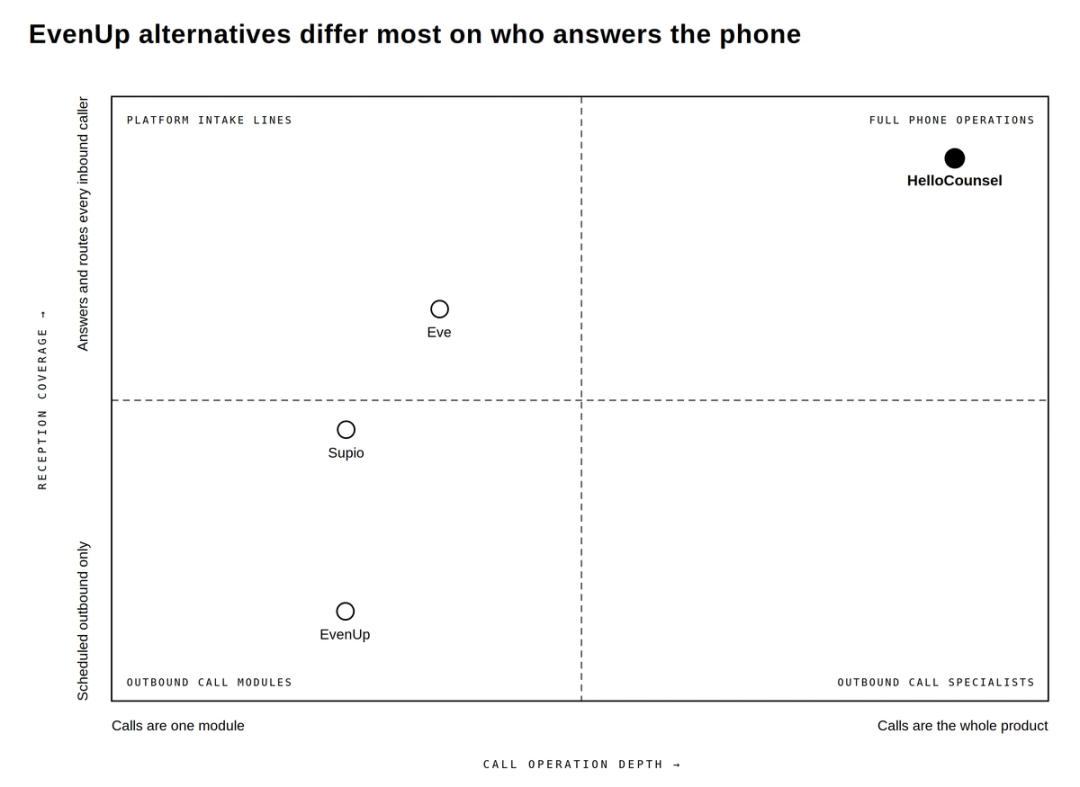
The medical-provider call automation guide goes deeper into another distinction: placing a call is only the beginning when the workflow includes an IVR, a hold queue, an unanswered attempt, or another required follow-up.
If your problem is mostly front-door coverage, compare reception separately through our AI receptionist guide for law firms and legal answering-services comparison for PI firms.
One Broad Platform or Multiple Focused Tools?
Some firms evaluating EvenUp alternatives are really deciding between two architectures.
One broad platform: Fewer vendors, broader data access, and one commercial relationship.
A focused stack: Separate products for demands, calls, and case management, each selected for a narrower job.
| If Your Firm… | Start With… | Why |
|---|---|---|
| Wants demands, casework, communications, and firm-level AI together | EvenUp or Eve | Consolidation may create more value than specialist depth |
| Primarily needs demand drafting | Supio or embedded CMS demand AI | Keeps the evaluation focused on drafting quality and review |
| Already runs Litify | LitifyAI Instant Demands | Keeps demand work close to existing case data |
| Already runs NeosAI Platinum | Neos Demands Plus | Keeps chronology and demands inside Neos |
| Primarily needs plaintiff call operations | HelloCounsel | Avoids buying unrelated drafting or analytics capabilities to solve a phone-work problem |
| Wants humans on sensitive intake | Human legal reception or intake service | Automation does not have to own every conversation |
The two-tool model only works if the systems know where the matter lives and where completed work belongs.
Our AI receptionist vs. virtual receptionist comparison can help with the human-versus-AI coverage decision. For human-first intake, use the legal intake answering-services guide.
Compare Cost Against Operational Value
Enterprise and mid-market PI firms do care about cost. They rarely care about the lowest line item in isolation.
The decision is whether the spend produces enough value to justify itself.
When comparing EvenUp alternatives, build the ROI model around:
- Staff capacity: Which repetitive drafting, calling, follow-up, review, or data-entry work disappears?
- Completion depth: Does the tool finish the workflow or stop at an output someone must process?
- Software consolidation: Can the firm remove another tool, service, or manual process?
- Case-system fit: Does the result reach the system staff already work in?
- Implementation burden: How much setup, integration, training, and governance is required?
- Scale: Does the operating benefit continue as matter volume grows?
A focused product can cost more than one module inside a broad platform and still produce better ROI if it removes materially more work.
A broad platform can cost more than a point tool and still make economic sense if it meaningfully consolidates the firm's stack.
That is a more useful enterprise comparison than ranking EvenUp alternatives by published price alone.
AI Governance Still Applies to Every Option
Plaintiff-specific software does not move the firm's professional responsibilities to the vendor.
ABA Formal Opinion 512 says lawyers using generative AI must consider duties including competence, confidentiality, communication, supervision, candor, meritorious claims and contentions, and reasonable fees.
The governance questions should follow the workflow.
For demand AI, ask how facts are sourced, how hallucinations or unsupported claims are caught, who reviews the output, and how the final work is approved.
For voice workflows, ask about caller identification, escalation, recording or transcription practices where applicable, data retention, system permissions, and which decisions the agent is prohibited from making.
NIST's Generative AI Profile provides a broader voluntary framework for identifying and managing generative-AI risks across the AI lifecycle.
If a workflow involves protected health information, the HIPAA analysis also depends on the parties, the data involved, and whether the vendor falls within a covered-entity or business-associate relationship. HHS guidance explains that business-associate obligations arise from defined functions and relationships involving PHI rather than merely because a product touches healthcare-related information.
How to Choose the Right EvenUp Alternative for Your Firm
Use actual work before you use feature matrices.
One month of matter and task data usually shows whether your buying problem is demands, phone workflows, broader case intelligence, or a combination.
Then run every EvenUp alternative through the same test.
- Define the workload: Use the same matter count, demand volume, call volume, provider tasks, and user assumptions.
- Run real examples: Use redacted firm matters, templates, SOPs, and exception cases.
- Inspect the final result: For drafting, verify sources and edits. For calls, inspect the note, task, transcript, follow-up, and matter update.
- Count what staff still do: Measure reviews, callbacks, manual entry, transfers, cleanup, and escalations.
- Test failure cases: Include incomplete records, an unhappy caller, an unreachable provider, ambiguous instructions, and a task that should escalate.
- Model the busy month: Include the highest realistic workload, implementation, integration, platform requirements, and add-ons.
- Calculate ROI: Put spend against staff capacity, process time, vendor consolidation, and operational work removed.
- Assign governance: Decide who owns configuration, review, exceptions, vendor oversight, and changes to the workflow.
For call operations, our case-manager workload guide helps identify repetitive phone work before the vendor demo.
Choose the EvenUp Alternative That Matches the Bottleneck
There is no useful universal winner among EvenUp alternatives.
Supio is the most direct option here when demand drafting is the problem. Eve belongs in the broad plaintiff-platform conversation. LitifyAI Instant Demands and Neos Demands Plus become more compelling when the firm's existing CMS is already central to the decision.
HelloCounsel belongs in a different part of the shortlist.
If your demands are working and case managers are still spending time on inbound calls, records follow-up, treatment communication, insurers, and repeated outbound tasks, changing the demand platform may create disruption without touching the workload your team actually feels.
The cleaner decision is to identify the bottleneck, compare the EvenUp alternatives that actually solve it, and measure what work disappears after the product is deployed.
If the bottleneck is the phone operation, review HelloCounsel's plaintiff-firm call workflows and bring one recurring workflow, its SOP, and your required case-system outcome to the evaluation.
Book a workflow review with HelloCounsel.
Frequently Asked Questions
What Are the Best EvenUp Alternatives in 2026?
The best EvenUp alternatives depend on the workflow. Supio is strong for demand drafting, Eve for broader plaintiff AI, LitifyAI and Neos for CMS-centered demand work, and HelloCounsel for plaintiff call operations.
What Is the Closest EvenUp Alternative for Demand Letters?
Supio is the closest demand-focused alternative in this shortlist. It generates plaintiff demand letters from case documentation and firm templates and provides linked sources for important case facts.
Is HelloCounsel a Direct EvenUp Alternative?
Only for overlapping call workflows. HelloCounsel handles supported plaintiff-firm inbound and outbound voice operations. It does not replace EvenUp's demand drafting, medical chronology, case intelligence, or broader case-progression features.
Does EvenUp Have AI Phone Agents?
Yes. EvenUp Communication Agents support post-retainer workflows including claims initiation, liability or coverage checks, treatment monitoring, medical-record follow-up, and balance confirmation.
How Does EvenUp Pricing Work?
EvenUp publicly describes an all-in-one, case-based pricing model rather than a simple public dollar rate card. Firms should compare quotes using the same case volume and workflow scope.
Which EvenUp Alternative Is Best for Litify Firms?
LitifyAI Instant Demands is particularly relevant to existing Litify firms because the Supio-powered demand workflow runs within the Litify environment.
Should a Firm Replace EvenUp With One Product or Several?
Either architecture can work. A broad platform can consolidate vendors and data. Focused products can go deeper on specific workflows. Compare integration effort, governance, workflow completion, staff capacity, and total ROI before deciding.
Share this article