Automated Phone Answering Service vs Virtual Receptionist

- Ask any vendor who or what answers at 2am, and who answers at 2pm. An automated phone answering service handles calls without a person. A virtual receptionist is a live human answering remotely under your firm’s name.
- Judge both on what exists in the file when the call ends, not on who picked up. Neither model decides whether the call ends with the work done or with a message somebody actions in the morning.
- Check the billing unit before the monthly price. Per-minute and per-call billing float with volume, so a mass tort push raises the invoice in the month your cost per signed case is already under pressure.
- Discount the claim that callers hate automation. Almost all of that evidence comes from lawyers describing calls they placed to other firms, not from injured claimants calling at 11pm.
- Place a test call as an existing client with two open matters, then open the file and see where the note landed. One client can carry a liability claim, a UM or UIM claim, and a med-pay matter at once.
- Confirm your phone system supports conditional call forwarding before you sign. It is how most of these services receive calls at all, and firms usually discover that after the contract.
An automated phone answering service picks up on the first ring, plays a menu, and routes the caller to an extension or a voicemail box. A virtual receptionist is a live person, working remotely, who answers under your firm’s name and takes a message. That is the honest one-paragraph version, and every comparison page on this subject spends two thousand words getting to it.
What those pages skip is the part a plaintiff firm actually pays for. A woman rear-ended on a Tuesday afternoon calls three firms from the shoulder of the highway. The first puts her in a phone tree. The second has a receptionist who takes her name and number. The third answers, asks what happened, confirms she is being treated, and opens a file before she hangs up. Two of those firms will call her back tomorrow. One of them already has her case.
The choice gets framed as people against machines, and that framing is what costs firms money. The narrower question is the one worth asking: after this call ends, what exists in the file, and who still has to make a phone call?
Full disclosure. We build HelloCounsel, an AI voice agent for plaintiff firms, so we have a view on the last part. The cost math and the review evidence below hold up whichever way you go.
What Is an Automated Phone Answering Service?
An automated phone answering service answers inbound calls without a person on the line. It greets the caller, presents options, and routes the call based on what the caller presses or says. Three different products get sold under that one phrase, and they are not interchangeable.
- An auto attendant or IVR plays a recorded menu and moves the caller to an extension, a queue, or a voicemail box. Your callers call it a phone tree. It routes. It does not answer questions and it captures nothing.
- A voicemail-to-text or call-capture tool records the caller and sends a transcript to an inbox. Better than a voicemail nobody clears, and it still leaves the whole conversation for tomorrow.
- An AI voice agent holds a real conversation, runs your intake criteria, and can complete a task before the call ends. This is where the category has moved, and it is why the older comparison pages read as though they were written for a dentist’s office.
The difference that matters is not how the caller is greeted. An auto attendant that sends a new lead to voicemail has technically answered the call, and your firm is exactly where it would have been with no system at all.
What Is a Virtual Receptionist?
A virtual receptionist is a live person employed by a third-party service who answers your calls remotely under your firm’s name. They work from a script your firm writes, greet callers, take messages, transfer calls, and in some configurations book appointments or run a short intake questionnaire.
The naming in this category is confusing, and the confusion costs firms money. Lawyers routinely assume Smith.ai is an AI product because of the name, when its virtual receptionist service is staffed by people, and several services marketed as legal answering services now run an AI layer for overflow without saying so plainly. So ask every vendor the blunt version: who or what answers at 2am, and who answers at 2pm? Our breakdown of how to choose a phone answering service as a law firm covers the rest of the contract questions.
How the Two Compare on What Changes Monday Morning
Feature grids on this subject compare greeting styles and hold music. These six rows change what your team does on Monday morning.
| Factor | Automated phone answering service | Virtual receptionist |
|---|---|---|
| A person on the line | No. A menu, an IVR, or an AI voice agent handles it | Yes. A live person, working from your script |
| Can resolve the call | Depends on the product. An auto attendant routes and nothing more. An AI voice agent qualifies the caller and finishes the task | Yes, within the script. A person can improvise on a fact pattern the script never anticipated |
| Where the record lands | Varies. Often a call log or an email. Ask where a note on an existing client goes | Usually an email or an app notification. A contact record in your CRM is not a note on the matter |
| Billing unit | Usually a flat monthly fee, sometimes bundled into your phone system | Per minute or per call, so the invoice moves with volume |
| When the call goes sideways | Weakest point. A caller who does not fit the menu gets looped or dumped into a directory | Strongest point. A person can hear distress and escalate |
| Setup effort | Hours to days for a menu. Two to four weeks for an AI agent running real intake | Two to four weeks of script writing and revision, owned by someone at your firm |
Read the third row twice. Every comparison page on this subject leaves it out, and for a personal injury firm it decides everything else.
What Each Option Actually Costs a Plaintiff Firm
Monthly price is the wrong number when you price an automated phone answering service against a receptionist. What your firm manages to is cost per signed case, and that takes three inputs: what you pay the service, what your staff still spend on the calls it did not finish, and how many cases you signed.
Start with what a person costs, because it anchors everything else. The Bureau of Labor Statistics puts the median receptionist wage at $38,010 a year as of May 2025, and benefits account for 31.6% of civilian employer compensation. That is roughly $50,000 loaded, or about $4,170 a month, for coverage of about 40 of the week’s 168 hours. Evenings, weekends, lunch breaks and sick days are not in that number.
Now run a firm handling 1,200 calls a month, of which 180 are new-lead intake and the rest are existing clients, providers, adjusters and vendors, signing one in six qualified leads for 30 signed cases. These figures are illustrative, so run them against your own logs.
| Setup | Monthly service spend | Staff time it leaves behind | What to add up |
|---|---|---|---|
| Auto attendant only | Usually bundled into your phone system, so close to nothing | Every caller the menu could not route calls back, or does not. Callbacks and lost leads land on intake | The service is nearly free. The leakage is the cost, and it appears on no invoice |
| Virtual receptionist | Per minute or per call, so the number moves with volume | Messages come back to be actioned. If half of 180 intake calls need a six-minute callback to return and log, that is nine hours a month | At the BLS median paralegal wage of $30.24 an hour, loaded to about $44, those nine hours cost roughly $400 that never shows on the invoice |
| AI voice agent with write-back | Fixed monthly. HelloCounsel starts at $500, scoped to volume with a 20% tolerance | Supported calls end with the action done and the note in the matter, so the callback queue shrinks rather than moving to the morning | Divide the fixed fee by signed cases. At 30 signed cases, $500 a month is under $17 per signed case |
The billing unit is the part worth sitting with. Per-minute and per-call pricing both float with call volume, so the month you run a mass tort push is the month your phone bill peaks, which is also the month your cost per signed case is under the most scrutiny. There is a second-order version vendors never mention: under per-call billing, the anxious caller who rings five times because nobody called her back is billed five times. Your most desperate lead is your most expensive one.
Our analysis of the hidden cost of missed calls works through what the leakage side is worth, and how many calls a PI case actually generates covers the volume the whole calculation rests on.
Put your own numbers through that table. Send us a month of call logs split by caller type and we will show you the cost per signed case under a fixed fee, next to what you pay now. Book a call with our founders.
Where the Call Note Lands Decides More Than Who Answers
An automated phone answering service and a virtual receptionist are both judged on whether the call was answered. Your case file is judged on something else entirely.
An intake specialist explained the mechanism better than any vendor page does. She asks every caller for a date of birth or a date of loss, and she knows callers find it tedious, because the note she writes has to attach to the right case and two clients can share a name. The screening questions people resent exist because of the file.
For a personal injury firm that has a second layer. One client can carry a liability claim, a UM or UIM claim, and a med-pay matter at once. A firm running a phone system wired into its case management system described where it breaks: one client and one matter, the call log attaches automatically; one client and two open matters, somebody picks manually. Multiply that by a caseload and you have a permanent tax on your case managers.
So the useful question at a demo is not whether a service integrates. Place a test call as an existing client with two open matters, then open the file. A new contact record in a CRM and a note on the correct matter are different outcomes, and only one is worth anything to the case manager who opens that file six weeks later. We have written separately on CMS write-back and on the documentation problem an answering service quietly creates.
Put the cost argument and the file argument together and the category stops looking like a straight line from cheap to expensive. What it costs as volume grows and what the call ends with are separate questions, and most products are strong on one and weak on the other.
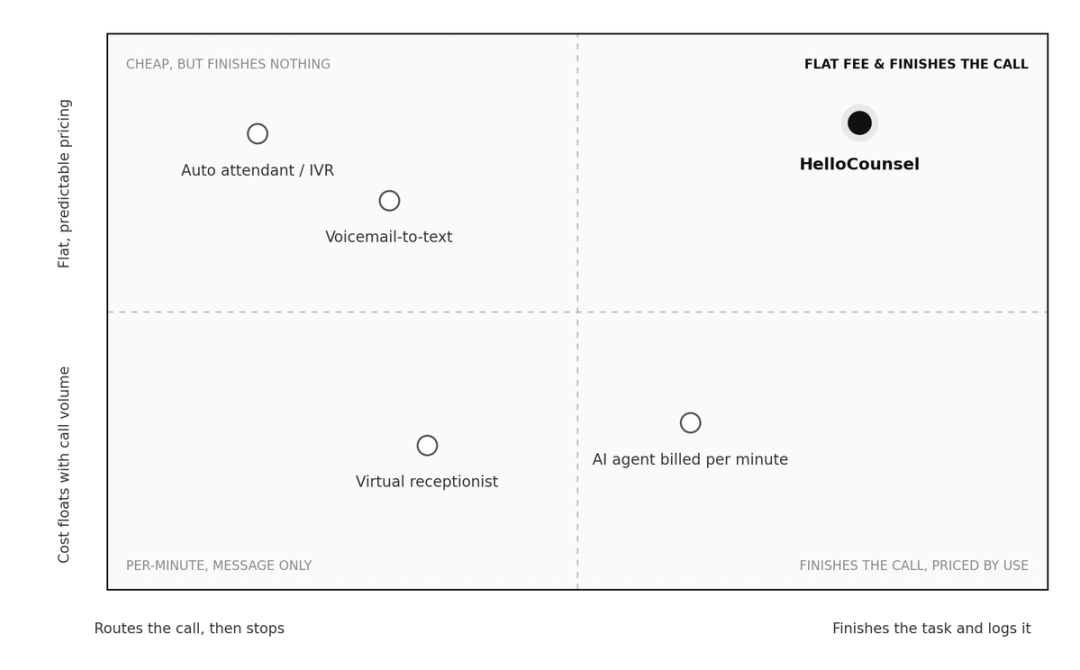
The auto attendant sits top left for a reason worth taking seriously. It costs almost nothing and never surprises you at renewal, which is why so many firms keep one, and it finishes nothing, so the work reappears as callbacks on your intake team’s morning. Bottom left is the opposite trade: a person answers, and the meter runs while the work still comes back.
Do Callers Really Hate Automation?
Every page selling virtual receptionists says yes, and the evidence is weaker than the confidence suggests.
Lawyers say it loudly. In practitioner threads they describe hanging up the moment they realise a system is automated, pressing zero repeatedly, and emailing opposing counsel to say they were defeated by the phone tree. Read what those threads are actually about, though, and the target is not automation. It is anyone, human or not, running a scripted interrogation they cannot get past. The variable is not whether a person or a system answers. It is whether whoever answers can resolve anything.
There is a sampling problem underneath it too. Almost every hang-up account comes from an attorney describing a call they placed to another firm, which is an impatient, high-status caller with a direct line they would rather be using. We found no evidence at all about how an injured claimant behaves at 11pm after a crash, so the conventional wisdom is well supported for lawyer-to-lawyer calls and untested for intake.
The comparison most firms are actually making is the one nobody writes about. You are rarely choosing between an automated system and a good human. At 8:40 on a Friday night you are choosing between an automated system and voicemail. Against voicemail, automation wins on the evidence. Against a capable person who can see the matter, it does not.
Did you know
Hiya’s State of the Call 2026 found that 86% of consumers do not answer calls from numbers they do not recognise. Only 14% pick up immediately, and 41% wait to see whether a voicemail is left. The figure is a six-country aggregate, and it matters here for one reason: the callback you promised tomorrow morning is a call from an unknown number.
How Each Option Fails When a Call Goes Sideways
Both are sold on the calls that go well, so evaluate them on the ones that do not. An automated phone answering service fails visibly. A caller who does not fit the menu gets looped, lands in a dial-by-name directory, or is asked to leave a message. One firm running its own AI intake described the expensive version: the setup worked until a time-sensitive call bounced around and the client was gone.
A human fails quietly. Reviewers describe transfers that failed, names taken down wrong, and message details arriving scant or incorrect, and one elder law attorney recorded her own calls and found the questions she had scripted were not being asked. The failure mode is not a loop. It is a message that looks fine and is missing the thing that mattered.
Two things belong in any pilot. Claimants call from roadsides and hospital corridors, and a reviewer of one AI receptionist product named the conditions that break it: wind from a car window, crying children, machinery nearby. That is the acoustic profile of your intake line. The second is the escalation rule, demonstrated rather than described. Ask to hear a live one, where the agent confirms a teammate is available, hands over who is calling and why, and spares the caller from telling the story twice.
Worth knowing
Gartner’s August 2026 customer survey of 3,566 customers found that 87% say companies using generative AI for customer service must provide access to a human agent, and the Consumer Financial Protection Bureau has described the same failure in consumer finance: repetitive loops, no way through to a person. Automation without a working escalation path is the configuration people object to, not automation itself.
Our guide to evaluating an AI voice agent has the full list of test calls worth placing, and why a generic AI receptionist will not work for a personal injury firm covers what case-phase routing has to do that a general-purpose product does not.
The Call Forwarding Requirement Nobody Mentions Until You Have Signed
Both options take longer to get right than either sells. Practitioner accounts converge on two to four weeks to something usable, with revision after that, and nobody reports the script ever being finished. One reviewer praised a service specifically because changing the script was easy, which tells you how often you will be doing it.
They also fail on the same hidden dependency. A solo attorney bought an answering service and then discovered his phone provider did not support conditional call forwarding, the routing rule that sends a call onward when nobody picks up, which is how most of these services receive calls at all. He had to change phone providers to keep the service he had already bought. The gate is not a particular brand. It is whether your system can forward on busy and on no-answer, and it is a five-minute question to ask before you sign.
Somebody at your firm also has to own the configuration. In every review account where the service worked, a named person wrote the script, tested it, and kept revising it. Where it failed, no one did. Decide who that is before you buy, and be honest about whether they have the hours.
Recording Consent and AI Disclosure
On outbound calls the position is settled. The FCC ruled in February 2024 that calls using AI-generated voices count as artificial under the TCPA, so prior express consent applies as it does to any automated call, and any check-in or follow-up agent that dials out sits inside that rule.
On disclosure, be careful what you read. No state currently requires a business to announce an AI voice on a phone call. The chatbot disclosure laws in Maine, Utah and California cover text interactions, minors, or consumer transactions, and the FCC rule requiring callers to disclose AI-generated technology at the start of a call is proposed rather than in force. A vendor telling you disclosure is already a legal requirement is overstating it, though disclosing is cheap and the reputational arithmetic differs from the legal one. On recording, federal law requires the consent of at least one party and a number of states require all parties, so confirm the rule for every state your firm takes calls from and have your ethics counsel look at your greeting.
Which One Fits Your Firm
There is no universal winner here, and the pages that crown one are usually selling it. Match the option to the gap you actually have.
| If your situation is | The fit is | Because |
|---|---|---|
| Calls ring out after 5pm and land in voicemail | Almost anything beats the status quo | Against voicemail, an automated phone answering service wins. Start there and raise the bar later |
| Your callers are mostly existing clients and providers | An option that can see the matter | A receptionist without case context takes a message. Your case manager makes the call anyway |
| Partners want a familiar voice on referral calls | Keep a person on those lines | Referral relationships are a real constraint. Route them separately rather than automating them |
| The invoice doubles in campaign months | Fixed monthly pricing | Per-minute and per-call units float with volume by design |
| Your intake team re-interviews callers every morning | Write-back to the matter | Message-taking moves the work to tomorrow instead of removing it |
| Records, treatment and adjuster calls eat case manager afternoons | An agent that also dials out | Reception is only the inbound half. The post-signature call load is the larger one |
| You are a solo or general practice firm with light volume | A virtual receptionist or a simple auto attendant | HelloCounsel is built for plaintiff firms with case managers and a production CMS, so it is a poor fit here |
Where we sit in that table is narrow and deliberate. We identify the caller and the matter before the conversation starts, qualify the lead against your criteria in seconds, open the case once it qualifies, chase and organize medical records, run treatment and client check-ins, and carry the case management tasks a file needs between intake and demand. Every outcome writes into SmartAdvocate, Filevine, Litify, Lead Docket or Clio, with custom integrations for other systems, and pricing is fixed from $500 a month with no per-minute billing and no setup fee. Across deployments our agents have handled more than 25,000 calls and 500 hours of call time, with 93% SOP precision on every call and a 48% improvement in call reception rates.
If the strain sits after the retainer rather than before it, reducing case manager workload is the better starting point, and our AI receptionist against a virtual receptionist comparison goes deeper on staffing.
Test us on the call that decides it. Bring the two-matter test call and your worst-case escalation, and we will run both live against your own criteria before you commit to anything. Book a call with our founders, or see the product.
Answer the Call, Then Finish It
An automated phone answering service and a virtual receptionist solve the same narrow problem, which is that the phone rings and nobody picks it up. Both do that. Neither one decides what your firm knows tomorrow morning.
So price an automated phone answering service and a virtual receptionist on the unit they bill, not the headline. Test both on a caller who does not fit the script, because that caller is a real case. Then open a matter and look at where the note landed, because that is the only part of the call that survives the week.
Before any of that, pull thirty days of call logs, sort them by caller type, and count how many ended with an action completed rather than a message created. That number decides whether you are shopping for a better greeting or for something that finishes the work.
Frequently Asked Questions
What is the difference between an automated phone answering service and a virtual receptionist?
An automated phone answering service handles calls without a person, using a menu, an IVR, or an AI voice agent. A virtual receptionist is a live human answering remotely under your firm’s name and working from your script.
How much does an automated phone answering service cost?
An auto attendant, the simplest automated phone answering service, is often bundled into your phone system at little or no cost. AI voice agents are priced monthly. HelloCounsel starts at $500 a month, fixed and scoped to your call volume, with no per-minute billing and no setup fee.
Will call notes land on the right matter in my case management system?
Ask every vendor to prove it with a test call as an existing client with two open matters. HelloCounsel identifies the caller and the matter before the conversation starts, so the note attaches correctly.
Does HelloCounsel handle inbound and outbound follow-up?
Yes. We answer inbound calls, open the case once intake qualifies, and place outbound calls for medical records retrieval and organizing, treatment and client check-ins, and lead follow-up, logging every outcome to the matter.
Do I need a particular phone system to use an answering service?
What you need is conditional call forwarding, which routes a call onward when nobody answers. Some providers do not support it. Check before you sign rather than after, since it is how most services receive your calls.
Do I have to tell callers they are speaking to an AI?
No state currently requires it on a phone call, and the FCC has a proposed rule pending. Outbound AI voice calls do fall under TCPA consent rules. Confirm recording consent in every state you take calls from.
Share this article