Should You Outsource Legal Intake?

- To outsource legal intake is to pay a third party to answer new-client calls, qualify callers against your criteria, and hand back a lead or a signed retainer. Write down what you are buying before you shop.
- If you are sending after-hours callers to voicemail, outsource legal intake first and optimise later. Almost any answered call beats voicemail for an injured caller at 9:40pm.
- Ask every provider what their busiest client paid last quarter against their quietest. A bill that moves with call volume peaks in the month you most need coverage.
- Budget for supervision, because outsourcing does not outsource responsibility. Under ABA Formal Opinion 08-451 you keep ultimate responsibility for the provider’s conduct, and Formal Opinion 506 sets out what a nonlawyer may do during intake.
- Track cost per signed case, not salary against monthly fee. An in-house legal intake specialist averages $43,288 a year before benefits.
- Keep intake in-house when one person can still own it, when your case mix needs judgment a script cannot carry, or when your real problem is lead quality.
- Check what happens to the other calls. New-lead calls are the smaller half of the phone problem, because most of a personal injury case’s call volume arrives after the client signs.
The call report says forty per cent of last month’s new-lead calls came in after six. Nobody is going to staff that, so the question becomes which provider takes them. Then a quote, a script, a go-live date, and a line item nobody revisits for a year.
Short answer: if those calls are hitting voicemail today, yes, outsource legal intake, and you will see it in signed cases within a quarter. The longer answer is where firms get caught. What breaks at six months. What the ABA rules put on you once a third party is talking to your prospective clients. What the math looks like with no hourly rate to recover. Whether the calls you actually drown in are new leads at all.
Our disclosure first. HelloCounsel builds AI voice agents for plaintiff firms, which makes us one of the three options in this comparison. We have tried to be straight about where outsourcing to people beats us, and there are places where it does.
What Does It Mean to Outsource Legal Intake?
To outsource legal intake is to pay a third party to take the first conversation and hand back a qualified lead or a signed retainer. Four quite different products get sold under that one phrase.
| Provider type | What they actually do | Typical pricing shape |
|---|---|---|
| Answering service | Picks up, takes a message, sends it over. Minimal qualification | Per minute, lower rate |
| Legal intake call centre | Trained agents run your intake script, qualify against criteria, sometimes send the retainer | Per minute or per qualified lead, higher rate |
| Offshore or nearshore staffing | Dedicated people who work your hours as an extension of your team | Monthly per seat |
| AI voice agent | Software answers, qualifies, and logs the call, escalating to your team by your rules | Per minute, or fixed monthly |
Most firms searching for this have the first one and want the second. That distinction is the one we unpack in AI receptionist versus virtual receptionist.
The Three Models, Side by Side
Underneath the vendor categories there are three choices. Hire in-house, outsource to people, or run an AI agent. Each wins on something, so the row that decides it is the one sitting closest to your own bottleneck.
| In-house intake | Outsourced human provider | AI voice agent | |
|---|---|---|---|
| Hours covered | Your business hours, plus whatever overtime you pay for | 24/7 with most providers | 24/7 |
| Cost behaviour | Fixed salary, rises with headcount | Usually rises with call volume | Per minute, or fixed depending on vendor |
| Knows your existing clients | Yes, over time | Rarely. They see a caller, not a case | Yes, if the agent identifies the caller and pulls the matter |
| Depth of PI qualification | As deep as you train it | As deep as the script goes | As deep as you configure, applied identically every call |
| Record of what was said | Whatever gets typed up | A message or a summary, recordings vary | Recording, transcript and summary on every call |
| Handles calls after the retainer | Yes, until capacity runs out | Generally out of scope | Yes, if the system covers reception and outbound |
| Judgment on a genuinely unusual call | Strongest | Strong | Escalates to your team |
The last row is the one we lose, and we would rather say so than argue it. An intake specialist who has heard ten thousand accident calls handles a strange one better than software does. The question is how many of your calls are genuinely strange, and what the other six rows cost you to cover those few.
The Real Benefits of Outsourcing Legal Intake
Four things outsourcing legal intake genuinely fixes.
- The 9: 40pm call. If the alternative is voicemail, almost any answered call beats it. Providers cover the hours you cannot staff without paying overtime to someone who does not want to work them.
- Consistency. Two callers with identical facts should get identical questions. In-house that depends on who picks up and what kind of week she is having.
- Capacity you can turn up. A TV flight doubles volume in a week. Hiring against that is slow, and those people are surplus when it ends.
- Somebody else carries the turnover. Recruiting, training and the empty-seat gap never show up in a salary line, but you pay them.
So if you are losing after-hours calls right now, outsourcing is a real improvement. What follows is how to do it well, not a case against doing it. We have put numbers on the leakage in the hidden cost of missed calls and why PI firms lose cases before they sign them.
Where Outsourced Intake Runs Into Trouble
Five problems come up again and again once a firm has outsourced legal intake for six months. We would rather you raise them on the demo call than find them at renewal.
The bill moves with your call volume
Most of the regret firms report after they outsource legal intake starts here. Per-minute and per-call pricing are fair right up until the month you most need coverage. A campaign doubles your calls, intake is stretched thinnest, and the invoice picks that month to double too. Reviewing one of the larger providers, Lawyerist notes it bills primarily by the minute and that firms wanting an entry-level option may find it pricey. One question sorts it at the demo: what did your busiest client pay last quarter, against your quietest?
The agent does not know who is calling
A client you signed four months ago calls for a treatment update and reaches someone who has never heard of her, asks what it is about, and takes a message. For a new lead, an outside agent with a good script is fine. For a client three weeks into treatment, being handled as an anonymous caller is where the relationship starts leaking.
Qualification stops where the script stops
A script can ask every question on your intake sheet. What it cannot do is ask the eighth question, the one your case manager asks because something in the seventh answer did not sit right. So ask any provider to play you a call where the caller was confusing, rather than a clean one.
You get a message, not a record
Most outsourced legal intake ends with information arriving somewhere. An email. A CRM field. A portal your paralegal logs into twice a week. What does not arrive is the conversation itself, attached to the matter, where anyone opening the file in six weeks can hear what was said and what was promised. It is the same documentation problem a message-taking service creates, and as the next section gets to, it is not only a service problem.
Setup is heavier than the sales call suggests
Scripts, transfer rules, qualification criteria, CRM mapping and escalation paths all have to be built before a single call is handled properly. The same Lawyerist review describes onboarding as requiring a conference with a dedicated account manager and a programmer. Budget for it, and ask for the implementation timeline in writing.
See what a complete call record looks like. Every HelloCounsel call produces a recording, a transcript and a structured summary written straight into the matter in your case management system. Nothing waits for someone to type it up. See how call write-back works.
What the Ethics Rules Actually Require
Outsourcing intake does not outsource responsibility for it. ABA Formal Opinion 08-451 holds that a lawyer who outsources keeps ultimate responsibility for the work and must make reasonable efforts to ensure the provider’s conduct is compatible with their own obligations. That pulls in Model Rules 1.1, 1.6, 5.1, 5.3 and 5.5. Three duties follow in practice.
1. Informed consent. Confidential client information reaching a third-party provider requires appropriate disclosure to the client.
2. Conflicts. Your provider cannot be working for adversaries on the same or substantially related matters, which means asking who else they serve.
3. Supervision. Rule 5.3 requires reasonable efforts to ensure a nonlawyer’s conduct is compatible with your obligations. You cannot supervise what you cannot see.
On intake specifically, ABA Formal Opinion 506 is directly on point. Nonlawyers may gather initial information, run conflict checks, confirm a matter fits your practice area, answer general questions about the fee agreement, and obtain a signature on it, and a prospective client must always get the opportunity to consult the lawyer. The opinion is candid about the hard part, too. Where permissible intake ends and legal advice begins depends on the question presented, and it varies by jurisdiction. Which is the line an agent on their fourth call of the hour has to hold, live, with someone who has just asked whether she has a case.
Worth knowing
Confidentiality has a price tag attached. IBM’s 2026 Cost of a Data Breach Report put the global average at a record $4.99 million, a 12% year-on-year rise, across 602 organizations breached between March 2025 and February 2026. Before client data flows to a provider, ask where it is stored, who can see it, and what their breach notification obligations to you are.
Here is the part worth sitting with. None of that changes with who is asking the questions: employee, contractor overseas, software, the supervision duty is identical. What changes is how much of the conversation you can go back and review, and a message gives you less to supervise than a recording, a transcript and a note in the file. Confirm the specifics for your jurisdiction with your own ethics counsel.
What It Costs a Firm That Does Not Bill by the Hour
The usual arithmetic, hourly rate times hours saved, does you no good on contingency. There is no hourly rate to recover, so the saving has to appear somewhere else. Three numbers carry it: the baseline, what the provider costs when volume moves, and cost per signed case.
A legal intake specialist averages $20.81 an hour, or $43,288 a year, most of them between $35,500 and $47,500, on ZipRecruiter data updated September 2026. BLS figures for customer service representatives, a fair proxy, put the median at $44,770 as of May 2025. Benefits, payroll taxes and management time push a seat past both. That seat buys forty hours of coverage in a week that contains 168. BLS projects the occupation to shrink 5% through 2035, so the hiring side is not getting easier.
| Pricing model | How it works | What happens in a campaign month |
|---|---|---|
| Per minute | You pay for talk time, often with a minimum | Cost rises directly with volume. Long, high-quality intake calls cost more than short ones |
| Per qualified lead | A flat fee for each lead meeting your criteria | Predictable per lead, and worth checking who decides what counts as qualified |
| Flat monthly with an allowance | A set fee covering a call volume, with overage above it | Predictable until you exceed the allowance, then overage rates apply |
| Per seat | A monthly fee per dedicated agent | Stable, and capacity is capped by how many seats you bought |
| Fixed monthly to expected volume | Priced to your forecast with a tolerance band | Stays flat through ordinary swings |
Per-minute carries an incentive problem worth naming out loud. The thorough intake call, the one that surfaces a complication, runs longer than the quick one, so it bills higher. Nobody is cheating you. You are paying a premium for the behaviour you actually want. For the last row: our plans start at $500 a month, priced to expected volume with a 20% tolerance either way, no per-minute billing, no setup fee.
Run it on your own numbers. Say 400 calls a month, 120 of them new leads averaging seven minutes. That is 840 minutes of intake, and on a $1.99 per-minute plan the intake portion alone bills $1,672. Sign 30 of those 120 and you paid about $56 a signed case, which is cheap for a PI file. The other 280 calls are the ones to watch: at two and a half minutes each they add 700 minutes and roughly $1,393, and not one of them signed anything. Same month on a fixed $500 plan covering the whole line: $17 a signed case.
Then track the one number that survives all of this. Cost per signed case, three months before you change anything and three months after. Everything else is a proxy.
Find out what your call volume would cost on a fixed plan. No per-minute meter and no setup fee. Bring last quarter’s call volume, including your busiest month, and we will show you the number before you commit to anything. Get a fixed-price quote.
When You Should Not Outsource Legal Intake
Sometimes the honest answer is not to outsource legal intake at all. Three situations where it is worth fixing something else first.
- Your volume still fits one person. If one intake person owns every business-hours call and after-hours volume is genuinely low, a provider adds a handoff, a contract and a second system for a problem you do not have yet. Fix after-hours on its own.
- Your case mix needs judgment a script cannot carry. Firms handling complex or high-value matters where the first conversation is itself substantive work will struggle with any scripted model, outsourced or automated. If your intake call is effectively an attorney consultation, keep it with the attorneys.
- Your conversion problem is a lead problem. If the signed-case rate is low because marketing is delivering the wrong callers, outsourcing intake makes you fail faster and more consistently. Pull thirty recent unconverted leads and read them first.
The Calls That Arrive After the Retainer Is Signed
Outsource legal intake and you have bought coverage for new leads. The provider qualifies the caller, hands back the lead or the retainer, and the engagement ends there. Which leaves the question nobody asks on that sales call. Who answers the phone for the next eighteen months?
Our analysis puts a case at roughly 150 calls over its life, which is more than 15,000 a year for a case manager carrying 100 files, and most of it lands after signing. About 80% of what reaches an intake team is reception work: clients, adjusters, providers, lien holders. Outsource intake alone and you have covered the minority of your call volume. The rest is on the same desks it was on last year.
That is the gap our AI voice agents were built for. They take the main line, know the caller and the matter before the conversation starts, send clients to the case staff on their file, and qualify new leads against your criteria. They also dial out: chasing and organizing records, opening the case, running treatment check-ins off tasks in your CMS. Every call lands back in the matter with a recording, transcript and summary, which is what CMS write-back means in practice, through direct integrations with SmartAdvocate, Filevine, Litify, Lead Docket and Clio plus custom builds. Across deployments that is 25,000+ calls and 500+ hours handled, at 93% SOP precision, with a 48% improvement in call reception rates.
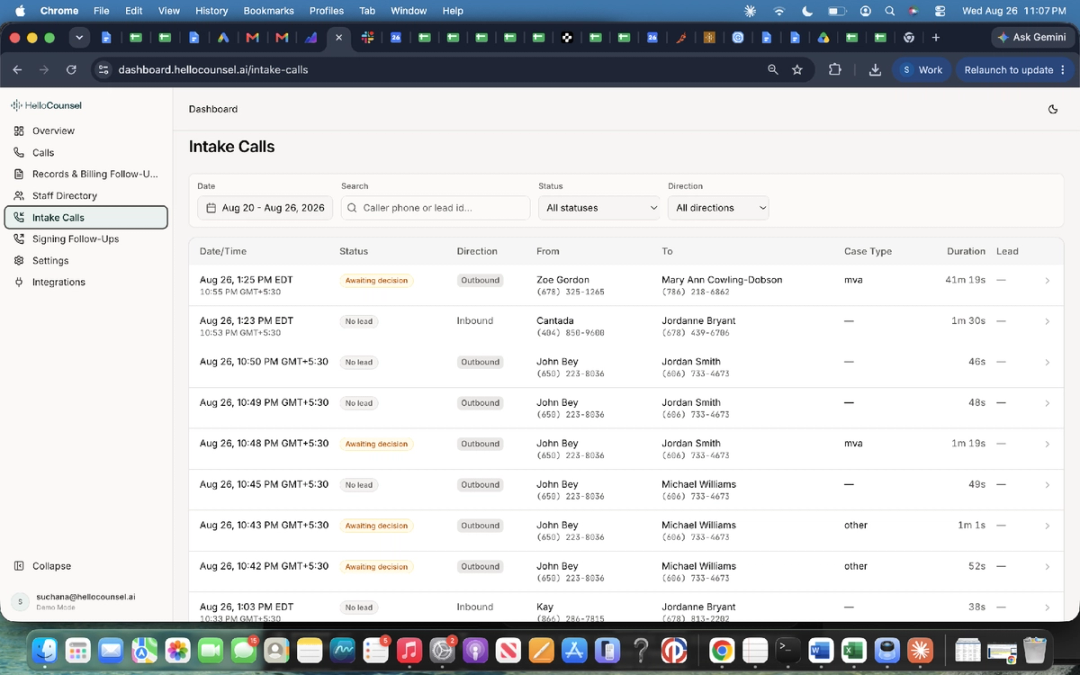
You notice it first in case manager workload and in client communication.
How to Run an Intake Pilot Instead of a Switch
Run it as a pilot, not a switch. Six steps, in order.
1. Write down your qualification criteria. Statute, liability, injury severity, treatment status, insurance, prior representation, disqualifiers. If it only exists in one person’s head, get it out before you hand intake to anyone.
2. Capture your baseline for one month. Missed call rate, speed to lead, calls answered after hours, cases signed, and cost per signed case. Without the before number you cannot prove the after.
3. Start with after-hours only. The current alternative is voicemail, so the downside is capped and the upside is measurable.
4. Agree the SLAs in the contract. Answer time, abandonment rate, escalation triggers, reporting frequency, and what happens when they miss. Ask for recordings by default, not on request.
5. Review recordings weekly for the first month. Five calls a week. That is your Rule 5.3 supervision, and it is how you find out whether the script holds on a confusing call.
6. Compare at ninety days. Same five metrics. Expand, renegotiate, or stop.
Two questions before you sign. What happens when a caller asks something outside the script? Can you show me the full record of a call inside my case management system, not in your dashboard? Our guide to evaluating an AI voice agent has the technical version, and we have ranked named providers in the best legal intake answering services and the best AI voice agents for personal injury firms.
So, Should You Outsource Legal Intake?
Sending after-hours callers to voicemail right now? Almost anything is better, and outsourcing legal intake will improve your numbers quickly. Volume still small and one person owning it well? Keep it, and fix coverage on its own. Problem is the whole phone rather than the new-lead slice of it? A provider that stops at the signed retainer will only ever solve part of it.
Two things decide it either way. Whether you wrote your criteria down before handing them to anyone, and whether you can go back and hear what was said. Which are also the two things the ethics rules quietly require. Next, if you are weighing providers: how to choose a phone answering service as a law firm, and more about the team behind HelloCounsel.
Get a straight answer on what your firm should do. Send us a week of call logs sorted by caller type. We will tell you honestly which calls belong with your team, which an outsourced provider handles well, and which an AI agent can take end to end. Fixed monthly pricing from $500, no setup fee, no per-minute billing. Book a call with our founders, or see the product.
Frequently Asked Questions
What does it mean to outsource legal intake?
To outsource legal intake is to pay a third party to answer calls from prospective clients, ask your qualifying questions, and hand back a qualified lead or a signed retainer. Providers range from answering services to legal intake call centres and AI voice agents.
How much does outsourced legal intake cost?
Pricing comes as per minute, per qualified lead, flat monthly with an allowance, or per dedicated seat. For comparison, an in-house legal intake specialist averages $43,288 a year before benefits. HelloCounsel uses fixed monthly pricing from $500 with no per-minute billing.
Is outsourcing legal intake ethical?
Yes, with conditions. ABA Formal Opinion 08-451 holds that you retain ultimate responsibility for the provider, need informed consent before sharing confidential information, and must check for conflicts. Supervision under Model Rule 5.3 remains yours.
What can a nonlawyer do during client intake?
Under ABA Formal Opinion 506, a nonlawyer may gather initial information, run conflict checks, confirm practice-area fit, answer general questions about the fee agreement, and obtain a signature. The prospective client must always be able to consult the lawyer.
Is outsourced legal intake different from an answering service?
Yes. An answering service picks up and takes a message. A legal intake provider runs your qualifying script, screens the caller against your criteria, and in some arrangements sends and completes the retainer.
Does HelloCounsel handle inbound and outbound follow-up calls?
Yes. We answer inbound calls from leads, existing clients, adjusters and providers, and place outbound calls for medical records retrieval and organizing, treatment check-ins, case opening and lead follow-up, logging every outcome to the matter.
How long does it take to set up outsourced legal intake?
It varies widely, from days to several weeks, depending on script complexity and CRM integration. Ask for the timeline in writing. HelloCounsel onboarding is one hour-long call, and SmartAdvocate firms are typically live in about a week.
Share this article