Best Alternatives to CaseGen.ai for Personal Injury Law Firms in 2026

- HelloCounsel is the strongest CaseGen alternative for plaintiff firms whose case managers carry the post-sign call load, with custom pricing set by call and case volume rather than seats or minutes.
- CaseGen.ai covers intake well, so most firms searching for a CaseGen alternative want help with the calls that follow a signed retainer.
- CaseGen's Maya agent coordinates treatment, while chasing a records request through provider phone menus and hold queues is a separate workflow to test in any CaseGen alternative.
- Eve and EvenUp suit firms that want calls as one module inside a larger AI platform, Smith.ai fits firms that want a live person behind the AI, and Finch fits firms that want paralegals running pre-litigation.
- Before switching, check where each call note lands, how transfers carry context, and how each tool handles AI disclosure and recording consent in your states.
CaseGen.ai is a solid intake tool. Its three voice agents answer calls around the clock, chase leads who didn't sign, and check in on treatment, and for a firm that used to lose 9 p.m. calls to voicemail, that closes a real leak.
The strain shows up once the client signs. A case manager's phone day fills with providers who need a third follow-up, adjusters calling back at 4 p.m., and clients asking where their case stands.
Those status calls can't simply wait, since ABA Model Rule 1.4 requires lawyers to keep clients reasonably informed and to respond promptly to reasonable requests for information.
HelloCounsel's analysis of PI call volume puts the typical case at roughly 150 calls over its life. At that rate, a case manager carrying 100 active cases fields upward of 15,000 calls a year, and only a few hundred of them are new intake.
What Are the 7 Best CaseGen.ai Alternatives in 2026?
| Tool | Best for | Handles post-sign calls | Medical records follow-up | Published pricing |
|---|---|---|---|---|
| HelloCounsel | Case managers carrying the calls after intake | Yes. Reception, intake, check-ins, case opening, claims, and follow-up | Yes. Calls providers until records are confirmed | No. Custom, based on call and case volume |
| Eve | One AI platform for intake, demands, and calls | Yes. Comms Agent opens claims and runs check-ins | Yes. Comms Agent follows up on records | No. Custom quote |
| Finch | AI plus paralegals running pre-litigation | Yes, with US-based staff | Yes. AI plus staff track records | No. Per-case pricing |
| Smith.ai | A live human behind the AI | No. Inbound-focused | Not listed | Yes. AI plans up to $500 per month |
| EvenUp | Firms already on EvenUp for demands | Yes. Communication Agents call carriers, providers, and clients | Yes. Agents request records | No. Case-based quote |
| Hello Megan | Fixed-fee AI reception across practice areas | Yes, for client check-ins | Not listed | No. Quote through sales |
| LegalClerk.ai | Lightweight AI intake | No. Intake-focused | Not listed | Yes. $400 per seat a month |
What CaseGen.ai Does Well, and Where Firms Hit the Ceiling
CaseGen was founded by a practicing personal injury attorney and a legal marketing team, and the intake questions show it. They sound like the ones your best intake specialist asks.
What the three agents cover
| Agent | What it handles |
|---|---|
| Justina (intake and reception) | Answers calls 24/7, runs full intakes, handles existing-client calls, blocks spam, and live-transfers high-value leads |
| Justin (intake outreach) | Follows up with leads who didn't sign and calls them back to complete the intake |
| Maya (medical coordination) | Confirms treatment visits, reschedules missed appointments, and alerts the firm when a client stops treating or switches providers |
CaseGen also lists 17 language pages, nine practice areas, a built-in CRM, and integrations with Clio, Filevine, Lawmatics, Zapier, and Google Sheets. Phone setup works through call forwarding to an assigned CaseGen number.
Where CaseGen fits best
CaseGen suits firms that run several practice areas or take intake calls in languages beyond English and Spanish. It also fits firms that want after-hours intake live quickly and are comfortable with a separate CRM next to the case management system (CMS).
Where firms start looking elsewhere
The gaps that send firms toward a CaseGen alternative show up in the middle of the case, where most plaintiff-firm phone work happens.
- Records follow-up: Maya coordinates treatment and records with providers and clients, and CaseGen's pages do not describe working a provider's phone menu and hold queue until the records department confirms a request.
- Adjuster and lien calls: Insurance claim opening, adjuster follow-ups, and lien holder calls are not described as agent workflows.
- Two systems of record: Intake data lands in CaseGen's built-in CRM first, CaseGen's FAQ notes that CasePeer offers no API for its integration, and its own CMS guide says MyCase connects through Zapier or Make.
- Setup expectations: The FAQ says most firms launch within 14 days, while another section of the site promises seven days or less.
- Staffing framing: CaseGen's homepage FAQ says it replaces most or all of the phone tasks handled by in-house intake and medical coordinators.
That last point cuts against how mid-market plaintiff firms win. Referrals and client relationships sit with experienced staff, and those people are hard to replace.
Worth Knowing
The Bureau of Labor Statistics projects about 40,800 openings for paralegals and legal assistants each year from 2025 to 2035, mostly from people leaving the role rather than new jobs. Every departure takes case context out of the firm.
The stronger play is keeping your team and taking the repetitive calls off their desks. Every CaseGen alternative below is judged on that test.
1. HelloCounsel Is the Best CaseGen Alternative for Post-Sign Call Operations
Those repetitive calls run in both directions, and HelloCounsel's AI voice agents cover both: the calls coming into your main line and the calls your case team has to place. The agent, Counsel, works across reception, intake, case opening, medical records retrieval, and client communication for PI, workers' comp, Social Security disability, and mass tort firms.
Key features
- Caller pre-identification: The agent matches the caller ID to the case file before handling the call, so it knows whether it is speaking with a client, provider, adjuster, or new prospect, which matter is involved, and which case staff to route to.
- Custom call flows: Separate flows for new callers, current clients, providers, adjusters, attorneys, and after-hours traffic, each following your firm's SOP.
- 24/7 answering: Answers in under two rings on the main line, including nights, weekends, holidays, and overflow.
- AI intake: Qualifies intake calls against your criteria and writes the lead into your CRM or case management system.
- Bilingual English and Spanish: Handles both languages on one line, including callers who switch mid-conversation, with no transfer.
- Lead follow-up and Client Check-ins: Calls back new leads who did not sign on the first call and logs each attempt.
- Medical records retrieval: Submits and re-submits requests by phone, email, and fax until it reaches the records custodian, and logs every attempt to the file.
- Treatment check-ins: Checks in after every appointment on pain, referrals, and provider fit, and escalates to the case manager with context.
- Case opening: Collects documents from clients, gets the police report, calls the carrier until it has the claim number, and checks what the file is missing.
- Hold-time handling: Works insurer and provider phone menus and waits in hold queues, then connects your staff when a person answers.
- Task completion: Each supported call ends with the action done and the case file updated, so staff do not have to act on a forwarded message.
- CMS write-back: Integrates with SmartAdvocate, Filevine, Litify, Lead Docket, CASEpeer, MyCase, and Lawmatics, and adds new systems on request.
- Call reporting: A dashboard measures call volume, caller type, transfers, and script adherence, so you can size the phone load before and after launch.
- Human escalation: Your transfer rules send sensitive, judgment-heavy, or out-of-scope calls to the right person with context loaded.
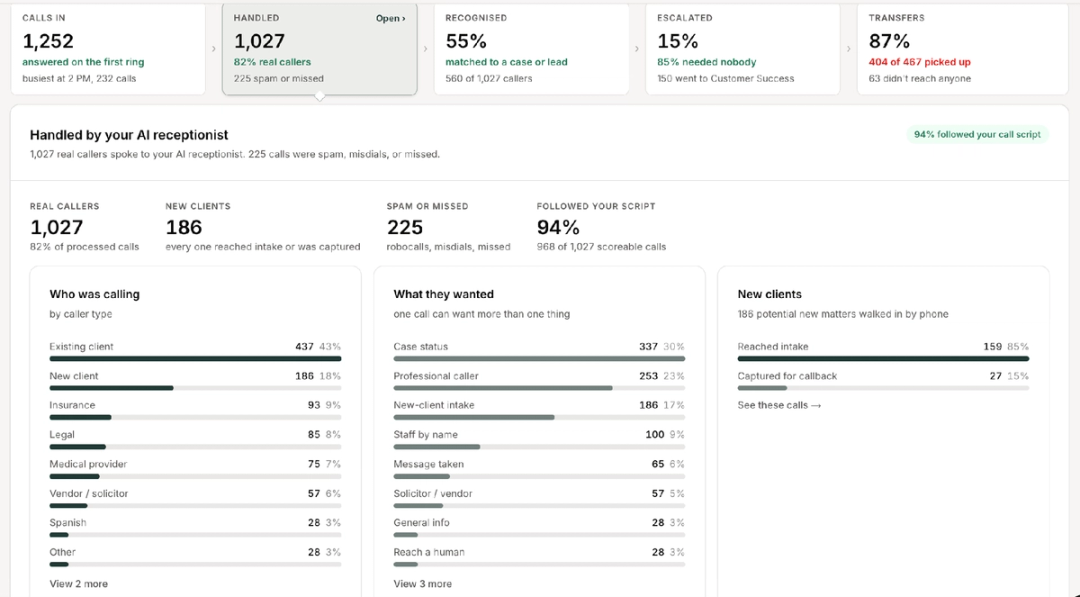
How HelloCounsel covers the calls CaseGen leaves to your team
Five workflows show where HelloCounsel works as a CaseGen alternative rather than a copy of it. For a direct feature-by-feature look, see our HelloCounsel vs CaseGen.ai comparison.
Medical records retrieval that runs to completion
- CaseGen today: Maya coordinates treatment visits and provider updates.
Requesting records is the easy part. Getting them takes four or five calls to a records department that rarely calls back, so a case manager drops a task on Counsel inside the CMS and Counsel calls the provider, works the phone menu, waits on hold, confirms the request, sends the follow-up email, and writes the status to the file.
For a case manager with 90 open files and 30 waiting on records, the chase list moves out of her head and into the case file. The mechanics of AI on medical provider calls show why this is its own workflow.
Reception routing by case phase
- CaseGen today: Justina routes new leads, existing clients, and third parties.
Counsel identifies the caller before handling the call. An existing client in treatment goes to her case manager, not to intake, and an adjuster gets verified, gets the information he needs, and the exchange lands in that matter's file.
Counsel confirms a teammate is available before transferring and briefs them on the same call, which is why a generic AI receptionist rarely fits a PI firm.
Notes written into the matter, not a side CRM
- CaseGen today: Intake data goes to CaseGen's built-in CRM, then to your systems through integrations.
HelloCounsel adds no CRM. It pulls matter context while the call is live and writes notes, fields, and summaries into the matter the moment the call ends.
That is the difference CMS write-back makes: a call the file can prove happened.
Message-based tools leave a documentation problem instead.
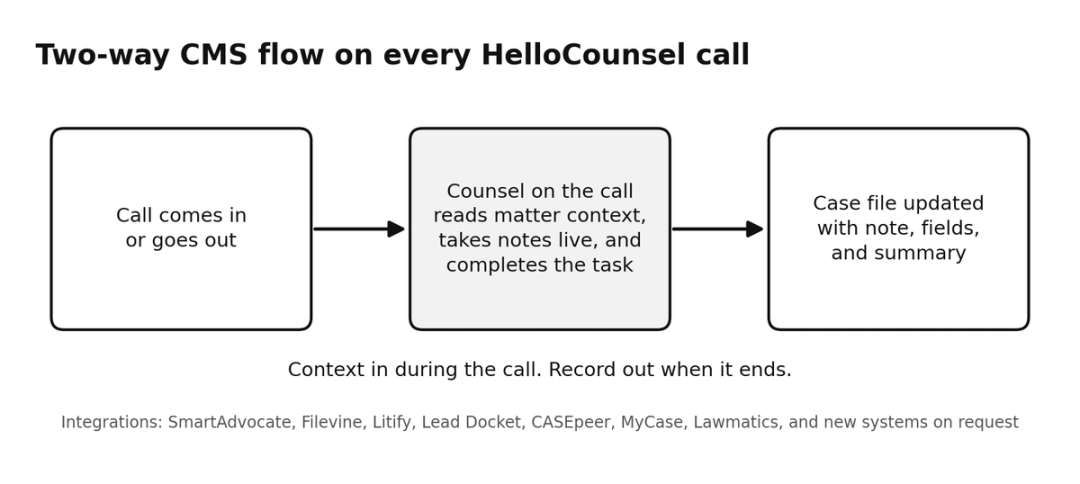
A hold-time bridge for calls your team has to make
- CaseGen today: Not described.
Some calls need a person, like a paralegal asking an adjuster about settlement authority. She starts the call and hangs up, and Counsel works the insurer's phone menu, waits in the queue, and rings her phone the moment a live person picks up. It is one piece of the case for automating outbound calls.
Scheduled client check-ins
- CaseGen today: Maya runs treatment check-ins, a real strength.
Counsel runs the same check-in after each visit and adds routine status updates by text and call, so clients hear from the firm before they think to call. A new specialist referral lands in the file while it is current, and treatment gaps surface early, which keeps client communication on schedule.
What changes for your team
- Faster speed to answer: Calls are picked up in under two rings, including nights, weekends, and campaign spikes.
- Shorter intake: Qualification happens during the call, and intake notes reach the file without re-entry.
- Automated check-ins: Treatment and status calls run on schedule, with check-ins twice as frequent as before.
- Faster records: Firms have cut 15 days from records turnaround time.
- Lower overhead: Routine calls stop pulling paralegals and case managers off case work, the most direct way to reduce case manager workload.
HelloCounsel by the Numbers
30,000+ calls handled, 500+ hours of call time, 93% SOP precision in every call, and a 48% improvement in call reception rates. Figures reported by HelloCounsel.
"Working with HelloCounsel has been an outstanding experience. We've been extremely impressed with our new AI receptionist, Kate, and the impact it's already making for our firm," says Anthony Ramos, COO of Pendergast Law.
HelloCounsel pricing
HelloCounsel pricing is custom and based on your firm's call and case volume, not on seats. You only pay for the tasks agents complete, so a long intake call or a campaign spike does not reprice the work by the minute.
Onboarding starts with one hour-long call, and most firms go live in under two weeks. Every engagement starts with a two-week pilot on your real call volume.
SmartAdvocate firms can also review the best AI intake assistants for SmartAdvocate.
Filevine firms can compare the best AI voice agents for Filevine.
HelloCounsel pros and cons
| Pros | Cons |
|---|---|
| One product for reception, intake, case opening, records, and check-ins | English and Spanish only, so firms taking intake in Vietnamese or Arabic will find CaseGen's language list broader |
| Writes notes and summaries into the matter across seven case management integrations | RingCentral and Zoom are the listed phone integrations, and other phone systems are configured during onboarding |
| Pricing linked to call and case volume, with no per-seat or per-minute billing | Built for plaintiff firms with case managers and a production CMS, not solo or general practices |
To see how Counsel would handle your firm's call mix, bring your ten most common post-sign call types to a demo.
2. Eve Suits Firms That Want an All-in-One Plaintiff AI Platform
Firms that want calls bundled with demands and discovery look at Eve. Since launching EveOS in June 2026, Eve combines intake, casework agents that draft demands and discovery, firm analytics, and a Comms Agent for outbound calls. Firms weighing Eve on its own can compare Eve Legal alternatives.
Eve key features
- Comms Agent: Opens insurance claims, follows up on records requests, runs treatment check-ins, and sends case updates.
- Phone menus: Works through automated insurer and provider menus and retries when nobody answers.
- Call plans: Reads the matter record before each call and builds a plan your team approves.
- Intake: An intake agent answers 24/7 in 28 languages and sends the engagement letter for signature.
Eve pros and cons
| Pros | Cons |
|---|---|
| Outbound coverage close to HelloCounsel's, including records follow-ups and claim openings | Calls are one module inside a much larger platform, so buying it is a platform decision |
| Broad intake language support | Firms happy with their demand and drafting stack pay for tools they may not use |
Eve pricing and fit
Eve does not publish pricing. As a CaseGen alternative, Eve fits firms ready to run intake, demands, discovery, and communications on one vendor, while firms that want a focused call layer on their current CMS will find HelloCounsel the narrower, faster decision.
3. Finch Pairs AI With Paralegal Staffing
Finch pairs AI agents with US-based paralegals and case staff to run pre-litigation for personal injury firms, from intake through demand.
Finch key features
- Intake: Bilingual staff handle intake 24/7, including holidays and weekends.
- Claims and records: AI plus staff request and track medical records.
- Beyond calls: Case management touchpoints, demand drafting, and lien negotiation at settlement.
- Your systems: Staff work inside your CMS and email from firm addresses.
Finch pros and cons
| Pros | Cons |
|---|---|
| Covers most of pre-litigation, with people reviewing the work | A managed service rather than software your team configures and controls |
| Per-case pricing that scales with volume and scope | Day-to-day case work moves to an outside team |
Finch pricing and fit
Finch prices per case, scaling with volume and scope. As a CaseGen alternative, it fits firms that want outside capacity, while firms that want to keep case work in-house and remove only the repetitive calls lean toward an agent they run themselves.
4. Smith.ai Backs Its AI With Live Human Agents
Smith.ai is a multi-industry receptionist service with an AI-first plan that can hand calls to live, North America-based agents at any hour. For a head-to-head, see our HelloCounsel vs Smith.ai comparison.
Smith.ai key features
- Hybrid handling: AI answers first and can transfer complex calls to a live receptionist.
- Intake: Lead qualification, call routing, and AI scheduling.
- Call records: Recording, transcription, and call summaries on every plan.
- Integrations: Native Clio and Zapier integrations, plus custom integrations on Enterprise.
Smith.ai pros and cons
| Pros | Cons |
|---|---|
| A human backstop for sensitive or confusing calls | Built for many industries, so case-phase routing is not modeled |
| Month-to-month, with published pricing | Per-call billing means a campaign spike raises the bill, and outbound records or claims workflows are not offered |
Smith.ai pricing and fit
| Plan | Monthly price | Included calls | Extra calls |
|---|---|---|---|
| Free | $0 | 25 | $3.00 each |
| Pro | $150 | 75 | $2.50 each |
| Enterprise | $500 | 300 | $2.17 each |
Prices are from Smith.ai's pricing page as of September 2026. At the Enterprise tier, a firm taking 600 calls in a campaign month pays $500 plus 300 extra calls at $2.17, or $1,151.
As a CaseGen alternative, Smith.ai fits firms that value a human on the line more than post-sign coverage, which is the core split between an AI receptionist and a virtual receptionist.
For a deeper look, see these Smith.ai alternatives.
5. EvenUp Fits Firms Already Using It for Demands
EvenUp is best known for AI demand packages built on a large personal injury claims dataset. Its Communication Agents, launched in January 2026, add outbound voice and text calls to carriers, providers, and clients.
EvenUp key features
- Communication Agents: Open claims, confirm coverage, check treatment status, request records, and verify balances by voice and text.
- Medical management: Treatment timelines that flag gaps and missing bills.
- Demand generation: The core product, with AI or professionally reviewed demands.
EvenUp pros and cons
| Pros | Cons |
|---|---|
| Adds outbound case calls to a demand workflow many PI firms already use | Calls sit inside a drafting platform rather than a dedicated call product |
| One vendor for demands and case communication | Main-line reception is not the platform's focus, and G2 lists no user reviews to check claims against |
EvenUp pricing and fit
EvenUp uses case-based pricing without published dollar amounts. As a CaseGen alternative, EvenUp makes sense for firms already sending demands through it, and these EvenUp alternatives show where a call-focused tool sits alongside it.
6. Hello Megan Sells Fixed-Fee AI Reception for Several Practice Areas
Hello Megan is an AI legal receptionist for criminal defense, personal injury, family, employment, and business law firms, sold on fixed monthly pricing.
Hello Megan key features
- Intake: Collects new-client details and books calls on your calendar.
- Existing clients: Checks in on how clients are doing.
- Urgency: Tells a judge's call apart from a prospect's.
- Languages: Multilingual support.
Hello Megan pros and cons
| Pros | Cons |
|---|---|
| Fixed monthly pricing avoids per-minute surprises | A multi-practice product, so plaintiff call types get less specific handling |
| Legal-only focus with existing-client check-ins | No outbound medical records retrieval or claims workflows described |
Hello Megan pricing and fit
Pricing is fixed monthly and quoted through sales. As a CaseGen alternative, it suits firms seeking a like-for-like replacement across several practice areas, though firms that also need provider and adjuster calls handled will outgrow it the same way.
Compare it with other AI receptionists for law firms.
7. LegalClerk.ai Handles Lightweight AI Intake
LegalClerk.ai is a Y Combinator-backed AI receptionist built for legal intake, with a 7-day free trial.
LegalClerk.ai key features
- Intake: Qualifies leads, collects caller details, and schedules appointments 24/7.
- Call records: Call summaries, transcripts, and reporting.
- Integrations: Connects with Clio, MyCase, Google Calendar, and Calendly.
LegalClerk.ai pros and cons
| Pros | Cons |
|---|---|
| Simple flat pricing and a free trial | Scope is close to CaseGen's, so post-sign calls stay with your team |
| Quick to test | Built around intake rather than case operations |
LegalClerk.ai pricing and fit
LegalClerk lists an Unlimited Calls plan at $400 per seat a month, with custom Enterprise pricing. It fits firms leaving CaseGen over execution rather than scope.
If intake alone was never the bottleneck, compare these LegalClerk.ai alternatives first.
How to Choose the Right CaseGen Alternative
Pick a CaseGen alternative by the bottleneck your team names most often. Firms that still want a staffed service can also compare legal intake answering services.
Firms also weighing Meet Gabbi can review these Meet Gabbi alternatives.
| If your firm's problem is | Choose | Why |
|---|---|---|
| Case managers stuck on provider holds and records follow-ups | HelloCounsel | Agents chase records to completion and write each status to the file |
| Existing clients and adjusters landing on the intake desk | HelloCounsel | Caller pre-identification routes by case phase |
| One vendor for demands, discovery, and calls | Eve or EvenUp | Calls sit inside a broader AI platform |
| Outside staff to run pre-litigation | Finch | AI plus US-based paralegals |
| A live human behind every AI call | Smith.ai | Hybrid AI and live receptionists |
| Intake in many languages or practice areas | CaseGen or Hello Megan | Broader language and practice coverage |
| Intake execution only | LegalClerk.ai | Lightweight intake at a flat price |
Mid-market firms often make this call with less in-house AI experience than larger firms, which makes a structured pilot more useful than a polished demo. Our guide on how to evaluate an AI voice agent lists the full criteria.
Did You Know
In the ABA 2024 AI TechReport, 30.2 percent of attorneys said their offices use AI-based tools, and the rate was 29.5 percent at firms with 10 to 49 lawyers.
What to Test in a Two-Week Pilot Before You Switch
Demos of any CaseGen alternative show the first 30 seconds of a call, while a pilot shows how the agent behaves across real call types. Run each CaseGen alternative through the same scenarios.
- Silence and hang-ups: Stay quiet mid-call and see how the agent checks in and closes.
- Time-sensitive facts: Describe an injury from years ago and see whether the call gets flagged to a person.
- Existing-client ID: Call from a client's number and check whether the agent confirms who is calling.
- Transfers: Ask for your case manager and see whether she is briefed before she picks up.
- The case file: Open the matter afterward and check that the note, summary, and fields sit in the right place.
- Your phone system: Confirm routing works on your actual carrier, not a demo line.
- Double handling: Count how many non-intake calls still reach your intake team by week two.
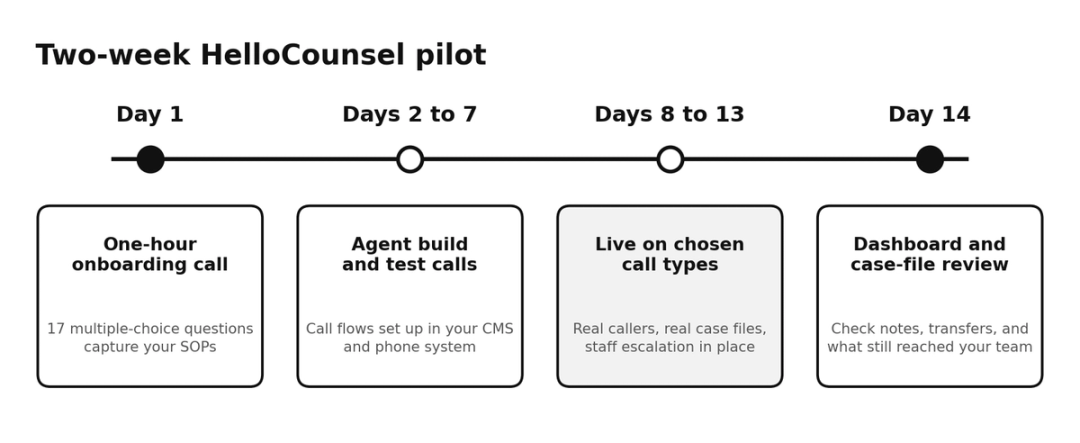
AI disclosure and recording consent
Disclosure rules vary by state. Utah requires disclosure when a consumer clearly asks and in high-risk interactions, according to Davis Polk's summary of the amended AI Policy Act.
Note
Maine requires clear and conspicuous notice when a business uses an AI chatbot or other technology in a way that could lead a reasonable consumer to think they are talking with a human, under 10 M.R.S. § 1500-DD.
Recording consent varies too, and some states require every party's consent. Ask each vendor how disclosure and recording announcements are configured for your jurisdictions, and confirm the specifics with your own counsel.
Running CaseGen and a new tool side by side
You do not have to rip anything out on day one, and keeping CaseGen live while you test a CaseGen alternative lowers the risk. A common setup keeps CaseGen on after-hours intake while HelloCounsel handles existing clients, providers, and adjusters.
The pilot shows which calls each tool should own, and the hidden cost of missed calls shows what the leftover gap costs.
Match the Tool to Where Your Cases Stall
If the leak is at the front door, CaseGen or another intake-first tool does the job. Most firms searching for a CaseGen alternative are past that point, with cases stalling between the signed retainer and the demand, in records requests, adjuster callbacks, and clients waiting for an update.
For that stretch, the right CaseGen alternative has to answer three questions: who makes the calls, whether the outcome lands in the matter, and whether a busy month costs more.
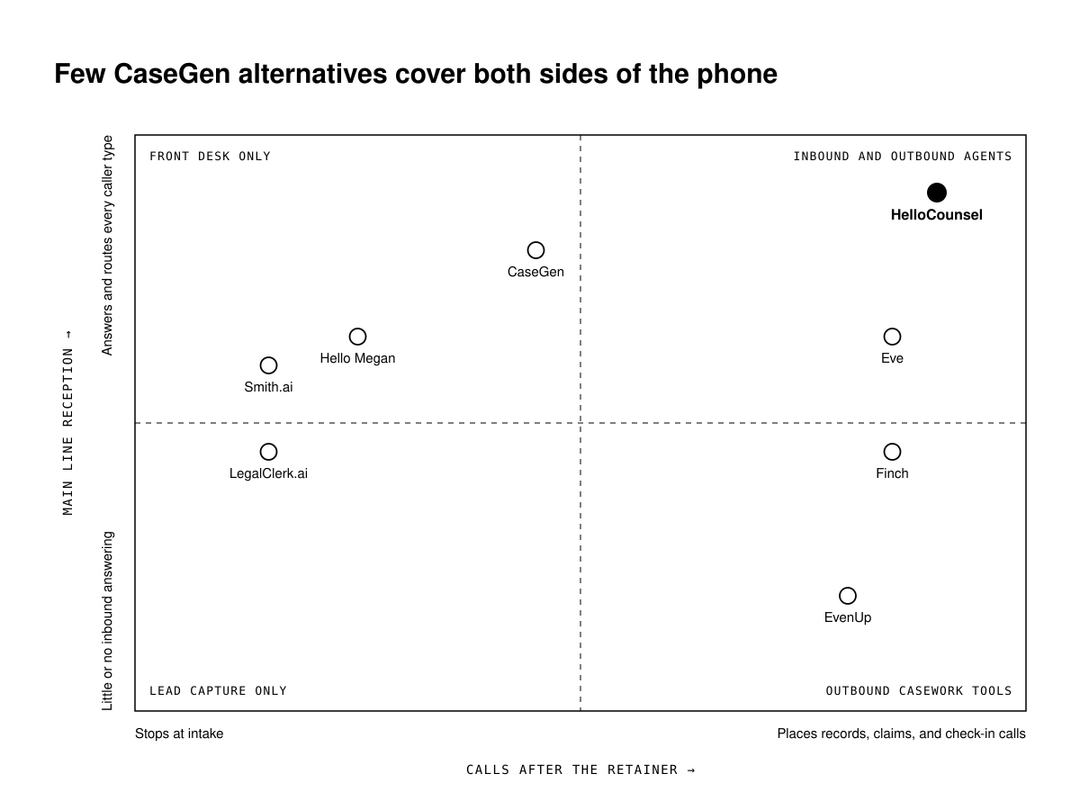
HelloCounsel answers all three with inbound reception, outbound records and check-ins, notes written to your CMS, and custom pricing tied to call and case volume. By HelloCounsel's estimate, a typical PI case generates around 150 calls over its life, and most of those calls come after intake.
Review the HelloCounsel product against your own call mix.
You can also compare other AI voice agents for personal injury firms.
See HelloCounsel on your actual workflow
Bring one call process your team handles today. We'll show you where the agent fits, what gets completed, and what still goes to a person. Book a demo
Frequently Asked Questions
These are the questions firms ask most often when comparing CaseGen alternatives.
1. What is the best CaseGen alternative for personal injury firms?
For plaintiff firms whose case managers carry heavy post-sign call volume, HelloCounsel is the strongest fit. It covers reception, intake, medical records retrieval, and client check-ins, and writes notes into the case file.
2. Which case management systems does HelloCounsel integrate with?
Direct integrations cover SmartAdvocate, Litify, Filevine, CASEpeer, Lead Docket, MyCase, and Lawmatics. For a system that isn't listed yet, the team can look at adding it.
3. How much does HelloCounsel cost compared with CaseGen?
HelloCounsel prices each firm on its call and case volume rather than seats, billing only for completed tasks. CaseGen does not publish pricing and quotes through a sales call.
4. How long does it take to switch from CaseGen?
Expect one onboarding call, then a launch inside two weeks for most firms. Many firms run both tools during a two-week pilot.
5. Can a firm run CaseGen and HelloCounsel together?
Yes. Many firms leave CaseGen answering after-hours intake and give HelloCounsel the calls from existing clients, providers, and adjusters. Test call routing on your phone system before splitting the lines.
6. Do firms have to tell callers they are speaking with AI?
It depends on the state. Maine requires clear notice when callers could mistake AI for a person, and Utah requires disclosure when asked and in high-risk interactions. Confirm requirements with counsel.
Share this article