5 Best Smith.ai Alternatives for Plaintiff Firms in 2026

- Smith.ai publishes full rates: $300 for 30 calls up to $2,100 for 300, with overage of $8.50 to $11.50 per call (August 2026)
- A firm taking 55 calls a day runs about 1,200 a month, four times the largest published plan
- The Smith.ai alternatives split into services that route, and agents that resolve
- Review complaints cluster on the bill: stacked add-ons, unauthorized transfers, charges after cancellation
- LEX Reception and Answering Legal are legal-only human services; CaseGen.ai and Hello Megan are AI-native and intake-built
- HelloCounsel quotes custom on licences and volume, charging for completed requests rather than interactions, with the integration fee covered
- The question that separates all Smith.ai alternatives: does the platform handle callers who are not new clients
Smith.ai publishes its rates now, which makes comparing Smith.ai alternatives easier than it used to be. Human-first plans run $300 a month for 30 calls, $810 for 90, and $2,100 for 300, with an average between $8.50 and $11.50 per call (pricing as of August 2026).
Run those numbers against a plaintiff mainline and the problem shows up quickly. A firm taking 55 calls a day is at roughly 1,200 a month, four times the largest published plan.
The billing model is only half of it. Smith.ai answers and hands the call back as a message, and your mainline does not mostly ring with new clients. It rings with existing clients asking where their case stands, adjusters returning calls, providers confirming appointments, and lien holders checking balances.
Those callers need an answer, and most of the answers already sit in your case management system (CMS). This guide covers five Smith.ai alternatives, what each costs, and the one question that separates them. Every vendor was checked against its own published pricing in August 2026.
Why Firms Look for Smith.ai Alternatives
Firms leave for two reasons: the billing model scales with volume, and the service takes messages rather than resolving calls. Both get worse as caseload grows, so the problem arrives exactly when the firm is doing well. A third reason shows up in public reviews and gets less attention.
The bill grows in the month you wanted to celebrate
Per-call billing is kinder than per-minute on a long intake call, and Smith.ai is right to say so. The trouble sits above the plan ceiling: on the 300-call Pro plan, call 301 costs $8.50, and so does every call after it. A mass tort campaign or a TV spot that lands converts straight into invoice.
Any vendor whose price rises with your call count is charging you for growth, which is why most Smith.ai alternatives get judged on the billing model first. Our breakdown of what missed calls cost covers the other side of that ledger.
What reviewers keep reporting about the bill
Smith.ai holds strong ratings on G2 and Clutch, and reviewers praise the receptionists themselves. The complaints concentrate on billing mechanics rather than call quality, and four themes recur across G2, Trustpilot, Clutch, and the Better Business Bureau:
- Add-on stacking. Appointment booking, call recording, a dedicated Spanish line, conflict checks, extended intake, and a second CRM connection are each billed per call on top of the tier
- Transfers the firm did not authorize. Reviewers of the AI tier report escalations to live agents without their sign-off, each one billed
- Charges after cancellation. BBB complaints describe billing continuing past cancellation, which runs through email rather than a self-serve control
- Receptionist consistency. You do not get the same receptionist twice, and reviewers advise detailed scripts and periodic test calls to your own line
None of this makes Smith.ai a bad service. It does mean the quoted tier is not the number to budget against.
The harder problem no Smith.ai alternative fully solved
Almost every vendor in this category automated intake, because intake is one call type running through a structured questionnaire and it is straightforward to build.
Reception is the harder problem. A plaintiff firm fields roughly thirteen caller types, each with six or seven reasons for calling, and the right handling depends on the case phase. A client in treatment needs a different answer from one waiting on disbursement. That permutation is where message-taking fails, and where the volume sits. Our analysis of how many calls a PI case generates counts it.
Worth Knowing
Legal occupations carried a mean hourly wage of $67.07 in May 2025, against $33.54 across all occupations, per the BLS wage survey. Every routine status call absorbed by licensed or paralegal-level staff is billed against that rate, whether or not anyone tracks it.
What to Look For in a Smith.ai Alternative
Four questions decide the fit, and they matter in this order. Run every vendor through the same four before comparing price, because an affordable service that still routes everything back to your team has removed no work.
| Question | Why it decides the outcome | What a weak answer looks like |
|---|---|---|
| Does it resolve the call or route it? | A message hands your team the same work in a different format | Every call ends in an email to a case manager |
| Does it write into your CMS automatically? | A call that ends without a note in the file is a call your team repeats | A person retypes it, or the note lands in a generic field |
| Does it handle callers who are not new clients? | Adjusters, providers, lien holders, and clients in treatment are most of the volume | The flow assumes every caller is a prospective client |
| Does it make outbound calls? | Records retrieval, claims opening, and treatment check-ins are half the operation | Outbound means appointment reminders only |
The fourth question thins the field fastest. Most Smith.ai alternatives in the answering category exist to catch calls a firm would otherwise miss, and none dial out for you. That is the argument in automating outbound calls at a PI firm.
What Are the Best Smith.ai Alternatives for Plaintiff Firms?
The Smith.ai alternatives below split into legal-only human answering services and AI-native platforms. The table compares them on the four questions above plus the pricing model, since Smith.ai and Ruby publish full rate cards and the rest quote through sales.
| Platform | Type | Resolves or routes | Outbound | Pricing model | Best for |
|---|---|---|---|---|---|
| HelloCounsel | AI agent | Resolves | Yes | Custom, on licences and volume | Reception-heavy volume, not intake |
| LEX Reception | Human, legal-only | Routes | Scheduling follow-up only | Per minute, plus setup fee | Legally-trained humans with Filevine access |
| Answering Legal | Human, legal-only | Routes | No | Per minute, quoted after trial | Testing before committing to a quote |
| CaseGen.ai | AI agent | Resolves intake | Lead and treatment follow-up | Quoted by outcome, not call length | Heavy new-matter intake volume |
| Hello Megan | AI receptionist | Resolves inbound | Client check-ins | Flat monthly | AI reception across practice areas |
| Ruby | Human, multi-industry | Routes | No | Per minute, published | Benchmark for human coverage cost |
1. HelloCounsel: Reception Depth and Outbound for Plaintiff Firms
Disclosure
HelloCounsel is our own product. We think it belongs on this list, but you should know we are not a neutral party.
Smith.ai runs a hybrid model, AI for routine queries and humans for complex ones. HelloCounsel runs a different one: resolve the call rather than escalate it. Of the Smith.ai alternatives here, it is the only one built solely for plaintiff operations.
What separates it is caller-type routing by case phase. Counsel identifies who is calling, an existing client, an adjuster, a provider, a lien holder, or a prospective client, and handles the call according to where that case sits.
Counsel also calls out. Records retrieval means calling the provider, working the phone menu, holding, and following up until records arrive. The agent calls, emails, or faxes mid-call, checks DataVant every 30 minutes, and raises a task when an invoice is due. Case development covers claims opening, treatment coordination, and client updates. No answering service here does any of it.
Notes, tasks, documents, and case expenses land in Smart Advocate the moment the call ends, so nothing waits in a call log for someone to write up. Firms already on that system can read our guide to AI intake for Smart Advocate firms.
Key features
- Case-phase routing: identifies the caller type and handles the call by case phase
- Medical records retrieval: calls providers, works hold queues and phone menus, and follows up until records arrive
- Case development: opens insurance claims, pulls the crash report, sends the letter of representation, and coordinates treatment
- Treatment check-ins: calls after each appointment on pain, referrals, and provider fit, flagging gaps early
- Two-way CMS integration: writes notes, tasks, documents, and case expenses into Smart Advocate
- Bilingual on one line: English and Spanish mid-sentence switches, handled without a transfer
- Hold-time bridge: your team starts the call and hangs up; Counsel connects them when a human answers
- Counsel Dashboard: shows which clients have not been called back and where cases stall
Pricing
HelloCounsel quotes custom, scoped to your licence count and your call and case volume, and prices against completed requests rather than interactions. Everything the agent does to finish a request is included in it.
| What you are quoted on | How it works |
|---|---|
| Licences | Scoped to the people and workflows you actually run, rather than a seat count you grow into |
| Usage and volume | Set against your expected call and case volume, with 20% tolerance either way before anything changes |
| The billing unit | Completed requests rather than calls or minutes, so a long call and a short one cost the same |
| Where it lands | Itemized to the case as an expense, passing through the way your records vendor already does |
| What is not charged | No setup fee, no per-call add-ons, and Smart Advocate's $1,000 per-vendor integration fee is covered |
Why the model matters more than the unit price. The monthly figure is fixed, priced to your expected volume, and holds within 20% either way, so a busy month does not become an expensive one. Every action is itemized to its case as a case expense, passing through the way your records vendor already does. Smart Advocate charges $1,000 per vendor for integration; HelloCounsel covers it, with no setup fee.
What setup costs you in time. One call, 17 multiple-choice questions, and your agents are configured. From there to agents working inside Smart Advocate is about a week, against a service needing scripts written and refined over a month.
Pros and cons
Pros
- Case-phase routing across caller types, which no competitor here describes
- Outbound records retrieval and case development alongside inbound
- Cost tied to completed outcomes rather than to how long people talk
- Fixed monthly cost that holds through a volume spike
Cons
- Smart Advocate is the confirmed CMS integration; others need scoping at onboarding
- Case opening is in beta, scheduled for September 2026
- Built for plaintiff firms, so general practice and solos are out of scope
Who it fits
Of the Smith.ai alternatives here, this one fits mid-market plaintiff firms of 10 to 200 people running PI, workers' compensation, social security, or mass tort caseloads on Smart Advocate, particularly those leaving Smith.ai or Ruby over per-interaction billing. The product breakdown shows how the five agent stages hand off.
2. LEX Reception: Legal-Only Human Receptionists With Filevine Access
Among the human Smith.ai alternatives, LEX Reception has the deepest integration list: Clio, MyCase, LawPay, PracticePanther, Filevine, Lawmatics, Smokeball, CosmoLex, and CASEpeer.
Receptionists are trained in legal terminology and intake workflows, with personal injury listed as an explicit practice area, bilingual capacity, and outbound scheduling follow-up. It is the most deliberate of these vendors in counter-positioning against AI, and its marketing states that 84% of legal clients want to speak to a real person.
Key features
- Legal-only training in terminology and intake workflows
- Filevine and CASEpeer, the most complete list in the human category
- Personal injury intake questionnaires customized per firm
- Outbound calls for scheduling and follow-up
- Bilingual English and Spanish at no extra cost
Pricing
Per-minute billing on custom plans, with a setup fee. LEX quotes through sales rather than publishing rates. A NextPhone comparison from May 2026 put the entry plan at $425 for 150 minutes, with a $75 setup fee and $2.75 per minute overage in one-minute increments. Those are NextPhone's figures rather than LEX's price, so confirm directly.
Pros and cons
Pros
- Legal-only training builds familiarity with plaintiff intake
- Filevine and CASEpeer integrations are a genuine step up from Smith.ai
- Suits firms whose clients prefer human contact
Cons
- Human-staffed, so cost scales with call volume
- Per-minute billing makes the busiest months the most expensive, and one-minute rounding inflates short calls
- CMS entries are human-logged after the call, not written automatically
- Adjuster, provider, and lien holder volume still lands on your team
3. Answering Legal: Legal-Only Answering With an All-Inclusive Trial
Answering Legal serves law firms exclusively, so all receptionist training is legal-specific with intake scripting customized per practice area.
The trial structure separates it from similar vendors. Answering Legal quotes nothing until you have used the service: the free trial runs 14 days or 400 minutes, whichever comes first, with no credit card and no contract, and your minute package is built from real usage. Every feature is included, and setup takes a 15-minute call.
Key features
- Legal-only across all training and scripting
- All features included at no extra cost
- Intake questionnaires customized per practice area
- 24/7 bilingual coverage on every plan
- Integrations custom-built to your legal software
Pricing
Minute packages, month to month, quoted only after the trial ends. Answering Legal states custom plans run from 50 minutes to over 50,000 and publishes no rate card, so any figure you see elsewhere is a third-party estimate.
Pros and cons
Pros
- Legal-only, so scripting starts from legal intake
- Your quote is built from real trial usage, not an estimate
- No credit card at signup, so evaluation carries no commitment
- Every feature included, so the quoted rate is the whole cost
Cons
- Human-staffed, so cost scales with volume
- Integrations are custom-built per firm, so scope them before signing
- No public pricing, so you cannot model cost before the trial
- No provider, adjuster, or lien holder handling
Common Mistake
Assuming AI disclosure is a courtesy rather than a rule. Under the amended Utah Artificial Intelligence Policy Act, a person in a regulated occupation, lawyers included, must disclose generative AI use in a high-risk interaction, verbally and at the start. A safe harbour applies where the AI discloses that it is not human at the outset, per Davis Wright Tremaine's analysis. Ask any vendor how their agent opens the call.
4. CaseGen.ai: Three Specialized Intake and Follow-Up Agents
Of the AI-native Smith.ai alternatives, CaseGen.ai is the most intake-centred. Justina handles inbound intake, capturing case details, running qualification, and routing high-value leads to a live transfer. Justin chases unsigned leads. Maya runs treatment check-ins, a plaintiff-specific workflow with no equivalent among the human services here.
CaseGen's FAQ puts most firms live within 14 days, with onboarding managed and a built-in CRM configured to the firm's workflows. It lists 17 languages beyond English, and states plainly that CasePeer cannot be integrated because it offers no API. Firms already considering CaseGen can also compare our list of CaseGen.ai alternatives for PI firms.
Key features
- Three agents: intake, lead follow-up, and treatment check-ins
- Text follow-up to collect case photos and documents
- Treatment check-ins, a workflow most receptionist tools skip
- Filevine, Clio, MyCase, PracticePanther, Smokeball, and Zapier
- Live call interrupt, so an intake manager can take over mid-call
- Automatic spam call filtering
Pricing
Quoted in a call with the founders. CaseGen describes charging for the outcome rather than call length, so a longer qualifying conversation does not cost more. For a direct side-by-side, see our HelloCounsel vs CaseGen.ai comparison.
Pros and cons
Pros
- Law-firm-only, with plaintiff intake vocabulary and qualification
- Covers treatment check-ins that the human services do not
- Charges by outcome rather than call length, so deep qualification is not penalized
- Filevine integration puts intake data in your existing system
Cons
- Pricing requires a sales conversation
- Intake-built, so adjuster, provider, and lien holder volume is untouched
- No records retrieval workflow, so the outbound half stays with your team
- The built-in CRM is another system to keep in step with your CMS
5. Hello Megan: Legal-Exclusive AI Reception Across Practice Areas
Hello Megan is a legal-exclusive AI receptionist marketed on a human-sounding voice developed from real human speech. It serves criminal defense, personal injury, family, employment, and business law, so training spans practice areas rather than concentrating on plaintiff work.
It runs flat monthly pricing with no per-minute charges, the same billing argument HelloCounsel makes, so cost structure is not a point of difference here. Setup takes 2 to 4 weeks. It handles existing-client check-ins, which puts it ahead of the human Smith.ai alternatives for post-intake volume.
Key features
- AI reception across five practice areas
- Flat monthly pricing, no per-minute or overage charges
- Voice built from real human speech, with regional accent matching
- Existing-client check-ins alongside new callers
- Solicitation and telemarketing filtering
- Setup typically 2 to 4 weeks, month to month thereafter
Pros and cons
Pros
- Flat monthly pricing removes the volume-scaling problem
- Legal-exclusive rather than general business answering
- Handles existing clients, not only new callers
Cons
- Five practice areas, so plaintiff workflow depth is shallower
- Inbound only, with no records retrieval or claims opening
- Setup runs 2 to 4 weeks, longer than AI-native platforms quoting days
- No published CMS write-back, so documentation stays with your team
What Smith.ai Alternatives Actually Cost at Plaintiff Volume
Two of these Smith.ai alternatives publish full rate cards, so you can model real numbers against them. The table runs those published rates at 300 calls a month for a small firm and 900 for a mid-market mainline, with the quoted models shown for contrast.
| Vendor | Published rate (August 2026) | 300 calls / month | 900 calls / month |
|---|---|---|---|
| Smith.ai, human-first Pro | $2,100 for 300 calls, then $8.50 per call | $2,100 | $7,200 |
| Smith.ai, human-first Starter | $300 for 30 calls, then $11.50 per call | $3,405 | $10,305 |
| Ruby, 500 minutes | $1,725 for 500 minutes | $1,725 at 500 min | Above plan ceiling |
| HelloCounsel | Custom, fixed monthly on licences and volume | Held to plan | Held to plan |
Read that table honestly. Smith.ai offers custom Enterprise pricing above these tiers, so a firm at 900 calls would be quoted rather than charged overage straight through. The card still shows the direction of travel: human coverage is priced per interaction, and the invoice follows your volume upward.
Then add the per-call extras. Call recording, a Spanish line, a second CRM connection, and extended intake are billed on every call rather than monthly. At 300 calls that stack lands in the high hundreds before a single overage call counts, and PI intake rarely stops at the five included questions.
The minutes nobody prices. The cost on no invoice is case manager time after the message arrives: a callback, a note somebody types, a follow-up somebody remembers. Our guide to reducing case manager workload puts numbers against that time.
Note
Utah extended its AI Policy Act to July 1, 2027 under SB 332, with four other AI bills taking effect on May 7, 2025, per Perkins Coie's summary. Disclosure rules for AI voice agents are still moving, so build the question into your evaluation rather than into a bar inquiry.
See the agents in context
Reception, records, treatment, and case opening run as five stages inside one case file, which is what separates it from the inbound-only Smith.ai alternatives. The product page shows what each stage does and where your team stays in control.
The Question Every Smith.ai Alternative Dodges
Comparisons argue about whether callers can tell they are speaking to AI. Hello Megan markets that under 1% of callers notice, and human services counter that most legal clients want a person. Both answer a question that is turning into a compliance matter rather than a marketing one.
Lawyers sit in a regulated occupation. Where disclosure rules apply, it happens at the start of the call, out loud, with a safe harbour where the agent identifies itself as non-human. The vendor that sounds most convincingly human has the most to lose from that, because indistinguishability is the whole product claim.
The useful question is what the agent says in the first five seconds, and whether the transcript proves it. That is a documentation question, and it lands where every other call record lands: the case file. The argument runs further in why your answering service creates a documentation problem.
The second dodged question is where the note lands. CMS write-back separates a case file from a pile of phone messages, so ask whether the note reaches the correct matter or a generic field.
Which Smith.ai Alternative Should You Choose?
The right Smith.ai alternative depends on where your call pressure is coming from, not on which vendor demos best. Match your situation to the row below.
| If your situation is | Choose | Because |
|---|---|---|
| Clients prefer a human voice and you run on Filevine or CASEpeer | LEX Reception | Legal-trained humans with the deepest CMS list in its category |
| You want to test before any quote, with no card and no commitment | Answering Legal | All features included, month to month, and a quote built from real trial usage |
| New-matter intake volume is the pressure point | CaseGen.ai | Three agents across intake, lead chasing, and treatment check-ins |
| You run several practice areas and want AI reception across all of them | Hello Megan | Legal-exclusive AI reception on flat monthly pricing |
| Existing clients, adjusters, providers, and lien holders are what is drowning your team | HelloCounsel | Automation workflows, case registration and development, agents pick up and close open tasks, send out outbound follow up: all in one at a fraction of cost. |
| You need a benchmark for what human coverage costs | Ruby | Published per-minute rates, $250 for 50 minutes to $1,725 for 500 |
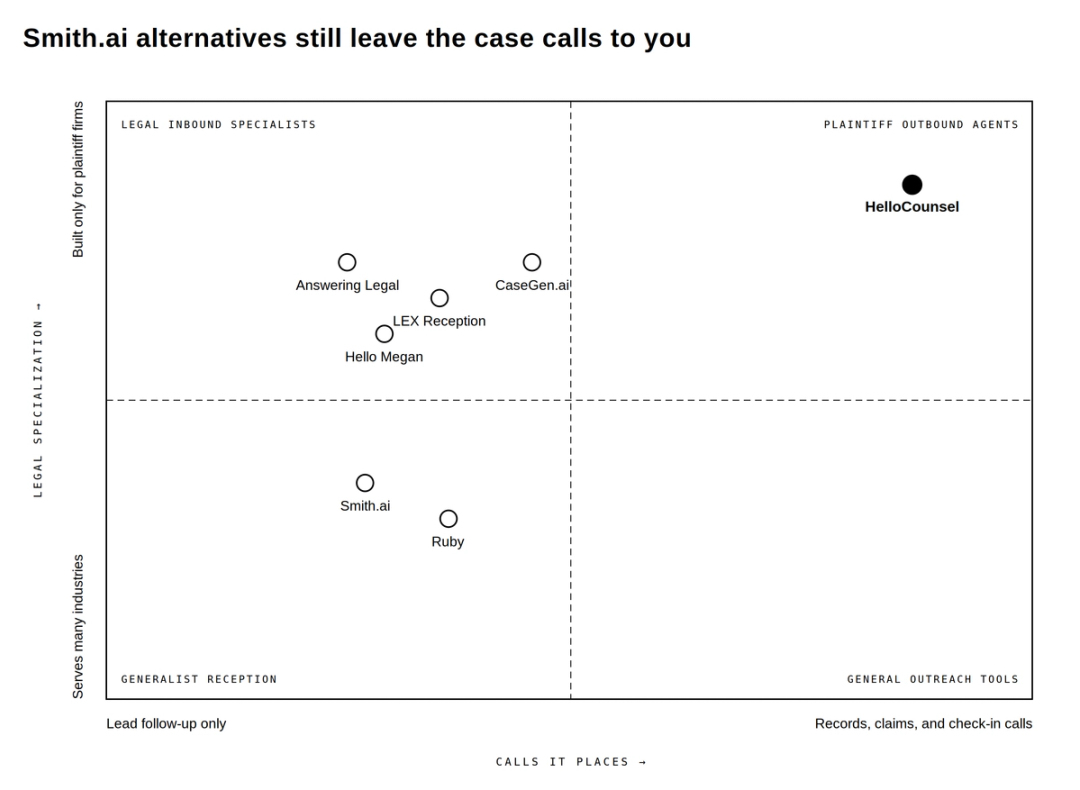
The human Smith.ai alternatives still take messages, so that work returns to your team. If Ruby is your benchmark, our guide to Ruby alternatives for PI firms runs the same comparison. The difference between the two categories is set out in AI receptionist versus virtual receptionist.
Pick the Model That Matches Your Call Mix
Smith.ai publishes its rates, holds strong reviews, and answers the phone reliably. Firms compare Smith.ai alternatives for a different reason: a plaintiff mainline carries a call mix the message-taking model was never built for, on a bill that grows with the caseload you worked to build.
The Smith.ai alternatives here separate cleanly along those four questions, and the answers matter more than any tier on any rate card.
Then price the model rather than the plan. A service billed per interaction charges you for growth; one priced per completed request charges you for outcomes, and the gap compounds every month your firm gets busier.
See what HelloCounsel can do for your firm
Weighing Smith.ai alternatives against your own numbers? Book a call with the founders for the actual figures on your caseload, including what your call mix would cost per completed request. Talk to the team, or read the product breakdown first.
Frequently Asked Questions
Why is Smith.ai not enough for a plaintiff firm?
Smith.ai charges per interaction and escalates complex calls back to your team. Most of a plaintiff firm's volume is existing clients, adjusters, providers, and lien holders asking what the CMS already answers. Those calls get routed, not resolved, which sends firms to Smith.ai alternatives.
How much do Smith.ai alternatives cost?
It depends on the model. Smith.ai publishes $300 to $2,100 a month by call tier and Ruby $250 to $1,725 by minute tier. HelloCounsel and the rest quote per firm, scoped to licences and volume.
Which Smith.ai alternatives integrate with a case management system?
LEX Reception covers Filevine, Clio, and CASEpeer. CaseGen.ai covers Filevine, Clio, and MyCase. HelloCounsel writes notes, tasks, documents, and case expenses into Smart Advocate. Ask each vendor whether write-back is automatic or human-logged.
Is a human answering service or an AI agent better for plaintiff work?
It depends on the call type. New client calls where someone is distressed may suit human coverage. For adjuster follow-ups, provider confirmations, and lien checks, the answers are deterministic and the volume is high.
Do any Smith.ai alternatives make outbound calls?
Few do. LEX Reception makes outbound scheduling calls, and CaseGen.ai chases leads and runs treatment check-ins. Medical records retrieval is handled by HelloCounsel and by specialist retrieval outsourcers.
How long does it take to switch away from Smith.ai?
It varies. HelloCounsel configures agents in a one-hour call and goes live in about a week. CaseGen.ai puts most firms live within 14 days, and Hello Megan quotes 2 to 4 weeks.
What should a plaintiff firm look for in a Smith.ai alternative?
Judge Smith.ai alternatives on four things: whether it resolves calls or routes them, whether it writes into your CMS automatically, whether it handles callers who are not new clients, and whether it makes outbound calls.
Share this article