Legal Intake Service vs. Answering Service: What's the Difference?

- An answering service picks up the firm's calls and hands back a message, while a legal intake service runs the firm's intake script and hands back a screened lead, a booked consultation, or a signed retainer.
- Answering services use operators who cover many industries, while intake services train staff on legal intake questions, case criteria, and the details a conflict check needs.
- Intake services raise more ethics questions, since collecting case facts creates duties to prospective clients under Model Rule 1.18 and operators can't tell callers whether they have a case.
- Answering services are usually billed by the minute or call, while intake services are priced by call, lead, hour, or monthly plan, and pay-per-signed-case pricing deserves a check against Model Rule 7.2(b).
- Both are built for new callers, so existing clients asking about their cases, who make up most of a PI firm's call volume, still end up as messages for case managers.
The two labels are used loosely enough that they can mislead. One vendor's "answering service" runs a scripted intake for injury callers, another's "intake service" mostly takes names and numbers, and some providers sell both under a single brand with tiered plans.
A more reliable way to sort them is to ask what comes back to the firm when the call ends. An answering service hands back a message: who called, how to reach them and roughly why. A legal intake service hands back a case that has already been screened, with the facts the firm needs to decide whether to take it, and sometimes a consultation on the calendar or a contingency agreement already signed.
That difference shapes everything that follows the call. A message starts a task for someone at the firm, usually a callback the next business morning, while a screened lead starts a decision. For a personal injury firm competing for the same injured caller as two or three other firms, the hours between those two outcomes are often where the case is won or lost.
The legal intake service vs answering service comparison also leaves out a large part of the picture. Both services are designed around new callers, and at a PI firm new callers are the minority. As per our estimate, a case manager carrying 100 cases fields about 15,000 calls a year, and only a few hundred of those are intake.
What is the difference between a legal intake service and an answering service?
An answering service is a general call-coverage provider. Operators answer in the firm's name, follow a short script to capture the caller's details and reason for calling, and pass the message to the firm by email, text, or a web portal, often for businesses in many industries at once.
A legal intake service specializes in law firm intake. Its staff run the firm's own intake questions, screen callers against the firm's case criteria, gather the details needed for a conflict check, and, depending on the plan, book consultations or send retainer agreements for electronic signature.
Reduced to one line, an answering service records that someone called, while a legal intake service records whether the firm has a case. The rest of the legal intake service vs. answering service decision comes down to how much of that screening the firm wants done before its own staff get involved.
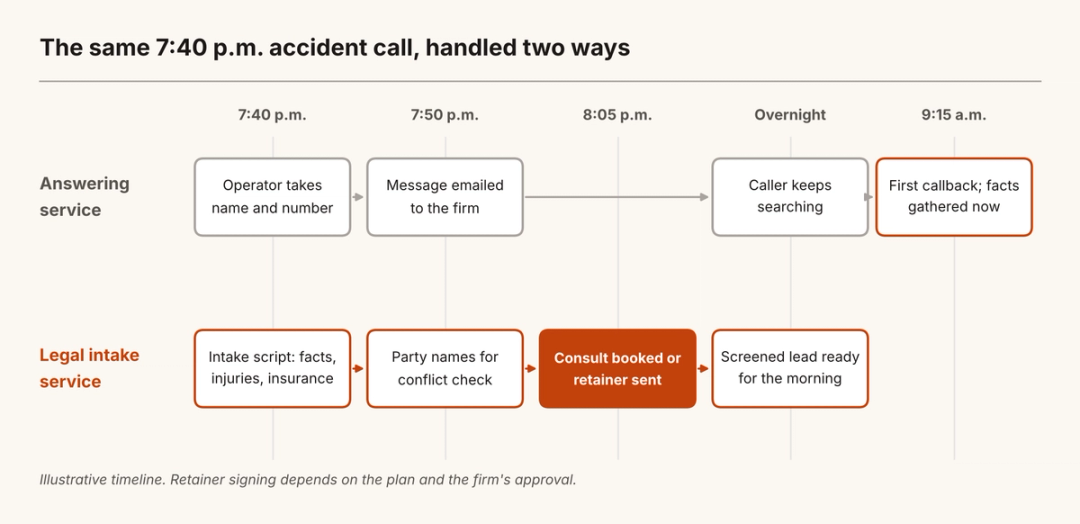
One new-case call, handled by each service
Consider a caller who was rear-ended at 7:40 on a Tuesday evening, went to urgent care, and is now searching for a lawyer from the parking lot. The firm's office closed at 5:30, so the call rolls to whichever service the firm uses.
With an answering service
An operator greets the caller in the firm's name and takes their name, phone number, and a one-line reason: car accident, wants to talk to a lawyer. The message reaches the firm's inbox a few minutes later, and the operator tells the caller someone will be in touch.
The firm's intake coordinator sees the message when the office opens the next morning, calls back, and only then learns the date, the injuries, the treatment so far, and the insurance details. If the caller has already spoken with another firm overnight, that callback is the first time the firm learns it has lost the case.
With a legal intake service
An intake specialist runs the firm's personal injury script on the first call, covering how the accident happened, who was involved, what treatment the caller has received, whether police responded and which insurers are on each side. The specialist also collects every driver, owner, and passenger name for the firm's conflict check.
If the case meets the firm's criteria, the specialist books a consultation or, where the firm allows it, sends the contingency agreement for electronic signature that night. The intake record lands in the firm's intake system, such as LeadDocket or Lawmatics, before the caller has left the parking lot.
The difference in that one evening is the difference between a callback scheduled for tomorrow and a case already moving. Our analysis of why PI firms lose cases before they sign them looks at how much of that loss happens in exactly this gap.
With an AI voice agent
A third option has entered the comparison in the last few years. An AI voice agent connected to the firm's intake system can run the same intake questions as a human specialist, at any hour and on several calls at once, and write the lead into the intake system as the call ends.
The trade-offs differ from both services. An AI agent doesn't get tired on a busy Friday night or go home at the end of a shift, but the firm has to define clearly which situations go to a person, such as a caller in distress or a question about case value, and test those hand-offs before going live.
Side-by-side comparison
Laid out factor by factor, the legal intake service vs. answering service differences come down to how deeply each one screens a caller and what the firm receives afterwards.
| Factor | Answering service | Legal intake service |
|---|---|---|
| Who answers | Operators covering many industries | Staff trained on legal intake and case criteria |
| What they collect | Name, number, and reason for calling | Accident facts, injuries, treatment, insurance, and party names |
| What the firm receives | A message by email, text, or portal | A screened lead in the intake system, often with a booked consultation |
| Case screening | None, or a basic yes or no question | Screens against the firm's criteria and flags cases to decline |
| Retainer signing | Not offered | Offered on some plans through electronic signature |
| Scripts | Short, general script | The firm's own intake script, updated as criteria change |
| Pricing basis | Per minute or per call, often with a monthly minimum | Per call, per lead, per hour, or per monthly plan |
| Best suited to | Overflow and after-hours coverage when in-house staff handle intake | After-hours and high-volume intake when the firm wants cases screened on the first call |
Pricing structures vary enough that comparing quotes takes some care. A per-minute answering service can look cheaper until long injury calls stretch the minutes, and an intake service quoted per lead can cost more in a month when marketing produces a burst of unqualified callers. Our breakdown of legal answering service cost explains the common billing models in more detail.
Training is the other gap the table can't fully show. An operator who answers for a dental office, a plumbing company, and a law firm in the same shift can follow a script, but a legal intake specialist is more likely to notice that a caller's description of a slip in a store parking lot raises a premises liability question rather than a car accident one and to ask the follow-up questions that fit.
Integration matters as much as training. A message emailed to a shared inbox has to be read, copied, and entered by someone at the firm, while an intake record written straight into the intake system can be reviewed, assigned, and followed up from the place the team already works.
What each service does with a caller the firm won't take
Not every caller has a case the firm wants. Some were hurt too long ago, some have no injury, some were at fault and some are calling about a legal problem the firm doesn't handle.
An answering service passes all of them along as messages, so the firm's own staff do the screening on the callback, including the awkward conversation of turning someone away. A legal intake service screens them out on the first call, which saves that callback, but it also means a nonlawyer is applying the firm's criteria in real time.
Declined callers still deserve care. Because they may be prospective clients under the ethics rules, the firm should record their names and any adverse parties in its conflicts database and a short non-engagement letter so the caller knows the firm is not representing them and that deadlines may apply to their claim.
When comparing vendors, ask to see the decline script and the record a declined call produces. In the legal intake service vs. answering service decision, how a vendor handles the callers you turn away says a good deal about how carefully it handles the ones you keep.
Ethics questions each service raises
The ethics side of the legal intake service vs. answering service choice is easy to overlook. Both services act for the firm, so both count as nonlawyer assistance the firm must supervise. The ethics questions grow with how much the service does, which puts intake services under closer scrutiny.
The first question is prospective-client duties. Under Model Rule 1.18, a person who consults with a lawyer about possibly forming a client relationship is a prospective client, and the firm owes them duties even if it declines the case. An intake specialist who gathers detailed facts is collecting information the firm may have to protect, which is why the conflict check should run before the full story is taken.
The second is legal advice. Callers routinely ask whether they have a case or what it might be worth, and Model Rule 5.5(a) bars a lawyer from assisting another in the unauthorized practice of law, so intake scripts should route those questions to an attorney instead of answering them.
The third is the retainer itself. Model Rule 1.5(c) requires a contingent fee agreement to be in a writing signed by the client.
The federal E-SIGN Act says a signature or contract in commerce can't be denied legal effect solely because it is electronic, though the firm should confirm its state's rules on how contingency agreements must be presented.
The last is how the vendor gets paid. Model Rule 7.2(b) bars a lawyer from giving anything of value to a person for recommending the lawyer's services, with limited exceptions, so an intake vendor that also supplies leads or charges per signed case is worth reviewing with ethics counsel before signing.
Confidentiality applies to both services. Model Rule 1.6(c) requires reasonable efforts to prevent unauthorized disclosure of client information, so the firm should know where each vendor stores recordings and intake records, who can access them and how long they are kept.
The calls both services leave with your team
Comparisons of the two services tend to center on the new caller, because that is the call both were designed for. At a personal injury firm, though, the phone rings far more often for people who are already clients.
Clients call to ask whether the adjuster responded, whether records arrived, when their next appointment is and when the settlement check will clear. As per our estimate, a typical PI case generates about 150 calls over its life, and case managers spend 50+ hours a week on routine calls.

An answering service turns each of those calls into a message, and an intake service, whose script is built for new cases, does much the same with an existing client. Either way the case manager gets a callback to make, and the call record often lives outside the case file, which creates a documentation problem of its own.
Handling those calls takes access to the case itself: knowing who the caller is, what stage the case is at and what the client was last told. Our piece on the difference between AI intake and AI operations covers why intake coverage and existing-client coverage are separate problems.
See how HelloCounsel handles both kinds of calls
We'll show you HelloCounsel screening a new injury caller with your intake questions and answering an existing client's question from your case management system. Book a demo of intake and client calls
How to choose between the two
An answering service fits a firm with a strong in-house intake team that mainly needs someone to pick up overflow and after-hours calls. If the coordinator can return messages early each morning and the firm's marketing doesn't produce large evening volume, a message is enough for the firm to work with.
Some firms split the work, using an answering service for daytime overflow and an intake service after hours. That can work, though it means two scripts to maintain, two sets of records to reconcile and two vendors to supervise, so the split should be a deliberate choice rather than something the firm drifted into.
A legal intake service fits a firm that receives meaningful volume at night and on weekends, runs advertising that produces bursts of calls or wants cases screened and signed before the caller reaches another firm. The higher price buys speed and screening, which matter most when each signed case is worth thousands in fees.
The fairest cost comparison is cost per signed case. Divide a month's invoice by the number of cases signed from calls the service handled, and compare that figure across vendors and against what the firm earns on an average case, since a cheaper service that signs fewer cases can end up costing more.
Language coverage belongs in the same comparison. Ask whether Spanish-speaking callers reach a bilingual operator on every shift or are put through an interpreter line, because an interpreted intake takes longer and can miss details that a native speaker would catch.
Neither fits on its own when the main strain is existing client calls. In that situation, the firm needs coverage that can read the case file, whether through more staff or an AI voice agent with access to case management data.
Whichever way the firm leans, five questions to each vendor will clarify what it is buying:
- What exactly do you send us at the end of a new-case call, and where does it land?
- How do you handle a caller who is already a client of the firm?
- Who updates the intake script when our case criteria change, and how fast?
- What triggers a charge, and what happens to the bill in a month with a marketing spike?
- How are call recordings and intake records stored, and who can access them?
Our guide to outsourcing legal intake covers contract terms and service levels for intake vendors in more depth.
For message-taking providers, our guide to choosing a phone answering service walks through scripts, trial periods, and what to test before signing.
How HelloCounsel handles intake and every other call
HelloCounsel builds AI voice agents for plaintiff personal injury firms, and it covers both halves of the call mix that the two services split.
For new callers, HelloCounsel's intake agent answers in under two rings, runs your intake questions in English or Spanish, including callers who switch languages mid-call, and writes the lead to intake systems such as LeadDocket and Lawmatics. When a caller needs a person, it checks live availability and makes a warm transfer or schedules a callback.
For existing clients, the AI receptionist matches the caller ID to the case file and answers status questions from case data. Every call is written to the case file as a note in systems such as Filevine, Litify, SmartAdvocate, CASEpeer, and MyCase, so the case manager sees what was asked without a message to process.
Across 30,000+ calls, firms using HelloCounsel have seen a 48% improvement in call reception and 2x more frequent client check-ins. Pricing is custom, based on call and case volume rather than seats, so you pay for tasks completed, and HelloCounsel costs about a quarter of what virtual receptionists charge. Most firms go live in under two weeks.
Compare call records before you sign
Vendor websites describe services in similar language, and the labels overlap more than the services do. The clearest comparison comes from the work product itself.
Ask each provider for three redacted call records from a law firm client: one new injury caller, one caller the firm declined and one existing client. Then look at each record and ask what your team would still have to do after reading it.
An answering service's records will mostly lead to callbacks. An intake service's new-case record should lead to a decision, and the existing-client record will show what both services leave on your case managers' desks, which is usually the deciding factor in the legal intake service vs. answering service question for a PI firm.
Not sure which coverage your firm needs?
Talk with HelloCounsel's founders about your call volume, the service you use today and where calls are falling through. Book a call with HelloCounsel's founders
Frequently asked questions
1. Is a legal intake service the same as an answering service?
They overlap but differ in output. An answering service takes a message and passes it to the firm. A legal intake service runs the firm's intake script, screens callers against case criteria, and may book consultations or send retainers for electronic signature.
2. Is a legal intake service more expensive than an answering service?
Usually, because intake calls run longer and staff need legal training. Answering services typically bill per minute or per call, while intake services price per call, lead, hour or monthly plan. Compare the cost per signed case rather than the cost per call.
3. Can a legal intake service sign clients on behalf of a law firm?
Some intake services send the firm's contingency agreement for electronic signature when a caller meets the firm's criteria. The firm stays responsible for the agreement, so it should approve the template and confirm its state's requirements for contingent fee agreements.
4. Can intake staff tell a caller whether they have a case?
Nonlawyer intake staff shouldn't give legal advice, and Model Rule 5.5 bars lawyers from assisting the unauthorized practice of law. Scripts should collect facts, apply the firm's screening criteria, and route questions about case merit or value to an attorney.
5. Do answering services and intake services handle existing client calls?
Both can take a message from an existing client, but neither is usually connected to the case file. The case manager still has to call back with the answer, which is why existing-client calls often need separate coverage at a PI firm.
6. Can one provider offer both answering and intake services?
Yes. Some providers sell tiered plans that range from basic message-taking to full intake with retainer signing. Ask which tier your calls will actually receive after hours, since some plans quietly switch to message-taking at night or during high-volume periods.
Share this article