Bilingual Legal Receptionist: When Spanish-Speaking Coverage Matters for Law Firms
- Executive Order 13166, cited across vendor pages as the legal basis for Spanish-language access, was revoked by Executive Order 14224 on March 1, 2025.
- The federal guidance built on that order has been withdrawn since, by DOJ in 2025 and by DHS in 2026.
- Title VI and its implementing regulations remain in force, but they bind recipients of federal financial assistance, which a private contingency-fee firm is not.
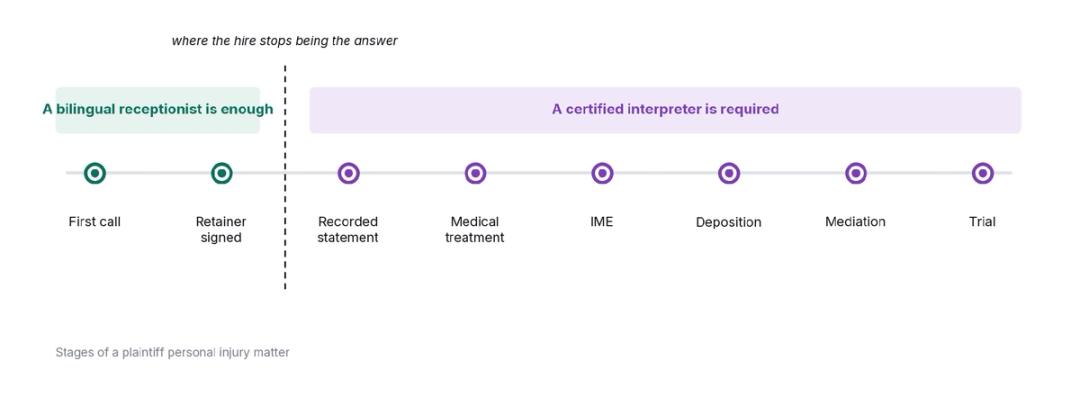
- A bilingual legal receptionist is not a court interpreter, and the two roles are not interchangeable at any point after the first call.
- ABA Formal Opinion 506 applies to a Spanish-language intake call exactly as it applies to an English one, and the three questions that require a lawyer do not translate into exceptions.
- Model Rule 5.3 obliges you to supervise a vendor whose calls you may not be able to read, which is the practical problem nobody selling Spanish coverage addresses.
A firm deciding whether to add a bilingual legal receptionist will find a consistent answer online: federal law requires it. Page after page cites Executive Order 13166, the Clinton-era order directing federally funded programs to provide meaningful access to people with limited English proficiency, and presents it as the compliance floor every law firm sits on.
That order was revoked on March 1, 2025. Executive Order 14224, "Designating English as the Official Language of the United States," rescinded it outright.
The guidance underneath it followed. The Department of Justice rescinded its Title VI limited-English-proficiency guidance in April 2025, and the Department of Homeland Security rescinded its own version effective July 14, 2026. The highest-ranking page on this topic still describes 13166 as "signed in 2000 and still in effect."
The correction matters less than what it exposes. The regulatory argument for Spanish coverage was never the real argument for a plaintiff firm, because a contingency-fee practice takes no federal financial assistance and was never inside Title VI's scope to begin with. Building the case on a revoked order means the actual case, which is commercial and ethical, goes unmade.
This piece makes that case instead and takes seriously a distinction the whole category skips: what a bilingual legal receptionist can do and where the job stops.
What the 2025 executive order changed and what it left alone
EO 14224 is narrower than its title suggests. It revokes EO 13166 and then limits its own reach: "Nothing in this order, however, requires or directs any change in the services provided by any agency," and agency heads "are not required to amend, remove, or otherwise stop production of documents, products, or other services prepared or offered in languages other than English." Section 4(c) states the order creates no right or benefit enforceable at law.
So agencies may keep their language access programs. They are no longer directed to build them.
Title VI itself is untouched, because a statute is not undone by an executive order. The DHS rescission notice says so directly, reminding recipients that they have "a continuing obligation to comply with Title VI, all applicable Title VI regulations, all applicable federal civil rights laws, and nondiscrimination provisions." What disappeared was the interpretive guidance telling recipients what compliance looked like in practice, not the underlying prohibition.
For a plaintiff PI firm the net effect is a clarification rather than a change. Hospitals, legal aid organizations, state courts, and agencies sit inside Title VI's reach. A contingency-fee firm taking cases on referral and television advertising does not.
If your firm has been told it has a federal obligation to answer the phone in Spanish, it did not have one in 2024 either. What remains is the part that was always doing the work.
Why the commercial case is the one that holds up
Strip out the compliance framing, and the argument for a bilingual legal receptionist gets simpler and harder to dismiss. A caller who reaches a receptionist they cannot talk to hangs up and calls the next number in the advertisement. There is no record of that call in your intake data, because the call that produces no record produces no row.
Plaintiff practice makes this sharper than it is for most firms. Case acquisition is almost entirely inbound and almost entirely advertised, which means the firm has already paid for the call before anyone answers it.
A missed Spanish-language call is therefore not a lost lead at the margin. It is a lead the firm bought, delivered to a competitor at full price.
The second effect runs through the case rather than the sign-up. Intake quality determines how fast a case moves, and a caller working in a second language under stress gives a thinner account of what happened.
The mechanism of injury gets compressed, prior injuries go unmentioned because the question was not understood as asking about them, and treatment already underway is described vaguely. Those gaps surface months later, usually in a deposition, and they cost more to repair than they would have cost to avoid.
Neither of those arguments depends on a regulation, which is why neither one evaporated in March 2025.
Find out what your Spanish-language calls are actually doing Send us a month of call logs and we will show you the Spanish-language calls that ended without an intake record. See where the calls are going
A bilingual receptionist and a certified interpreter are different jobs
This is the distinction the category does not draw, and it costs firms real money when they discover it late.
A bilingual legal receptionist answers the phone, takes an intake in Spanish, and produces a record your office can act on. The qualification is fluency plus training in your intake process, and the job ends when the intake record is written.
A court interpreter renders meaning between two parties who cannot understand each other in a setting where the accuracy of that rendering carries legal consequence. Certification involves examination in simultaneous interpretation, consecutive interpretation, and sight translation, and it exists because conversational fluency does not predict accurate rendering of legal and medical terminology under pressure.
The gap becomes a practical problem at predictable points in a PI matter: a recorded statement to an adjuster, an independent medical examination, treatment appointments where the provider has no Spanish-speaking staff, a deposition, mediation, or trial. At each of those, a bilingual legal receptionist is not the right resource, and in most of them, it is not a permissible one.
Three consequences follow for a firm planning coverage. Spanish-language intake capacity does not reduce the interpreter budget on a case, because the two serve different stages.
Interpreter cost is a case expense that has to be disclosed in the fee agreement and accounted for on the disbursement sheet, which puts it inside the economics of taking Spanish-language cases at all. And a firm that signs Spanish-speaking clients without an interpreter relationship in place has built a bottleneck it will hit in month three.
Hiring a bilingual legal receptionist solves the front of the matter. It does not solve the matter.
Opinion 506 does not have a Spanish exception
A bilingual legal receptionist runs into the same boundary an English-language one does, and that boundary is drawn in ABA Formal Opinion 506, issued June 7, 2023.
The opinion is generous about what a nonlawyer may handle: "obtaining initial information about the matter, performing an initial conflict check, determining whether the assistance sought is in an area of law germane to the lawyer's practice," along with "answering general questions about the fee agreement or process of representation" and even "obtaining the prospective client's signature on the fee agreement." All of it conditioned on the prospective client being offered an opportunity to communicate with the lawyer.
Then it draws the line. "If the prospective client asks about what legal services the client should obtain from the lawyer, wants to negotiate the fees or expenses, or asks for interpretation of the engagement agreement, the lawyer is required to respond."
Two things make this harder in Spanish than in English.
The first is script fidelity. An English script is written once and reviewed by people who can read it, while a Spanish script is frequently a translation, and translations drift toward the explanatory.
An agent rendering "I can't advise you on that, but an attorney will call you back" into natural Spanish may produce something closer to reassurance about the strength of the claim without intending to. Opinion 506's first trigger is the question callers ask most, and it is the easiest one in the world to answer helpfully.
The second is the retainer. The opinion lets a nonlawyer take a signature on a fee agreement and field general questions about it, while reserving interpretation of that agreement to a lawyer.
A Spanish-speaking claimant signing an English-language contingency agreement is asking for interpretation by definition, whether or not the word comes up. Any firm signing those clients needs a Spanish version of the agreement and a documented answer to who walks through it.
You cannot supervise calls you cannot read
Model Rule 5.3 applies to any nonlawyer the firm retains, which includes an outside bilingual legal receptionist. It requires the supervising lawyer to make reasonable efforts to ensure the vendor's conduct is compatible with the lawyer's professional obligations, and under 5.3(c) makes the lawyer responsible outright for conduct they ordered, ratified, or knew about in time to remedy.
Spanish coverage creates a supervision problem that English coverage does not. If nobody at the firm reads Spanish, the transcripts arrive and sit there. Quality assurance becomes a matter of trusting the vendor's own account of its performance, which is the one arrangement Rule 5.3 is written to prevent.
This is the question to put to any provider, and almost nobody asks it: how does a firm with no Spanish-speaking staff verify what was said on a Spanish-language call?
Workable answers exist. A transcript in Spanish paired with an English translation of the same call makes the record auditable without a bilingual reviewer. Writing the structured intake record in English, whatever language the call was in lets anyone check field completeness.
Beyond that, a sample of Spanish calls should be reviewed periodically by a qualified third party rather than by the vendor's own QA team, and calls that triggered the script's hard stops should be flagged, so the exceptions surface without anyone reading every transcript.
A vendor who answers this question with reassurance about agent quality has not answered it. The issue is not whether the agents are good. It is whether you can tell.
Ask a vendor the question that has no comfortable answer
We will walk you through how to audit Spanish-language calls when nobody at your firm speaks Spanish. Get the audit method
The intake fields that break first in translation
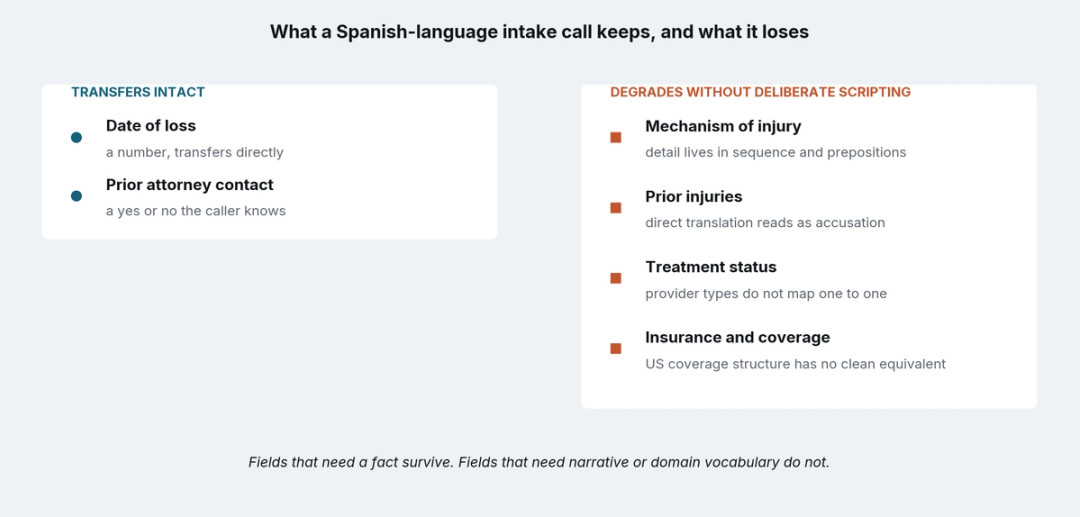
Some fields survive a language barrier intact and some do not, and knowing which is which tells you where the scripting effort belongs.
Two come through unharmed. Date of loss is a number, so it transfers cleanly. Prior attorney contact is a yes or no; the caller already knows, though it carries more weight here, because someone who has spoken to another firm may not distinguish a consultation from a representation.
Four degrade, each for its own reason.
Mechanism of injury: the detail that decides liability sits in sequence and prepositions, and it is the first thing lost when a caller is working in a second language and an agent is summarizing rather than transcribing.
Prior injuries: the question is often heard as an accusation rather than an inquiry, particularly by callers with reason to be cautious around institutions, so a direct translation of the English wording tends to produce a denial. This one needs scripting in Spanish from scratch.
Treatment status: provider types, specialties, and the line between an emergency department visit and ongoing care do not map one-to-one, and a caller who has been to a clinic may answer no when asked whether they have seen a doctor.
Insurance and coverage: the structure of US auto coverage has no clean equivalent in the vocabulary many callers bring, so a question about uninsured motorist coverage will produce a guess unless the script explains before it asks.
The pattern holds generally. Fields that need a fact transfer intact and fields that need narrative or domain vocabulary do not. Our breakdown of how many calls a PI case generates covers how often these gaps force a second call.
What the coverage costs against a bilingual hire
The in-house comparison is straightforward on one side. The Bureau of Labor Statistics reports median pay for receptionists at $38,010 per year, $18.27 per hour, for 2025. Bilingual candidates command a premium over that, and the figure covers wages before payroll taxes, benefits, and equipment.
The structural problem is coverage rather than rate, because one bilingual legal receptionist covers one shift. Spanish-language call volume does not confine itself to business hours, and for practice advertising to working people, it skews later than English volume does.
A single hire leaves evenings, weekends, and that person's vacation uncovered, and calls arriving in those windows are the ones most likely to be first contact.
On the vendor side, published rates give a reference point. Smith.ai's rate card lists $300 per month for 30 calls with overage at $11.50 per call, rising to $2,100 for 300 calls with overage at $8.50.
Many providers price bilingual coverage at the English rate, and some treat it as a separate tier. Ask which, because it changes the comparison.
Set against each other, the options cover different things, and the comparison most firms run compares only two of them.
| Option | Hours it covers | Takes a full intake | Usable at a deposition or IME | Published cost reference |
|---|---|---|---|---|
| In-house bilingual hire | One shift, minus leave | Yes | No | BLS median is $38,010 a year, before employment costs. |
| Outsourced live bilingual service | Up to 24/7, by plan | Yes | No | Smith.ai lists $300 to $2,100 a month by call volume. |
| AI voice agent | 24/7, concurrent | Yes | No | Varies by vendor; ask for the rate at your volume. |
| On-demand telephonic interpretation | 24/7, by the minute | No, it renders rather than collects. | Sometimes, depending on the setting | Per-minute, quoted by vendor |
| Certified court interpreter | Scheduled in advance | No | Yes | Hourly, usually with a minimum |
The fourth column is the one that settles the hire-versus-vendor argument, because no front-desk option clears it. A firm comparing only the first two rows is choosing how to answer the phone, not how to run the case.
The figure that decides it is neither of these. It is the value of the cases currently being lost, which a firm can estimate from its own advertising spend and the share of its market that is Spanish-speaking, and which is almost always larger than either side of the staffing question.
How HelloCounsel handles a Spanish-language intake call
HelloCounsel is our product, so treat this as a description of our design choices rather than a neutral assessment.
Language is detected on the call rather than routed by phone line, so a caller who reaches the main number in Spanish is handled in Spanish without being transferred or asked to press anything.
The Spanish script is authored in Spanish rather than translated from the English one, which is the decision that matters most for the fields listed above. The prior-injury and insurance questions in particular are written to explain before they ask.
Opinion 506's three triggers are hard stops in both language versions. A caller asking whether they have a case, asking about fees, or asking what the retainer means is routed to an attorney, and the attempt is logged whether or not the attorney picks up.
Every Spanish call produces a Spanish transcript, an English translation of that transcript, and a structured intake record written to the case management system in English. That combination exists specifically so a firm without a Spanish reader on staff can satisfy Rule 5.3 with a record rather than an assurance. The mechanics of that write-back are covered in our note on CMS write-back.
For the broader question of why general-purpose products struggle with plaintiff intake, see why a generic AI receptionist does not work for a PI firm.
How to test Spanish coverage without a Spanish speaker on staff
Four steps for testing a bilingual legal receptionist, none of which require anyone internally to read Spanish.
Have someone call in Spanish and ask the case question. Recruit a Spanish-speaking acquaintance, have them ask whether they have a case, and then ask what happened next. You are testing whether the script's hard stop fired, and the caller can tell you without you reading anything.
Request the English translation of that call. Not the summary. The translation. If a provider can only give you a summary, your supervision record is somebody's paraphrase.
Check the intake record against the fields above. Mechanism of injury, prior injuries, treatment status and coverage. These are the four that degrade, and an English-language record shows you whether they landed.
Ask who wrote the Spanish script. A translated script and an authored one behave differently, and the vendor will tell you which they have if you ask directly.
Deciding whether to add it
The question of whether to hire or contract a bilingual legal receptionist is worth separating from the question of whether your firm can serve Spanish-speaking clients properly, because the first is a front-desk decision and the second runs the length of the matter.
A bilingual legal receptionist at intake is the cheap part and the part with the clearest return, since it recovers calls you have already paid to generate. The rest, meaning an interpreter relationship, a Spanish retainer, a script written rather than translated, and a way to audit what gets said, is the part that determines whether the cases you sign are ones you can actually run.
Firms that add the first and skip the second usually find out in month three.
Bring us a Spanish call you have never been able to check
Play us a Spanish-language intake call and we will send back the translation and tell you what the script did. Talk to the HelloCounsel founders
Frequently asked questions
1. Is my law firm legally required to provide Spanish-language service?
Almost certainly not. The statute everyone points to binds organizations taking federal money, which a private contingency-fee practice does not, and the executive order vendor pages still cite was rescinded in March 2025, with the guidance built on it withdrawn since. What is left to argue from is commercial and ethical, not regulatory.
2. Is a bilingual legal receptionist the same as an interpreter?
No, and the roles are not interchangeable. A bilingual legal receptionist needs fluency and training in your intake process, while court interpreting is a credentialed qualification tested by examination. A Spanish-language PI matter will need both.
3. Can an intake agent answer a caller's legal questions in Spanish?
No more than in English. Opinion 506 hands three questions to a lawyer: what services the caller should obtain, what the fees will be, and what the engagement agreement means. Those triggers apply in whatever language the call happens in.
4. How do I know the Spanish on my intake calls is any good?
Ask for an English translation of a specific call rather than a summary, and check the intake record for the fields that degrade in translation. If a provider offers only its own quality assurance, you have no independent record, which is a problem under Model Rule 5.3 rather than only a quality concern.
5. Does a Spanish-speaking client need a translated retainer agreement?
Opinion 506 keeps explaining the engagement agreement with a lawyer, and a client who cannot read it is asking to have it explained. A translated agreement plus a recorded decision about who walks the client through it is the safer arrangement.
6. Should Spanish coverage be a separate phone line?
A dedicated line captures callers who are looking for Spanish service and makes attribution cleaner. It does not help the caller who dials the main number from an advertisement, which is most of them. Detection on the main line covers both; a separate line on its own does not.
Share this article