What Is the Difference Between Medical Records Follow-Up and Medical Records Retrieval?

- Medical records retrieval covers the whole job, from identifying providers to organizing records for demand, while follow-up covers the stretch between submitting a request and receiving everything the case needs.
- Follow-up is the part of retrieval that repeats, so it carries most of the staff hours; a request open for six weeks can take a dozen or more calls, portal checks, and resends before the bill and affidavit arrive.
- When you compare records vendors, ask who makes the follow-up calls, where the call notes live, and who pays provider invoices, because the three models answer those questions differently.
- ABA Formal Opinion 08-451 keeps supervision and confidentiality with the firm when it outsources support work, so any records vendor or agent should leave notes, recordings, and status where your team can review them.
- Buy follow-up on its own if your team already submits requests well, and buy end-to-end retrieval if provider identification and authorizations are where requests stall.
Medical records retrieval is the full job of getting a client's records and bills from every treating provider into the file: finding the providers, preparing the authorization, submitting the request, chasing it, paying for it, and checking what comes back. Medical records follow-up is one stretch of that job, the part that starts after a request goes out and ends when everything the case needs has arrived.
The two terms often get used interchangeably, and for a single request the medical records follow-upvs. retrieval distinction hardly matters. Someone sends the request someone calls the provider until the records come in, and the paralegal who did both doesn't need a name for each half.
The distinction starts to matter when you buy help. A retrieval vendor, an in-house records specialist, and an AI agent each take a different share of the job, and follow-up is the share where the hours sit, so the term on the proposal decides how much of your team's week actually changes.
Which steps of medical records retrieval count as follow-up?
Retrieval runs through ten steps from a client's first treatment list to a demand-ready file. Five of them, from confirming receipt to re-requesting missing pages, make up follow-up, and those five are the ones that repeat.
The steps on either side of follow-up happen once per request. Identifying providers, preparing the authorization, and submitting the request are front-end work that depends on the firm's own documents, and checking and organizing the records are back-end work that depends on what arrived.
The front end is heavier at a plaintiff firm than the word "submit" suggests. A single motor vehicle case can involve an ambulance company, an emergency department, a radiology group billing separately from the hospital, an orthopedic practice, a physical therapy clinic, and a pharmacy, and each one needs its own request and its own bill.
The follow-up steps run on the provider's schedule instead. A records department confirms receipt when it gets to the fax, gives a callback window on the phone, sends the chart before the bill, and asks for prepayment after the copy is made, so each step can repeat several times before the request closes.
That repetition is what makes follow-up its own line item. A vendor that only submits requests, or a template that only generates authorizations, leaves the five middle steps with your team, which is where the case manager's day goes when records run late, as our piece on reducing case manager workload traces.
Why does follow-up take most of the hours in medical records retrieval?
Submission is one action, while follow-up is a loop that runs until the provider finishes. Under 45 CFR 164.524, a provider has 30 days to act on a patient's access request and can take one 30-day extension, so a request can stay open for up to two months on its own terms before anyone has missed a deadline.
We plan follow-up at about four calls per open request per month, a working assumption each firm should check against its own provider mix. A request that stays open for six weeks at that rate takes about six calls, plus portal checks and resends on the other channels the provider uses.
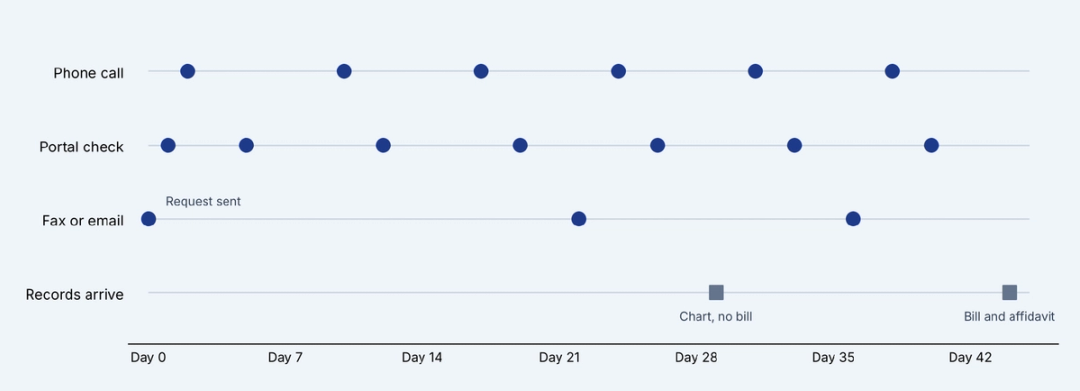
The illustrative request above takes 16 touches over 44 days: six calls, seven portal checks, and three faxes or emails, with the chart arriving on day 29 and the bill and affidavit on day 44. Only the first fax was submission, and every other mark on the strip was follow-up.
Multiply that by the number of open requests, and the split becomes clear. A firm with 150 requests open at once runs about 600 follow-up calls a month on our planning figure, part of the outbound load we cover in the case for automating outbound calls, and each call that reaches a phone tree and a hold queue takes far longer than the minute it takes to log the result.
Four things stretch the loop past its normal length: a prepayment invoice that waits for approval, an authorization the provider rejects as defective, a request sent to the wrong department, and records split across facilities that each process requests separately. Each one adds a round of calls, and each one surfaces only because someone kept calling.
The hours also land on the wrong people. A records specialist on hold isn't reviewing the records that already arrived, and a paralegal covering records calls during a backlog isn't preparing demands, so follow-up volume shows up as delay in work that has nothing to do with records.
Who owns medical record follow-up under each retrieval model?
Firms handle records in one of three ways, and each one assigns follow-up to a different party. The difference shows most clearly in where the notes from each provider call end up.
| Question | In-house team | Retrieval vendor | Follow-up layer |
|---|---|---|---|
| Who submits the request? | Your team | The vendor | Your team, or the layer once trusted |
| Who calls the provider? | Your team | The vendor's staff | An agent or service working inside your process |
| Where do call notes live? | Your case management system, if someone logs them | The vendor's portal or reports | Your case management system, on the matter |
| Who pays provider invoices? | Your team | Set by the vendor contract | Your team, from a task the layer creates |
| Who decides on gaps or discrepancies? | Your team | Your team, after the vendor reports them | Your team, after the layer, flags them. |
An in-house team keeps everything visible but carries every hour. A retrieval vendor takes the hours off your team's week, though status often lives in the vendor's system, so your case managers check two places to know where a file stands.
A firm can end up running a mix without naming it. Hospital requests go to a vendor because they run through release-of-information portals, while requests to chiropractors and physical therapy clinics stay in-house because the front desk answers the phone, and the firm ends up with two status systems and two sets of notes.
A follow-up layer sits between the two. Your team keeps submission and judgment, and the layer takes the repeating calls and checks while writing each result to the matter, which is the model behind an AI system for medical provider calls.
The medical records follow-upvs. retrieval choice therefore comes down to which hours you want off your team's plate and where you want the record of the work to sit. The answer also depends on which organization picks up the provider's phone.
How do release-of-information companies differ from records retrieval vendors?
Follow-up often reaches a third party that is neither the firm's vendor nor the provider's own staff. Many hospitals and health systems hand their record requests to a release-of-information company, which processes requests, prepares copies, and issues invoices on the provider's behalf, so the call your team makes about a hospital chart often goes to that company's queue instead of the hospital's records office.
The two kinds of company sit on opposite sides of the request. A records retrieval vendor works for your firm and chases records, while a release-of-information company works for the provider and fulfills requests, and the Ciox Health v. Azar case that changed HIPAA fee rules in 2020 was brought by a company on the provider side.
That split changes how follow-up works in practice. A request to a hospital may need a status check in the release-of-information company's portal, a call to its customer line, and an invoice paid through its system, while a request to a small practice goes to a front desk that also schedules patients, so one follow-up cadence rarely fits both.
Ownership, channel, and the party on the other end of the call all bear on the same thing: whether the firm can see and supervise the work. The ethics rules on outsourcing treat that visibility as part of the firm's supervision duty.
Provider calls that land on the matter
See HelloCounsel call a provider about an open request and write the outcome and the next follow-up date to the case file. Schedule a provider-call demo
What does ABA Formal Opinion 08-451 require when a firm outsources records work?
The ABA addressed outsourcing support work in August 2008. Formal Opinion 08-451 applies Model Rules 5.1 and 5.3 to outside providers, so a lawyer who outsources legal or nonlegal support remains responsible for making sure the work meets the same ethical standards as work done in the office.
The opinion also calls written confidentiality agreements strongly advisable in outsourcing relationships and says a firm should confirm the provider isn't working for an opposing party on the same or a related matter. Where the arrangement means the firm can't closely supervise the work, the opinion says the client's informed consent may be necessary.
For records work, supervision depends on visibility. A firm can only supervise follow-up if it can see, so the practical test for any vendor or agent is whether each call, portal check, and resend leaves a note, a recording, or a transcript that a case manager can open from the matter.
The provider's obligations don't change with the firm's model. The same HIPAA timelines apply whether a paralegal, a vendor, or an agent makes the call, and a request made on a client's authorization under section 164.508 carries no federal response deadline, so follow-up on those requests runs on the provider's own policy and any state rule that applies.
When should a firm buy follow-up instead of full medical records retrieval?
The right purchase depends on where requests stall today. A firm whose requests go out quickly and correctly but then sit for weeks has a follow-up problem, and buying full retrieval for it means paying a vendor to redo front-end work the team already does well.
Full retrieval fits a different pattern. If requests stall before they go out because the provider list is incomplete, authorizations come back defective, or a mass tort docket brings in hundreds of new clients at once, the front end is the bottleneck, and a vendor that handles provider identification and submission earns its fee.
| Where requests stall | What to buy | What your team keeps |
|---|---|---|
| After submission, waiting on providers | Follow-up only | Submission, payments, and judgment calls |
| Before submission, building provider lists or authorizations | End-to-end retrieval | Payments, judgment calls, and review of what arrives |
| Both, during a volume spike | End-to-end retrieval for the spike, follow-up for the steady caseload | Judgment calls and the standard requests |
A staff-hour benchmark makes the comparison concrete. The Bureau of Labor Statistics puts legal secretary pay at $55,570 a year, about $26.72 an hour, and with benefits at roughly 30% of total compensation, the loaded cost comes to about $38 an hour.
At our planning figure of 600 follow-up calls a month for 150 open requests, and an illustrative 12 minutes per call once the phone tree and hold are counted, follow-up takes about 120 staff hours a month. At $38 an hour, that is about $4,580 a month, or roughly $30 per open request per month, before logging, portal checks, or resends.
Cost follows the same split. Retrieval vendor pricing varies by contract, and provider copy fees can come on top, so a firm that only needs follow-up should compare that price against the staff hours follow-up actually takes, using its own count of open requests.
The medical records follow-upvs. retrieval decision can also change over time. Starting with follow-up on requests your team already sends gives you a month of call logs to judge the work, and the same logs show whether submission can move over next.
How can a firm tell whether requests stall before or after submission?
Three dates on each request answer the question, and a case management system that tracks requests already holds them: the date the client signed, the date the request went out and the date the last required item arrived. The gap between the first two measures the front end, and the gap between the last two measures the follow-up.
Pull those dates for the last 50 closed requests and compare the two gaps. A firm averaging four days from signing to submission and 40 days from submission to completion has a follow-up problem, while a firm averaging three weeks before a request even goes out has a front-end problem that follow-up help won't fix.
The same pull shows which providers drive the follow-up gap. The providers with the longest averages are the ones where a fixed follow-up cadence and a named contact pay off first.
HelloCounsel handles medical record follow-up and end-to-end retrieval
The diagnostic above usually points a firm toward one model, and an agent can serve either one. What matters is that the hours come off the team while the notes, recordings, and payments stay where the firm can supervise them.
HelloCounsel builds AI voice agents for plaintiff personal injury firms, and its agent works as a follow-up layer or as an end-to-end retrieval agent depending on what the firm hands over. HelloCounsel is our own product.
- Follow-up on firm-submitted requests: Your team prepares and submits the request, and HelloCounsel handles provider calls, status checks, invoices, missing items, and documentation.
- End-to-end retrieval: HelloCounsel prepares and submits the request by email, fax, or retrieval portals such as Datavant, MRO, and ChartSwap, then follows it through completion.
- Persistent follow-up: HelloCounsel calls through provider phone trees, waits on hold, checks portals with credentials your firm provides, watches inboxes and fax lines, and follows each provider's stated callback window.
- Completeness checks: HelloCounsel validates the plaintiff, provider, and dates of service and flags missing records or discrepancies before closing a request.
- Invoice handling: HelloCounsel obtains invoices and creates a payment task for your team when prepayment is required, without handling the firm's card details.
- CMS updates and visibility: HelloCounsel writes every interaction, status change, and next task to the matter, with call recordings and transcripts available to your team, and Filevine is a confirmed workflow for record follow-up.
- Qualification and case management: The same agent qualifies new leads, opens the case, and runs client and treatment check-ins, so records work starts from a matter that is already set up.
HelloCounsel keeps the firm in control of the parts. Opinion 08-451 cares about. Every call leaves a recording or transcript on the matter, payments stay with your team, and stalled providers and material discrepancies go to a person instead of sitting in a vendor queue.
HelloCounsel has limits worth stating plainly. It doesn't handle hard-copy mail, portal access needs credentials your firm provides, and completion times depend on how quickly each provider responds.
We usually start a firm on follow-up only, with 10 to 20 live requests, a 60-minute setup call, about three to five days of configuration and a 30-minute go-live review. HelloCounsel has handled more than 25,000 calls and 500 hours of call time, and you can see the medical records workflow on our product page.
Six questions to ask before buying medical records retrieval or follow-up
Proposals for records work tend to describe turnaround, while these questions pin down who does the work and where the record of it sits. Ask every vendor, including us.
1. Follow-up ownership: Ask who makes the follow-up calls, how often, and what happens when a provider gives a callback window.
2. Note location: Ask where the notes from each call live and whether they reach the matter in your case management system without anyone copying them.
3. Recordings and transcripts: Ask if your team can open a recording or transcript for any call, which is what supervision under Opinion 08-451 relies on.
4. Invoice payment: Ask who pays provider invoices, how those costs reach the firm, and whether any card details leave your team.
5. Escalation: Ask what triggers a handoff to your team, such as a stalled provider, a defective authorization, or a discrepancy in the dates of service.
6. Confidentiality and conflicts: Ask for a written confidentiality agreement and a conflict confirmation covering the defendants and insurers on your docket.
Run the three-date pull on your last 50 closed requests before the first vendor call. With the front-end and follow-up gaps in hand, the conversation shifts from a vendor's average turnaround to where your own requests wait, and that is the number a proposal should promise to move.
The answers sort vendors into the three models quickly. A firm that knows whether its requests stall before or after submission can then match the model to the problem, and the CMS write-back question decides whether the follow-up it buys shows up where your case managers already work.
Follow-up only or full retrieval for your firm
Talk through where your records requests stall with HelloCounsel's founders and decide which model fits your caseload. Scope your records workflow with our founders
Frequently asked questions about medical record follow-up vs. retrieval
1. What is the difference between medical record follow-up and retrieval?
Retrieval is the whole job, from identifying providers to organizing records for demand. Follow-up is the stretch after a request goes out, covering status calls, portal checks, invoices, missing items, and re-requests until everything the case needs arrives.
2. Can a law firm outsource only medical records follow-up?
Yes. A firm can keep preparing and submitting requests and hand the follow-up to a service or agent. HelloCounsel works this way, calling providers and writing each result to the matter.
3. Who pays provider invoices when a firm uses a retrieval vendor?
It depends on the vendor contract, so ask before signing. A follow-up layer like HelloCounsel creates a payment task and leaves payment with your team, which keeps card details inside the firm.
4. How long can a medical records request stay open?
Under 45 CFR 164.524, a provider has 30 days to act on a patient's access request, with one 30-day extension. Authorization requests carry no federal deadline, so they can stay open longer.
5. Does outsourcing records work change a firm's ethics duties?
ABA Formal Opinion 08-451 keeps supervision and confidentiality with the firm when it outsources support work, so the firm should be able to review notes and recordings from every call.
6. Does HelloCounsel handle inbound and outbound record calls?
Yes. HelloCounsel makes outbound follow-up calls to providers and answers inbound calls on your main line, writing each call to the matter in your case management system.
Share this article