What Should a Personal Injury Law Firm Automate in Medical Record Follow-Up?

- Medical record follow-up at a personal injury law firm is mostly repetition, from status calls and hold time to portal checks and logging, so automate those steps and keep payments, case-value judgments, and legal routes with your team.
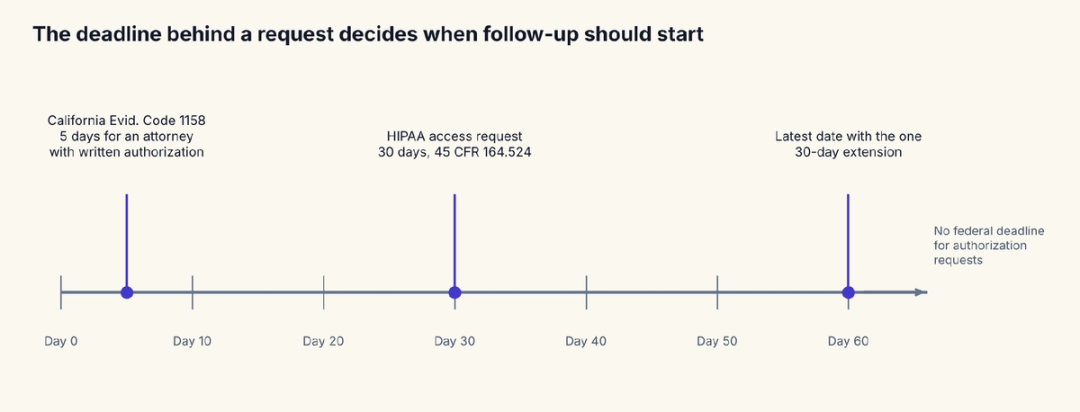
- Set the follow-up cadence from the deadline behind each request: HIPAA gives a provider 30 days on an access request plus one 30-day extension; an authorization request carries no federal deadline, and California gives a provider five days to make records available to an attorney with written authorization.
- Since Ciox Health v. Azar (2020), the patient-rate fee limit no longer applies when records go to a third party such as your firm, so let automation retrieve invoices while a person approves and pays them.
- Have the agent check every response against the plaintiff, the provider, and the dates of service, and route any mismatch to a case manager before the request closes.
- Start with follow-up on 10 to 20 live requests your team has already submitted, record open requests and days outstanding as a baseline, and expand to submission once the logs look right.
Medical record follow-up is the work between sending a request and holding a complete, correct set of records and bills in the file. At a personal injury law firm, that work runs through phone queues, portals, fax lines, and inboxes, and nearly all of it is repetition. The difficulty is that the repetition and the few real decisions arrive mixed together, often on the same call.
One request shows the pattern. A paralegal faxes a request to an orthopedic practice on a Monday; the portal shows it as received on Wednesday; and a call on day 10 runs through the phone tree and 20 minutes of hold before a records clerk says to call back in seven to ten business days. On day 22 the records arrive without the itemized bill, the bill follows a week later with a prepayment invoice, and the chart turns out to be missing two dates of service.
Only two of those steps needed judgment: approving the invoice and deciding whether the missing visits matter to the claim. Everything else was calling, waiting, checking, and logging, which is the part of the medical record follow-up law firm teams that can be handed to software.
Which parts of medical record follow-up should a law firm automate?
Sort the work by what each step needs from the person doing it. A step that repeats the same action until a condition changes belongs to automation; a step that needs a decision about money, case value, or legal process belongs to a person; and a third group sits between them, where software spots the problem and a person decides what to do.
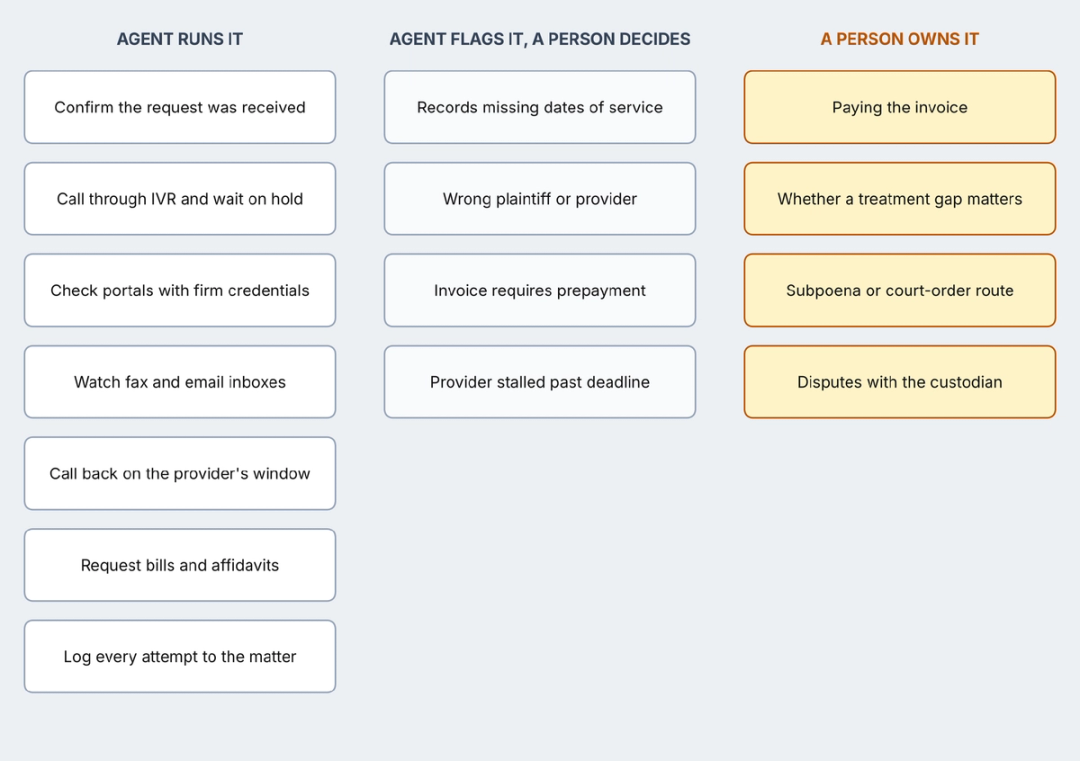
The first column carries most of the hours. Phone trees, hold time, portal checks with the firm's credentials, and the fax line repeat across every open request, and each one ends in a note that someone has to enter into the matter. Those notes add to the case manager workload at a PI firm with every request that stays open.
The first column also has to follow each provider's preferred channel. A hospital system may route every request through a release-of-information vendor's portal, while a two-doctor chiropractic office answers only by fax and phone. A follow-up process that forces both through the same channel loses days on whichever one it doesn't fit, a difference we cover in our guide to AI systems for medical provider calls.
The middle column needs software that notices problems and then stops. An agent can compare a response against the request and see that a chart skips two visits or carries another patient's name, but whether those visits matter to the claim is a case manager's call.
The third column stays human for reasons that have little to do with what software can do. Payments involve the firm's money and card details, a treatment gap affects case value, and choosing a subpoena over another follow-up call is a legal decision.
How should the legal deadline behind a request set the follow-up cadence?
A schedule that treats every request the same either calls too early or waits too long, because the deadline depends on how the firm asked. A patient's own access request, including one that directs the records to the firm, falls under 45 CFR 164.524, which gives the provider 30 days to act and allows one extension of up to 30 more days with written notice.
A request made on a HIPAA authorization under section 164.508 works differently. The regulation sets out what a valid authorization must contain but no deadline for the provider to respond, so state law and the provider's own policy decide the timing.
Authorization requests also fail for reasons a follow-up call uncovers. A provider may reject an authorization that lacks an expiration date or event, a signature and date, or a description of the records, all of which section 164.508(c) requires, and the request sits until someone asks why it hasn't moved.
An agent can ask that question on the first status call and record the provider's stated reason on the matter. Fixing the form and getting the client's new signature is a person's job, though the agent can reopen the follow-up the day the corrected authorization goes out.
Some states move much faster than HIPAA. California Evidence Code section 1158 gives a provider five days after an attorney presents a written authorization to make the records available for inspection and copying, and a provider that misses that window can be liable for the reasonable expenses, including attorney's fees, of enforcing the request.
| Request route | Deadline | Follow-up rhythm we suggest |
|---|---|---|
| HIPAA access request directed to the firm | 30 days, plus one 30-day extension with written notice | Confirm receipt within two business days, check status at day 14, call at day 25 and ask for the written notice if the provider needs more time |
| Authorization request with no state deadline | None under federal rules | Confirm receipt, then follow the provider's stated callback window, with a call at least every 10 business days |
| California attorney request under section 1158 | Five days | Confirm receipt the same day and call on day 4 if the records are not yet available |
| Urgent or aging request | Set by the case, such as a demand date | Shorten the interval and escalate to a person after a set number of attempts |
An agent can run a different cadence on each request without anyone tracking it in a spreadsheet, which matters most when a firm has hundreds of requests open under different rules. The cadence also tells the agent when to stop calling and hand the request to a person.
Deadlines decide when to call. What happens when the provider answers with an invoice turns on federal fee rules that changed in 2020.
Why should invoice payment stay with a person after Ciox Health v. Azar?
HIPAA limits what a provider can charge on an individual's access request to a reasonable, cost-based fee. In 2016 guidance, HHS extended that limit to copies a patient directed to a third party, which gave law firms the patient rate when they requested through a patient's directive.
In January 2020, the federal district court in Ciox Health v. Azar vacated that part of the guidance, so the patient-rate limit now applies only when records go to the patient. Records sent to your firm on a patient's direction or on an authorization can carry a different fee, and invoices vary by provider and by the copy vendor handling the request.
That variation is why invoices sit in the middle and right-hand columns. An agent can obtain the invoice, attach it to the matter, and create a payment task, while a person checks the amount against the request and pays it, which keeps card details out of any automated workflow.
Bills and affidavits follow the same logic. Itemized bills, billing affidavits, and record affidavits often arrive separately from the chart, so the agent tracks each one as its own item and keeps following up until every piece the case needs is in the file. Once the pieces arrive, the question becomes whether they are the right ones.
What should an automated completeness check verify before a request closes?
A request that closes on arrival instead of on review is how a demand goes out missing three months of physical therapy. Before closing any request, the agent should compare the response against the request on three points and stop if any of them fails.
1. Plaintiff identity: Match the name and date of birth on every page set against the client in the matter, and flag any page that belongs to someone else.
2. Provider and facility: Confirm the records come from the provider and location requested, since a practice with several locations may send one site's chart.
3. Dates of service: Compare the dates in the chart with the treatment dates the firm has from the client and the bills, and flag any visit that appears in one and not the other.
A flag stops the request from closing and passes it to a person. The agent re-requests what is plainly missing, while a person decides whether a gap reflects missing paperwork or an actual break in treatment, since an adjuster will read the second as a reason to discount the claim.
Checking each response as it arrives also lets the team organize the records into the file in order, so the chronology is ready when the case reaches demand. Checks like these depend on what earlier follow-up calls left on the matter.
What should every provider follow-up call record on the matter?
A follow-up call is only worth the hold time if the next person who opens the file can see what happened without calling again. Each call should leave the same fields on the matter, whoever or whatever made it.
1. Who answered: The department and, where given, the name of the person who spoke for the provider.
2. Request status: Whether the provider has the request, is processing it, has sent the records or needs something from the firm.
3. Reference number: The provider's or vendor's request number, which shortens every later call.
4. Expected date and callback window: When the provider says the records will go out and when it asks the firm to call back.
5. Open items: Any invoice amount, missing bill or affidavit, or rejected authorization, with the reason the provider gave.
6. Next action and date: The next call, resubmission, or escalation is scheduled on the matter as a task.
Fields like these are what make CMS write-back useful for records work, because a status note in free text can't drive the next task. They also show which providers run late, which matters more as the number of open requests grows.
How many follow-up calls does a records desk handle each month?
We plan medical record follow-up at about four calls per open request per month. That figure is a working assumption, and each firm should check it against its own provider mix and history before building a staffing or ROI case on it.
At that rate, a firm with 150 open requests makes about 600 follow-up calls a month. If each call takes 12 minutes once the phone tree and hold time are counted, an assumption for illustration, the desk spends 120 hours a month on calls alone, roughly 70% of one full-time position before any logging, inbox checks, or portal work.
The hours are only part of the cost, since a records specialist on hold isn't reviewing the records that already arrived. Spare intake capacity doesn't cover a records backlog either, because the two roles need different knowledge, a pattern our analysis of how many calls a PI case generates traces across the life of a matter.
Volume also hides age. A weekly view that groups open requests by days outstanding, under 30, 31 to 60, and over 60, shows where follow-up is falling behind more clearly than a total count does, and the over-60 group under a HIPAA access request has run past the latest date the rule allows.
Records follow-up is also one slice of the outbound calling a plaintiff firm carries, alongside lead follow-up and client check-ins, which is the case we make for automating outbound calls at a PI firm.
Supervision applies to whoever makes those calls. ABA Model Rule 5.3 makes lawyers responsible for supervising the nonlawyers who work for the firm, and an automated agent calling providers on the firm's behalf should leave the trail a careful paralegal would: a recording or transcript, the outcome and the next date.
Records follow-up, from phone tree to case note
See HelloCounsel work a live records request through the provider's phone tree, hold queue and callback window, then log it to the matter. Request a records follow-up demo
How HelloCounsel runs medical record follow-up inside your case management system
HelloCounsel builds AI voice agents for plaintiff personal injury firms, and its agent takes over the agent-run tasks sorted earlier and flags the ones that need a decision. HelloCounsel is our own product.
- Request submission: HelloCounsel submits requests by email, fax and retrieval portals such as Datavant, MRO, and ChartSwap, or follows up on requests your team has already sent.
- Persistent follow-up: HelloCounsel calls providers through their phone trees, waits on hold, checks portals with credentials your firm provides, watches inboxes and fax lines, and follows each provider's stated callback window until the request resolves.
- Status tracking: HelloCounsel tracks records, invoices, billing affidavits, record affidavits, and documents that arrive separately.
- Completeness checks: HelloCounsel validates the plaintiff, provider, and dates of service, and flags missing records or discrepancies before closing a request.
- Invoice handling: HelloCounsel obtains invoices and creates a payment task for your team when prepayment is required, without handling the firm's card details.
- CMS updates: HelloCounsel writes every interaction, status change, note, and next task back to the matter, and Filevine is a confirmed workflow for record follow-up.
- Escalation and visibility: HelloCounsel routes stalled providers, material discrepancies, and decisions that need judgment to your team and shows request status, task history, recordings, and transcripts for each matter.
- Qualification and case management: The same agent qualifies new leads at intake, opens the case, and runs treatment and client check-ins, so records follow-up starts from a matter that is already set up.
HelloCounsel has limits worth stating plainly. It doesn't handle hard-copy mail, portal access needs credentials your firm provides, prepayments stay with your team, and completion times depend on how quickly each provider responds.
We recommend starting with follow-up only so your team keeps preparing and submitting requests while HelloCounsel works 10 to 20 live ones. After a 60-minute workflow and setup call, we configure the agent in about three to five days and review real activity with your team in a 30-minute go-live session before expanding toward submission.
HelloCounsel has handled more than 25,000 calls and 500 hours of call time. It runs in English and Spanish inside your case management system rather than replacing it, and it opens each new matter through case opening so records requests attach to the right file from day one.
When should a law firm automate records submission as well as follow-up?
Follow-up is the safer place to start, because the request already exists and the agent only has to chase it. Submission adds steps that depend on the firm's own documents, such as choosing the right authorization, attaching it, and sending it through the channel each provider accepts.
The point to expand is when the follow-up logs show three things for at least a month: the agent reaches the right department at most providers, its notes match what the records team would have written, and escalations reach a person the same day. At that stage, the medical record follow-up law firm staff still do it by hand, mostly the first send, and moving it to the agent removes the last handoff in routine requests.
Some requests should stay with a person even then. Psychotherapy notes need their own authorization under section 164.508(a)(2), substance use disorder treatment records are covered by 42 CFR Part 2 needs a consent that meets that rule's separate requirements, and anything headed to a subpoena or court order is a legal decision rather than a follow-up task.
Requests for a deceased client's records, or for a minor's records signed by a guardian, also deserve a person's review before they go out, since the authority behind the signature is part of what the provider checks. Everything else can move to the agent once the five decisions below are written down.
Settle five decisions before automating medical record follow-up
Automation follows the rules a firm writes down, so these five decisions come before the agent's first call.
1. Request routes: Mark each open request as an access request, an authorization request, or a state-law request so the cadence matches its deadline.
2. Provider channels: Record how each frequent provider wants to be contacted, whether by portal, fax, email, or phone, and its usual callback window.
3. Escalation rules: Set how many attempts or days pass before a stalled request goes to a person, and name that person.
4. Payment workflow: Decide who approves and pays invoices and how quickly, since an unpaid prepayment stops the request.
5. Baseline numbers: Record open requests, average days outstanding, and follow-up calls per request today so the first 30 days have something to compare against.
With those five settled, the medical record follow-up law firm staff carry today becomes a supervised queue, and the team's time moves to the decisions in the right-hand column. The practical next step is to pick 10 to 20 requests already in flight, let the agent work them, and compare days outstanding and staff hours against the baseline after 30 days.
A 10 to 20-request pilot on your open records
HelloCounsel's founders can review your provider mix and set up a pilot on requests your team has already sent. Plan a records pilot with our founders
Frequently asked questions about medical record follow-up at a law firm
1. What parts of medical record follow-up can a law firm automate?
A firm can automate status calls, hold time, portal and inbox checks, callbacks on the provider's stated window, requests for missing bills, and logging. HelloCounsel handles these, while payments, treatment-gap decisions, and subpoenas stay with your team.
2. How long does a provider have to respond to a medical records request?
Under 45 CFR 164.524, a provider has 30 days to act on a patient's access request, with one 30-day extension. HIPAA sets no deadline for authorization requests, though some states do, such as California's five days for attorneys.
3. Do HIPAA fee limits apply to records sent to a law firm?
Since Ciox Health v. Azar (2020), the patient-rate limit applies only when records go to the patient. Records sent to a law firm can carry different fees, so a person should check each invoice before paying.
4. How often should a law firm follow up on a medical records request?
Match the cadence to the deadline behind the request: confirm receipt early, check status before the deadline, call on the provider's stated callback window after it, and escalate to a person after a set number of attempts.
5. Can an AI agent pay medical record invoices?
HelloCounsel obtains invoices and creates a payment task for your team when prepayment is required. It does not handle the firm's card details, so a person approves and pays each invoice.
6. Can HelloCounsel follow up on requests my team already sent?
Yes. HelloCounsel can follow up on requests your team prepared and submitted, calling providers, checking portals, and writing each update to the matter, and can later take over submission as well.
Share this article