What Is a Conflict Check, and How Do Law Firms Screen Conflicts at Intake?
- A conflict check is the search a law firm runs before taking a matter to confirm that representing the new client won't conflict with duties owed to current clients, former clients, or prospective clients.
- At intake, the check matters early because Model Rule 1.18 gives duties to anyone who shares information about possibly hiring the firm, even if the firm never takes the case.
- PI firms face recurring conflicts, such as a driver and passenger from the same car, multiple claimants against one insurance policy, and an adverse party who is a current or former client.
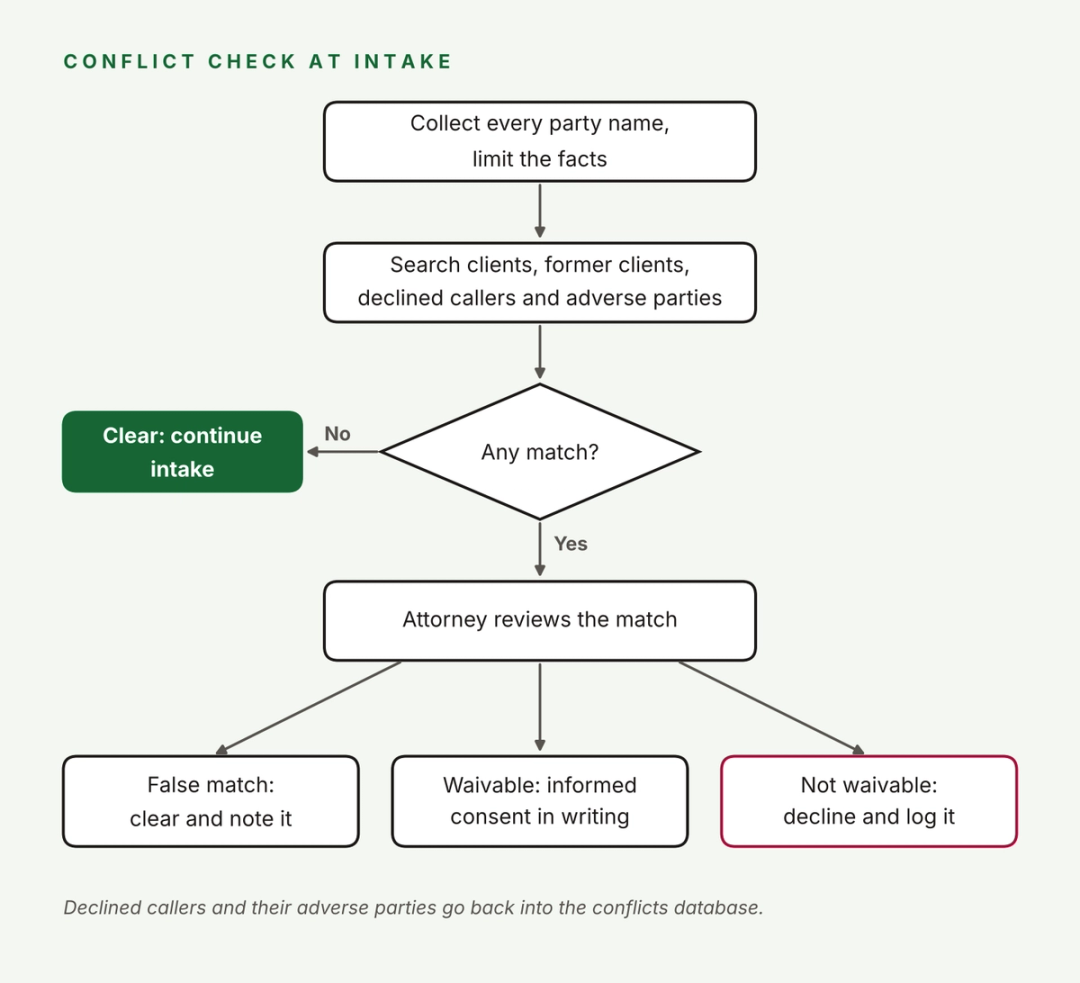
- Intake should collect the names needed for the check, including every driver, owner, passenger, and business involved, while limiting the facts gathered until the check clears.
- Log declined callers and adverse parties in the conflicts database, since a conflict check is only as reliable as the names the firm has recorded.
Most of a new caller's first conversation with a plaintiff firm is about whether the firm wants the case: what happened, how badly the caller was hurt, who was at fault and whether there's insurance. The conflict check asks a different question, which is whether the firm is allowed to take the case at all.
That question arrives earlier than it often gets treated. Under the ethics rules, a caller who shares information about possibly hiring a lawyer becomes a prospective client during that call, and the firm owes them duties even if it never signs them. If the caller turns out to be adverse to someone the firm already represents, the details they shared can create a problem for the firm in the existing matter.
Personal injury practice produces its own patterns. The passenger in a client's car may have a claim against the client who was driving, and three people hurt in the same crash may all be chasing one insurance policy that can't cover everyone. The driver who caused the accident may have been a firm client two years ago or may have called the firm last month and been turned away.
None of these situations is rare, and each one is easier to catch before the caller has told their whole story than after the retainer is signed. A reliable conflict check at intake starts with a clear picture of what the check is actually looking for.
What is a conflict check?
A conflict check is a search of the firm's records for anyone connected to a new matter: the prospective client, the parties on the other side, and anyone else whose interests could be affected. It shows, before the firm takes the case, whether representing the new client would conflict with a duty the firm already owes someone else.
The duty to look comes from the conflict rules themselves. Comment 3 to Model Rule 1.7, shown here in Minnesota's version, says a lawyer should adopt reasonable procedures, appropriate for the size and type of firm and practice, to determine the persons and issues involved in a matter.
The search covers the whole firm, not one lawyer's caseload. Under Model Rule 1.10, while lawyers are associated in a firm, none of them may knowingly take a matter that any one of them would be barred from under Rules 1.7 or 1.9, so a conflict check that only looks at one attorney's files misses most of the risk.
The records searched should match that reach: open matters, closed matters, declined consultations, adverse parties, and related parties such as employers and vehicle owners. A conflict check that searches only client names will miss the former adverse party who now wants to hire the firm against its own client.
Knowing which conflicts to expect tells the firm what those records need to catch. That firm-wide reach is why the kinds of conflicts matter as much as the search itself.
Which conflicts does a PI firm run into?
Four rules generate most of the conflicts a plaintiff firm sees at intake, and each has a familiar PI version.
| Conflict type | Rule | How it shows up at a PI firm |
|---|---|---|
| Direct adversity to a current client | 1.7(a)(1) | The at-fault driver in a new caller's crash is a current firm client in another matter |
| Material limitation | 1.7(a)(2) | The firm represents the driver and is asked to take the passenger, who may have a claim against that driver |
| Former client | 1.9(a) | The defendant was a firm client in a substantially related matter |
| Prospective client | 1.18(c) | The other driver called the firm after the same crash and shared details before being declined |
| Multiple claimants, one policy | 1.7(a)(2) and 1.8(g) | Several injured people from one crash compete for limited insurance proceeds |
The driver and passenger pattern is that one PI firm meets regularly. The Florida Bar's Ethics Opinion 02-3 treats it case by case: where objective evidence suggests the driver was partly at fault, one lawyer can't represent both the driver and the passenger because an independent lawyer would advise the passenger to consider a claim against the driver.
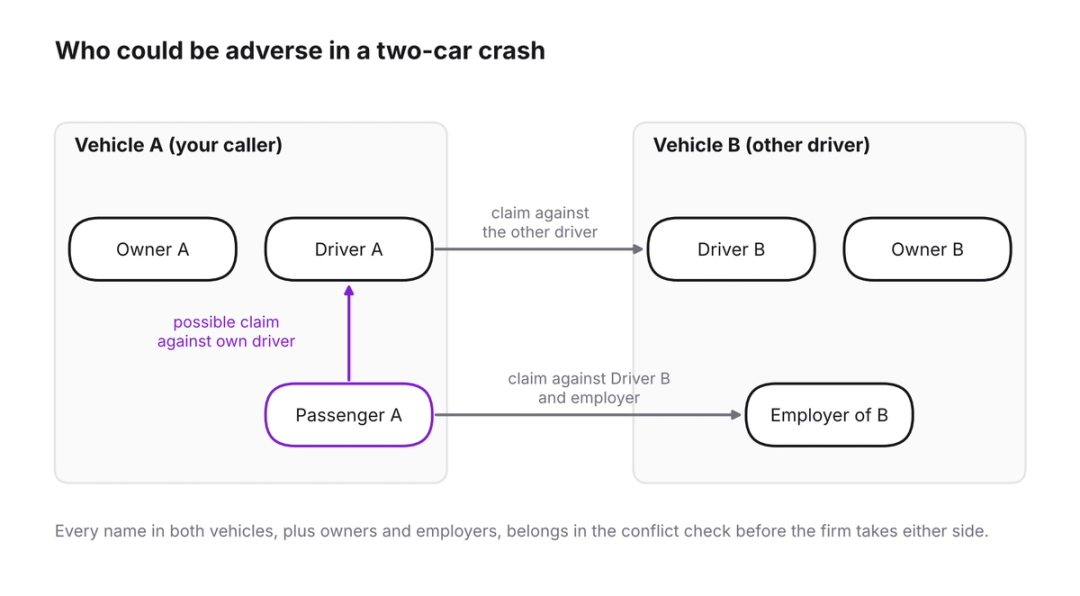
Comment 23 to Rule 1.7 makes the same point about coplaintiffs more broadly, noting that a conflict can arise from substantial differences in the parties' testimony or substantially different possibilities of settlement. When the claimants share one limited policy, Rule 1.8(g) adds that an aggregate settlement needs each client's informed consent in a writing signed by the client.
The former client rule reaches further than it first appears. Under Rule 1.9(a), a lawyer who represented a client in a matter can't later represent someone else against that former client in the same or a substantially related matter without the former client's informed consent, confirmed in writing. Catching any of these requires the right names, which makes the intake call the place where a conflict check succeeds or fails.
What information does intake need for a conflict check?
A conflict check can only search the names the intake gathers, so the intake script should collect every person and business connected to the matter before it collects the detailed story:
- The caller: Full legal name, any prior names or aliases, and anyone calling on their behalf, such as a parent or spouse.
- Every vehicle involved: The name of each driver and each registered owner, since a company vehicle or a borrowed car adds a party.
- Passengers: Everyone in the caller's vehicle and in the other vehicles, because passengers are often potential claimants or adverse parties.
- Businesses: An employer of the at-fault driver, a property owner in a premises case, or a manufacturer in a product case.
- Prior representation: Whether the caller has spoken with or hired another lawyer about the same incident.
Spellings matter as much as the names themselves. Confirm how each name is spelled and record a second detail where the system allows it, such as a phone number or the vehicle's insurer, since a name alone produces both false matches and missed ones.
The facts can wait until the check clears. Comment 4 to Model Rule 1.18 advises lawyers considering a new matter to limit the initial consultation to the information that reasonably appears necessary for that purpose, and Rule 1.18(c) can disqualify a lawyer who receives information from a prospective client that could be significantly harmful to them.
The ABA's Formal Opinion 492 from 2020 recommends warning prospective clients against sharing detailed information early and notes that a firm can condition a consultation on the person's informed consent that what they share won't bar the firm from future representation.
Firms that outsource legal intake should make sure the vendor's script collects the same names. Collecting names first and facts second is easier when the conflict check happens at the right moment in the intake process.
When should the conflict check run?
The first check belongs on the intake call itself, or immediately after it, before the firm takes detailed facts, gives any opinion on the case, or sends an engagement agreement. Running it after the retainer is signed means the firm has already received everything Rule 1.18 worries about.
After-hours intake needs a rule of its own. If an answering service or an AI agent screens new callers at night, the firm should decide whether the engagement agreement waits until a person clears the conflict check in the morning or whether an automated search in the intake system must clear first so a contract never goes out to someone the firm can't represent. Our comparison of after-hours intake for PI firms covers how those overnight calls are handled.
The check also needs to run again whenever the matter changes. A new defendant added to a complaint, a second claimant from the same crash who wants to hire the firm, or a lawyer joining from another firm can each create a conflict that didn't exist on day one.
Lateral hires deserve a check of their own before their start date. A lateral lawyer brings former clients and matters along, and the rules on screening a lateral to avoid imputing their conflicts vary by state, so run their client list through the conflict check before they arrive. Each of those checks needs someone responsible for running it, which is easy to leave undefined in a busy intake operation.
Hear intake collect every name a conflict check needs
Watch HelloCounsel take a new caller after hours, ask your intake questions about every driver, owner and passenger, and write the lead to your intake system for review. Book an intake call demo
Who should run the conflict check at a PI firm?
The search itself is usually an intake job. The intake specialist or case manager who takes the call enters the names and runs the conflict check in the intake or case management system, ideally before the caller hangs up or within the hour.
The decision on any match belongs to a lawyer. An intake specialist can see that a name came back, but whether the earlier matter was substantially related, whether the interests are materially adverse, and whether a waiver is possible are legal judgments, and the firm's written procedure should say which attorney reviews hits and how quickly.
Someone also has to own the database. An operations manager or conflicts coordinator keeps party records consistent, merges duplicate contacts, and makes sure declined consultations are logged, since a conflict check depends on that maintenance as much as on the search. With roles defined, the response to a match can follow a routine instead of being improvised.
What happens when a conflict check finds a possible conflict?
Many hits turn out to be false alarms: a common name, a different John Smith, a business with a similar name. A lawyer should review each match rather than an intake specialist deciding alone, since telling a false positive from a real conflict takes judgment about the matters involved.
Real conflicts fall into two groups. Some can be waived: under Rule 1.7(b), a lawyer can proceed with a concurrent conflict if the lawyer reasonably believes they can represent each client competently and diligently and each affected client gives informed consent, confirmed in writing. Others can't, including asserting a claim by one client against another client the lawyer represents in the same litigation.
A waiver is only as strong as the disclosure behind it. The written confirmation should explain the conflict in plain language, the risks of joint representation, what happens if the clients' interests diverge later, and the client's right to consult independent counsel, and it should be signed before the firm does substantive work.
Prospective client conflicts have their own path. Rule 1.18(d) allows the representation if both affected clients give informed written consent, or if the lawyer who received the information took reasonable steps to limit it, is screened from the matter, receives no part of the fee and the prospective client gets prompt written notice.
When the firm can't take the case, tell the caller promptly and clearly so they can find other counsel before any deadline runs. That decline also creates a record the firm will need for the next conflict check.
A short written non-engagement letter makes the decline unambiguous. It should state that the firm isn't representing the caller, offer no opinion on the merits, and note that time limits apply to claims, so the caller understands the urgency of finding another lawyer. Logging that decline is what protects the firm the next time the conflict check runs.
Why declined callers belong in the conflicts database
A caller the firm turned away is still a prospective client under Rule 1.18, and the information they shared stays protected. If that person's adversary calls next month, the firm needs to know it already heard the other side. The risk is highest in PI practice because both sides of a crash often call several firms in the same week, and a busy intake line can speak with each of them.
That only works if declined consultations are logged with the same care as signed cases: the caller's name, every adverse party they named, and the date of the call. Firms that log only signed clients run a conflict check against an incomplete list, and the gaps sit exactly where Rule 1.18 conflicts come from.
Conflict of interest is consistently among the most frequently alleged errors in legal malpractice claims, according to a commentary on the ABA's 2020 to 2023 malpractice claims study. Keeping those records complete is largely a software question.
How software supports conflict checks
Case management and intake systems typically include a conflict search that looks across contacts, matters, and parties. Several legal CRMs list conflict checks among their intake features, and the best legal intake software options vary in how thoroughly they search and how early in intake they run.
AI intake tools are adding to that process, and our list of AI intake automation tools compares how they capture caller details. Whatever the tool, three settings decide how useful the conflict check is. Fuzzy matching catches misspellings and nicknames that an exact search misses, party roles let the firm see whether a match was a client, an adverse party, or a witness, and searching declined leads closes the Rule 1.18 gap.
Where intake records flow straight into the case management system through CMS write-back, the names a caller gave are searchable the moment the call ends, instead of after someone transcribes a message.
The search is only as good as the data behind it. A conflict check run against names typed hastily into a message slip, or never entered at all, can come back clean when it shouldn't, which is why the intake call that captures those names matters as much as the software that searches them.
Keeping intake and case management data in one searchable place helps too. When leads live in a separate CRM, make sure the conflict check searches both systems, or that declined leads and their adverse parties sync into the case management system where the firm's main search runs. Getting complete names into those systems in the first place is the intake call's job.
How HelloCounsel captures conflict information on intake calls
HelloCounsel builds AI voice agents for plaintiff personal injury firms, and the intake call is where its work and a firm's conflict check meet.
HelloCounsel's AI intake asks new callers the questions in your firm's intake script, including the names of every driver, owner, passenger, and business involved. It answers at any hour, in English or Spanish.
Each lead is written with the full call context into your intake system, such as Lead Docket or Lawmatics, or your case management system, where your conflict search runs. Whether a qualified caller is transferred or sent an engagement agreement follows your firm's rules, so you can require a cleared conflict check before any contract goes out.
The conflict decision itself stays with your attorneys. HelloCounsel's job is to make sure the names reach the search complete and on time, including for the calls that arrive at 11 p.m., and for the declined callers your database needs to remember. HelloCounsel is built for personal injury firms, where intake volume makes those gaps likely.
A conflict check is only as good as the names in it
The usual way to judge a conflict's process is by its software, but the weak point is usually the names that never reached it. A practical test takes ten minutes: pick the last ten callers the firm declined, and search each of their names and each adverse party they mentioned in the conflicts system.
Every name that doesn't come back is a gap. It might be a caller who never got logged, a misspelled driver or an employer nobody asked about, and each one is a conflict the next check would miss. Fixing those gaps means tightening the intake script, logging every consultation, and making sure after-hours calls produce the same record as daytime ones.
A firm that passes that test can trust its clean results. One that doesn't has a conflict check that works only on the calls someone remembered to write down, which makes the intake call, at any hour, the place where conflicts are actually prevented.
Check how your intake calls feed conflict screening with HelloCounsel's founders Bring your intake script and a recent week of new callers, and see which names an AI voice agent would capture for your conflict search. Book a call with the founders to review your intake script
Frequently asked questions about conflict checks
1. What is a conflict check?
A conflict check is a search of a law firm's records before taking a matter, looking for current, former, or prospective clients whose interests could conflict with the new client's. It applies firm-wide, since conflicts are usually imputed to the whole firm.
2. When should a law firm run a conflict check?
Run it during or right after the first intake call, before taking detailed facts or sending an engagement agreement. Run it again when new parties join the matter, another claimant from the same incident calls or a lawyer joins the firm.
3. What information is needed for a conflict check at a PI firm?
Collect the caller's full legal name and any aliases, every driver and registered vehicle owner, all passengers in every vehicle, any businesses involved such as an employer or property owner, and whether the caller has consulted another lawyer about the same incident.
4. Can a PI firm represent both the driver and a passenger?
Sometimes. Florida Bar Ethics Opinion 02-3 says it depends on the facts, and where evidence suggests the driver was partly at fault, one lawyer can't represent both, since the passenger may have a claim against the driver. Rules vary by state.
5. Do declined callers create conflicts?
They can. Under Model Rule 1.18, a declined caller remains a prospective client whose information stays protected, and receiving significantly harmful information can disqualify the firm from representing their adversary. Log every declined consultation so later conflict checks find them.
6. Can HelloCounsel help with conflict checks?
Yes. HelloCounsel's AI intake asks your intake questions about every driver, owner, passenger, and business involved, at any hour, and writes the lead with full call context to your intake system, where your conflict search runs and attorneys make the decision.
Share this article