Will AI Replace Receptionists at Law Firms, and What Should PI Firms Expect?

- Will AI replace receptionists? At PI firms, AI is taking over the phone work, such as answering, caller identification, status questions, and message logging, while the front desk, upset callers, and judgment calls stay with people.
- The Bureau of Labor Statistics projects receptionist employment to decline 2 percent from 2025 to 2035, with about 105,100 openings a year, which points to a role that shrinks and changes rather than disappears.
- AI voice agents answer every call, recognize callers from the case file, and write each call to the matter, which removes the message-taking and logging that fill much of a receptionist's day.
- Receptionists who stay take on the hand-offs, in-person visitors, client experience, and the review of AI calls, so the role moves from answering phones to managing what happens around them.
- Plan the change task by task, keep a person on the front desk and on escalations, and tell clients how the firm uses AI on its phone lines.
The question can arrive at a plaintiff firm from two directions in the same month. A managing partner reading about AI voice agents asks whether the firm still needs to hire for the front desk, and the receptionist who has answered the main line for six years wonders the same thing from the other side.
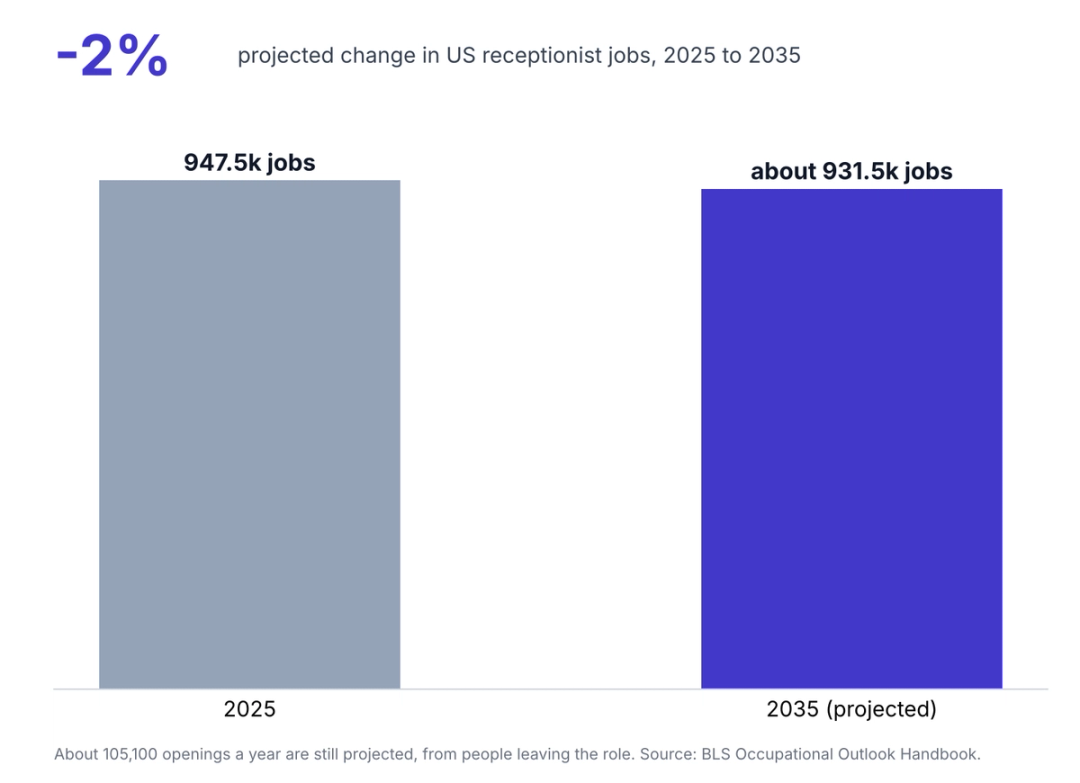
The national numbers give a measured answer. The Bureau of Labor Statistics counted 947,500 receptionist jobs in 2025 and projects employment to decline 2 percent over the following decade, citing software and other technology that lets organizations interact with the public, while still expecting about 105,100 openings each year as people leave the role. That is a job getting smaller and different, not one about to vanish.
A PI firm's receptionist, though, isn't an average receptionist. Most of the job happens on the phone, with new callers, existing clients asking about their case, providers chasing records, and adjusters trying to reach a case manager, and the phone is exactly where AI has moved fastest. A hotel front desk or a medical office will feel the change differently from a plaintiff firm whose main line rings all day.
So the useful version of "will AI replace receptionists" is narrower: which parts of the job will AI take, which parts will stay with a person, and what does the role look like once that split settles? The answer comes into focus once the job is broken into the tasks that actually fill a receptionist's day.
What a PI firm receptionist does all day
The job title covers eight distinct tasks, and asked task by task, will AI replace receptionists get a different answer for each one? In short, AI takes the high-volume phone work that follows a procedure, and people keep the in-person work and the calls that need judgment.
| Receptionist task | What AI handles today | What stays with a person |
|---|---|---|
| Answering and greeting calls | Simultaneous calls, day and night | Callers who ask for a person |
| Identifying and routing callers | Caller ID matched to the case file, routing on case data | Calls where the right person isn't obvious |
| Status questions | Answers from the case file and logs the call | Anything that needs an opinion on the case |
| Screening new callers | Intake questions against the firm's criteria | Hesitant callers and the signing conversation |
| Scheduling and callbacks | Books slots and schedules callbacks within set rules | Rescheduling that needs negotiation |
| Messages and call logging | A note, summary, and transcript in the matter | Reviewing escalations and follow-up |
| Upset or grieving callers | Recognizes distress and hands off | The conversation itself |
| Front desk duties | Nothing | Visitors, deliveries, documents, and the office |
The reasons behind each row start with the most basic task on the list.
Answering and greeting every call
The first task is picking up, and it is the one a single person can't always do. When two lines ring at once, or the receptionist is helping a walk-in client, the second caller waits or reaches voicemail, and as per our estimate, PI firms miss 35 to 50 percent of inbound calls during business hours alone.
AI voice agents answer every call at once, at any hour, including nights, weekends, and the minutes when the receptionist steps away. This is the task AI has already taken over most completely, and for a plaintiff firm it is the one with the clearest link to the hidden cost of missed calls.
The gap is widest after hours, when no receptionist is on shift and new callers decide in minutes whether to try another firm. Our comparison of after-hours intake options for PI firms covers how AI and answering services handle those calls.
Identifying callers and routing them
A good receptionist knows who's calling before they finish their name: a client of Maria's, the records clerk from the orthopedic group, and the adjuster on the rear-end case. That knowledge takes years to build and walks out the door when the receptionist leaves.
An AI voice agent gets it from the case file instead. It matches the caller ID to the matter, knows which case manager is assigned and what stage the case is in, and routes the call to the right person with a live check that they're free, scheduling a callback if they aren't.
Answering status questions
Existing clients call far more often than new leads, and most want to know where their case stands. Receptionists usually can't answer, so they take a message for the case manager, who calls back later, and the client often calls again in between.
AI changes this task more than any other, because the answer usually sits in the case file: the current stage, the last action taken and the next expected step. An agent can read that back and log the call, and anything that needs an opinion about the case goes to a person.
Screening new callers
New callers need the firm's intake questions asked quickly, because they are often calling other firms too. AI intake screens callers against the firm's criteria at any hour and writes the lead to the intake system, while the conversation that signs a hesitant client stays with an intake specialist.
Scheduling consultations and callbacks
Receptionists spend part of each day booking consultations, rescheduling appointments, and promising callbacks. AI agents can book a slot or schedule a callback when the firm's calendar and routing rules allow it, and the reschedule that involves a nervous client or a conflicted attorney calendar still benefits from a person who can negotiate it.
Taking messages and logging calls
Much of a receptionist's day disappears into notes: the message slip, the email to the case manager, and the entry in the case management system that may or may not get made. That record is what tells the firm later whether a client was kept informed.
An AI agent writes every call to the matter automatically, with a summary and transcript, which is why CMS write-back matters as much as answering. The message-taking part of the receptionist's job is the part most likely to disappear entirely.
Calming upset and grieving callers
Plaintiff firms take calls from people who were just in a crash, who lost a family member, or who are frustrated that their case has gone quiet. A skilled receptionist hears that in the first sentence and slows down.
AI agents can recognize distress and pass the call to a person, and that hand-off is exactly what they should do. Comfort, patience, and the judgment about when to bring in an attorney stay human.
Running the front desk
The physical office still needs someone. Walk-in clients, couriers, deliveries, document drop-offs, conference room setup, and the person who arrives an hour early for a deposition all need a human at the desk, and no phone agent replaces that.
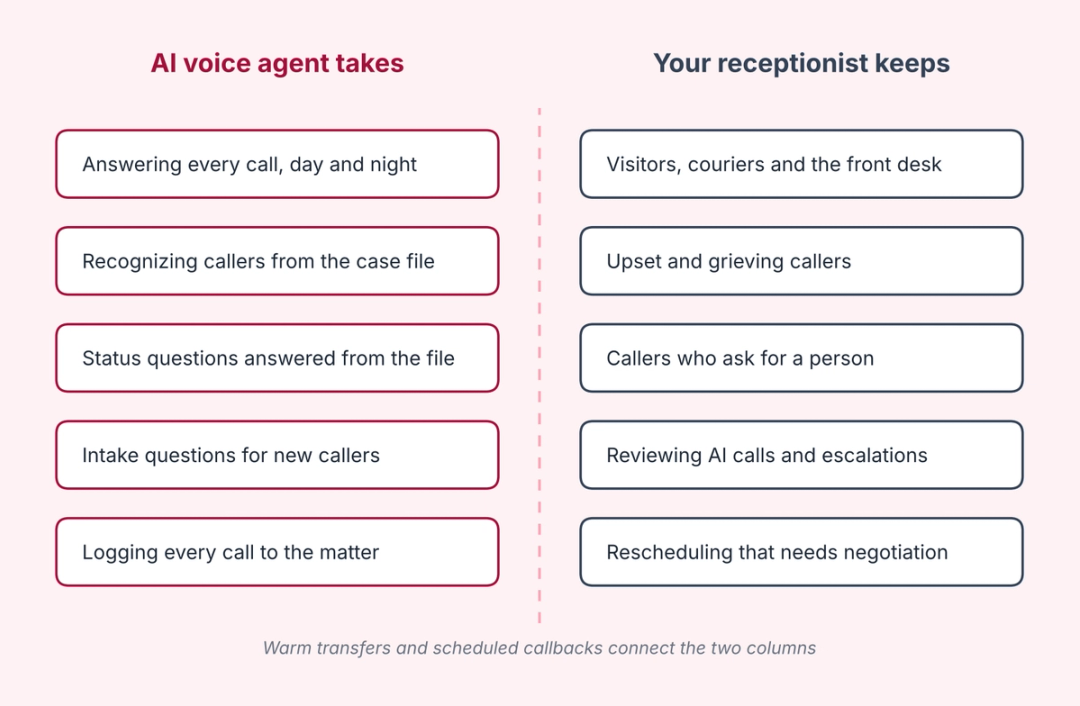
That split explains why the job data shows a slow decline rather than a collapse, and it is worth looking at those numbers more closely.
What the job numbers say about receptionist roles
The Bureau of Labor Statistics projects receptionist employment to fall from 947,500 jobs in 2025 by about 16,000 over the decade, a decline of 2 percent. It attributes the decline to organizations using software, websites, and other technology to interact with the public and still expects about 105,100 openings each year from people leaving the role.
Those openings say as much as the decline. About 105,100 openings a year against 947,500 jobs means roughly one position in nine turns over annually, so firms rehire and retrain receptionists often, and the knowledge of who calls and why leaves with each departure. Nationally, the data answers will be AI replacing receptionists with a slow decline in headcount and a steady change in what the job involves.
Law firms are earlier in the curve than the national figure suggests. In the ABA's 2024 Legal Technology Survey, 30 percent of lawyers said they were using AI, and the most cited barrier was accuracy, with three-quarters of hesitant respondents pointing to concerns about AI hallucinations.
For phone work, that accuracy concern is easier to test than in legal research, because every AI call leaves a transcript and a note in the case file. The pace of change at any one firm will depend less on national trends than on how its own receptionist role is built, which is where the real change shows up.
How the receptionist role changes at a PI firm
For the receptionist asking if AI will replace receptionists like them, the honest answer at a PI firm is that the phone part of the job shrinks while the rest grows. Once AI takes the phone volume, the receptionist who stays has a different job. Instead of answering every ring, they handle the calls the agent passes on, which are, by design, the calls that need a person: upset clients, unclear requests, and callers who ask for someone by name.
The role also picks up work that rarely got done before. Someone has to read a sample of AI call transcripts each week, notice when the agent passed on a call it should have handled or kept one it should have passed on, and suggest changes to the firm's scripts and escalation rules.
Client experience is the third piece. With routine calls answered instantly, the receptionist can spend time on the visitors in the lobby, the client who needs help with a document, and the follow-up calls that make a firm feel attentive, which is often a better use of an experienced receptionist than answering status questions. Getting there starts with an honest conversation with the receptionist.
Hear an AI agent handle the calls your front desk takes
Watch HelloCounsel answer an existing client, recognize them from the case file, answer a status question, and pass an upset caller to staff with the context attached. Book a front desk call demo
How to talk to your receptionist about AI
The conversation goes better when it happens before the tools arrive. A receptionist who hears about AI from a vendor demo in the conference room will assume the worst, while one who hears it from the managing partner with a plan for their role can help shape it.
Be specific about what changes. Name the tasks moving to the agent, such as after-hours calls, status questions, and message logging, and name the tasks staying, such as the front desk, escalations, and callers who ask for a person. Then describe the new parts of the role, including reviewing AI call transcripts and owning the escalation list.
Involve them in the setup. An experienced receptionist knows which callers need gentle handling, which providers call every Tuesday and which questions clients ask most, and that knowledge makes the agent's scripts better from the first week. Once the team knows its part, the practical adjustments are easier to plan.
What PI firms should expect in the first months
Moving phone work to AI agents brings a few predictable adjustments in the first months, and planning for them keeps the change smooth:
- Clients notice faster answers first: Calls stop going to voicemail, and status questions get answered on the first call.
- Escalations need an owner: Someone has to take the calls the agent passes on promptly, or the callback promise breaks.
- Scripts improve week by week: Early transcript reviews show where the agent's instructions need adjusting.
- Reporting gets clearer: Every call is logged, so the firm sees volumes by caller type and unanswered callers for the first time.
- Clients should hear about it: A line in the engagement letter and an agent that identifies itself at the start of each call settle the question of disclosure.
The ABA's Formal Opinion 512 places responsibility for AI tools with the lawyers who supervise them, so a supervising attorney should approve what the agent may say. Those expectations also point to the main risk, which is removing people too quickly.
The risks of replacing a receptionist entirely
Firms that hear will AI replace receptionists as a question about cutting the role take on the most risk. Removing the role altogether leaves gaps the phone agent can't fill. Nobody greets the client who walks in after a crash, nobody signs for the overnight package of medical records, and the firm's first in-person impression becomes an empty desk.
It also leaves the hand-offs without a home. An agent that passes an upset caller to "a team member" needs a team member to receive that call, and a firm that has quietly moved that duty to busy case managers has shifted the problem rather than solved it.
Generic tools add a third risk. A receptionist product built for any business won't know case phases, providers, or adjusters, which is why a generic AI receptionist won't work for a PI firm without the case context a plaintiff firm's calls depend on. Cost is the other factor firms weigh, and it looks different once the front desk is counted separately from the phones.
What AI phone coverage costs compared with a staffed front desk
A staffed receptionist covers the hours they work. At the May 2025 median wage of $38,010 a year from the BLS, one receptionist costs that much in wages before benefits and payroll taxes and covers roughly a quarter of the week's 168 hours, with nights, weekends, lunches, and sick days going to voicemail or a backup.
AI voice agents price differently. HelloCounsel's receptionist is priced at a quarter of the cost of virtual receptionists, and our breakdown of AI receptionist pricing compares the main models side by side.
For a PI firm the comparison usually isn't one or the other, since the front desk still needs a person. The real calculation is the cost of covering every call with AI against the cost of the calls a single receptionist can't reach, which is why AI will replace receptionists. becomes a question about coverage as much as headcount. Coverage is also the part of the job HelloCounsel was built for.
How HelloCounsel handles a PI firm receptionist's phone work
HelloCounsel builds AI voice agents for plaintiff personal injury firms, built around the phone tasks above.
HelloCounsel's AI receptionist takes on that phone work. It answers in under two rings, after hours, on holidays and during overflow, recognizes callers from the case file before answering, and routes calls on case data with a live check that the right person is free.
Every call is written into the case file as a note the whole team can see in case management systems such as Filevine, Litify, SmartAdvocate, CASEpeer, and MyCase. New callers go through AI intake against your criteria, in English or Spanish, and calls that need a person reach staff by warm transfer or a scheduled callback.
Firms using HelloCounsel have seen a 48% improvement in call reception, and the HelloCounsel dashboard shows call volume by caller type, transfer rates, and clients who haven't been reached, which gives the receptionist a clear view of the hand-offs waiting for them. That leaves each firm with one practical decision about how to divide the work. Your receptionist keeps the front desk, the hand-offs, and the callers who need a person, which leaves one practical question for every firm considering the change.
Decide which receptionist tasks to move first
The answer to whether AI will replace receptionists for a PI firm is that AI will replace most of the phone tasks and very little of the person. The decision a firm actually faces is which tasks to move first and who takes the work that remains.
Start with a list of what your receptionist does in a typical week and roughly how many hours each task takes. Move the phone tasks that follow a procedure, keep the front desk and escalations with a person, and give the receptionist a defined role in reviewing AI calls, so the change adds capacity instead of removing the person clients already know. Revisit the split after the first month, since transcript reviews and escalation volumes will show whether more tasks can move or some should come back.
For firms comparing options for the phone work itself, our breakdown of AI and live answering services sets out the trade-offs.
The cost of a virtual receptionist is the other useful benchmark, since it shows what outsourcing the same phone tasks to people costs before comparing it with an AI agent.
Map your receptionist's week with HelloCounsel's founders
Bring a list of your front desk's daily tasks and call volume, and see which calls an AI voice agent would take and which stay with your receptionist. Book a call with the founders to review your front desk
Frequently asked questions about AI and law firm receptionists
1. Will AI replace receptionists at law firms?
AI is replacing much of the phone work, including answering, caller identification, status questions and call logging. The front desk, upset callers and judgment calls stay with people, so at a PI firm the role is shrinking and changing rather than disappearing.
2. What does the job data say about receptionists and AI?
The US Bureau of Labor Statistics projects national receptionist employment to decline 2 percent from 2025 to 2035, citing technology that lets organizations interact with the public, while still expecting about 105,100 openings each year as people leave the role.
3. Which receptionist tasks can AI handle at a PI firm?
AI voice agents can answer every call, recognize callers from the case file, answer status questions, screen new callers against intake criteria, route calls to the right case manager, and write each call to the matter in the case management system.
4. Should clients be told when an AI agent answers the phone?
Disclosure rules vary, and ABA Formal Opinion 512 ties disclosure of AI use to the circumstances. A clear approach is to mention AI agents in the engagement letter and have the agent identify itself at the start of each call.
5. What happens to the receptionist when AI handles the phones?
The role shifts toward the calls the agent passes on, in-person visitors, client experience, owning the escalation list, and reviewing a sample of AI call transcripts to improve scripts and escalation rules. The front desk itself still needs a person.
6. How does HelloCounsel work alongside a law firm receptionist?
HelloCounsel's AI receptionist answers calls in under two rings, recognizes callers from the case file, and writes every call to the matter. Calls that need a person reach your receptionist or case manager by warm transfer or a scheduled callback.
Share this article