Does Your Law Firm Need an Answering Service? 7 Signs It's Time

- A law firm needs an answering service; when calls are unanswered, whether during business hours, after hours, or when staff are out.
- Seven signs point to the need: business-hours voicemail, unanswered after-hours callers, case managers buried in calls, slow callbacks, marketing spend that doesn't produce signed cases, coverage that breaks with one absence, and Spanish-speaking callers waiting on one employee.
- Each sign can be checked against data the firm already has, such as phone system reports, intake records, and a one-week tally of case manager calls.
- A message-taking service closes coverage gaps but leaves callbacks with the firm, while an AI voice agent connected to the case file can also answer existing clients' status questions.
- Before signing, confirm how the provider protects client information, where call records land, and how urgent calls are escalated, since Model Rule 5.3 requires reasonable efforts to supervise outside services.
The question rarely shows up on its own. It arrives inside something else: a one-star review saying the firm never called back, a referring chiropractor mentioning that their patient hired a firm across town, or a receptionist's two weeks' notice landing in the same month as a new TV campaign.
Each of those moments points at the phones, though each points at a different part of them. The review is about callbacks, the lost referral is about who answered first, and the resignation is about how thin coverage was to begin with. A partner asking, "Does my law firm need an answering service?" is often asking three or four questions at once.
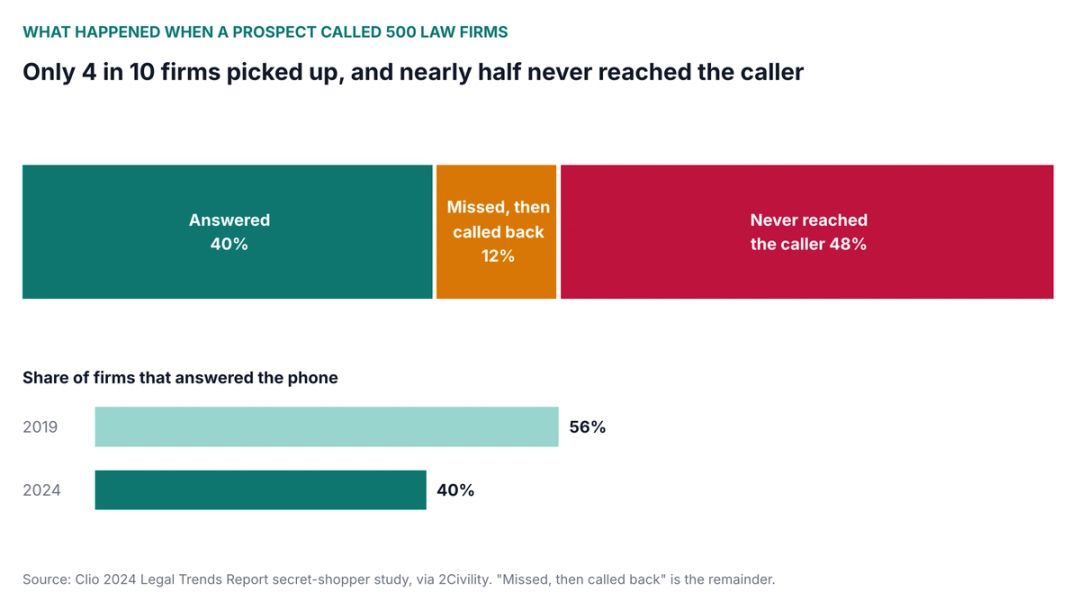
The stakes on those calls run high for a plaintiff firm. An injured caller usually has several firms' numbers from a search, a billboard, or a friend, and the first firm that answers and takes the details has a strong head start. In the 2024 Clio Legal Trends Report secret-shopper study of 500 U.S. firms, only 40% answered the phone, down from 56% in 2019.
Existing clients call too, and far more often than new ones. As per our estimate, a typical PI case generates about 150 calls over its life, and a case manager carrying 100 cases fields roughly 15,000 calls a year, of which only a few hundred are new-case intake. When the phones fall behind, those status calls fill the case manager's afternoon and feed the "nobody calls me back" complaint.
That split is why the answer depends on which calls are being missed and who is missing them. A firm that loses new-case calls at night needs different coverage from a firm whose case managers can't get through an afternoon without a run of status calls, even though both would describe the trouble as "the phones."
Getting it wrong is expensive in both directions. A firm that buys message-taking coverage for a status-call problem ends up with a tidier voicemail queue and the same overloaded case managers, while a firm that hires another receptionist for a night and weekend problem pays a full salary for hours when the calls aren't coming in.
What does an answering service do for a law firm?
Part of answering "does my law firm need an answering service?" is knowing what one does. An answering service picks up the firm's calls when staff can't, either around the clock or during set windows such as evenings, overflow periods, and absences. What happens after the pickup varies widely by provider, and that difference decides whether the service fixes the firm's actual problem.
Law firms generally choose among three kinds of coverage:
- Message-taking service: A live operator answers in the firm's name, takes the caller's name, number, and reason for calling, and sends the message to the firm by email, text, or portal.
- Legal intake service: Operators trained on the firm's intake script collect case details from new callers, screen them against the firm's criteria, and may book consultations or send retainer agreements.
- AI voice agent: Software answers every call at once and runs intake questions, and when it connects to the case management system, it can recognize existing clients and answer their status questions from the case file.
The first two cover the moment of the call. Whether they also reduce work for the team depends on what lands on the firm's side afterwards, since a message still needs someone to call back and a call summary still needs someone to enter it in the file.
Notes that live in an email inbox instead of the case file create a documentation problem of their own.
For a side-by-side on hours, accuracy and cost between operators and software, see our comparison of AI and live answering services for law firms.
7 signs your law firm needs an answering service
Any one of these signs can justify coverage, and they often show up together because they share a cause: too few people answering too many calls. The table lists each sign with the check that confirms it and where the data lives.
| Sign | What to check | Where to find it |
|---|---|---|
| Business-hours calls go to voicemail | Missed and abandoned calls by hour of day | Phone system call report |
| After-hours callers get no live answer | Calls received outside office hours and how many became leads | Phone system report, intake system |
| Case managers spend the day on the phone | Calls each case manager takes in a week, by type | One-week tally by each case manager |
| Callbacks wait until the next day | Time from voicemail or message to return call | Phone system, case notes |
| Marketing spend rises but signed cases don't | Calls to tracking numbers compared with leads logged | Call tracking platform, intake system |
| One absence breaks phone coverage | Who answers when the receptionist is out, and what happens to calls | Staff schedule, phone routing settings |
| Spanish-speaking callers wait on one person | Spanish-language calls and how long each waits for a response | Phone system, intake notes |
Pull two ordinary weeks of data, avoiding holiday weeks or the week after a big verdict, so the numbers reflect normal traffic. Two weeks of real figures show if your law firm needs an answering service more clearly than any sales conversation.
Business-hours calls go to voicemail
The calls most often missed aren't the ones at midnight. They cluster in the hours when the office is open but stretched: the first hour of the morning, lunch, and late afternoon when clients call after their own workday ends. As per our estimate, PI firms miss 35% to 50% of calls during business hours.
Cloud phone platforms such as RingCentral and Zoom Phone can report missed and abandoned calls by hour. Look at abandoned calls separately from voicemails, since a caller who hangs up before the greeting finishes leaves nothing to return.
Then lay the missed-call peaks over the staff schedule. If the gaps line up with lunch breaks, team meetings, or the receptionist covering another desk, the firm has a capacity problem at specific hours, which is the situation overflow coverage is built for.
After-hours callers get no live answer
Car accidents don't keep office hours. A crash on a Friday evening produces a caller who wants a lawyer that night, and a firm whose phones go to voicemail until Monday has given every other firm on the caller's list two and a half days to answer first.
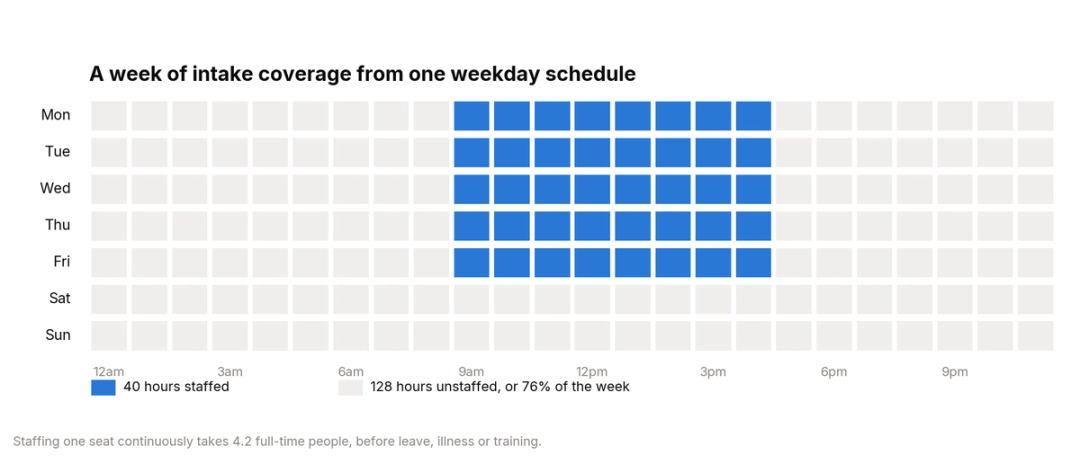
The schedule math is stark. A desk staffed from 9 to 5 on weekdays covers 40 of the 168 hours in a week, about 24%, before subtracting lunch breaks and sick days.
To size the gap, count calls received after hours and on weekends for two weeks, then check how many of those callers show up as leads in the intake system. For the trade-offs specific to night and weekend coverage, see our comparison of after-hours intake options for PI firms.
Case managers spend the day on the phone
This sign rarely gets described as a phone problem. It sounds like "case managers are behind on demand letters" or "records requests keep slipping," though the cause is often a steady stream of calls asking questions the case file already answers: Has the adjuster called?Did the records come in? When will the check arrive?
As per our estimate, case managers at a PI firm spend 50+ hours a week on routine calls. Every one of those hours is time not spent on demands, negotiations, and the records chase that moves a case toward settlement.
The check is a one-week tally. Ask each case manager to mark every call by type (status question, document request, new information, complaint) so the share of calls that only needed an answer from the file becomes visible, and our guide to reducing case manager workload covers what to do with the results.
A message-taking service relieves little of this load, because the caller still needs an answer that only the case file holds. Coverage that can read the case file and answer from it is what takes these calls off the case manager's desk.
Callbacks wait until the next day
A voicemail returned the next morning is a missed call with a delay. Comment 4 to Model Rule 1.4, shown here in New Hampshire's version, says a lawyer should promptly respond to or acknowledge client communications, and when a prompt answer isn't feasible, the lawyer or staff should acknowledge receipt and say when a response can be expected.
The Clio secret-shopper results show how callbacks shape a first impression. Among the 500 firms tested, 48% neither answered nor returned the call, and prospects who received only voicemail follow-ups were nearly eight times less likely to recommend the firm than those who reached someone by phone.
Measure the gap from message to return call for a sample of 30 or 40 messages. If the median runs past the end of the same business day, callers are waiting longer than many will tolerate, and some are dialing another firm in the meantime.
Marketing spend rises, but signed cases don't
TV, billboards, search ads, and lead vendors produce calls in bursts, often within minutes of an ad airing. An intake team that handles a normal Tuesday comfortably can't absorb a sudden burst, and the overflow goes to voicemail at the exact moment the firm paid the most to make the phone ring.
Compare calls to your tracking numbers against leads logged in the intake system over the same period. A wide gap between the two, especially on days a campaign ran, means paid calls are being lost before anyone records them, and our breakdown of the hidden cost of missed calls shows how to put a dollar figure on it.
One absence breaks phone coverage
A firm with one receptionist and a backup who has a full job of their own has no real plan for sick days, vacations, or a resignation. The first day the receptionist is out, calls either ring through to whoever is nearest or roll to voicemail.
Turnover in the role is a fact of the labor market. The Bureau of Labor Statistics projects about 105,100 openings for receptionists each year through 2035, most of them to replace workers who move to other occupations or leave the labor force.
The check here is a question rather than a report. Ask who answered the phones the last time the receptionist was out for a full day, and how many calls went to voicemail; if no one can say, the firm has no backup plan for its phones.
Spanish-speaking callers wait on one person
For firms serving Spanish-speaking communities, one bilingual employee often becomes the de facto Spanish line. When that person is on another call, at lunch or out for the day, Spanish-speaking callers leave a message, struggle through in English, or hang up.
Count Spanish-language calls for two weeks along with how long each caller waited for a Spanish-speaking response. Then compare the intake notes for those callers with notes for English-speaking callers, since a rushed or interpreted intake can miss details such as a second vehicle or a prior injury.
Coverage that handles both languages, including a caller who switches partway through, removes the bottleneck instead of shifting it to a different employee.
Which kind of coverage fits the signs you found?
The seven signs split into two groups. Some are about calls going unanswered, and others are about calls that get answered but need information from the case file, and the right coverage depends on which group dominates.
| Coverage option | Signs it addresses | What stays with your team |
|---|---|---|
| Message-taking answering service | Business-hours voicemail, after-hours calls, absences | Callbacks, intake and entering notes into the case file |
| Legal intake answering service | After-hours calls, marketing bursts, absences and new-case intake | Existing-client calls and case file updates unless integrated |
| AI voice agent connected to the case file | All seven, when it reads case data and supports Spanish | Attorney decisions, sensitive conversations and escalations |
| Another in-house hire | Business-hours voicemail, plus absences of other staff | Nights, weekends, marketing bursts and the hire's own absences |
A firm whose signs are mostly about unanswered calls (voicemail during the day, nothing at night, gaps during absences) can be well served by a message-taking or intake service. A firm whose case managers are buried in status calls and slow callbacks needs coverage connected to the case management system, because only that kind of coverage can answer the question the caller is asking.
Price follows the same split. Answering services commonly bill per minute or per call, AI voice agents are often priced on call volume or completed tasks, and our guide to legal answering service cost lays out typical ranges for each model.
A new hire carries a different cost structure. The BLS puts the median receptionist wage at $38,010 a year as of May 2025, before benefits and payroll taxes, for coverage of roughly one shift on weekdays.
What to confirm before signing with an answering service
An answering service speaks for the firm and handles confidential information, so the ethics rules treat it as nonlawyer assistance the firm must supervise. Comment 3 to Model Rule 5.3 says lawyers using outside services must make reasonable efforts to ensure the services are compatible with their professional obligations, weighing factors such as the provider's experience and reputation and the terms protecting client information.
In practice, that means getting clear answers on six points before routing calls to a provider:
- Confidentiality terms: How the provider stores call recordings and transcripts, who can access them and whether its contract terms match your duties under Model Rule 1.6.
- Where call records land: Whether call summaries are written into your case management or intake system, or arrive as emails someone has to copy over.
- Existing-client handling: Whether the service can tell a current client from a new caller and what it does with a status question.
- Urgent-call escalation: How a caller who needs an attorney right away gets transferred, and what happens when nobody picks up the transfer.
- Language coverage: Whether Spanish is available on every shift or only during certain hours.
- Billing unit: Per minute, per call or per task, and how a marketing burst or a long intake call changes the invoice.
Our guide on how to choose a phone answering service as a law firm goes deeper on scripts, trial periods and contract terms.
If you're already comparing vendors, our list of the best legal answering services for PI firms covers specific providers and what each does well.
When an answering service won't solve the problem
Sometimes the phones get answered and cases are still lost, and a firm in that position may not need an answering service at all. If calls reach a person but leads sit in the intake system for a day before anyone follows up, the gap is in the follow-up process, and more answering capacity only adds leads to the same stalled queue.
Unclear intake criteria cause a similar problem. A service that takes careful messages from callers the firm would never sign adds callbacks without adding cases, so the criteria need fixing before the coverage does.
The check for both is to trace ten recent lost leads from the first call to the point where each one dropped off. If most of them were answered and then went quiet, the fix lies in intake follow-up rather than phone coverage.
Low volume is the other exception. For a solo practitioner taking a handful of calls a day, with a dependable voicemail habit and same-day callbacks, the honest answer to "does my law firm need an answering service?" may be "not yet," although the after-hours sign still applies to any firm taking injury cases.
How HelloCounsel covers the calls behind these signs
HelloCounsel builds AI voice agents for plaintiff personal injury firms, covering intake, existing-client calls and provider follow-up.
The AI receptionist answers in under two rings, day or night, and matches the caller ID to the case file, so an existing client is recognized before they explain who they are.
When a client asks about their case, the agent answers from case data. When the call needs a person, it checks live availability and makes a warm transfer or schedules a callback, and every call is written to the case file as a note, so the case manager sees what was asked and answered without a separate message to process.
For new callers, HelloCounsel's intake agent runs your intake questions in English or Spanish, including callers who switch languages mid-call, and writes the lead to intake systems such as LeadDocket and Lawmatics. Case management integrations include Filevine, Litify, SmartAdvocate, CASEpeer and MyCase, alongside phone systems such as RingCentral and Zoom.
Across 30,000+ calls handled, firms using HelloCounsel have seen these results:
- A 48% improvement in call reception
- 2x more frequent client check-ins
- 15 days cut from medical records turnaround
HelloCounsel costs about a quarter of what virtual receptionists charge, with custom pricing based on call and case volume rather than seats, so you pay for tasks completed. Most firms go live in under two weeks, and the dashboard shows call volume by caller type, transfer rates and clients not yet reached, which gives the firm the call data behind each of the seven signs.
Hear HelloCounsel answer a client's status call from the case file Watch an AI voice agent pick up a call from an existing client, answer from case data and write the note to the file, then take a new caller through intake in English or Spanish. Book a status call demo
Call your own front desk
A missed call leaves no complaint and no file, only a caller who signed with someone else. That's why the cost of thin phone coverage stays hidden until someone counts, and why the counting is worth doing before any vendor conversation.
The counting doesn't take long. Two weeks of missed-call reports, a week of case manager tallies and a comparison of tracking-number calls with logged leads will answer "does my law firm need an answering service?" with figures instead of impressions, and the coverage table shows what each pattern calls for.
One last test costs nothing. Call the firm's main number yourself at 12:30 p.m., at 5:45 p.m. and at 8 p.m. on a weekday, and listen to what happens on each call, because that is exactly what a new client hears.
Go through your missed-call report with HelloCounsel's founders Bring two weeks of call data from your phone system and see which of the seven signs apply to your firm and which calls an AI voice agent would answer. Book a call with the founders to review your call data
Frequently asked questions
1. How do I know if my law firm is missing calls?
Pull your phone system's missed and abandoned call reports for two ordinary weeks and sort them by hour. Cloud platforms such as RingCentral and Zoom Phone include these reports. Compare the peaks with staff schedules to see when calls go unanswered and why.
2. Does my law firm need an answering service if we already have a receptionist?
Often, yes. One receptionist covers about 40 of the week's 168 hours and can take only one call at a time. An answering service or AI voice agent covers overflow, lunch, absences, evenings and weekends while the receptionist handles the in-office work.
3. Is an answering service worth it for a small law firm?
It depends on call volume and case value. A small firm taking injury cases loses the most on after-hours and overflow calls, and one signed case can outweigh months of coverage. Compare missed calls against your average fee to estimate the likely return.
4. Can an answering service handle calls from existing clients?
A message-taking service can take the message, though a case manager still has to call back with the answer. An AI voice agent connected to the case management system can recognize the client by caller ID and answer routine status questions from the case file.
5. Do legal ethics rules allow law firms to use an answering service?
Yes. Model Rule 5.3 allows lawyers to use outside services if they make reasonable efforts to ensure the provider's work is compatible with their professional duties, including confidentiality. Review the provider's data handling and contract terms before routing any client calls to it.
6. How quickly can a law firm start using an answering service?
Message-taking services can often start within days once the script and call forwarding are set. Setups that run intake or connect to case management take longer because of integration and testing. With HelloCounsel, most firms go live in under two weeks.
Share this article