Outsource Legal Intake vs In-House Legal Intake for Law Firms

- An in-house intake seat costs about $79,400 a year at the median once benefits are counted, which is roughly $6,600 a month before a single call is answered.
- Staffing one seat continuously takes 4.2 full-time people, since a week holds 168 hours and no single schedule covers more than 40.
- The outsource legal intake vs in-house legal intake decision turns on control, and control means observability more than it means management authority.
- Both models carry the same ethical duties, since ABA Opinion 08-451 leaves supervision, confidentiality and conflict screening with the firm regardless of who answers.
- Most firms that run the numbers land on a split rather than a side, keeping judgment calls in-house and moving coverage out.
An in-house intake team costs a firm salaries, benefits, payroll tax and desk space, spread across several budget lines. An outsourced intake service costs one invoice line. Firms comparing the two usually set the invoice against the salaries alone, which is not the same basis and consistently flatters the in-house option.
Costed properly, the picture is less even than it looks. Outsourcing is cheaper at most volumes once benefits are counted, and it is the only one of the two that covers nights and weekends without multiplying headcount. In-house holds one real advantage, which is direct authority over who gets signed and why.
So the outsourced legal intake vs. in-house legal intake decision comes down to how much of that authority a firm actually exercises and what it is worth against the coverage being given up to hold it.
What an in-house intake seat costs once benefits are counted
The Bureau of Labor Statistics puts the median annual wage for legal secretaries and administrative assistants at $55,570 as of May 2025, which is the closest published occupation to a dedicated intake role.
Wages are not the cost. The BLS Employer Costs for Employee Compensation release for June 2026 puts benefits at 30.0% of total compensation for private industry workers, with wages and salaries making up the other 70.0%. Dividing the median wage by 0.70 gives a fully loaded figure of roughly $79,400 a year, or about $6,600 a month.
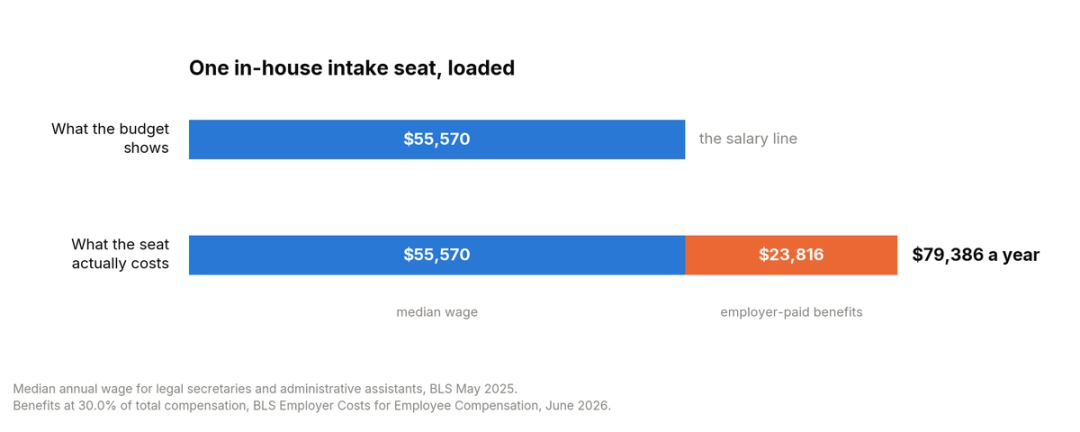
That figure covers one person, working one schedule, taking paid leave and occasionally being ill. It excludes recruitment, the training period before the seat is productive, software licences and the floor space. It also assumes the seat stays filled, which the BLS quits rate of 1.9% a month across private industry in August 2026 suggests is not a safe assumption over a multi-year horizon.
None of this makes in-house intake a bad decision. It makes the comparison honest, which a $6,600 monthly cost set against a $2,000 invoice is not, since the difference between them is not $4,600 of savings.
Why continuous coverage takes 4.2 people rather than one
The cost of one seat matters less than the number of seats coverage requires. A week contains 168 hours and a full-time schedule covers 40 of them.
Staffing a single position around the clock therefore takes 4.2 people before anyone takes a holiday.
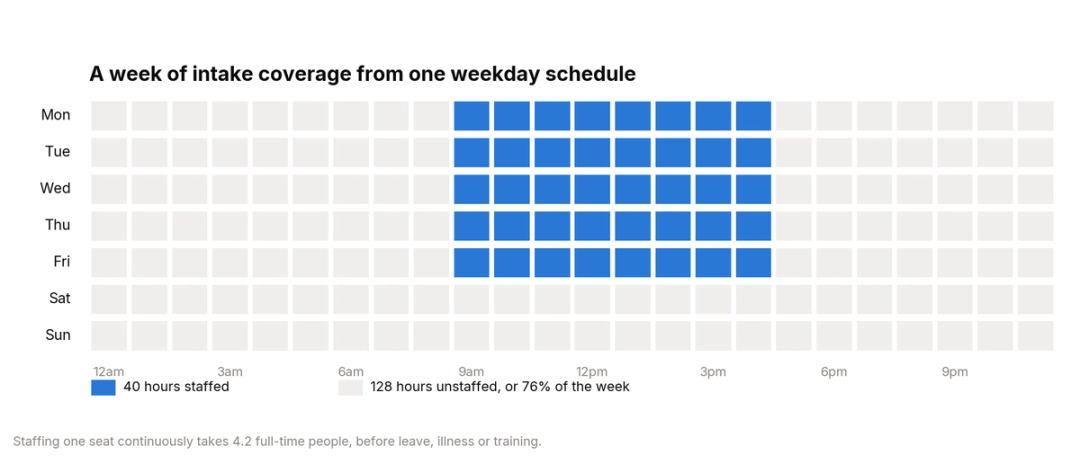
At the fully loaded figure above, that comes to roughly $333,000 a year for one continuously staffed intake position. For most plaintiff firms the number is theoretical, which is precisely the point, because nobody staffs it.
The standard weekday schedule leaves 76% of the week uncovered, and that share includes every evening and both weekend days. How many calls a PI case generates sets out what arrives in those hours.
Whether that matters depends on when your claimants call. A firm whose new-claimant calls cluster between 10am and 4pm loses little.
A firm receiving a third of them after 6pm is choosing, by default, to answer two-thirds of its opportunities. Our breakdown of the hidden cost of missed calls puts numbers against that share.
Outsourcing changes the arithmetic because the coverage is already staffed and shared. You are buying a slice of a schedule somebody else built, which is the structural reason the invoice comes in below the payroll cost rather than a claim about efficiency.
Where the two models actually differ on control
Control is the word that decides this in most partners' meetings, and it carries two different meanings that pull in opposite directions.
In-house control is managerial. You write the script, you hire the person, you can walk to their desk and change how a call is handled that afternoon. That is real and it has no direct equivalent with a vendor.
What in-house control is not, at most firms, is observable. Very few firms record intake calls, fewer review them systematically, and almost none can produce a transcript of how a specific caller was qualified six weeks after the fact. Authority over the process is not the same as evidence of it.
A good outsourced arrangement inverts this. You lose the ability to change something at 2pm and gain a recording, a transcript, and a logged outcome for every call, which is evidence you can audit. A poor outsourced arrangement gives up the authority and returns nothing but a message, which is the worst of both.
The practical question is therefore which kind of control your firm actually uses. A firm that already reviews intake calls weekly gives up something real by outsourcing.
A firm that has never listened to one is trading authority it does not exercise for evidence it does not currently have. Structured call records are what make that trade visible.
Audit what your intake control is worth
Pick five signed cases and five declined ones from last month and try to reconstruct why each decision was made. If you cannot, the control you are protecting is authority rather than oversight. Book a demo
What the ethics rules ask of both models
Neither model changes the firm's obligations.
ABA Formal Opinion 506, issued in June 2023, sets out what a trained non-lawyer may do during intake. They may gather initial information, run the conflict check, confirm the matter fits the firm's practice areas, explain how fees and costs are charged, and obtain the prospective client's signature on the fee agreement. Questions requiring legal judgment have to reach a lawyer, and the prospect must be able to raise the fee agreement and the scope of representation with one before signing.
That list applies identically to an employee and to a vendor. The permissions do not widen because the person sits in your office.
Opinion 08-451 adds what changes when the work moves outside. A lawyer outsourcing legal or non-legal support services stays responsible for competent representation, and supervision, confidentiality and conflict screening travel with the firm rather than the vendor.
The vendor needs its own conflict screening, so it is not running intake for both sides of the same collision. And because plaintiff intake collects treatment detail within the first two minutes, HHS guidance requires a signed business associate agreement with the vendor before protected health information reaches it.
How each model moves the conversion number
Conversion is where the two models separate for reasons that have nothing to do with who is better at the job.
An in-house team converts well on the calls it takes. It knows the firm's criteria, it can walk a borderline case to an attorney in the next room, and it carries context a script cannot hold.
On the calls it takes, in-house usually wins. The gap opens on the calls it never receives, which is where firms lose cases before they sign them.
The calls it does not take are the issue. A claimant who reaches voicemail at 7pm has not been converted badly, they have not been converted at all, and they are typically calling more than one firm that evening. Coverage sets the ceiling that qualification then works inside.
This is why firms adding intake headcount sometimes see a flat sign rate. The new person works the same hours as the existing ones, so the contact rate does not move, and the conversion problem was never in the qualification step. Our guide to choosing a legal intake service covers how to tell those two failures apart before spending on either.
When each model is the right answer
In-house intake is the better answer when the qualification decision is genuinely difficult and genuinely valuable. Firms running complex liability screens, high-value single-event work, or mass tort criteria that shift week to week are making judgment calls that benefit from proximity to the attorneys making them.
It is also the right answer when volume is low enough that a seat is not sitting idle, and when the firm already treats intake as a supervised discipline with review built in. The vendors serving the alternative are covered in our roundup of legal intake companies.
Outsourcing suits the opposite conditions: the constraint is coverage rather than judgment, call volume swings with marketing spend, and the criteria are stable enough to be written down. It is also the practical answer for the hours no firm staffs, which is most of the week.
The case for outsourcing weakens where the criteria cannot be articulated. If nobody at the firm can write down what makes a case worth taking, no vendor will apply it, and the first thing an outsourcing project surfaces is usually that the criteria lived in one person's head.
The hybrid split most firms land on
Framed as a binary, the outsource legal intake vs in-house legal intake choice produces bad answers. Firms that work through the numbers tend to keep the judgment and move the coverage.
That usually means an outsourced service answers every call, applies written qualification criteria, handles the straightforward sign-ups, and escalates anything ambiguous to the in-house team during business hours. The firm keeps the decisions that need judgment and stops paying payroll for the hours in which nothing arrives.
The split also changes what the in-house team does. Instead of answering the phone, they review escalations, refine the criteria, and work the borderline cases, which is the part of intake that justifies a salary. It is the same shift described in our note on reducing case manager workload.
Where HelloCounsel fits
HelloCounsel is our own product, so this section describes what it does rather than arguing it suits every firm.
Counsel answers the main line in under two rings at any hour, identifies the caller and the matter before the conversation starts, and runs your qualification criteria on the call. When a prospect qualifies, it opens the matter, pulls the crash report and sends the Letter of Representation. Anything outside the written criteria escalates to a named destination rather than to whoever is free.
Every call is written back to the case management system as a structured record with the transcript attached, which is the observability half of the control argument above. Post-signing calls run on the same agents, so medical records retrieval works provider phone trees and re-requests, and treatment check-ins run on schedule.
Pricing is fixed monthly from $500, scoped to expected volume with 20% tolerance either way, with no per-minute billing and no setup fee. Set against the $6,600 monthly cost of one fully loaded seat, the comparison worth running is not price against price but coverage against coverage.
Onboarding takes about an hour, built on 17 multiple-choice questions, and firms on SmartAdvocate are typically live in about a week. Direct integrations cover SmartAdvocate, Filevine, Litify, Lead Docket and Clio, with custom builds for other systems. Across 25,000 calls and 500 hours of call time, firms working with HelloCounsel have seen a 48% improvement in call reception rates.
How to decide between outsourced and in-house legal intake
Three numbers settle the outsource legal intake vs in-house legal intake question faster than a cost comparison will.
The first is the share of new-claimant calls arriving outside your staffed hours. That share is the part of the market an in-house-only model cannot reach at any headcount you would realistically hire.
The second is whether your qualification criteria exist in writing. If they do, they can be delegated. If they do not, write them down before shopping, because that exercise improves the in-house team as much as it enables a vendor.
The third is how often intake decisions get reviewed today. A firm with real oversight is giving up something by outsourcing. A firm with none is trading nothing for a transcript of every call.
What to work out before your next budget cycle
Take your current intake payroll and divide it by 0.70 to get the loaded figure, then set that against the hours it actually covers rather than against a vendor quote.
Then answer one question about the hours it does not cover: what happens to a new claimant who calls at 8pm on a Saturday today, and how would you know if that answer were costing you cases. A firm that can answer the second half already has the data this decision needs. A firm that cannot has found its first problem.
Get a scoped figure against your own call mix
Send last week's call log split and your staffed hours. We will come back with a fixed monthly price, what it covers beyond intake, and a walkthrough on three of your own recordings. Talk to the HelloCounsel founders
Frequently asked questions
1. Is outsourced legal intake cheaper than hiring?
It costs less at most volumes once the full employment cost is counted. A median intake wage of $55,570 loads to about $79,400 a year, and coverage beyond one schedule multiplies that figure rather than adding to it.
2. Does outsourcing intake mean losing control of qualification?
That risk sits where the criteria are unwritten. Written criteria can be delegated and audited, and a vendor that returns transcripts gives more evidence of how decisions were made than an unrecorded in-house team can.
3. Can an outsourced service sign clients on the firm's behalf?
A trained non-lawyer may obtain that signature under ABA Opinion 506, provided a lawyer is available to the prospect and the fee agreement says so on its face.
4. How many people does 24/7 in-house intake need?
The raw arithmetic gives 4.2 per seat, and the practical number runs higher once leave, illness and training are scheduled around.
5. What should a firm keep in-house if it outsources?
Keep the qualification criteria, the escalation decisions and the review of both, since those are the parts that need judgment and firm-specific knowledge.
6. Does the firm still carry the ethics risk?
The firm carries it either way. Opinion 08-451 leaves those duties with the lawyer rather than the vendor, so the contract has to give the firm enough visibility to discharge them.
Share this article