5 Ways to Improve Your Law Firm's Intake Process

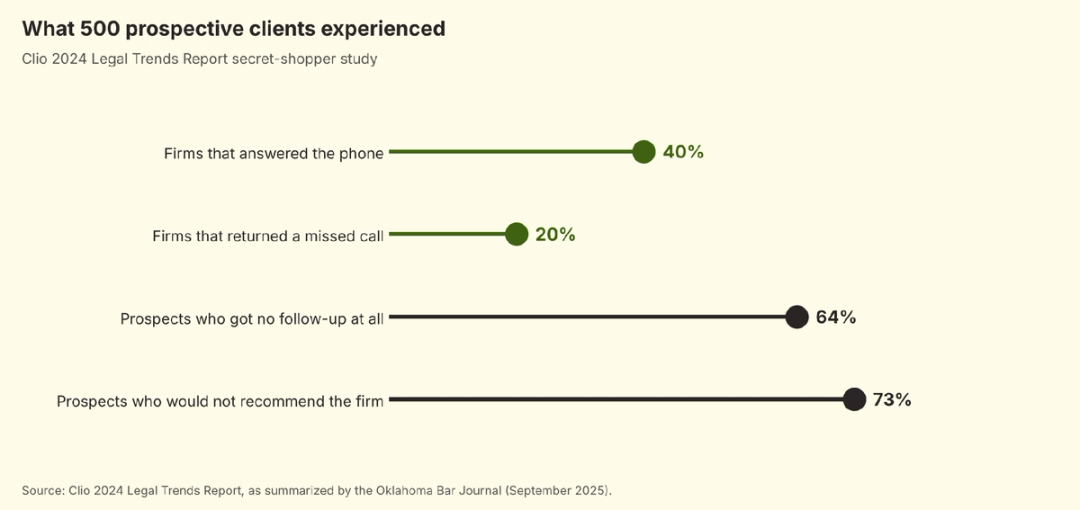
- Answer new-case calls live, since secret-shopper research found only 40% of law firms picked up and just 20% of firms that missed a call returned it.
- Rebuild the intake script around the decision the firm needs to make, collecting conflict names early and limiting case facts until the conflict check clears.
- Follow up with every unsigned lead on a set schedule, because 64% of prospects in the same study received no follow-up at all.
- Shorten the path to a signed retainer with same-day consultations and electronic signatures, while meeting the written-agreement rule for contingency fees.
- Measure intake as a funnel by lead source: answer rate, speed to first contact, qualification, consultation and signed cases.
Every client a law firm ever signs passes through intake, which makes it the one process that touches the entire caseload. It is also, at plenty of practices, run by the newest hire, guided by a script written years ago and tracked in a system that nobody pulls reports from.
The results show up in outside testing. In Clio's 2024 secret-shopper study, as summarized by the Oklahoma Bar Journal, only 40% of firms answered the phone, just 20% of firms that missed a call returned it and 64% of prospective clients received no follow-up at all.
Online leads fare somewhat better but still leak. Hennessey Digital's 2025 study of 1,333 law firms found a median response time of 13 minutes to a web form, yet 26% of firms never responded within a week.
None of those failures comes from a lack of legal skill. They come from coverage gaps, scripts that ask the wrong questions in the wrong order, follow-up that depends on someone remembering and a funnel the firm can't see, and each of those can be fixed without rebuilding the practice.
Each of the five ways to improve your law firm's intake process covered here targets a different point where cases slip away. They can be made one at a time, and each comes with a number the firm can track to see whether it worked.
Where a law firm's intake loses cases
Intake is a sequence, and cases leak at every step. Knowing which step loses the most is what tells a firm where to start when it sets out to improve a law firm intake process.
| Intake stage | Where cases leak | What to measure |
|---|---|---|
| First contact | Calls missed, forms unanswered, callbacks too slow | Answer rate and time to first live contact |
| Screening | Scripts that miss key facts or qualify the wrong cases | Share of leads qualified and accuracy of the screen |
| Follow-up | Unsigned leads never contacted again | Follow-up attempts per lead and conversion after the first call |
| Consultation and signing | No-shows, slow scheduling, agreements left unsigned | Consultation show rate and time from first call to signature |
| Hand-off to the case team | Signed clients waiting days to hear from their case manager | Time from signature to first case manager contact |
One or two stages usually account for the majority of a firm's losses. Each of the five ways that follow maps to one of those stages, so a firm can start with the one its own numbers point to.
The last stage is easy to overlook because it happens after the case is signed. A new client who waits days to hear from anyone at the firm starts to doubt the decision, which is why intake and the start of case work need a clean hand-off, a distinction our piece on AI intake and AI operations explores.
5 ways to improve your law firm's intake process
Answer every new-case call while the caller is still on the line
Any effort to improve a law firm intake process should start with the first conversation, because it decides more than any other. An injured caller usually has several firms' numbers, and the first one to answer, listen and take the details has a head start that later callbacks struggle to overcome.
The secret-shopper numbers show how often firms give that head start away. A callback returned the same afternoon is better than no callback, but by then the caller may have already spoken with another firm, which is why live answering matters more than any later improvement to intake.
The front desk isn't always the right first answer either. A receptionist juggling visitors, existing clients and mail can pick up a new-case call and still lose it by taking a message instead of running the screen, so the goal is a live answer from someone, or something, able to start intake on the spot and finish it without passing the caller around.
Measure answer rate by hour of day, not just by month. A firm with a respectable monthly average can still be missing a third of its calls between noon and 1 p.m., and the hourly view shows exactly where coverage needs to be added.
Coverage gaps cluster in predictable places: lunch, the first hour of the morning, late afternoon, evenings and weekends. A personal injury firm that answers live from 9 to 5 on weekdays covers 40 of the week's 168 hours, and accidents happen at all of the others, a gap our comparison of after-hours intake options examines in detail.
Language belongs in the same plan. If Spanish-speaking callers can reach intake only when one bilingual employee is free, the firm has a coverage gap that doesn't show up on a schedule.
Rebuild the script around the decision you need to make
An intake call exists to answer one question: should the firm take this case? Scripts that grow over years can bury that question under a long list of fields, and the specialist spends the call filling boxes instead of deciding.
A decision-first script puts the screening facts at the front and saves the rest for after the firm has decided. It typically covers five areas:
- Eligibility: The date of the incident, the type of injury, whether there was treatment and who appears to be at fault, checked against the firm's case criteria.
- Conflict names: Every driver, owner, passenger, employer and business involved, collected before the caller tells their whole story.
- Insurance: The caller's insurer and the other party's insurer, plus any claim numbers already assigned.
- Urgency flags: An approaching statute of limitations, an adjuster pressing for a recorded statement or a recent hospital stay.
- Next step: A booked consultation, a retainer sent for signature or a clear decline with the reason given.
The order matters for ethical reasons too. Under Model Rule 1.18, a person who consults about possibly hiring the firm becomes a prospective client, and detailed information from someone adverse to an existing client can create a conflict, so collecting names and running the check before the full story protects the firm.
Review the script every quarter with the attorneys who make case decisions, since it is one of the cheapest ways to improve your law firm's intake process. Criteria change as the firm's caseload and strategy change, and a script that still screens for cases the firm stopped taking wastes calls on both sides.
The script should also make room for the person on the other end. Callers are often in pain or frightened, and a specialist who acknowledges that before moving to the next question gets better answers and a caller more likely to sign, so build a line or two of acknowledgment into the opening rather than leaving it to chance.
Declines deserve a script too. A caller the firm won't take should hear a clear, kind explanation and, where appropriate, a referral, and the firm should log their name and any adverse parties for future conflict checks and consider a short non-engagement letter so there is no confusion about representation.
Follow up until the caller says yes or no
Plenty of qualified leads don't sign on the first call. They want to talk with a spouse, compare firms or wait for a doctor's appointment, and the firm that stays in touch respectfully can still sign the case weeks later.
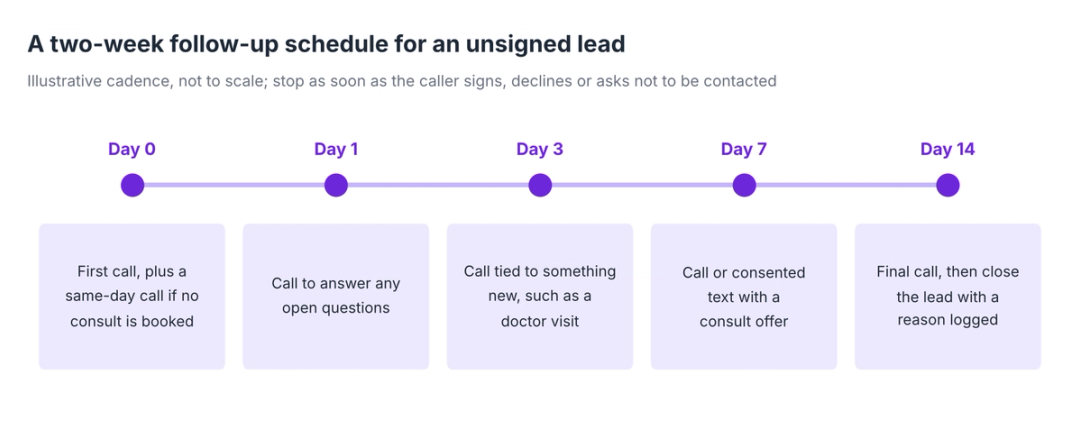
The 64% no-follow-up figure shows how seldom that happens. Follow-up fails when it depends on a person remembering to make calls between everything else, so the fix is a schedule: a call the same day, another the next day, then a few spaced over the following two weeks, each logged against the lead until the caller signs, declines or asks not to be contacted.
Each follow-up should add something. A call that only asks "are you ready to sign?" wears thin, while one that answers a question the caller raised, confirms a consultation time or checks on a doctor's appointment gives them a reason to stay in touch.
Mix channels where the caller has agreed to them. A short text confirming what was discussed or an email with the firm's contact details can reach someone who won't pick up an unknown number, as long as the firm has consent for that channel and keeps a record of it.
Record why unsigned leads didn't sign. Over a few months, the reasons (chose another firm, case too small, couldn't reach anyone, wanted to wait) show which part of the intake process to improve next, and they are often more useful than the sign rate itself.
Automated outbound calls need care. The FCC has ruled that AI-generated voices count as artificial voices under the Telephone Consumer Protection Act, so firms using automated or AI-voice follow-up should confirm with counsel that their consent records cover those calls, as our piece on automating outbound calls discusses.
Get the retainer signed the same day
A qualified caller who leaves the first call with nothing scheduled is a caller who may never come back. The shortest path is a consultation booked during the call, ideally the same day, or a contingency agreement sent for electronic signature once an attorney has approved the case.
Electronic signatures are well established for this. The federal E-SIGN Act says a signature or contract in commerce can't be denied legal effect solely because it is electronic.
Model Rule 1.5(c) requires contingent fee agreements to be in a writing signed by the client, and an e-signature can satisfy that requirement where state rules allow, so confirm how your state treats electronically signed fee agreements before switching.
Consultation logistics decide whether booked appointments actually happen. Send a confirmation right away, a reminder the day before and another an hour ahead, and offer phone or video consultations for clients who are injured, working or caring for family, since a long drive to the office is a reason to cancel.
Speed shouldn't replace understanding. Walk the client through the fee and what happens next before sending the agreement, because a client who signs without understanding the terms is a future complaint rather than a secure case. A short follow-up call after signing, confirming that the client received a copy and knows who their case manager will be, closes the loop.
Measure intake as a funnel, by lead source
A firm can't improve the law firm intake process it can't see, and intake is often invisible beyond a monthly count of signed cases. Tracking each stage, broken out by where the lead came from, shows which marketing produces signed cases and which produces calls that go nowhere.
Attribution comes first. Give each campaign its own tracking number or form source, and make sure the intake record captures where the lead came from, because a funnel that can't separate a billboard lead from a referral can't tell the firm where to spend.
| Intake metric | How to calculate it | What it tells you |
|---|---|---|
| Answer rate | Live-answered new-case calls divided by all new-case calls | Whether coverage is the bottleneck |
| Speed to first contact | Minutes from call or form to a live conversation | Whether leads are cooling before anyone talks to them |
| Qualification rate | Qualified leads divided by all leads, by source | Which sources send the cases the firm takes |
| Consultation show rate | Consultations held divided by consultations booked | Whether scheduling and reminders are working |
| Sign rate | Signed cases divided by qualified leads | How well the firm converts the cases it wants |
| Cost per signed case | Marketing spend divided by signed cases, by source | Which channels are worth more budget |
Review these numbers monthly with whoever runs marketing. A source with a high answer rate and a low sign rate may be sending the wrong cases, while one with a low answer rate may be losing good cases at the phone, and our analysis of why PI firms lose cases before they sign them walks through how to read the gaps.
Lost leads deserve the same review as signed ones. Once a month, pull ten qualified leads that didn't sign and listen to their intake calls with the attorney who sets case criteria, since patterns in those calls, such as a question that confuses callers or a delay before the consultation, are the clearest guide to the next fix.
See HelloCounsel run your intake questions on a live call
We'll show you how HelloCounsel answers a new-case call in under two rings, screens the caller with your intake questions in English or Spanish and writes the lead to your intake system. Book an intake call demo with HelloCounsel
Who should own intake at a law firm
Intake improves fastest when one person owns it. That doesn't mean one person answers every call; it means someone is responsible for the script, the follow-up schedule, the metrics and the monthly review, with the authority to change them.
At smaller firms, that owner may be an office manager or a senior paralegal. At larger plaintiff firms, it is usually a dedicated intake manager, and the attorneys who make case decisions meet with them regularly to adjust criteria and review declined cases.
Training is part of the job. New intake staff need practice with the script, with distressed and angry callers and with the questions they must route to an attorney, and listening to recorded calls with an experienced specialist teaches more than reading the script alone. When the partners decide to improve the law firm intake process, the owner is the person who turns that decision into measured changes.
Intake habits worth retiring
Some habits quietly undo any attempt to improve your law firm's intake process, and they are worth stopping regardless of which change a firm makes first:
- Sending overflow calls to voicemail during business hours
- Promising a callback "soon" instead of giving a time
- Letting the caller tell the whole story before conflict names are checked
- Asking for a Social Security number up front without explaining why it is needed
- Leaving web leads in a shared inbox overnight
- Ending calls without telling the caller exactly what happens next
Each of these is easy to fix once someone names it, and most cost nothing beyond a change in routine. The harder part is noticing them, which is why listening to a handful of intake calls each month, including the ones that didn't sign, tells a firm more than any software report.
How HelloCounsel supports a law firm's intake
HelloCounsel builds AI voice agents for plaintiff personal injury firms, and intake is a common starting point.
HelloCounsel's intake agent answers new-case calls in under two rings at any hour, runs your intake questions in English or Spanish, including callers who switch languages mid-call, and writes the lead to intake systems such as LeadDocket and Lawmatics. When a caller needs a person, it checks live availability and makes a warm transfer to your intake team or schedules a callback.
For firms trying to improve the law firm intake process without adding headcount, the hand-off matters as much as the first call. Once a case is signed, Case Opening takes over the welcome call and collects what the new file needs, with 24 hours to get every case moving, so the hand-off stage in the funnel doesn't become the new leak.
Across 30,000+ calls, firms using HelloCounsel have seen a 48% improvement in call reception. Pricing is custom, based on call and case volume rather than seats, so you pay for tasks completed, and most firms go live in under two weeks.
Pick the leakiest stage and fix it first
Trying to improve a law firm intake process all at once tends to leave every stage half-fixed. The funnel table gives a firm a better plan: measure each stage for a month, find the one that loses the most qualified callers and apply the matching change.
For plaintiff firms, the first answer is frequently coverage, because a call that nobody answers never reaches the script, the follow-up or the retainer. Once live answering is in place, the next weakest stage becomes visible, and the process improves one measurable step at a time.
Revisit the funnel each quarter, since fixing one stage exposes the next one, and a firm that keeps going will find its intake process improving in a steady, measurable way.
Whatever the starting point, set the number before making the change. A firm that knows its answer rate, sign rate and speed to first contact today will know in 30 days whether the change worked, which is the only reliable way to tell an improvement from a guess.
Find your firm's biggest intake gap with HelloCounsel's founders Talk with HelloCounsel's founders about your intake numbers, from missed calls to unsigned leads, and see which stage would benefit most from automation. Book a call with HelloCounsel's founders about intake
Frequently asked questions
1. How can a law firm improve its intake process?
Answer new-case calls live, build the script around the case decision, follow up with unsigned leads on a schedule, book consultations or send agreements the same day and measure each stage by lead source so the firm knows where cases are lost.
2. What should a law firm intake script include?
Eligibility facts such as incident date, injury and fault, every party name for the conflict check, insurance details, and urgency flags like an approaching deadline and a clear next step: a booked consultation, an agreement sent for signature, or a clear decline.
3. How quickly should a law firm respond to a new lead?
Live, on the first call, whenever possible. Hennessey Digital's 2025 study found a median web-form response time of 13 minutes across 1,333 firms, but phone callers comparing firms often hire whoever answers first, so a callback is a weaker substitute.
4. How many times should intake follow up with a lead?
Use a set schedule rather than memory: a call the same day, another the next day and a few more over two weeks. Stop when the caller signs, declines or asks not to be contacted, and log every attempt against the lead.
5. Which intake metrics should a law firm track?
Track answer rate, speed to first contact, qualification rate, consultation show rate, sign rate and cost per signed case, each broken out by lead source. Review them monthly with marketing to see which lead sources and intake stages are losing cases.
6. Can AI improve a law firm's intake process?
Yes, mainly by answering every call live, running the firm's intake questions consistently, following up on schedule and writing leads to the intake system. Case decisions, fee discussions and sensitive conversations still belong with the firm's attorneys and intake staff.
Share this article