What Is the Difference Between a Legal Answering Service and a Virtual Receptionist?

- A legal answering service answers from a script, screens new callers, and sends the firm a message, while a virtual receptionist answers in your firm's name, transfers calls to your staff, and books appointments.
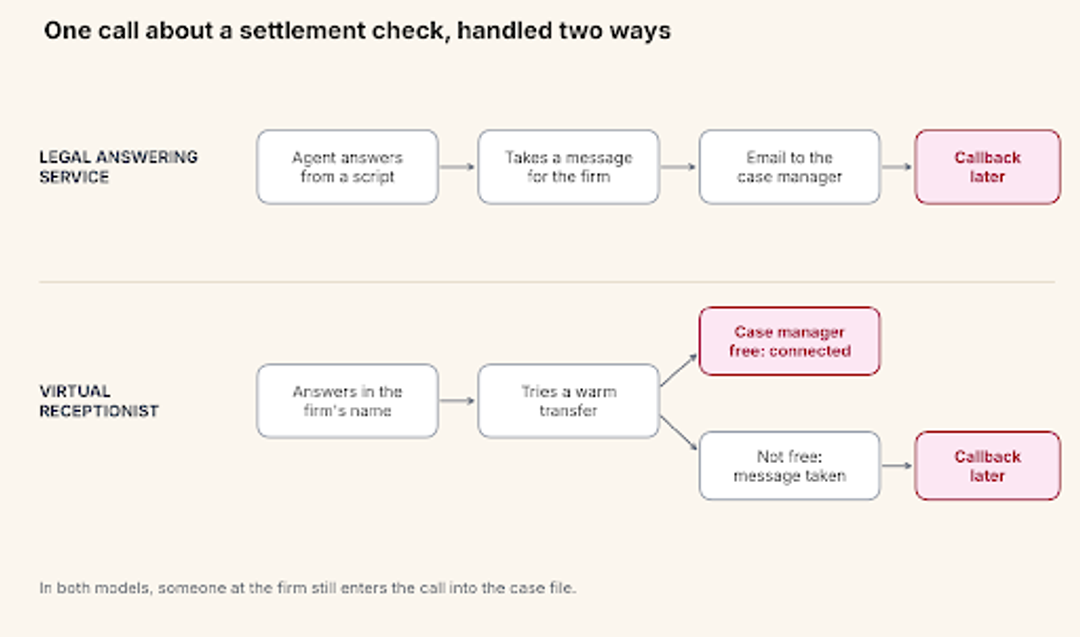
- In the legal answering service vs. virtual receptionist choice, the deciding question for a plaintiff firm is how each one handles existing clients, since a message or a failed transfer still leaves your team to return the call.
- ABA Model Rule 1.4 expects a lawyer to respond to or acknowledge client communications promptly, so check how fast a message from either service reaches the person who can answer it.
- Both models leave the case file to your team, so ask any vendor who enters each call into your case management system and how long that takes.
- Sort a week of your calls into new leads, existing clients, and provider or adjuster calls before choosing, because the mix decides which model fits.
A legal answering service and a virtual receptionist both answer your firm's phone when your own staff can't, but they are built for different jobs. A legal answering service works like a specialized call center: agents answer from a script, screen new callers against your intake questions, and send the firm a message. A virtual receptionist works like a front desk that happens to sit somewhere else, answering in your firm's name, transferring callers to the right person, and booking appointments on your calendar.
Grant a plaintiff firm the budget for either one, and the confident answers come quickly. The answering service covers nights and weekends for new leads, the virtual receptionist covers daytime overflow and transfers, and a firm with enough volume buys both.
Those answers hold until you ask about the calls that make up a plaintiff firm's day after intake. The legal answering service vs. virtual receptionist comparison turns on a client three weeks into treatment calling about an adjuster's letter, a provider's office calling about a bill, and who writes either call into the case file.
What does a legal answering service do with a call?
A legal answering service runs a shared team of agents trained on legal call handling. When your line rolls over, an agent answers with your firm's greeting, works through a script your firm approves, and ends the call with a message or a completed intake form sent to your team by email, text, or a portal.
The script is where legal services differ from general answering services. A legal service can ask a new caller about the incident date, injuries, treatment, and the other driver's insurer, and some will schedule a consultation or send an engagement agreement, as our list of the best legal answering services for PI firms compares.
Coverage is the main draw. A legal answering service usually staffs its lines around the clock, so a caller at 9 p.m. on a Saturday reaches a person instead of voicemail, and pricing usually follows calls or minutes, which our breakdown of legal answering service costs lays out by vendor.
A firm usually connects an answering service through conditional call forwarding. The main line rings at the office first and rolls to the service after a set number of rings, when every line is busy, or on a schedule for nights and weekends, so the same service can act as overflow during the day and as the whole front desk after hours.
What the service doesn't do is act inside your firm. The agent can't see the matter, doesn't know which case manager handles the caller and can only pass the call along as a message for someone at the firm to act on the next business day.
What does a virtual receptionist do differently?
A virtual receptionist acts as your firm's front desk from a remote office. The receptionist answers in your name, knows your staff directory, tries a warm transfer to the person the caller needs, takes a message only when nobody picks up, and can book consultations directly on your calendar.
The transfer is the defining feature. A caller asking for her case manager by name gets connected when the case manager is free, which a script-based answering service doesn't attempt, so a virtual receptionist fits a firm whose staff wants live calls during business hours instead of a stack of messages.
Virtual receptionist plans usually bill for each minute a receptionist spends on your calls, and some count hold time and the work done after the call, as our breakdown of virtual receptionist costs shows. Coverage hours vary by vendor, so confirm whether evenings and weekends come with the plan or cost extra.
The labels blur in vendor marketing. Many legal answering services now sell warm transfers and calendar booking, and many virtual receptionist services sell legal intake scripts, so the name on the website tells you less than the service description in the contract.
Ask each vendor what happens on three specific calls: a new lead at 10 p.m., a current client who wants her case manager at 2 p.m., and an adjuster asking for a records update. The answers show if the firm is buying a message-taking service, a transfer service, or something that finishes the call.
| Call type | Legal answering service | Virtual receptionist |
|---|---|---|
| New lead after hours | Screens the caller from your intake script and sends a message or form | Screens if the plan covers after hours; otherwise, the call goes to voicemail or an answering service. |
| New lead during business hours | Screens and sends a message for a callback | Transfers to your intake team if someone is free, or takes a message |
| Existing client asking about her case | Takes a message for the case manager | Transfers to the case manager if free, or takes a message |
| Provider or adjuster office | Records who called and why, then sends a message | Connects the caller to the right person when that person is free |
| Request for a specific attorney | Passes the request along as a message | Rings the attorney, then takes a message if there's no answer |
On new leads after hours, the answering service does more work on the call; on daytime calls for named staff, the virtual receptionist does; and on any call where nobody at the firm is free, both end with the same message.
How does each model handle calls from existing clients?
Existing-client calls are where a plaintiff firm feels the difference, because those calls need someone who knows the matter. A client asking whether the firm received her MRI report or when the settlement check will clear can't get an answer from an agent reading a script or a receptionist without access to the file.
The professional rules set the expectation for those calls. Comment 4 to ABA Model Rule 1.4 says a lawyer "should promptly respond to or acknowledge client communications," so a message that waits in an inbox until the case manager clears her afternoon calls is the kind of delay that comment addresses.
A virtual receptionist shortens that wait when the transfer connects. When it doesn't, the receptionist takes the same message an answering service would, and the callback lands in the same queue, so neither model shortens the case manager's callback list on the calls that don't connect.
Our analysis of how many calls a PI case generates traces how a matter's calls build up after intake, from treatment updates to adjuster and provider calls. For those calls, the deciding feature is whether whoever answers can identify the caller and the matter before the conversation starts.
Provider and adjuster calls follow the same pattern. A billing office calling about an unpaid balance, or an adjuster returning a call at 4 p.m. about a demand, needs a person who knows the file, and a message that names only the caller's phone number adds a round of calls before anyone knows which matter it concerns.
What do both models leave for your team to finish?
A message is the end of the call for the service and the start of work for your team. Someone has to read it, find the matter, enter the note, decide who calls back, and make the call, and each of those steps waits on a person who is also handling other files.
Documentation suffers in the handoff. An emailed message that never reaches the matter leaves a gap in the case file, which is the problem we describe in why your PI answering service is creating a documentation problem.
The delay compounds through the day. A message taken at 10:15 a.m. reaches the case manager's inbox at 10:20, gets read between other calls at 1:30 p.m., and turns into a callback at 3:45 p.m. that goes to the client's voicemail, which starts a second round the next morning.
Both models can take accurate messages, and the better vendors take very good ones. The work they leave behind is the same, though: entering the call into your case management system, returning it and closing the loop with the client.
An existing-client call handled from the matter
See HelloCounsel recognize an existing client, work from her matter, and write the call to the case file before it ends. Request an existing-client call demo
Which professional rules apply to a legal answering service or a virtual receptionist?
Both models put a nonlawyer on your firm's phone, so the same rules cover both. ABA Formal Opinion 506 lets nonlawyers gather facts, run conflict searches, and answer general questions about fees, while legal advice and questions such as "Do I have a case?" stay with an attorney.
The service works outside your office, which brings in the outsourcing rules. ABA Formal Opinion 08-451 applies the supervision duties in Model Rules 5.1 and 5.3 to outside providers and calls written confidentiality agreements strongly advisable, and Model Rule 1.18 extends confidentiality to prospective clients, so a caller who never signs is still protected.
Confidentiality also covers how the vendor stores what it hears. Model Rule 1.6(c) asks a lawyer to make reasonable efforts to prevent unauthorized access to client information, so ask where recordings and messages are kept, who at the vendor can open them, and how long they stay there.
Supervision depends on what you can review. A vendor that records calls and lets your team open any recording or transcript gives a supervising attorney something to check, while a vendor that sends only a summary email leaves the firm supervising a description of the call.
How do the costs of a legal answering service and a virtual receptionist compare?
The two models price the same phone traffic differently. Answering services sell plans by the call or the minute, often with intake add-ons, and virtual receptionist services sell plans by the minute of receptionist time, which counts transfers, holds, and after-call notes on some plans.
Billing rules differ inside each model, too. Some services bill wrong numbers, hang up, and spam calls at the same rate as a new lead, and others exclude them, so a firm whose number appears in TV and billboard ads should ask how the vendor treats calls that end in seconds.
Neither price includes the work the call leaves behind. A firm comparing quotes should add the staff time spent turning messages into case notes and callbacks, which can exceed the service fee for existing-client calls that end as messages.
The cleanest legal answering service vs. virtual receptionist price comparison takes one month of your own calls, priced on each vendor's rules, with the follow-up time added. Our ROI analysis of AI answering services walks through that calculation, including the staff hours that message-based models leave in place.
How should a firm test a legal answering service or virtual receptionist before signing?
A trial on your own calls tells you more than any demo, and the same test works on both sides of the legal answering service vs virtual receptionist decision. Run each call below with a staff member posing as the caller, record it, and score what reaches your team afterward.
1. After-hours new lead in Spanish: Call at 9 p.m. as a rear-end collision victim who switches to Spanish halfway through, and check whether the screening finishes and the intake answers arrive complete.
2. Existing client asking for her case manager: Call during the day, give a client's name, and check whether the caller reaches the case manager or a message that names the right matter.
3. Adjuster asking about records: Call as an adjuster asking whether the firm has sent the medical records, and check who receives the message and how long it takes to reach the matter.
4. Merits question: Ask, "Do I have a case?" and check that the agent gathers facts without giving legal advice, which Opinion 506 reserves for an attorney.
5. Three calls at once: Place three calls within a minute and check whether all three are answered within a few rings.
Score each call on four things: time to answer, accuracy of the information captured, time until the information reached the right person, and whether anyone had to retype it into the case file. The fourth score is usually where the two models look most alike.
Bilingual coverage deserves a separate check. Some services staff Spanish-speaking agents on every shift, and others route Spanish calls to a smaller team or charge per call for it, so ask whether a Spanish-speaking caller at 2 a.m. gets the same screening as an English-speaking one.
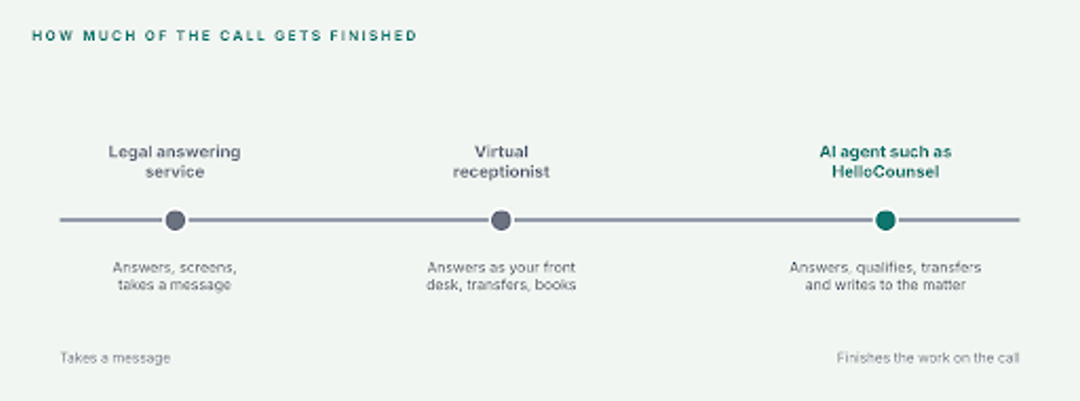
HelloCounsel answers like a receptionist and finishes the call like an intake team
The legal answering service vs virtual receptionist question assumes the call ends in a message or a transfer. HelloCounsel builds AI voice agents for plaintiff personal injury firms, and its agent answers like a front desk while finishing the work an answering service would pass back to your team. HelloCounsel is our own product.
- Caller pre-identification: HelloCounsel identifies the caller and any existing matter before the conversation starts, so an existing client's call starts from her matter instead of from scratch.
- 24/7 answering: HelloCounsel answers in under two rings, day and night, as an AI receptionist with custom call flows for new callers, existing clients, and attorneys.
- Qualification: HelloCounsel screens new leads through AI intake, in English or Spanish, with mid-call switching, and routes each file to signing, attorney review, or a referral.
- Case opening and case management: HelloCounsel opens the case and the insurance claim once the client signs, waits on hold with providers and adjusters, and completes tasks inside the matter.
- Records and check-ins: HelloCounsel retrieves and organizes medical records, runs treatment check-ins, and follows up with leads who haven't signed.
- CMS write-back: HelloCounsel writes every call to the matter through direct integrations with SmartAdvocate, Filevine, Litify, Lead Docket, and Clio, and we build custom integrations for other systems.
- Escalation and reporting: HelloCounsel transfers any call to a person when the flow calls for it and reports on call performance.
HelloCounsel has handled more than 25,000 calls and 500 hours of call time and has delivered a 48% improvement in call reception rates. We price on a fixed monthly fee starting at $500, scoped to expected call volume with 20% tolerance either way, with no per-minute billing and no setup fee.
Run the five test calls above on HelloCounsel the same way you run them on any service. The existing-client call is the one to watch, since HelloCounsel recognizes the caller, works from her matter, and writes the note to the case file before the call ends.
Onboarding takes about an hour and runs on 17 multiple-choice questions, and agents go live in SmartAdvocate in about a week. HelloCounsel works in English and Spanish only, runs inside your case management system rather than replacing it, and isn't a fit for a firm that tracks cases in spreadsheets.
Which should a plaintiff firm choose, an answering service or a virtual receptionist?
The choice follows your call mix. Sort one week of calls into new leads after hours, new leads during the day, existing clients, and provider or adjuster offices, then compare each group's share against what each model does with it.
A firm whose gap is after-hours new leads gets the most from a legal answering service with a strong intake script. A practice that wants daytime calls put through to staff, with consultations booked on the spot, gets the most from a virtual receptionist, and a firm where existing clients, providers, and adjusters make up most of the volume needs whoever answers to see the matter and update it.
A firm can also split the legal answering service vs. virtual receptionist decision by hour, with a receptionist on daytime transfers and an answering service on nights weekends. That setup covers the clock but doubles the places messages arrive, so it works best when both vendors can write to the same place your case managers already check.
Existing-client, provider, and adjuster calls are where both models leave the same work behind, so test those first. Ask each vendor, us included, to handle a recorded call from an existing client, then check how the answer, the note, and the callback reach your case file, using our guide to evaluating an AI voice agent for the rest of the questions.
The calls that end as messages today
HelloCounsel's founders will review your call mix with you and show how each type of call would be handled and logged. Arrange a call-handling consultation
Frequently asked questions about legal answering services and virtual receptionists
1. Is a virtual receptionist the same as a legal answering service?
No. A legal answering service answers from a script and sends messages, while a virtual receptionist answers as your front desk, transfers calls, and books appointments. HelloCounsel's AI agent does both and writes each call to the matter.
2. Which is better for a personal injury firm?
It depends on your call mix. After-hours new leads suit an answering service, daytime transfers suit a virtual receptionist, and heavy existing-client volume suits an agent like HelloCounsel that can see and update the matter.
3. Do virtual receptionists work after hours?
Some do and some charge extra, so confirm the coverage hours in the plan. Legal answering services usually staff their lines around the clock.
4. How do legal answering services and virtual receptionists charge?
Answering services usually charge by the call or minute, and virtual receptionists usually charge by the minute of receptionist time. HelloCounsel charges a fixed monthly fee starting at $500 with no per-minute billing.
5. Can a virtual receptionist do client intake for a law firm?
Yes, within ABA Formal Opinion 506. A nonlawyer can gather facts, run conflict searches, and answer general fee questions, while legal advice and merits questions stay with an attorney.
6. Does HelloCounsel handle inbound and outbound calls?
Yes. HelloCounsel answers inbound calls 24/7 and makes outbound calls for lead follow-up, client check-ins, and medical records, writing each call to the matter in your case management system.
Share this article