
- For most plaintiff firms, AI answering service ROI comes from case manager hours returned, not from replacing a receptionist.
- The role a PI firm usually weighs is a case manager or intake specialist, which costs close to $100,000 a year once benefits are included.
- One full-time hire covers about 40 of the 168 hours in a week, and a nonexecutive role takes a median of 39 days to fill.
- Add hire cost avoided, the value of hours returned, and after-hours cases signed, subtract the service cost, then divide by the service cost.
- Hours returned are the number you can prove in a two-week trial, while signed cases are real upside that takes longer to show.
- HelloCounsel starts at $500 a month on a fixed price scoped to your volume, so a campaign month does not raise the bill.
- What the agents do: HelloCounsel's AI voice agents take routine inbound and outbound calls, write notes to the case file, and hand sensitive calls to your team.
Yes, for most plaintiff firms an AI answering service costs far less than the hire it would replace. AI answering service ROI for a PI firm comes mainly from case manager hours returned, not from cutting a receptionist salary.
The hire most firms are weighing is another case manager or intake specialist. At the BLS mean wage for paralegals and legal assistants, that person costs about $99,600 a year once benefits are added, and still works business hours only. HelloCounsel starts at $500 a month and answers every hour of the week.
What Hiring In-House Actually Costs a PI Firm
Salary is only about 70% of what an employee costs. Wages made up 70.0% of private-industry employer compensation costs in June 2026, with benefits covering the other 30.0%, according to the BLS Employer Costs for Employee Compensation release. BLS does not track case managers or intake specialists as separate jobs, so the table uses the closest categories.
| Role | Mean annual wage (BLS, May 2025) | Fully loaded yearly cost | Fully loaded monthly cost | Weekly hours covered |
|---|---|---|---|---|
| Receptionist | $39,460 | About $56,370 | About $4,700 | About 40 of 168 |
| Legal secretary or administrative assistant | $60,620 | About $86,600 | About $7,220 | About 40 of 168 |
| Paralegal or legal assistant (closest to a case manager) | $69,700 | About $99,600 | About $8,300 | About 40 of 168 |
Wages are from the BLS Occupational Employment and Wage Statistics for May 2025. Loaded cost divides each wage by the 70.0% wage share of employer costs.
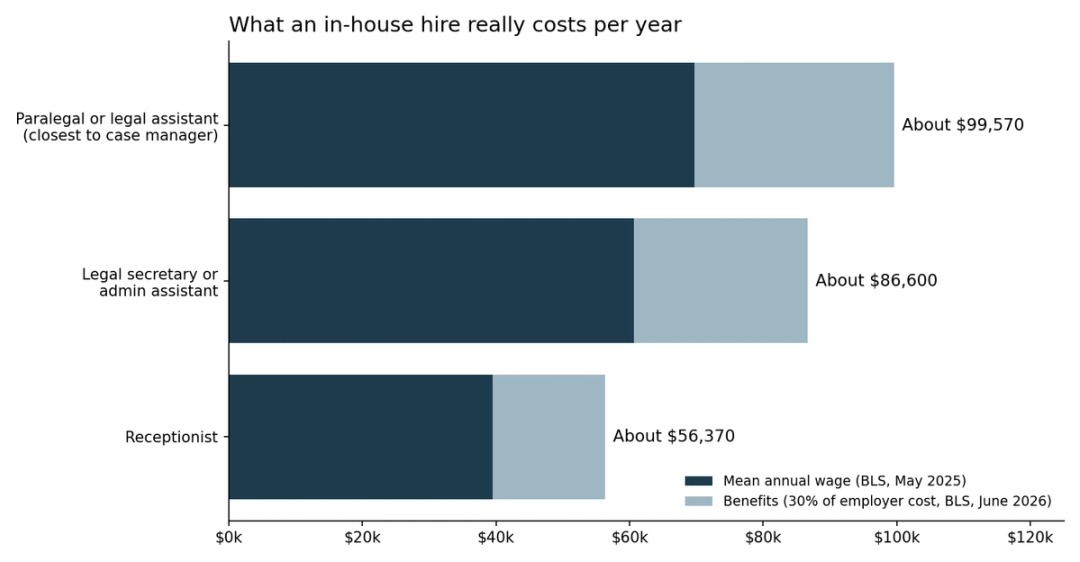
Time to fill, ramp-up, and turnover add to that number:
- Time to fill: The median nonexecutive role took 39 calendar days to fill in 2026, with a median cost per hire of $1,300, according to SHRM's recruiting benchmarks. The rest of the team carries the calls in the meantime
- Ramp-up: A new case manager learns your case management system and SOPs on live files, and senior staff spend time training instead of moving cases
- Turnover: When someone leaves, their callback list and case context leave with them, and the hiring cycle starts again
Why a new hire ends up on the phone within weeks
Calls follow the caseload. HelloCounsel's analysis of how many calls a PI case generates puts a typical case at around 150 calls over its life, and a case manager carrying 100 cases at more than 15,000 calls a year.
A new hire takes on part of that caseload, so they take on part of those calls too, and the added capacity can disappear into status updates and provider callbacks within a quarter. Our guide to case manager workload shows where those hours go.
Did You Know
Private-industry benefit costs rose 3.8% in the 12 months to June 2026, faster than wages at 3.1%, according to the BLS Employment Cost Index. Every in-house hire gets more expensive each year, even before a raise.
Which Calls an AI Answering Service Can Take Off Your Team
The calls eating that capacity are where AI answering service ROI comes from, and most of them are predictable. HelloCounsel's analysis estimates that about 70% of the calls a PI firm receives do not need a person to resolve them.
| Call type | AI voice agent handles it | Your team handles it |
|---|---|---|
| New lead after hours | Yes. Qualifies against your criteria and writes intake notes | When the lead needs an attorney conversation |
| Existing client asking for a status update | Yes. Identifies the client, gives the approved update, and logs the call | When the client is upset or the case has changed |
| Provider confirming records or appointments | Yes. Verifies the provider and writes the exchange to the file | Rarely |
| Adjuster returning a call | Yes. Captures the message against the right matter or transfers | Negotiation and anything needing judgment |
| Lien holder balance check | Yes. Handles the routine exchange and logs it | Disputes and reductions |
| Spam and wrong numbers | Yes. Screens and ends the call | Never |
| Distressed client or sensitive news | No. Transfers to your team with the context attached | Yes. People own these calls |
A generic AI receptionist struggles with this mix because it treats every caller as a new lead.
Worth Knowing
US consumers received 52.5 billion robocalls in 2025, and unwanted telemarketing and scam calls run close to 30 billion a year, according to the YouMail Robocall Index. Every one that reaches your front desk costs staff time.
Outbound calls belong in the ROI too
Some of the most expensive phone time in a PI firm is outbound: chasing medical records, running treatment check-ins, and sitting in insurer hold queues. An inbound-only answering service never touches those hours. The case for automating outbound calls shows how much time they take, and AI on medical provider calls covers the records loop in detail.
How to Calculate AI Answering Service ROI for a PI Firm
AI answering service ROI = (hire cost avoided + value of hours returned + after-hours cases signed − service cost) ÷ service cost.
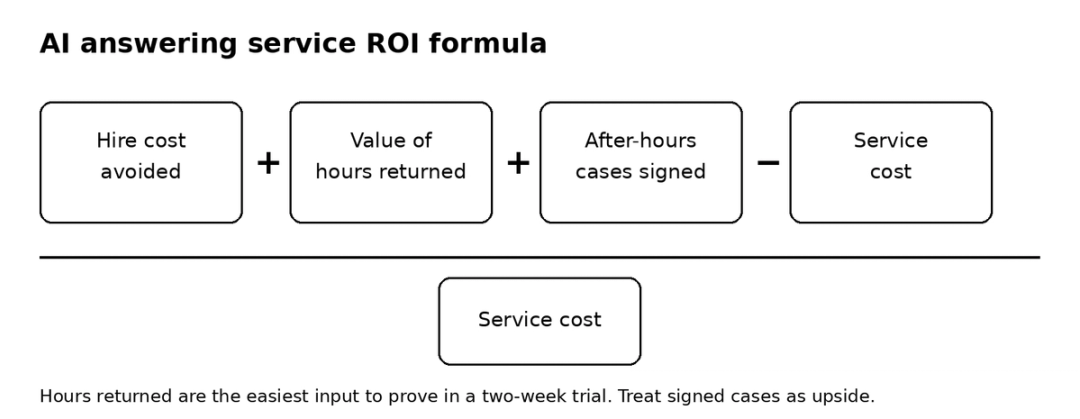
The first two inputs come from your payroll and call logs. The third depends on case value and attribution, so it works better as upside than as the headline number.
A worked example for a firm with four case managers
Say an AI voice agent takes 600 routine calls a month off your team, and each saves about four minutes of call and note time. These figures are illustrative.
| Line | Math | Monthly value |
|---|---|---|
| Hours returned | 600 calls × 4 minutes | 40 hours |
| Loaded hourly cost of case manager time | $30.24 BLS median wage ÷ 0.70 | About $43.20 |
| Value of hours returned | 40 hours × $43.20 | About $1,730 |
| Hire you can hold off on | One case manager at about $99,600 a year | About $8,300 |
| HelloCounsel | Fixed monthly price | From $500 |
The $30.24 figure is the May 2025 BLS median hourly wage for paralegals and legal assistants. If the service only returns hours, it pays for itself on the first line, and $1,730 of recovered time covers a scoped price up to three times the starting rate.
If it also lets you delay a hire, the math changes by an order of magnitude. An $8,300 monthly cost moves off the budget, and the team you already have gets its time back.
Where a traditional answering service fits in the math
A live answering service lowers missed calls, and many firms use one for exactly that. The ROI stalls at the message. Your case manager still returns the call, finds the matter, and writes the note, so the hours in the worksheet stay with your team, which is how an answering service creates a documentation problem.
Per-minute billing adds another variable to the AI answering service ROI comparison. Receptionist minutes, overages, and time spent on hold or on after-call notes all count toward the bill, so the cost climbs in the same months your call volume does.
Those two costs, the callback and the metered minute, drag down AI answering service ROI, and an AI agent removes both. HelloCounsel's agents identify the caller, pull up the matter, and write the note at hang-up, on a fixed price from $500 a month that holds when a campaign doubles call volume.
HelloCounsel by the Numbers
- 25,000+ calls handled - 500+ hours of call time handled - 93% SOP precision in every call - 48% improvement in call reception rates Figures reported by HelloCounsel.
AI Answering Service vs Hiring In-House: Side by Side
A hire and an AI agent do different jobs well. HelloCounsel takes the routine call work at plaintiff firms, so your hires spend their time on judgment and relationships.
| Capability | New in-house hire | HelloCounsel AI voice agents |
|---|---|---|
| 24/7 coverage | No. About 40 hours a week | Yes. Agents answer every call, day and night |
| Several calls at once | No. One call at a time | Yes. Agents answer every call, including at peak volume |
| English and Spanish | Depends on the hire | Yes. Agents handle both languages and follow mid-call switches |
| Caller pre-identification | No. Staff look up the caller during the call | Yes. Agents know the caller and the matter before the conversation starts |
| Notes written to the case file | Yes, when the person remembers to log the call | Yes. Write-back is part of the core workflow, direct to SmartAdvocate, Filevine, Litify, Lead Docket, and Clio, with custom integrations for other systems |
| Medical records retrieval and treatment check-ins | Yes, as time allows | Yes. Agents call providers and clients and keep following up until the task is complete |
| Phone menus and hold queues | Yes, at the cost of staff time | Yes. Agents wait on hold and connect your teammate when a person answers |
| Sensitive calls reach the right person | Yes. People own this work | Yes. Agents transfer these calls with the caller and matter context attached |
| Call performance reporting | No. Only what staff log | Yes. HelloCounsel measures call volume, caller type, transfer rates, and sentiment |
| Turnover risk | Yes. Context leaves with the person | No. Every call record stays in your system |
| Time to start | No. A median 39 days to fill, plus ramp-up | Yes. About a week after one onboarding call |
| Flat cost in a campaign month | No. Overtime or temporary help | Yes. No change within 20% of scoped volume |
When hiring is still the right call
Some work needs a person. Settlement conversations, a client hearing bad news, and a referral partner who expects a named contact all belong with your team. If your caseload growth is mostly that kind of work, hire.
An AI agent and a new hire also work well together. Agents take the routine calls, so the people you hire spend their day on the conversations that need them. Our comparison of an AI receptionist and a virtual receptionist covers how that handoff works.
What to Measure in a Trial Before You Decide
Two weeks of real calls will tell you more about AI answering service ROI than any calculator. Track these numbers before and during the trial.
| Metric | What it shows |
|---|---|
| Missed-call rate, including after hours | Coverage you gained |
| Case manager hours on routine calls | Capacity returned |
| Callbacks waiting per case manager | Whether messages are shrinking |
| Calls with a note in the case file | Whether documentation is complete |
| Transfer rate to staff | How often calls still need a person |
| Cost per signed case | The marketing impact over time |
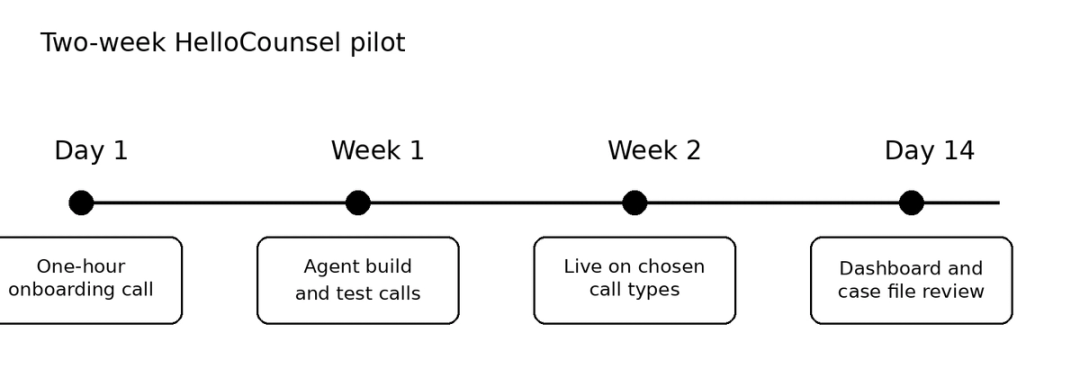
Watch the notes metric most closely, since a call without a record gets repeated. Our explainer on CMS write-back shows what a complete record looks like, our checklist for how to evaluate an AI voice agent covers the demo questions, and our breakdown of the hidden cost of missed calls covers the coverage side.
Note
An average of 3.3% of US workers left their jobs each month in 2025, with quits alone at 2.0% a month, according to the BLS Job Openings and Labor Turnover Survey. A trial result that does not depend on one person staying is worth more.
What Can Lower AI Answering Service ROI
The formula only holds if the service actually removes work. Four things quietly shrink the return, and each is easy to check before you sign.
- Usage-based pricing: Per-minute and per-call AI plans raise the AI answering service cost in exactly the months your call volume spikes, so ask what a campaign month would cost
- Intake-only coverage: An agent that only handles new leads leaves the status, provider, and adjuster calls with your case managers, which is where most of the hours sit
- Shallow integrations: A tool that creates a new contact instead of writing a note to the active matter hands your team cleanup work after every call
- Script upkeep: Every service needs its call flows maintained, so ask who updates them when your SOPs change and how long changes take to go live
HelloCounsel is built around those four checks: a fixed price, post-signature call coverage, notes written to the matter, and call flows built from your own SOPs during onboarding.
How HelloCounsel Is Priced Against a New Hire
With HelloCounsel, the service-cost line in the formula stays fixed. Plans start at $500 a month (pricing as of September 2026), scoped to your licences and expected volume. The price holds within 20% of that volume, there is no setup fee, and it is priced against completed call work, not minutes. Setup takes one hour-long onboarding call with 17 multiple-choice questions, and agents go live in about a week.
Plans include the full call workflow:
- Inbound: 24/7 answering, caller pre-identification, custom call flows, AI intake that qualifies calls in seconds, and English and Spanish with mid-call switching
- Outbound: Lead follow-up, medical records retrieval, treatment check-ins, insurance claim opening, and hold-time handling on provider and insurer lines
- Case opening: Matter setup after intake qualifies, contact, incident, and insurance details entered, retainer sent, case assigned to your team, and medical records requests organized from day one
- Follow-through: Task completion on every supported workflow, with human escalation when a call needs a person
- Records and reporting: CMS write-back through direct and custom integrations, plus call reporting on volume, caller type, transfers, and sentiment
Our rankings of AI answering services for law firms and legal answering services for PI firms show how other providers price the same work.
Hire for Judgment, Automate the Routine Calls
AI answering service ROI for a plaintiff firm is easiest to prove in hours. Price the hire you are considering at its loaded cost, count the routine calls your case managers take today, and run the formula on your own logs.
If most of those calls are status updates, provider confirmations, and follow-ups, an AI agent returns that time for a fraction of a new salary, and your next hire can focus on the work that needs a person. Faster callbacks also help at the front door, where slow follow-up is a common reason firms lose cases before signing. Review the HelloCounsel product against your call mix.
Book a call with HelloCounsel's founders. Bring one month of call logs and the payroll cost of the role you are thinking of adding, and the team will show you which calls the agents can take and what that is worth in hours.
Frequently Asked Questions
How do you calculate AI answering service ROI?
Add the hire cost you avoid, the value of staff hours returned, and after-hours cases signed. Subtract the service cost, then divide by the service cost. Hours returned are the easiest part to measure.
How much does HelloCounsel cost compared with hiring?
HelloCounsel starts at $500 a month on a fixed price scoped to your volume. A case manager-level hire costs about $8,300 a month once benefits are included, based on BLS wage and compensation data.
Does HelloCounsel handle inbound and outbound follow-up calls?
Yes. HelloCounsel's agents answer inbound calls and place outbound follow-ups for leads, medical records, treatment check-ins, and client updates, continuing until the task is done and writing each outcome to the case file.
Is an AI answering service cheaper than hiring a receptionist?
Yes, in most cases. A receptionist costs about $4,700 a month fully loaded and covers business hours. HelloCounsel starts at $500 a month and answers every hour of the week.
How long does it take to see a return from an AI answering service?
Most firms can measure hours returned within a two-week trial. Changes in signed cases and cost per signed case take longer, because they depend on lead flow and case timelines.
Can an AI answering service replace a case manager?
HelloCounsel takes the routine calls a case manager handles, while judgment stays with your team. Firms usually keep their case managers and let them carry more active cases with fewer interruptions.
What should a PI firm measure during an AI answering service trial?
Track missed calls, case manager hours on routine calls, callbacks waiting, calls with a note in the case file, transfer rate, and cost per signed case.
Share this article