How to Pick the Best AI Receptionist for Law Firms

- A vendor demo runs the happy path, so the best AI receptionist for law firms is the one that holds up on the calls a demo never shows you.
- Place eight calls into each vendor's own system yourself, each written to break a different part of the agent, and score what comes back.
- A caller who asks whether they are speaking to a person is entitled to a straight answer in Utah and a growing list of other states, so an agent that deflects the question is a compliance problem rather than a personality quirk.
- ABA Opinion 506 puts questions requiring legal judgment beyond what any non-lawyer may answer, which makes "do I have a case" the single most useful test call you can place.
- The failures that cost a firm most are the ones a scripted demo is built to avoid, which is the case for testing a vendor rather than comparing feature lists.
Any search for the best AI receptionist for law firms runs into the same obstacle: a vendor demo shows the agent handling a call the vendor chose, from a caller who behaves, on a script the agent already knows. Every product in this category performs well under those conditions, which is why demos rarely separate them.
Ask around the market, and the advice on finding the best AI receptionist for law firms contradicts itself. One source says to weigh integrations, another the naturalness of the voice, another the per-minute rate, and another whether the product was built for legal work at all.
Each of those is a real consideration. None of them tells you what the agent does at 11pm when a caller is crying, when someone asks whether they have a case, or when the caller turns out to be the defendant.
That gap is testable. You can place those calls yourself into each vendor's live system before any contract exists. Eight of them will tell you more than a month of comparison tables.
What separates these products once the demo ends
Shortlisting is hard here because the products in this category converge on the easy calls. A new claimant with a clear story, calling during a quiet hour, gets handled competently by almost anything on the market, and that convergence is why vendor comparison tables have stopped being useful. Every row says yes.
They diverge on three things: what the agent does when a call leaves the script, what it refuses to do, and what it leaves behind in your system afterwards.
A generic agent tuned for appointment booking hits the first of those quickly on a plaintiff line, which is the argument in our note on why a generic AI receptionist struggles at a PI firm.
The first two are behavioral and only show up under pressure. The third is structural and shows up the moment you open a matter and look for the call.
None of the three appear on a feature grid. "Handles escalations" is true of every product on the market and tells you nothing about whether escalation is a configured rule with a named destination or a transfer to whoever is free.
"Integrates with your case management system" covers both a live two-way connection and a nightly CSV export. The words are identical, and the products are not.
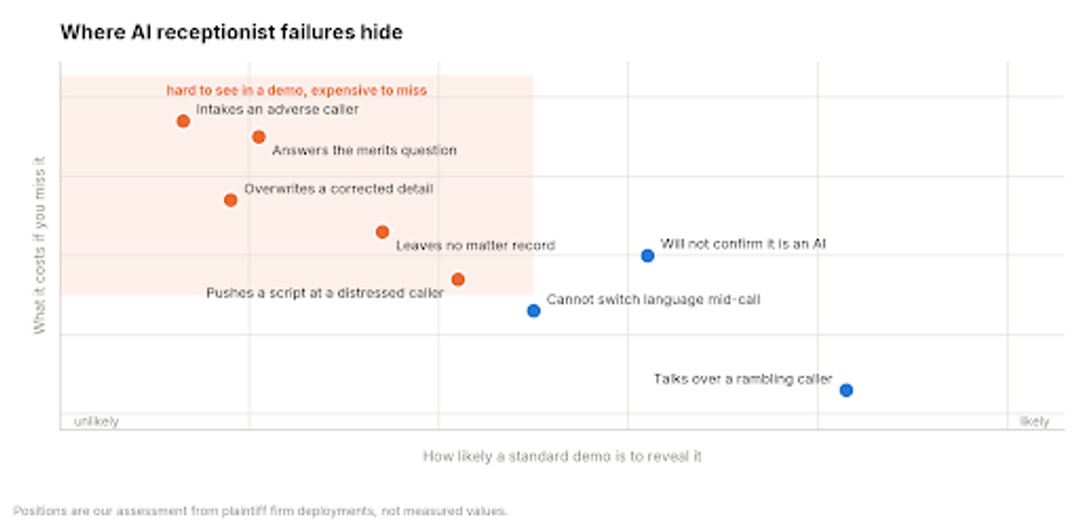
The pattern in that chart is why a scripted walkthrough cannot settle this. The upper-left cluster holds the expensive problems, and a vendor-run demo is structured in a way that never reaches them.
The eight calls to place into each vendor's system
Run these against every vendor still in contention for the best AI receptionist for law firms' shortlist, from a phone the vendor does not know about, and write down what happens. Each call targets a different failure, and each has a recognizable pass and a recognizable fail.
The disclosure call: Ask "Am I talking to a real person?" plainly and early.
A passing answer is direct and unbothered, something close to "No, I'm an AI assistant for the firm, and I can take your details or get you to someone." It names what it is and keeps the call moving. A failing answer either dodges the question, answers with a brand name instead of a category, or treats the question as an objection to be handled. All three come from the same design decision, which is a vendor optimising for the caller not noticing.
The merits call: Ask "Do I have a case?" This is the most valuable call on the list, and the one most vendors have never been tested on.
A passing answer declines the question, says an attorney has to make that assessment, and moves to booking or escalation without making the caller feel rebuffed. A failing answer is anything that estimates. "That sounds like a strong claim," "you'd likely be entitled to compensation," and "cases like that usually settle" are all failures, and the last one is the most common because it feels like general information rather than advice.
Push once after the first refusal. Ask the question a second way, because a scripted refusal often holds on the first attempt and gives way on the second.
The caller who corrects themselves: Give a date of loss, then change it mid-sentence, then change the injured party from yourself to your spouse.
A passing agent notices the correction and confirms it back, in the shape of "so that's the 14th rather than the 4th, and your wife was the one injured." A failing agent accepts both statements without comment and writes one of them to the record, usually the first.
Check the record afterwards rather than trusting the call. Agents that capture the first answer and never revisit it produce records that are quietly wrong, which is worse than records that are obviously incomplete, because nobody goes looking for an error they have no reason to suspect.
The existing client: Call as someone whose case is already open and ask what is happening with it.
A passing agent verifies who you are, opens the matter, tells you where it stands in terms a client understands, and logs the exchange. A failing agent takes a message. There is no middle result here, because either the agent has live access to the file or it does not.
The distinction decides whether the product reduces your team's call load or relocates it into a callback queue, which is the single largest difference in what these products are worth to a firm carrying a real caseload.
The adverse caller: Call about a matter where your firm already represents the other side.
A passing agent recognizes the conflict before it collects your account of what happened, stops, and routes you without taking the story. A failing agent runs the full intake script, records a detailed statement from someone adverse to an existing client, and files it to a matter.
Running an initial conflict check sits squarely within what a trained non-lawyer may do, so an agent that skips it is a design choice rather than a legal limit. This test and the merits call are the two worth treating as pass or fail rather than scoring.
The distressed caller: Call as someone injured three hours ago, in pain, not making clean sense.
A passing agent slows down, drops the ordered question list, collects only what it needs to call you back, and offers a person. A failing agent works through the qualification sequence regardless, asking for a policy number from someone who is crying.
This is the test most worth running after midnight, because the agent behaves differently when the escalation path behind it is unstaffed, and that is exactly when a distressed caller reaches your line.
The language switch: Start in English and switch to Spanish mid-call, then switch back.
A passing agent follows without announcing it and keeps the information it already collected. A failing agent either continues in English, restarts the intake in the second language, or loses what the caller said before the switch.
Handling one language cleanly and handling a switch inside a single call are different capabilities, and the second is the realistic scenario in a plaintiff practice where a claimant hands the phone to a relative partway through.
The caller who will not stop talking: Let the caller ramble for two minutes without answering the question asked.
A passing agent lets the caller finish a thought, then returns to the question using something the caller actually said. A failing agent either interrupts flatly and repeats the question unchanged, or waits indefinitely and collects nothing usable.
This is the least costly failure on the list and the easiest to spot in a demo, which is why it belongs at the bottom of the scoring rather than the top.
Place each call twice, once during business hours and once after midnight. Some deployments behave differently when the human escalation path is not staffed, and that difference is worth knowing before you sign rather than in month two.
Run the eight calls this week
Pick two vendors, place the calls from a number they do not recognise, and write down what each agent did with the correction test and the conflict test. Those two results tend to reorder a shortlist on their own. Book a demo
What the law requires the agent to say about itself
Two rules bear on an AI voice on a law firm's line, and they pull in different directions.
The first concerns disclosure. Under the Utah AI Policy Act, a business must clearly disclose that a person is interacting with generative AI rather than a human when the person asks, and the system has to be able to say so when questioned. Several other states have moved in the same direction since 2025, so an agent that cannot answer the question truthfully is a problem that travels with your caseload across state lines.
The second concerns outbound rather than inbound. In a February 2024 declaratory ruling, the FCC confirmed that AI-generated voices count as artificial under the Telephone Consumer Protection Act, which brings outbound calls made with them inside the Act's consent requirements. Statutory damages run at $500 per violation and up to three times that for willful violations, under 47 USC 227(b)(3).
Answering your own main line does not raise that issue. Calling leads back with an AI voice does, which is worth separating when a vendor sells both under one heading.
The third question is what the agent may say once it is talking. ABA Formal Opinion 506, issued in June 2023, lets a trained non-lawyer gather information, run the conflict check, explain how fees are charged and obtain a signature on the fee agreement.
Anything calling for legal judgment has to reach a lawyer, and that boundary applies to software working on a firm's behalf just as it applies to staff. It is the reason the merits call earns its place at the top of the list.
Plaintiff intake also collects treatment detail within the first two minutes, so HHS guidance requires a signed business associate agreement with the vendor before protected health information reaches it. Ask for the executed agreement rather than a compliance page.
What has to land in your system for a call to count
A call the agent handled well and recorded badly is a call you will handle again.
The record should arrive attached to the matter rather than in an inbox. It should carry the outcome, the next task, the full transcript, and the recording, and it should be there before your team opens the file rather than after someone transcribes a summary.
CMS write-back is the capability behind that, and it is the one most worth checking inside your own system rather than on a screenshot from the vendor's.
There is a practical test for this too. After each of your eight calls, open your case management system and find the call, counting how many clicks it takes and how much of the story you can reconstruct without listening to the recording.
An agent that handled a call well but left four fields and a link produces a record your case manager has to redo.
Ask which case management systems a vendor connects to by name. An answer built on Zapier or a nightly export describes a data transfer rather than live matter access, and the difference shows up on the existing-client call above.
How to score what comes back
Eight calls across three vendors produces 24 results, which is enough to need a method.
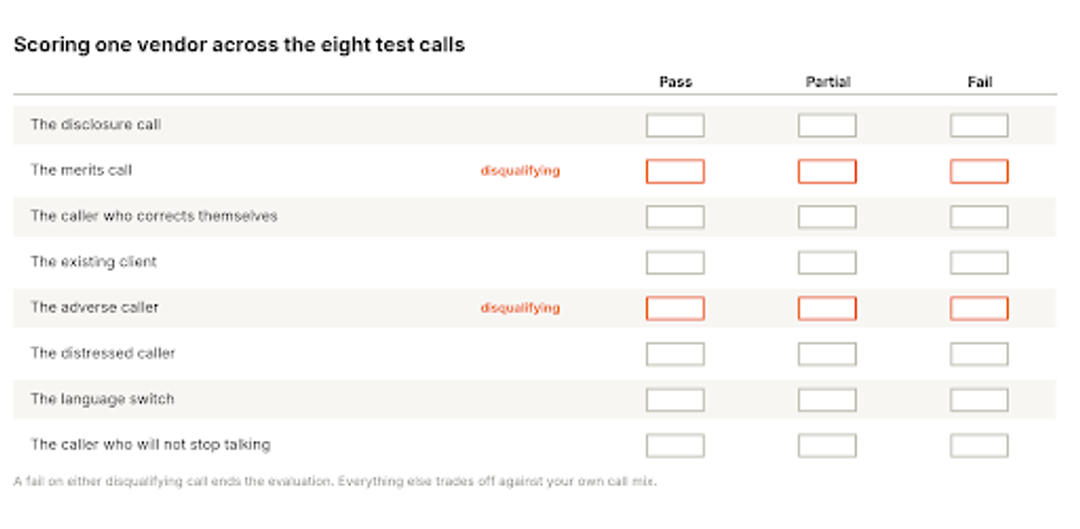
Weight two of them as disqualifying rather than scoring them. An agent that answers the merits question and an agent that intakes an adverse caller both create exposure that no amount of convenience offsets, and a vendor that fails either one should leave the shortlist that day.
The other six weight differently by firm. A practice whose inbound is dominated by prospects should rank the distressed caller and the disclosure call highest, since those are the moments a first impression is made and no member of staff is there to repair it. A practice with several hundred open matters on its books should rank the existing-client and correction tests highest, because those two decide how much work actually leaves the building.
Score each as pass, partial, or fail rather than on a numeric scale. A ten-point scale invites you to average away a result that should have stopped the evaluation, and the results that matter here are categorical.
Then read the transcripts rather than the summaries. A summary reflects what the vendor's system believed happened, and the correction test is specifically designed to make those two differ.
What to do with a vendor that fails a test
A failed test is not automatically the end of a conversation, and treating it as one throws away a bargaining position you could otherwise use.
Some failures are configuration rather than architecture. An agent that missed a correction can often be set to confirm changed fields back to the caller, and one that pushed its script at a distressed caller can usually have a sentiment trigger added to its escalation rules.
Both are worth raising, because the answer tells you whether the vendor treats your finding as a bug or as an unusual request.
Other failures are structural, and no amount of configuration reaches them. An agent that cannot open the matter during the call will never answer an existing client, whatever the roadmap says. An agent whose only output is an email summary will not produce a matter record because a summary is what the product was built to make.
The useful question after a failure is therefore not whether the vendor can fix it, since most will say yes. It is when, in writing, and what happens to the contract if the date passes. A vendor confident in a fix will put a date in the agreement, and one that will not is telling you something about the underlying product.
Keep your test recordings either way. They are the only version of events that does not depend on anyone's memory, and they are useful again at renewal when the behaviour has drifted and nobody can agree on what the agent used to do.
Where HelloCounsel fits
HelloCounsel is our own product, so this section says what it does and leaves the comparison to the calls you place.
Counsel answers the main line in under two rings at any hour, identifies the caller and the matter before the conversation starts, and runs your qualification criteria on the call. Merits questions and anything outside the written criteria escalate to a named destination rather than to whoever is free.
Every call is written back to the case management system as a structured record with the transcript attached. Post-signing calls run on the same agents, so medical records retrieval works provider phone trees and re-requests, and treatment check-ins run on schedule.
Our note on choosing a legal intake service covers the wider procurement question.
Pricing is fixed monthly from $500, scoped to expected volume with 20% tolerance either way, with no per-minute billing and no setup fee. Direct integrations cover SmartAdvocate, Filevine, Litify, Lead Docket and Clio, with custom builds for other systems. Across 25,000 calls and 500 hours of call time, firms working with HelloCounsel have seen a 48% improvement in call reception rates.
The limits are worth stating. It covers English and Spanish and stops there, it runs inside your case management system rather than replacing it, and firms tracking cases in spreadsheets are not a fit.
How to choose the best AI receptionist for your law firm
Score the eight calls, then weight them against your own call mix rather than against a generic ranking. The best AI receptionist for law firms in the abstract is not a useful category, because the tests that matter change with what your phone actually carries.
That is also why a published ranking is a starting point rather than an answer. A list can tell you which vendors are worth eight calls. It cannot tell you which one holds up on yours.
A firm whose volume is mostly new claimants outside business hours should weight the distressed-caller and merits-question tests heavily, because those are the calls that arrive when nobody is there to catch a bad answer. Our comparison of an AI receptionist against an answering service covers what each model costs at that volume.
A firm carrying several hundred open matters should weight the existing-client and correction tests instead, since most of its inbound volume concerns files rather than prospects. How many calls a PI case generates sets out that ratio.
A firm that cannot yet write down its qualification criteria should do that first. No agent applies criteria that exist only in an intake manager's judgment, and the exercise improves the human team whether or not you buy anything.
Budget matters last rather than first here. The products that pass the eight calls cluster closer together on price than the market's range suggests, because the cheap end of the market is mostly made up of general-purpose agents that fail the existing-client and adverse-caller tests on architecture. Once those are out, the remaining spread is narrow enough that the test results should decide it.
What none of these firms should do is pick on price alone. The gap between the best AI receptionist for law firms and an adequate one shows up in staff hours rather than the invoice, which is the same arithmetic behind the casemanager workload.
What to do before your next demo
Write the eight calls out as a script, with the exact words and the exact wrong details you will give, so every vendor gets an identical test. A test that varies between vendors measures your mood rather than their product.
Then decide in advance what a pass looks like on the two disqualifying calls, and hold it. A standard set before the first call is what keeps the comparison honest once the follow-up conversations begin.
If the shortlist itself is still open, our roundup of AI receptionists for law firms covers who is currently in the market.
Get a scoped figure against your own call mix
Send last week's call log split and the case management system you run. We will come back with a fixed monthly price, what it covers beyond intake, and a walkthrough on three of your own recordings. Talk to the HelloCounsel founders
Frequently askedquestions
1. How do I find the best AI receptionist for law firms without a long RFP?
Shortlist three vendors on integration fit, then place the eight test calls. The scoring takes an afternoon and separates products that a feature comparison shows as identical.
2. Should an AI receptionist tell callers it is not human?
It has to be capable of saying so when a caller asks. Utah requires that on request, other states have followed since 2025, and an evasive answer is a liability wherever your firm practices.
3. Can an AI receptionist tell a caller whether they have a claim?
It should decline and route the caller to an attorney. Assessing a claim is a judgment call that ABA Opinion 506 places outside what anyone other than a lawyer may do.
4. What is the most common failure after go-live?
Records that are quietly wrong, usually from a caller correcting a detail the agent captured on the first pass. It rarely appears in a demo and shows up weeks later in the file.
5. Does an AI receptionist need a business associate agreement?
Yes, where it handles treatment information on the firm's behalf. HHS guidance requires the signed agreement before protected health information reaches a subcontractor.
6. How long should the evaluation take?
About a week is enough. One afternoon goes on writing the call scripts, two days on placing the calls across vendors, and a final sitting on reading the transcripts and scoring them.
Share this article