Per-Minute vs. Per-Call vs. Monthly Legal Answering Service Pricing Compared
- Legal answering service pricing comes in three units: the minute, the call, and the month, and the unit decides which of your calls cost the most, so compare quotes on your own call log instead of headline rates.
- Per-minute plans that round each call up to the next full minute add about half a minute to every call, which inflates a two-minute call by roughly 25% and a six-minute call by about 8%.
- At published 2026 rates, per-call pricing becomes cheaper than per-minute pricing once your average billed call passes about two to two and a half minutes; a line, a full intake screening call, passes well before it ends.
- Flat monthly pricing moves volume risk to the vendor inside an agreed band, so ask how wide the band is and what happens in a campaign month that falls outside it.
- Before signing any plan, get the billing increment, the definition of billable time, the overage rate, and the renewal terms in writing, since those terms change the invoice more than the rate does.
Legal answering service pricing comes in three units: the minute, the call, and the month. Each unit puts a different price on the same phone traffic, so a plan that looks cheap for a firm with short status calls can cost several times more for a firm whose new-lead calls run nine or ten minutes. For a plaintiff firm, the unit on the quote matters as much as the rate printed next to it.
If you have priced answering services before, you have probably set a quote for 200 minutes next to a quote for 90 calls and found no direct way to compare them. You may also have watched an invoice land above the plan price because a few long intake calls in one week pushed the minutes past the allowance.
Two legal answering service pricing quotes only become comparable once both are converted into the cost of your actual month of calls. That conversion starts with what each model counts.
What does each legal answering service pricing model actually bill for?
Each model of legal answering service pricing measures something different, and the differences go beyond the unit on the invoice. Vendors also decide what counts toward that unit, including hold time, after-call notes, spam, transfers, and very short calls.
| Model | What the vendor counts | Who carries the volume risk |
|---|---|---|
| Per-minute | Receptionist time from pickup to hang-up or transfer, rounded up per call, sometimes including hold time and after-call work | The firm, because each added minute raises the bill. |
| Per-call | Each answered call regardless of length, with spam often excluded and add-ons such as Spanish or recording charged per call. | The firm, since every extra call raises the bill |
| Flat monthly | Expected volume for the month, priced as one fee within an agreed band | The vendor, until volume leaves the band |
Published terms show how much these details vary on the same model. Ruby bills receptionist time in 60-second increments, rounds every call up, and counts hold time and the work a receptionist finishes after the caller hangs up. LEX Reception times call from pickup to the end of the call, round up to the next minute, and leave 30 calls under 30 seconds unbilled each month.
Smith.ai bills per call, excludes spam and sales calls as long as forwarded lines pass caller ID, and lists its add-ons per call, from $0.25 for recording and transcription to $1.50 for complex routing. Answering Legal sells minute-based plans and bills overage at a per-minute rate set in each firm's agreement.
Plan ladders for each vendor sit in our breakdown of legal answering service costs. On a plaintiff firm's calls, the first difference between the units comes from the rounding built into per-minute plans.
Rounding up to the next minute adds about half a minute to every per-minute call
When a vendor rounds each call up to the next full minute, the invoice gains the unused part of that last minute on every call. Calls end at random points within a minute, so the rounding adds close to half a minute per call on average.
Call durations in a working call center spread out in a lognormal pattern, which Brown and colleagues documented in their study of a bank's call center. We simulated that pattern and a second one at average call lengths from 1.5 to 9 minutes, and rounding added between 0.50 and 0.56 billed minutes per call in every case.
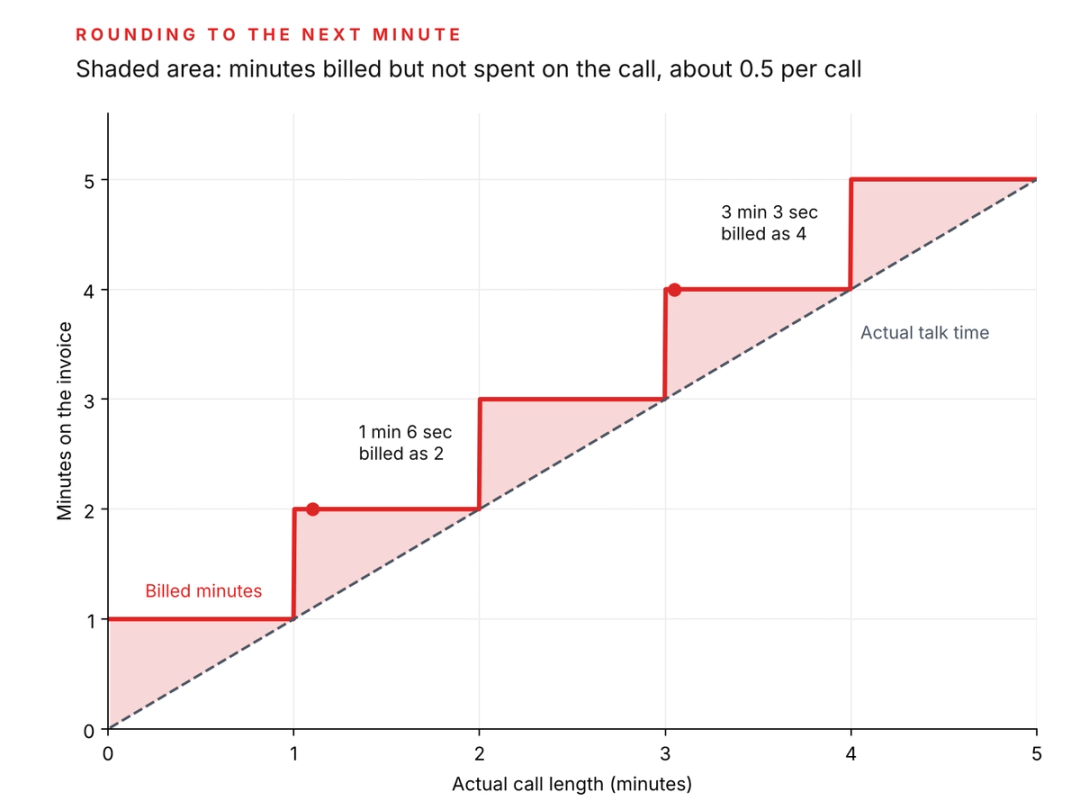
Half a minute weighs most on short calls. Rounding inflates billed time by about 25% on a two-minute average call, about 12% on a four-minute call, and about 8% on a six-minute call, so the overhead falls hardest on existing-client calls about a hearing date or a settlement check.
In the illustrative 400-call month below, rounding alone adds 200 billed minutes, which at $3.45 a minute comes to $690 a month and $8,280 a year for time nobody spent on the phone.
Hold time and after-call work run on the same meter. A ConsumerAffairs reviewer objected to being billed for "the RINGING and the HOLD TIME," and Ruby's published terms do count hold time as receptionist time, so it pays to know which parts of a call your plan bills before the first invoice arrives.
Rounding is the least visible line in legal answering service pricing, and hold time sits right behind it. Both push per-minute costs up on every call, which raises the obvious comparison: at what call length does paying per call become cheaper?
Where is the break-even between per-minute and per-call pricing?
The break-even between the two usage models of legal answering service pricing comes from one division. Divide the per-call price by the per-minute rate, and the result is the number of billed minutes at which both models charge the same for a call, with per-call pricing cheaper above that number and per-minute pricing cheaper below it.
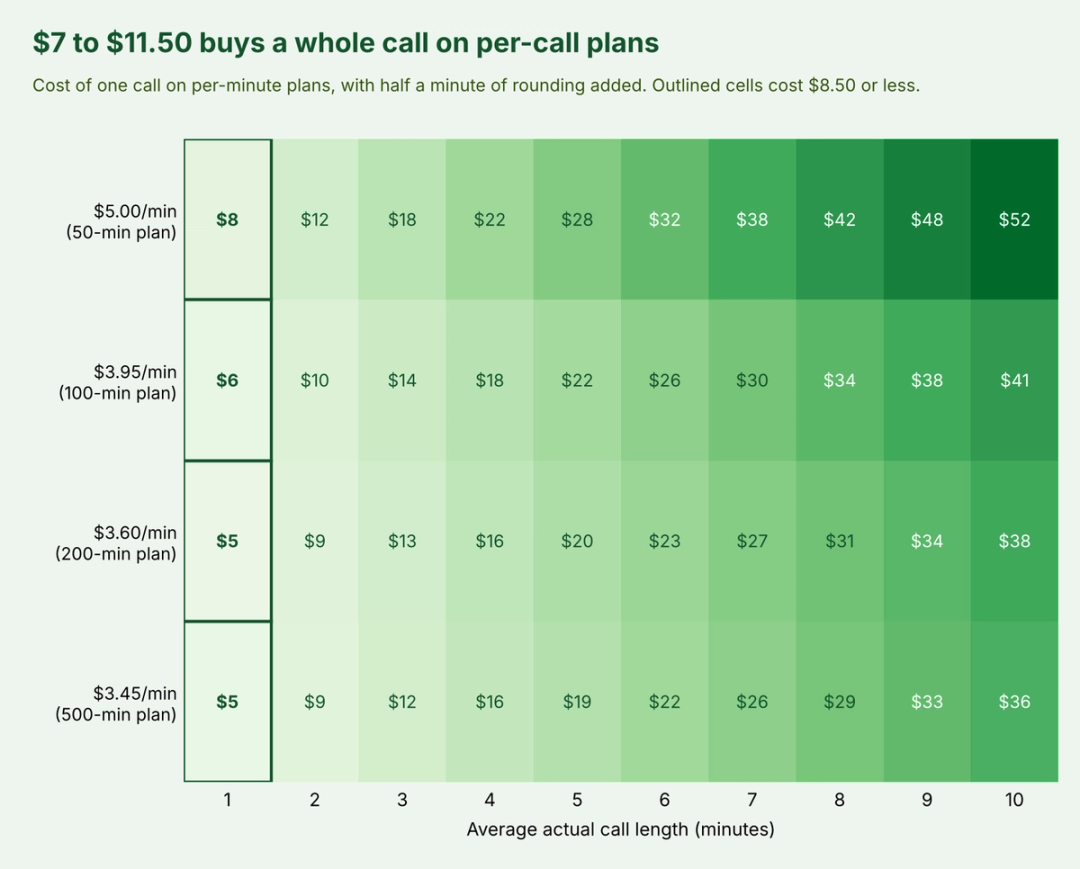
Published rates put that line low. Ruby's plans work out to $5.00 a minute on its 50-minute plan, $3.95 on 100 minutes, $3.60 on 200, and $3.45 on 500, while Smith.ai's included calls cost $10.00 each on its 30-call plan, $9.00 on 90 calls, and $7.00 on 300, with overage at $11.50, $10.50, and $8.50.
| Pairing at similar monthly spend | Per-minute rate | Per-call rate | Break-even billed minutes per call |
|---|---|---|---|
| Ruby 100-minute plan ($395) and Smith.ai 30-call plan ($300) | $3.95 | $10.00 | 2.5 |
| Ruby 200-minute plan ($720) and Smith.ai 90-call plan ($810) | $3.60 | $9.00 | 2.5 |
| Ruby 500-minute plan ($1,725) and Smith.ai 300-call plan ($2,100) | $3.45 | $7.00 | 2.0 |
Once the half-minute rounding overhead is counted, 2.5 billed minutes corresponds to an actual call of about two minutes. Any call that runs longer than that costs more on the minute meter than on the call meter, before add-ons.
Plan tiers add a second step to both meters. A firm that uses 210 minutes on a 200-minute plan pays overage on the last ten, and a firm that consistently lands just past a tier boundary is better off on the next tier up, so price the tier you will actually use in a normal month, not the one that matches last month.
Per-call add-ons narrow the gap without closing it. A Spanish-language line at $1.00 and recording at $0.25 lift a $7.00 call to $8.25, which still undercuts a four-minute call on every Ruby plan, since even the $3.45 rate charges about $15.50 for that call once rounding is included.
Transfers carry their own charges on some per-call plans. Smith.ai includes one transfer destination on its 30-call plan, two on 90 calls, and ten on 300, and charges $15 a month for each extra destination, which matters to a PI firm that routes callers to intake, case managers, and a records team.
Per-call pricing has its own weak spot, and it shows up on short calls. A 40-second call from an existing client asking whether the firm received her medical bill costs the same $7.00 to $11.50 as a ten-minute intake, against $3.45 to $5.00 on a minute plan, which is where a firm's call mix starts to decide the answer.
Why does a personal injury firm's call mix decide which model costs less?
A plaintiff firm's phone traffic mixes long intake calls with short calls from existing clients, providers, and adjusters' offices, and each pricing model charges those two groups very differently. The proportion matters more than the average, because the average hides which calls drive the bill, a pattern our analysis of how many calls a PI case generates traces across the life of a matter.
To show the effect, we built an illustrative 400-call month: 240 existing-client calls averaging three minutes, 120 new-lead intake calls averaging nine minutes and 40 other calls averaging 90 seconds. Counting talk time and rounding only, before any hold time or after-call work, those calls come to 2,060 billed minutes against 1,860 minutes of actual talk time.
| Pricing model | How we priced the 400 calls | Monthly cost |
|---|---|---|
| Per-call (Smith.ai 300-call plan) | $2,100 for 300 calls, plus 100 overage calls at $8.50 | $2,950 |
| Per-call with add-ons | The same, plus a Spanish line on 80 calls and recording on all 400 | $3,130 |
| Per-minute (Ruby rates) | 2,060 billed minutes at the 500-minute plan's included rate of $3.45 | About $7,107 |
| Flat monthly | One fee scoped to 400 calls | Quoted per firm |
The per-minute figure is an estimate, because Ruby's public pricing stops at 500 minutes and doesn't list an overage rate, so a firm at this volume would negotiate a custom plan. Whatever rate comes out of that negotiation, more than half of the billed minutes come from the 120 intake calls, which make up less than a third of the volume.
The mix flips the result for a different kind of practice. A firm whose traffic is mostly short status calls pays less per minute, a PI firm with heavy intake volume pays less per call, and both see the bill climb whenever volume does.
What does one nine-minute intake call cost on each model?
A single new-lead call shows where the billed minutes come from. Say the screening runs nine minutes and 10 seconds, the receptionist puts the caller on hold for a minute while trying the intake team, and then spends two minutes writing up the message.
On a per-minute plan that bills hold time and after-call work by the rules Ruby publishes, the meter records 13 minutes, which costs $44.85 at $3.45 and $65.00 at $5.00. On a per-call plan, the same call costs $7.00 to $11.50 plus any add-ons, and under a flat monthly fee it adds nothing to the invoice as long as the month stays inside its band.
The gap on one call looks small next to a signed case, but legal answering service pricing is paid on every call, including the leads that never sign. A firm taking 120 intake calls a month at 13 billed minutes each runs up 1,560 minutes on intake alone, three times the largest plan on Ruby's public page.
How do the totals compare with an in-house intake hire?
The other benchmark on any legal answering service pricing decision is a person on payroll. The Bureau of Labor Statistics puts receptionist pay at $38,010 a year, about $3,168 a month in wages before benefits, for one person covering 40 of the week's 168 hours.
That hire costs about the same as the per-call total in the 400-call example, yet one person answers only during business hours, can't take a second call while on the first and is off for breaks and sick days. A firm that hires still needs coverage for evenings and weekends, so the fair comparison is staff plus a service against a service on its own, and every option here except a flat fee charges more in the months when call volume rises.
One fixed fee for a variable call month
Bring a month of call volume and average call length, and see how HelloCounsel scopes a single monthly fee to it. Book a fixed-fee pricing demo
Flat monthly pricing moves volume risk from your firm to the vendor
A flat monthly fee is the one form of legal answering service pricing that prices the expected month instead of each unit inside it. The vendor scopes the fee to your normal volume and absorbs the swings inside an agreed range, so a week of long intake calls or a busy Monday doesn't change the invoice.
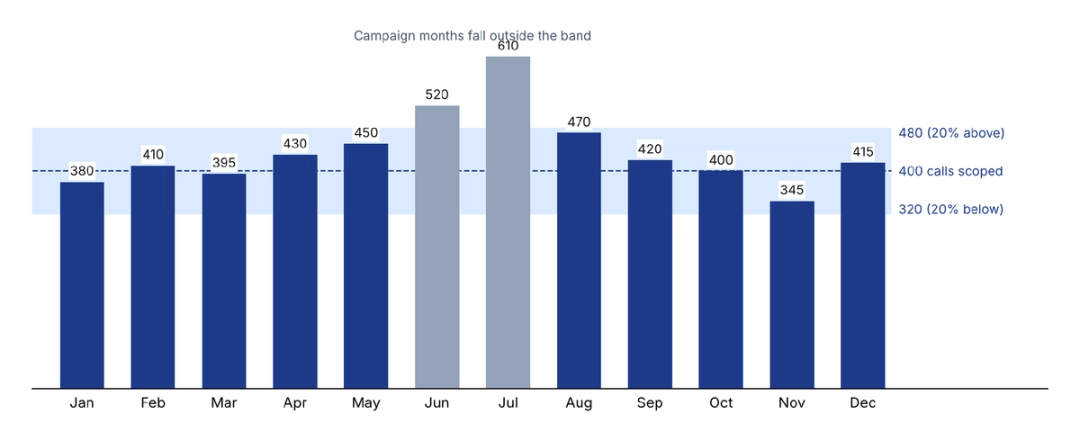
The band makes the model work, and its width is the first term to ask about. HelloCounsel, for example, allows 20% on either side of the volume a fee is scoped to, so a firm scoped at 400 calls pays the same in any month between 320 and 480 calls.
A flat fee is only comparable once you know what it covers. Ask which hours are included, whether outbound follow-up calls count against the scoped volume, and whether the fee covers writing each call into your case management system or only taking a message.
Campaign months are where flat pricing needs a second look. A mass tort campaign or a TV flight can push volume past any band, so ask every flat-fee vendor, including us, how the fee changes when a month lands outside the range and how much notice each side gets.
Usage pricing has the opposite exposure. On a per-minute or per-call plan, the campaign month is the most expensive month of the year, arriving in the same month the firm pays for the media that drove the calls.
Flat pricing also gives up something in quiet months. A firm on a usage plan pays less when volume drops below its normal level, while a flat fee stays where it was until the month falls below the band, so a practice with long, predictable lulls should weigh that before choosing a fixed fee.
Band width and rescoping are contract terms, and so are the details that set the real price on usage plans.
Six contract terms change an answering service invoice more than the rate does
Two quotes with the same headline rate can produce very different invoices, because every contract defines the unit in its own way.
1. Billing increment: Ask whether calls round to the minute, to the next 30 seconds or by the second, since the increment sets the rounding overhead on every call.
2. Billable time: Ask whether hold time, after-call notes, transfers and ringing count toward the meter.
3. Short calls and spam: Ask whether hang-ups, wrong numbers and robocalls are billed, and whether the exclusion depends on caller ID passing through.
4. Overage rate: Get the per-minute or per-call overage rate in writing, since several vendors set it in the agreement instead of on the pricing page.
5. Per-call add-ons: List every add-on your intake needs, such as Spanish, recording or appointment booking, and price each one on your full volume.
6. Renewal and price changes: Ask how much notice the vendor gives before a rate increase and whether plans can change mid-term.
Supervision belongs on the same list. ABA Model Rule 5.3 makes lawyers responsible for the nonlawyers who work for the firm, including outside services, so a contract that gives you call recordings or transcripts lets you supervise what the service tells callers and check the minutes on the invoice against the calls themselves.
A quarterly invoice audit needs only a sample. Ask the vendor for call-level detail with the start time, talk time, and billed minutes for each call; pull 20 calls at random; and match them against your own phone system's records, which show quickly whether rounding, hold time, and short calls are billed the way the contract says.
These six terms decide what an answering service bills for a call. They say nothing about what happens to the call afterward, which is the part of the cost that never appears on the invoice.
HelloCounsel charges a fixed monthly fee scoped to your call volume
Usage-based legal answering service pricing pays for the call and hands the follow-up back to your team, so someone still enters the caller into the case management system, calls the lead back to finish the screening, and opens the matter. That staff time stays off the answering service invoice and lands in your intake team's week, which our ROI analysis of AI answering services puts a number on.
HelloCounsel builds AI voice agents for plaintiff personal injury firms, and its agent does that follow-up work inside the call. HelloCounsel is our own product.
- Answering: HelloCounsel answers your main line 24/7 as an AI receptionist, in under two rings, identifies the caller and any existing matter before the conversation starts, and follows custom call flows for new callers, existing clients, and attorneys.
- Qualification: HelloCounsel screens new leads against your case criteria through AI intake, in English or Spanish with mid-call switching, and routes each file to signing, attorney review, or a referral.
- Case opening: HelloCounsel opens the matter and the insurance claim once the client signs.
- Case management: HelloCounsel runs treatment check-ins, waits on hold with providers and adjusters, and completes tasks inside the matter.
- Medical records: HelloCounsel requests records from providers and organizes them into the file after intake qualification.
- Lead follow-up and client check-ins: HelloCounsel follows up with leads who haven't signed and keeps clients updated between milestones.
- CMS write-back: HelloCounsel writes every call to the matter through direct integrations with SmartAdvocate, Filevine, Litify, Lead Docket and Clio, and we build custom integrations for other systems.
- Escalation and reporting: HelloCounsel hands a call to a person on any flow and reports on call performance.
We price on a fixed monthly fee starting at $500, scoped to your expected call volume with 20% tolerance either way, with no per-minute billing and no setup fee. Long intake calls, hold time and after-call write-back don't add to the invoice, because there is no minute meter running.
HelloCounsel has handled more than 25,000 calls and 500 hours of call time and has delivered a 48% improvement in call reception rates. Onboarding takes about an hour and runs on 17 multiple-choice questions, and agents go live in SmartAdvocate in about a week.
HelloCounsel has clear limits: it works in English and Spanish only, it runs inside your case management system rather than replacing it, and a firm that tracks cases in spreadsheets isn't a fit.
Three numbers from your call log decide which pricing model fits your firm
Pull three figures from the last three months of your phone system before requesting legal answering service pricing quotes.
1. Calls per month: Total answered calls, split into new leads and everyone else, since intake calls drive per-minute costs.
2. Average billed minutes per call: Your average call length plus half a minute for rounding, which shows which side of the 2 to 2.5 minute break-even you sit on.
3. Peak-to-average ratio: Your busiest month divided by your average month, which shows how often you would land outside a flat-fee band and what a usage plan would charge in that month.
Send the same three numbers to every vendor and ask each for a priced month at your average volume and at your peak. Quotes built on identical inputs can be compared line by line, and our side-by-side of Ruby and Smith.ai shows that comparison worked through for Ruby's per-minute plans and Smith.ai's per-call plans.
For a plaintiff firm with steady intake volume, legal answering service pricing usually comes down to this: long screening calls make per-minute plans the most expensive option, per-call plans cheaper but still tied to volume, and a flat fee the only model where a busy month costs the same as a quiet one.
A monthly figure built from your own call log
Share your call log with HelloCounsel's founders and leave with a fixed monthly figure covering intake, follow-up and write-back. Discuss your monthly figure with our founders
Frequently asked questions about legal answering service pricing
1. What are the main legal answering service pricing models?
Legal answering services price per minute of receptionist time, per answered call, or as a flat monthly fee scoped to expected volume. HelloCounsel uses the flat monthly model, starting at $500 with 20% volume tolerance either way.
2. Is per-call or per-minute pricing cheaper for a law firm?
At published 2026 rates, per-call pricing becomes cheaper once the average billed call passes about 2 to 2.5 minutes. Firms with long intake calls pay less per call, and firms with mostly short status calls pay less per minute.
3. How do answering services round call minutes?
Ruby and LEX Reception both round every call up to a whole minute, and Ruby also counts hold time and after-call work. Rounding adds about half a minute per call on average.
4. Do answering services charge for spam calls?
Policies vary. Smith.ai excludes spam and sales calls when forwarded lines pass caller ID, and LEX Reception leaves 30 calls under 30 seconds unbilled each month, so ask each vendor how it treats short and unwanted calls.
5. What happens in a busy month on a flat monthly plan?
Inside the agreed band, the invoice stays the same. HelloCounsel's band is 20% either side of scoped volume, so ask any flat-fee vendor before signing how it prices a month outside the band.
6. Does HelloCounsel charge per minute?
HelloCounsel charges a fixed monthly fee starting at $500, scoped to expected call volume, with no per-minute billing and no setup fee.
Share this article