What to Look for in a Legal Answering Service

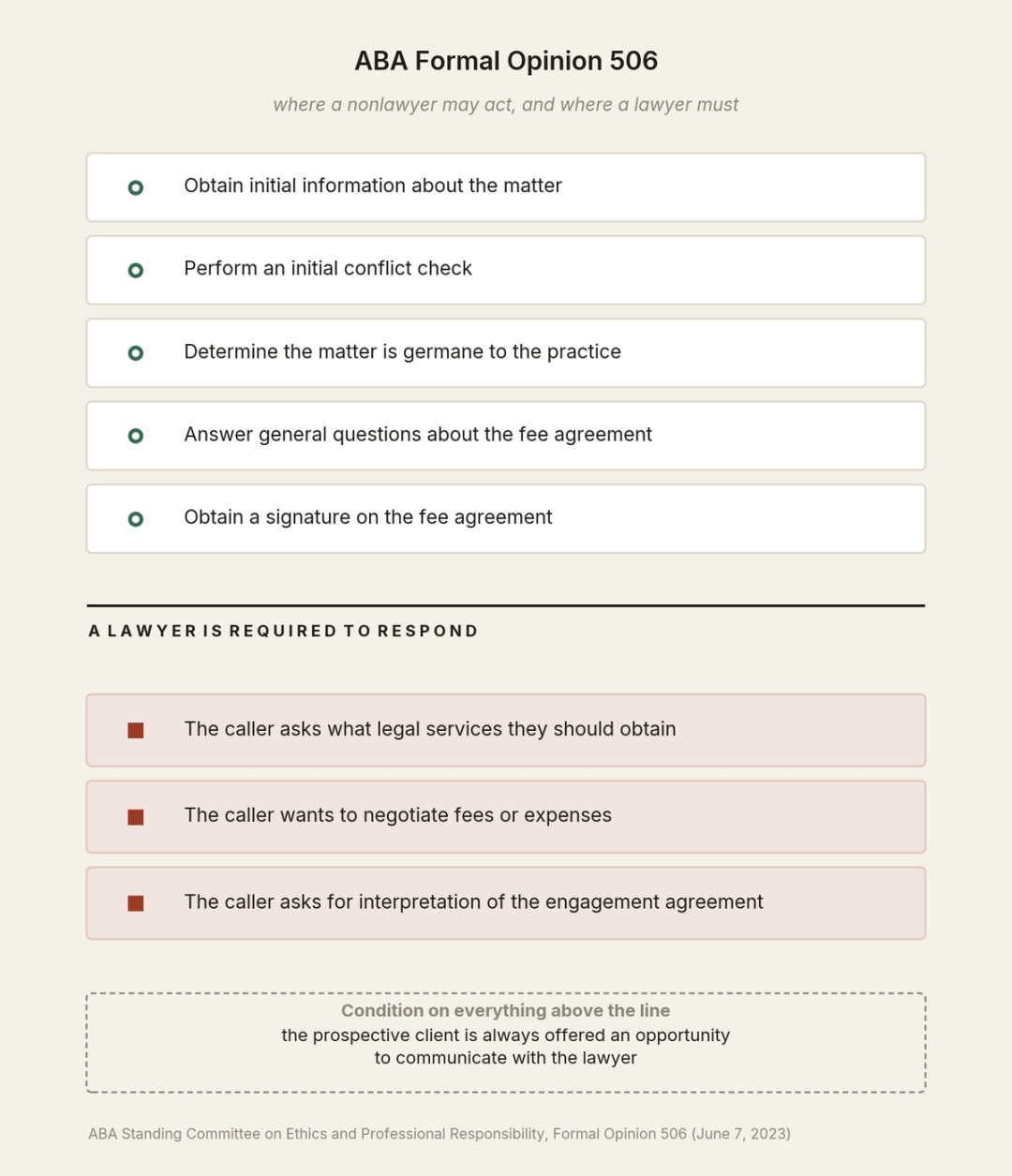
- ABA Formal Opinion 506 permits a nonlawyer to gather initial case information, run a conflict check, and even obtain a signature on a fee agreement, but only if the prospective client is always offered the chance to speak with the lawyer.
- The same opinion draws a hard line: if a caller asks what legal services they need, tries to negotiate fees, or asks what the engagement agreement means, a lawyer has to answer.
- Model Rule 5.3 makes the supervising lawyer answerable for a vendor's conduct, so a service that cannot show you what it said on a call leaves you unable to meet a duty you cannot delegate.
- Confidentiality attaches at hello. Under Rule 1.18, a caller who never signs is still a prospective client, and information learned on that call can disqualify the firm from the matter on the other side.
- California and Florida require consent from every party before a call is recorded, which makes a recording policy a legal question rather than a quality-assurance preference.
- Conflict screening is sold as a paid add-on by at least one major provider, which tells you it is not standard.
- Deciding what to look for in a legal answering service is ultimately a supervision problem rather than a feature comparison.
Search for guidance on what to look for in a legal answering service, and the same list comes back every time: round-the-clock coverage, bilingual agents, custom scripts, an integration with Clio or MyCase, and a warning about per-minute billing. Thirteen pages compete for this query, and they recycle the same thirteen points.
Every one of those points tests the vendor. Not one tests the firm, which is where the duty actually sits, because an answering service does not hold a bar license and your firm does.
That distinction is not theoretical, and the clearest evidence is in a rate card. Smith.ai, one of the larger providers in the category, publishes its pricing openly and lists conflict screening at fifty cents per lead, under optional add-ons, alongside calendar booking and Slack notifications.
A firm reading that page would reasonably conclude conflict checking is a feature it can decline. The duty to avoid a conflicted matter is not a feature, and it does not become optional because a vendor priced it that way.
That gap, between what the market sells and what the rules require, is what this guide works through: the authorities that govern an outside service handling your intake calls and the questions they turn into.
The line ABA Formal Opinion 506 draws through an intake call
In June 2023, the ABA Standing Committee on Ethics and Professional Responsibility issued Formal Opinion 506, titled "Responsibilities Regarding Nonlawyer Assistants." It is the most directly applicable authority in existence for anyone buying an answering service, and it is absent from every commercial page competing for this topic.
The opinion is permissive where firms often assume it is restrictive. A nonlawyer may handle "obtaining initial information about the matter, performing an initial conflict check, and determining whether the assistance sought is in an area of law germane to the lawyer's practice. " A nonlawyer may assist "with answering general questions about the fee agreement or process of representation. " A nonlawyer may go as far as "obtaining the prospective client's signature on the fee agreement."
That is a wide grant. An answering service that collects the facts of a crash, screens the matter against your existing client list, confirms the case is the kind your firm takes, and walks a caller through signing is operating inside the opinion, not outside it.
The grant carries one condition and one boundary. The condition runs through the whole opinion: all of it is permitted "provided that the prospective client always is offered an opportunity to communicate with the lawyer, including to discuss the fee agreement and scope of representation. "Not a callback at the firm's convenience, and not an offer made only when the caller pushes. An offer, extended as a matter of course.
The boundary is specific. The opinion states that "if the prospective client asks about what legal services the client should obtain from the lawyer, wants to negotiate the fees or expenses, or asks for interpretation of the engagement agreement, the lawyer is required to respond." Three triggers, and when a caller hits one, the answer has to come from an attorney.
Those three triggers are the first thing to test. They are also the point at which most intake scripts quietly fail, because a caller asking, "Do I even have a case?" has asked question one, and an agent trained to reassure will answer it.
Ask any vendor to show you the exact script language that fires on each of the three. A vendor who cannot produce that language on request does not have it.
Hear how your script handles the three questions that require an attorney Send us a recording of a live intake call, and we will mark the moments where the script crossed a line it should not have. Get your intake call reviewed
Why Rule 5.3 puts a vendor's mistakes on your firm's record
Opinion 506 construes several rules, and the load-bearing one is Model Rule 5.3, "Responsibilities Regarding Nonlawyer Assistance." The rule opens by naming its scope: it applies "with respect to a nonlawyer employed or retained by or associated with a lawyer." Retained covers a vendor. An answering service under contract is squarely inside the rule.
Rule 5.3(b) then places the obligation: a lawyer with direct supervisory authority over the nonlawyer "shall make reasonable efforts to ensure that the person's conduct is compatible with the professional obligations of the lawyer." Rule 5.3(a) extends a parallel duty to partners and lawyers with managerial authority, who must put firm-wide measures in place. And 5.3(c) goes further, making a lawyer responsible for the nonlawyer's conduct outright where the lawyer ordered or ratified it or knew of it in time to act and failed to take reasonable remedial action.
Read those three paragraphs together, and the practical meaning is unambiguous. The vendor's conduct is evaluated against your professional obligations, and reasonable efforts are measured by what you did to supervise, not by what the vendor promised in a sales call.
A contract clause assigning compliance to the provider does not move the duty. There is no mechanism in Rule 5.3 for transferring it.
This reframes the evaluation. A service that produces no transcript or produces a summary written after the fact rather than a record of what was said makes supervision impossible as a matter of fact. You cannot make reasonable efforts to ensure conduct is compatible with your obligations if you have no access to the conduct.
The question to put to a vendor is therefore not whether they record calls. It is what artifact reaches your file afterward, how soon, and whose words it preserves.
We have written separately on why answering services create a documentation problem for PI firms, and Rule 5.3 is the reason that problem has teeth.
Confidentiality attaches before anyone signs a retainer
A caller who never becomes a client is still owed duties, and the rule that creates them is routinely skipped in vendor evaluations.
Model Rule 1.18(a) defines the status: "A person who consults with a lawyer about the possibility of forming a client-lawyer relationship with respect to a matter is a prospective client." Rule 1.18(b) attaches the duty: "Even when no client-lawyer relationship ensues, a lawyer who has learned information from a prospective client shall not use or reveal that information, except as Rule 1.9 would permit with respect to information of a former client."
Then 1.18(c) delivers the consequence that matters to a plaintiff practice. A lawyer who received information from a prospective client "that could be significantly harmful to that person in the matter" may not represent someone with materially adverse interests in the same or a substantially related matter. And disqualification is imputed: "No lawyer in a firm with which that lawyer is associated may knowingly undertake or continue representation in such a matter."
Translate that into a motor vehicle practice. Two people are in the same collision, and one calls your firm on Tuesday night, describes the crash in detail to whoever answers, and signs with someone else.
The other calls on Thursday, and your firm signs her. The information taken on Tuesday now sits inside your firm, and whether it was significantly harmful determines whether you can keep Thursday's case.
The operational test is narrow and easy to run. Does the vendor screen for adverse parties during the call, before taking a narrative? Is a flagged matter stopped on the spot, or logged and passed through to be sorted out later?
Then ask what happens to the notes from a flagged call and which of these steps run automatically rather than depending on an agent remembering. Only the automatic ones will survive a busy Friday.
Where recording the call without a warning breaks state law
Nearly every evaluation guide recommends recording calls for quality assurance. Almost none of them mentions that in several states, recording a call without the consent of every party is a crime.
California Penal Code section 632 reaches "a person who, intentionally and without the consent of all parties to a confidential communication, uses an electronic amplifying or recording device to eavesdrop upon or record the confidential communication." The statute defines a confidential communication as one carried on in circumstances indicating a party wants it confined to the parties, which describes an injured caller describing a crash as well as any example could. Violations carry fines of up to $2,500, rising to $10,000 with a prior conviction, and the statute expressly reaches corporations and other legal entities, not just individuals.
Florida Statutes section 934.03 works the same way from the other direction. Interception is prohibited, and subsection (2)(d) carves out the exception: it is lawful "for a person to intercept a wire, oral, or electronic communication when all of the parties to the communication have given prior consent to such interception."
Two consequences follow for a firm shopping for a service. First, the disclosure has to be on the call, before the recording starts, which makes it a scripting requirement rather than a policy document.
Second, and the part firms miss, the exposure travels with the caller rather than the firm. A Georgia practice running television advertising will take calls from people sitting in California and Florida, and the consent rule that applies is determined by where the parties are, not where your office is.
Ask the vendor how the script behaves on an inbound call from an all-party state and whether that behavior is automatic or depends on an agent noticing an area code.
The criteria every vendor list repeats, scored by what they actually prove
The standard account of what to look for in a legal answering service is not useless. It is just undemanding, because each item is written as something a vendor can confirm rather than something a vendor can fail. Reframed as a test with a verifiable answer, the same items do real work.
| Standard criterion | What it proves, as usually asked | The version that can fail |
|---|---|---|
| Round-the-clock coverage | Nothing. Every provider claims it | What percentage of calls between 10pm and 6am last month reached a live person within 30 seconds |
| Legal specialization | Nothing. It is a marketing claim | How many plaintiff PI firms are on the platform now, and will two of them take a reference call? |
| Custom scripting | That scripts exist | How many business days from the requested change to the live script, and what does a mid-quarter revision cost? |
| CMS integration | That a connector exists | Which fields write back automatically, and what happens to a record when the write fails? |
| Confidentiality | That the vendor has heard of HIPAA | Whether agents are employees or subcontractors, where they are located, and who else can read the intake notes |
| Bilingual coverage | That Spanish is available | Whether a Spanish call is handled live or transferred, and the added wait if transferred |
| Call recording | That recordings exist | How consent is obtained on calls from all-party states, and who holds the recordings? |
| Urgent escalation | That escalation is possible | What defines urgent in the script today, and who maintains that definition? |
| Pricing transparency | That a rate card exists | Cost at your actual volume, with overage, rounding, and after-hours differentials applied |
| Conflict screening | Often nothing, because it is an add-on | Whether it runs before the narrative is taken, and whether a flagged matter stops |
The last row is the one to run first. A vendor who screens for conflicts only on request, or who charges for it separately, has told you where it sits in their product. The documented approach to evaluating an AI voice agent applies the same logic across a wider set of capabilities.
The intake fields a plaintiff PI firm cannot lose on the first call
General-purpose evaluation guidance treats intake as a contact-capture problem: name, number, reason for calling, and callback. For a contingency practice, several fields are worth more than the rest combined, because losing them either costs the case or costs the fee.
Date of loss: the statute of limitations runs from it, and a caller eleven months into a one-year window is a different operational priority than one who was hurt yesterday. An intake record without a date of loss cannot be triaged.
Prior attorney contact: whether the caller has already signed with another firm determines whether you can speak with them at all, and a service that collects this after the narrative has collected it too late.
Adverse and involved parties: names for the conflict screen, which has to happen before the facts are taken rather than after.
Treatment status: whether the caller has been seen, by whom, and whether treatment is ongoing drives the medical records workflow from day one.
Mechanism of injury: enough detail to assess liability posture without the agent offering an opinion on it, which is where Opinion 506's first trigger lives.
Insurance and coverage: carrier and whether a claim has been opened, which determines how fast the firm needs to move on preservation.
Referral source: where the call came from, which drives both marketing attribution and, where a referral fee is in play, the analysis of whether the arrangement is permissible.
A vendor demo will not surface whether these fields are captured. The script will. Ask for the current script, in writing, and read it against this list.
Compare your intake script against the fields that decide a PI case We will read your current script and mark every field a plaintiff practice needs that the script does not ask for. Request a script audit
What the service costs measured against the hire it replaces
Pricing comparisons in this category tend to rely on figures nobody sources. Two numbers can be checked, and they frame the decision adequately.
On the in-house side, the Bureau of Labor Statistics reports median pay for receptionists at $38,010 per year, or $18.27 per hour, for 2025. That is the median wage alone, before employer payroll taxes, benefits, equipment, and the hours the role is not covered, which for a single hire is every evening, every weekend, and every holiday.
On the vendor side, Smith.ai's published rate card lists $300 per month for 30 calls with overage at $11.50 per call, $810 per month for 90 calls with overage at $10.50, and $2,100 per month for 300 calls with overage at $8.50. The structure matters more than the tiers: every plan is a call allotment with a per-call charge beyond it, so the effective rate is set by how far past your tier you land, not by the headline price.
Run your own volume through whatever structure a vendor quotes, at your actual monthly call count rather than the one that makes the tier look sensible, and then run it again at the volume you would see after a campaign. Most of the unpleasant surprises in this category are overage, not base rate. Our breakdown of how many calls a PI case actually generates gives a realistic input for that model, and it is usually higher than firms expect.
The comparison that gets skipped is a third option. A missed call costs the case, not the minute, and the hidden cost of missed calls at a PI firm sets that against both figures above.
A vendor test that surfaces what a demo hides
A demo is a performance of the product's best path. These five steps put the product on paths it was not rehearsed for, and all of them can be run in an afternoon.
Most of what to look for in a legal answering service only shows up under conditions the sales process avoids, so build the trial around those.
Call the service as a prospective client three times. Once as a clean signable case, once as a caller outside your practice area, and once as an existing client with an urgent problem. Listen to what happens at the end of each. The second and third calls are where scripts break.
Ask the question that requires a lawyer. On one of those calls, ask whether you have a case, then ask what the firm charges. Note precisely what the agent says and whether an attorney is offered, which is Opinion 506's boundary tested live.
Place a call from an all-party consent state. Use a California or Florida number and listen for whether a recording disclosure is given before anything is recorded.
Request a script change and time it. Ask for a specific, small change, then measure business days to live. A vendor who needs two weeks for a word change cannot support a firm running campaigns.
Read the artifact that lands in your file. Not the dashboard. The record that reaches your case management system. Check whether it holds the caller's words or a summary, whether the fields above are populated, and whether you could hand it to a supervising partner as evidence of what was said.
How HelloCounsel handles the first call
HelloCounsel is our product, so read this section as a description of design decisions rather than a neutral assessment.
The agent runs the conflict screen on names before it takes a narrative, and a flagged matter stops the intake rather than completing and getting sorted out afterward. Opinion 506's three triggers are handled as hard stops in the script: a caller asking whether they have a case, asking about fees, or asking what a retainer clause means gets routed to an attorney, and the attempt is logged whether or not the attorney is reachable.
Recording disclosure is keyed to the caller's state rather than the firm's, so a call from a California or Florida number carries the all-party disclosure before recording begins, without an agent needing to catch it.
Every call produces a transcript and a structured record written back into the case management system, with the PI fields listed above as required rather than optional. The transcript exists so a supervising lawyer can satisfy Rule 5.3 with a record rather than an assurance. Our note on CMS write-back covers the mechanics of how that record lands.
Where a generic receptionist product falls short of this, we have written up why a generic AI receptionist does not work for a PI firm in more detail.
The numbers that tell you whether it is working
Vendors report call volume, answer rate, and average handle time. All three can look excellent while the service fails at its job, because none of them measures an outcome.
Four measures do. Signed cases by call source, which is the only number that answers whether the service pays for itself. Time from first call to first attorney contact, measured in business hours, which is where client communication problems begin.
Conflict flags raised per hundred intakes, which should not be zero, because a service reporting zero is not screening. Records with a complete field set, measured against the seven fields above, which tells you whether the intake is usable without a second call.
Review those four monthly against the script, not quarterly against the invoice. A script drifts, and the number that moves first is usually field completeness.
Choosing between the answers in front of you
The checklist circulating for this decision tests whether a vendor can say yes. The rules test whether your firm can show its work. Deciding what to look for in a legal answering service comes down to which of the two you are actually accountable for, and under Rule 5.3 it is the second one.
Three things settle most of it: whether conflict screening runs before the narrative and stops a flagged matter, whether the three questions in Opinion 506 route to an attorney reliably rather than occasionally, and whether what reaches your file afterward is a record you could hand to a supervising partner.
A service that clears those three will clear the standard checklist as a matter of course. A service that clears the checklist may fail all three.
Bring us the call that worries you
Play us the intake call you would least like a bar committee to hear, and we will tell you what we would change about the script. Talk to the HelloCounsel founders
Frequently asked questions
1. Can a legal answering service sign up clients without a lawyer involved?
Under ABA Formal Opinion 506, yes, a nonlawyer may take the signature on a fee agreement. The opinion conditions that on the caller being offered a conversation with the lawyer about the agreement and the scope of the work, and treats the offer as a condition of the arrangement rather than a courtesy.
2. Who is responsible if an answering service gives a caller legal advice?
The supervising lawyer carries it. Rule 5.3 reaches any nonlawyer the firm retains, places a supervision duty on whoever oversees them, and under 5.3(c) makes the lawyer answerable outright for conduct they ordered, ratified, or knew about in time to fix. A contract assigning compliance to the vendor does not shift that.
3. Does an answering service create a conflict of interest problem?
It can, and the mechanism is worth understanding. Rule 1.18 extends confidentiality to anyone who consults the firm, whether or not a retainer follows, and what the firm learns from one caller can bar it from taking the other side of the same incident. Because that bar is imputed firm-wide, screening has to happen before the narrative rather than after.
4. Is it legal to record intake calls?
It depends on where the parties are. California and Florida both require every participant to agree before a call is recorded, under Penal Code section 632 and Statute section 934.03(2)(d), respectively. Because the caller's location governs rather than the firm's, any practice advertising across state lines needs the disclosure built into the script rather than filed in a policy.
5. What should a legal answering service cost?
Published rates in this category run from roughly $300 to $2,100 a month depending on how many calls the plan covers, with $8.50 to $11.50 charged on each call past that. The number that decides the question is not the tier price but what you pay at your real volume, set against a receptionist hire at a BLS median of $38,010 a year plus employment costs and with no evening or weekend coverage.
6. Do these questions change if the answering service uses AI?
The rules do not change. An AI agent retained by a firm is non-lawyer assistance under Rule 5.3 exactly as a human agent is, and Opinion 506's boundary applies to it the same way. The practical differences are that script behavior is deterministic rather than dependent on an individual remembering and that a transcript is produced by default, which makes the supervision Rule 5.3 required easier to evidence.
Share this article