
- Plaintiff firms usually collect a client's records with a signed authorization, and they subpoena medical records once a lawsuit is filed and a provider stops responding or trial needs certified copies.
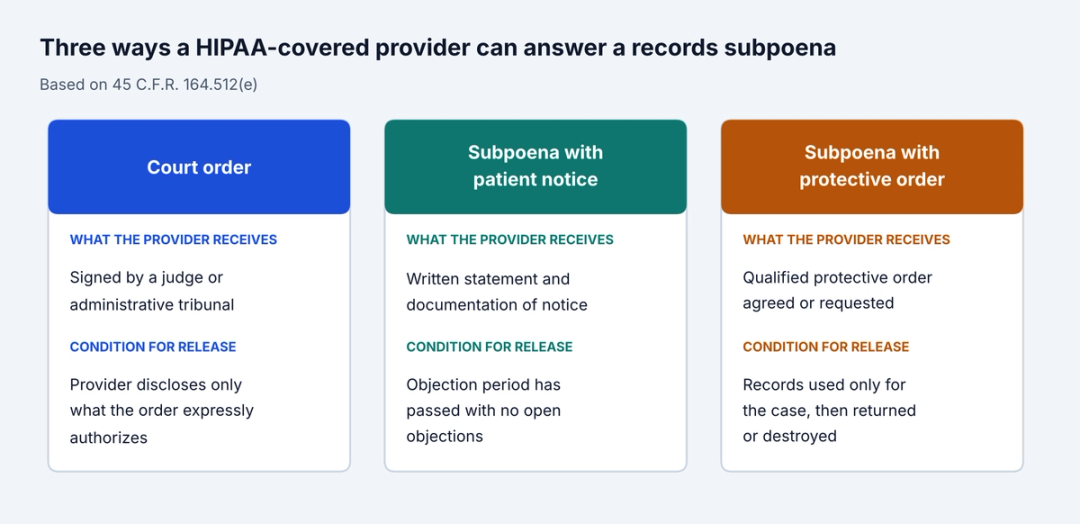
- HIPAA lets a provider answer a subpoena backed by a court order, and a subpoena without one needs proof of patient notice or a request for a qualified protective order.
- Federal Rule 45 requires notice to every other party before a document subpoena is served and gives the recipient 14 days to object.
- Treatment records from federally assisted substance use programs need a subpoena and a court order with specific findings under 42 C.F.R. Part 2.
- Defense subpoenas for a client's records deserve a same-day read, since a timely objection can narrow an overbroad date range.
An authorization covers almost every record request a plaintiff firm makes before suit. The client signs, the provider sends copies, and the case keeps moving without any court involvement.
Litigation changes the toolkit. Once a complaint is on file, a records department that has ignored three authorization letters can be compelled to produce, and a trial date creates a need for certified copies that an authorization request rarely produces.
Knowing when and how to subpoena medical records saves weeks in those moments. The same knowledge protects the client when the subpoena comes from the other side, since a defense request for "all records from birth to present" can reach far past the injury in the case.
Timing pressure makes the choice concrete. A provider that takes six weeks to produce can push a deposition or an expert report past its deadline, so a firm that knows the steps serves early and plans around the notice periods.
What is a subpoena for medical records?
Legally, a records subpoena is a court-issued command directing a provider's records custodian to produce documents by a set date. Lawyers call it a subpoena duces tecum, Latin for "bring with you," and it can be served on a provider who is no party to the case.
Some courts allow a records-only deposition subpoena. In that version the custodian delivers copies with a sworn declaration in place of a trip to a deposition room, which suits records that only need authentication.
Any adult who is outside the case may serve a federal subpoena under Rule 45(b)(1). Process servers and records copy services handle most of this work, and the copy service also handles pickup once the provider is ready.
Plaintiff firms subpoena medical records after an authorization stalls because a court command carries more weight. The court's power to compel stands behind it, and a custodian who ignores one risks a motion and, eventually, contempt.
When should a PI firm subpoena medical records instead of using an authorization?
Pre-suit requests run on authorizations, and a firm can subpoena medical records only once a case is in litigation. Within a lawsuit, the choice depends on whose records the firm needs and how the provider has responded so far.
| Situation | Better tool | Reason |
|---|---|---|
| The client's treating records before suit is filed | Signed HIPAA authorization | Fastest route, with no court process needed |
| A provider ignoring authorization requests after suit is filed | Subpoena duces tecum | Creates an enforceable deadline with court backing |
| Certified copies needed for trial | Subpoena with a custodian declaration | Produces records ready to authenticate without a live witness |
| Records of a person other than the client | Subpoena with notice or a protective order | The firm has no authorization from that person |
| Substance use disorder treatment records | Subpoena plus a Part 2 court order | Federal rules require both before disclosure |
The fourth row deserves extra care. A defendant driver's medical history, for example, becomes relevant only when a condition such as a seizure disorder may have caused the crash, and courts expect a narrow request tied to that issue.
Ownership changes create another common case for a subpoena. A physical therapy clinic sold to a regional chain may stop answering authorizations sent to the old address, and a subpoena served on the new owner's custodian puts a court deadline on the transfer of the old files.
For the client's own records, an authorization remains the default even after filing. Our guide to the medical records workflow covers the authorization route, and the subpoena comes out when that route stalls.
What does HIPAA require before a provider can comply?
When attorneys subpoena medical records, providers covered by HIPAA can release them through two doors. The first is a court order, and under 45 C.F.R. 164.512(e)(1)(i) the provider may disclose only the information that order expressly authorizes.
The second door is a subpoena without a court order, which works only with "satisfactory assurance" attached. The requesting party must show either that the patient received notice and a chance to object or that the parties sought a qualified protective order.
Notice-based assurance comes as a written statement with documentation. It shows a good-faith attempt to notify the patient and enough detail for the patient to object, along with proof that the objection period ended without unresolved objections.
Each provider decides how it handles these assurances in practice. Hospitals commonly publish a subpoena policy through their release-of-information vendor, and reading it before service avoids a rejection letter.
Notice to a non-client patient needs particular care. The letter should identify the case and the records sought, then state the deadline for objecting, so the documentation the provider receives shows the person had a fair chance to respond.
A qualified protective order limits use of the records to the lawsuit itself. It also requires the parties to return or destroy the records, including copies, when the case ends.
How do you issue a subpoena for medical records?
The procedure to subpoena medical records depends on the court hearing the case. Cases in federal court follow Federal Rule of Civil Procedure 45, and state courts use their own versions with different notice periods and forms.
Under Rule 45, an attorney admitted to practice in the issuing court may sign the subpoena as an officer of the court. Before serving a subpoena for documents, the firm must give every other party notice and a copy, and production may be required within 100 miles of where the provider regularly does business.
State rules can add steps of their own. California's Code of Civil Procedure section 1985.3, for instance, adds a mandatory notice to the patient before the records custodian can be served, and a patient who is a party may move to quash before production.
A well-drafted subpoena answers the custodian's questions before they are asked. Six details belong in every one:
- Custodian: The records custodian of the named facility, with the facility's legal name and address.
- Records described: Clinical records and itemized billing, each listed separately, for named dates of service.
- Date range: A range tied to the injury, such as the crash date through the present.
- Production method: Delivery of copies with a custodian declaration in place of a personal appearance, where the court's rules allow it.
- Deadline: A production date that satisfies the notice periods in the governing rule.
- HIPAA assurance: The notice statement or protective order documentation attached to the subpoena.
Draft the description narrowly enough that the custodian can find the records quickly. A request for "all records relating to treatment of the lumbar spine from March 2024 to present" gets processed faster than a request for "any and all documents."
Specify the delivery format in the subpoena as well. Searchable PDFs on a secure download link avoid paper copying charges and let the paralegal start the chronology the day the records arrive.
Witness fees matter only when the subpoena commands attendance. Rule 45(b)(1) requires tendering one day's attendance fee and mileage in that case, so a records-only subpoena with a custodian declaration avoids the expense.
How long does it take to subpoena medical records?
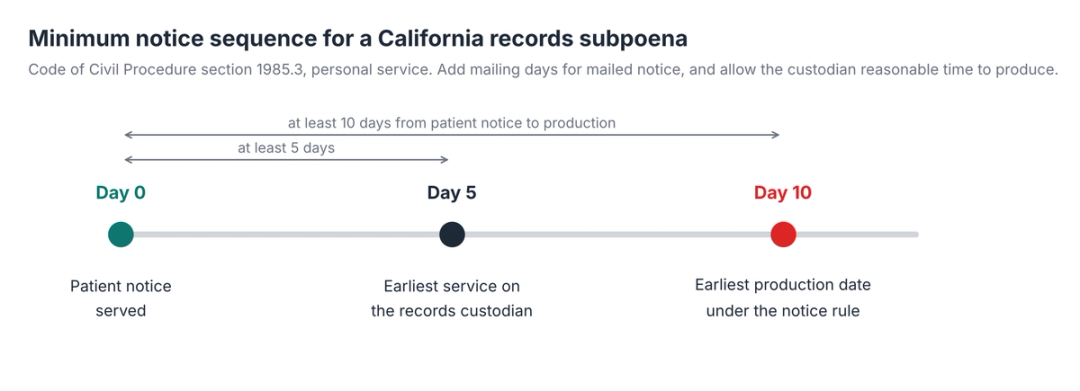
Notice rules set a floor on the calendar before any production can happen. In California, patient notice must go out at least five days before the custodian is served and at least 10 days before the production date, with extra days added when notice goes by mail.
In federal court, the sequence looks different. All other parties receive notice and a copy before service, and the provider then has up to 14 days to object, so a workable plan allows about a month from drafting to production.
Build that month into the case schedule. Subpoenas served in the first weeks after the defendant answers keep productions ahead of expert disclosure deadlines, which often arrive sooner than slow providers respond.
What happens after the subpoena is served?
Custodians usually produce the records by the deadline or call to ask for more time. A smaller share object in writing, often because the description is too broad or the HIPAA assurance is missing.
Rule 45 gives the recipient until the earlier of the compliance date or 14 days after service to object. After an objection arrives, the firm can ask the court for an order compelling production, and the issuing party must take reasonable steps to avoid imposing undue burden or expense on the provider.
Silence calls for persistence before motion practice. A records department that misses the production date often has the request sitting with the wrong person, and a call to confirm receipt and a new date resolves most of these cases within a week.
Contempt sits at the far end of the process. The court may hold a served person in contempt under Rule 45(g) for failing to obey without adequate excuse, though firms rarely need to reach that step with a cooperative call history in the file.
Keep dated notes of every contact with the custodian. That record shows the court a good-faith effort if a motion to compel becomes necessary, and it tells the next person on the file exactly where the request stands.
Budget for the provider's copy charges. If a court compels production over an objection, Rule 45(d)(2)(B)(ii) requires the order to protect a nonparty from significant expense, and paying reasonable invoices promptly removes a common reason for delay.
Litigation teams that subpoena medical records regularly should track each one the way they track authorization requests. Record the service date and the objection deadline, then set the next follow-up date in the case file, a routine our comparison of AI systems for medical provider calls shows can be automated.
How do you subpoena medical records from a provider in another state?
Out-of-state providers sit outside the reach of the trial court's own process. A large majority of states have adopted the uniform interstate deposition law known as the UIDDA, which lets a party domesticate the subpoena in the provider's home state.
Alabama's version shows the mechanics. The Alabama act has the party submit the foreign subpoena to the circuit court clerk in the county where the records are held, and the clerk then issues a local subpoena that incorporates its terms.
Submitting the request counts as no appearance in the local courts, so the firm can usually proceed without local counsel. Disputes over the subpoena, such as a motion to quash, go to the local court where production takes place.
Plan for extra time whenever the firm needs to subpoena medical records across a state line. A treating surgeon in a neighboring state can take an additional week or two to reach, since the clerk's issuance adds a step before service, and an early start keeps that delay off the critical path.
Which records need more than a subpoena?
A firm that needs to subpoena medical records from a federally assisted substance use program faces a stricter federal rule. Under 42 C.F.R. 2.61, a subpoena alone permits no disclosure, and the program releases records only when a court order under Part 2 accompanies the subpoena.
That court order requires its own application and findings. Plan for the extra weeks when a client's treatment history includes a federally assisted program, and keep the request limited to the records the case actually needs.
The client's own Part 2 records can follow a faster route. A written consent that meets 42 C.F.R. 2.31 lets the program release records to the firm, which can spare the court application entirely.
State law adds protected categories beyond the federal rules. Mental health records carry extra protection in several states, so check the state statute before serving a subpoena on a psychiatric provider or counseling practice.
What should you do when the defense subpoenas your client's records?
Defense counsel will subpoena medical records too, and the notice that arrives at the firm starts a short clock. Read every defense notice the day it arrives and calendar the objection deadline, because the window to object can close within two weeks.
Look first at the date range and the providers named. A subpoena reaching ten years before a 2024 crash, or naming a gynecologist in a neck injury case, may be objectionable as overbroad, and a call to defense counsel can narrow it before any motion is filed.
Prior records are the usual battleground. The defense wants earlier treatment to the same body part to argue the injury predates the crash, and the plaintiff firm is better served reviewing those records first than meeting them at a deposition.
Expect requests for blanket authorizations as well. A limited authorization covering named providers and a defined date range meets a legitimate request while keeping unrelated history out of the defense file.
When negotiation fails, the client may move to quash or modify the subpoena. A qualified protective order offers a second line of protection by limiting how the defense may use what it receives. The client also deserves an explanation of what was requested and why, which supports the communication habits our guide to improving client communication describes.
See HelloCounsel follow up with records departments on open requests We'll show you how HelloCounsel calls a provider about a pending records production and writes the status and next follow-up date to your case file. Book a records follow-up demo
How should the firm organize subpoenaed records?
Records produced under subpoena arrive with paperwork that matters later. Keep the custodian declaration with the records it covers, and log the production date against the subpoena so the authentication trail stays intact.
Other parties may ask for copies of what a subpoena produced. A copy service that already holds the production can fill those requests quickly, with the requesting party paying the charge.
Compare the production against the subpoena before closing it. Missing billing pages or a date range that stops short call for a written follow-up to the custodian that names the exact missing items.
File the records by provider and date, then add them to the medical chronology the same week. Paralegals working from a current chronology can spot a missing provider while the case schedule still allows another subpoena.
Subpoena volume adds to an already heavy records workload. Our guide to reducing case manager workload covers how firms free staff time for the follow-up these requests demand.
How HelloCounsel supports records follow-up
HelloCounsel builds AI voice agents for plaintiff personal injury firms. Its Medical Records workflow handles the repetitive calls between a records request and a complete response, while the firm keeps control of legal process and payments.
The agent calls providers and checks portals according to each provider's callback window, then tracks invoices and affidavits that arrive separately from the records. Before closing a request, it checks the patient and dates of service and flags anything missing.
Every call and status change is written back to the matter in case management systems such as Filevine, the operational side of a PI firm that our piece on AI intake and AI operations separates from intake. Firms using HelloCounsel have seen 15 days cut from records turnaround, with results depending on how quickly each provider responds.
A typical rollout starts with follow-up on 10 to 20 live requests, with the team reviewing the calls before expanding. Pricing is custom, based on call and case volume instead of seats.
Drafting and serving a subpoena remain attorney work. Once the firm decides to subpoena medical records, HelloCounsel's role starts after service, with the outbound calls that confirm receipt and keep the production on schedule.
Checklist before serving a records subpoena
Run through this list each time the firm prepares to subpoena medical records:
- The case is in litigation and the court's subpoena rule is identified
- The records description names specific record types and dates of service
- The HIPAA assurance is attached, in the form of patient notice or a protective order
- Every other party has received notice and a copy as the rule requires
- The production date satisfies the governing notice periods
- Part 2 or state-protected records have the additional court order they need
- A follow-up date is set in the case file for the day after production is due
Requests that pass this list rarely come back with a deficiency letter. Practices that subpoena medical records with this discipline spend their follow-up calls on getting records delivered, which is where the time belongs.
Talk through your records follow-up with HelloCounsel's founders Tell HelloCounsel's founders how many records requests and subpoena productions your team tracks, and see which follow-up calls an AI voice agent could take on. Book a call with HelloCounsel's founders about records follow-up
Frequently asked questions
1. Can a lawyer subpoena medical records without a court order?
Yes, in most courts an attorney can issue the subpoena. A HIPAA-covered provider can comply once satisfactory assurance is attached, meaning proof that the patient received notice and a chance to object, or proof that the parties sought a qualified protective order.
2. How long does a provider have to respond to a records subpoena?
The subpoena itself sets the production date, within the limits in the court's rules. Federal Rule 45 gives the recipient until the earlier of that date or 14 days after service to object, and state rules add their own notice periods.
3. Do you need to notify the patient before subpoenaing medical records?
Usually, yes. HIPAA requires either notice to the patient with a chance to object or a qualified protective order, and some states, including California, require patient notice a set number of days before the records custodian is served with the subpoena.
4. When should a PI firm use a subpoena instead of an authorization?
Use an authorization for the client's own records before suit. A subpoena fits after filing, when a provider ignores authorization requests or trial needs certified copies, and it is the main route to records of a person who has signed no authorization.
5. Can a plaintiff object to a defense subpoena for medical records?
Yes. A plaintiff can object to an overbroad date range or unrelated providers and can ask defense counsel for a narrower request first. If talks fail, a motion to quash or modify follows, and a qualified protective order limits how the records are used.
6. What records need more than a subpoena?
Records from federally assisted substance use programs need both a subpoena and a court order under 42 C.F.R. Part 2. Some states also give mental health records extra protection, so check the state statute before serving a subpoena on those providers.
Share this article