
- SimpleTalk pricing starts at $30 a month plus $0.45 per minute of talk time, with a $500 Business plan that includes 2,000 minutes at $0.25 each.
- Agency tiers run from $1,299 to $1,799 a month at lower per-minute rates, built for marketing agencies that resell AI voice agents.
- Customer reviews posted between September 28 and October 4, 2026 report that SimpleTalk stopped service and locked accounts, and the company has posted no public response.
- Firms that used SimpleTalk should secure their phone numbers and call data first, then compare replacements on legal fit as well as price.
- Legal-specific AI agents price by call and case volume and connect to case management systems, which a general voice platform leaves to the firm.
SimpleTalk built its business on AI voice agents that marketing agencies could set up for their clients and resell. Law firms that used it often signed up through an agency that handled the setup and billing.
SimpleTalk pricing looks simple on the public page, with a low monthly fee and a per-minute rate for talk time. The real cost for a law firm depends on call volume and on any activation fees an agency charged on top.
The bigger question in late 2026 is continuity. Several customers reported in reviews that the company stopped service at the end of September, so firms comparing SimpleTalk pricing now are often looking for a replacement as much as a price.
What does SimpleTalk charge?
SimpleTalk lists six plans on its pricing page, each combining a monthly fee with a rate per minute of talk time. The figures below reflect the page as it appeared in October 2026.
| SimpleTalk plan | Monthly fee | Per-minute rate | Notes from the pricing page |
|---|---|---|---|
| Pay as you Go | $30 | $0.45 | Free for 10 minutes, then $30 a month |
| Business | $500 | $0.25 | 2,000 minutes of talk time, 12+ languages |
| Enterprise | Not listed | $0.20 | 2,000 minutes, dedicated customer success manager |
| Branded Agency Enterprise | $1,299 | $0.16 | Branded dashboard for agencies reselling minutes |
| White Label Agency | $1,799 | $0.13 | Agencies market the platform as their own |
| Enterprise White Label Agency | Not listed | $0.10 | Onboards other agencies, Slack support |
On the Business plan, the fee works out to $0.25 for each of its 2,000 included minutes, which matches its listed rate. The page leaves the cost of minutes beyond that allowance unstated, so firms should confirm overage terms in writing.
Activation fees sit outside the published SimpleTalk pricing cards. The pricing page mentions a one-time activation for some tiers without a dollar figure, and a Smith.ai comparison updated in August 2026 cites customer reports of setup fees reaching $5,000.
Reseller economics explain much of the structure. A white label agency paying $0.13 a minute can resell those minutes to a law firm at a markup, which means the firm's bill may bear little resemblance to SimpleTalk pricing as published.
What does each SimpleTalk plan include?
Features step up with each tier, and the lower two plans cover what a single law firm would use. The agency tiers add reselling and branding tools that matter only to marketing agencies.
Pay as you Go
The entry plan includes unlimited calls and transfers, all billed through the per-minute rate. Firms get both inbound and outbound agents, more than 30 AI voices and prompt templates to start from.
Outbound calling campaigns come with metrics such as cost per booked appointment. That feature reflects SimpleTalk's roots in sales and lead follow-up, where agencies used it to call back web leads. Call recording and transcription come standard, according to the Smith.ai comparison.
Business
The Business plan adds unlimited AI voice agents and support for more than 12 languages. It also includes a native GoHighLevel integration and an AI dialer with local presence and number rotation.
SimpleTalk University, a training library for building agents, comes with this tier. The training points to who does the setup work, since the firm or its agency writes every prompt.
Enterprise and agency tiers
Enterprise adds white glove onboarding, a dedicated customer success manager and Slack support, with the monthly fee left off the page. Agency plans layer on branded or white-labeled dashboards and the right to resell minutes at a premium.
Those reseller tiers shape what law firms actually paid. At the agency level, SimpleTalk pricing ran as low as $0.10 a minute, while the firm buying from that agency paid whatever rate the agency set.
What would SimpleTalk cost a law firm each month?
Talk minutes drive the bill on every plan. A personal injury firm generates far more calls than most small businesses, and as per our estimate, a single PI case produces about 150 calls over its life, as our breakdown of how many calls a PI case generates shows.
Monthly cost on the two plans a single firm would buy directly follows from the published rates. The chart assumes minutes past the Business allowance bill at the same $0.25 rate, which the pricing page leaves unconfirmed.
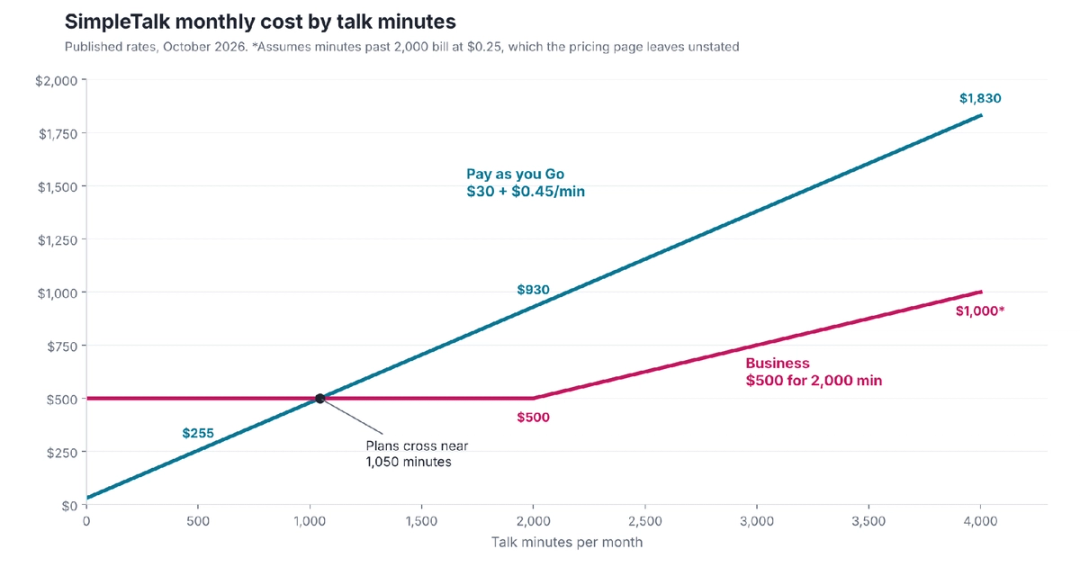
Pay as you Go stays cheaper until roughly 1,050 minutes a month, where it passes the $500 Business fee. At 2,000 minutes, the Pay as you Go plan costs $930 against $500 for Business.
Those totals cover talk time only. Agency markups and activation fees would add to the true cost for a firm that bought through a reseller.
Consider a firm handling 600 calls a month at an average of four minutes each, or 2,400 minutes. Under published SimpleTalk pricing, Pay as you Go would cost $1,110, while Business would cost about $600 if the extra 400 minutes bill at $0.25. Activation and agency fees from the firm's own contract would sit on top of either figure.
A per-call comparison helps put the rates in context. A four-minute call costs $1.80 on Pay as you Go and $1.00 on Business, while Smith.ai's own comparison page lists $150 a month for 75 calls on its AI receptionist plan, with overage of $2.10 to $3.00 per call.
Seasonal swings matter too. A firm running a TV campaign may double its call minutes in a month, and SimpleTalk pricing on Pay as you Go scales the bill with every extra minute.
Per-minute pricing also rewards short calls. An intake call that runs long because a new client is describing an accident costs more than a quick message, so the firm pays most for the calls it most wants handled well.
How to estimate SimpleTalk pricing from your own call logs
Published rates mean little until they meet a firm's real call volume. Pull three months of call data from a phone system such as RingCentral or Zoom, and note total minutes alongside the number of calls.
Split the calls by type before applying the rates. New-client intake calls in a PI practice run longer than status calls from existing clients, and SimpleTalk pricing charges both at the same per-minute rate.
Multiply each group's minutes by the plan rate and add the monthly fee. Practices that find most of their minutes in intake calls will see the per-minute model weigh heaviest on the calls that bring in new cases.
Run the same exercise for any replacement under review. Per-call and per-task models need the call count instead of minutes, which makes the comparison quick once the logs are pulled. Count after-hours calls on their own line, since those are the calls an AI agent most often takes over first.
Which costs sit outside SimpleTalk pricing?
The published rates leave out several costs that showed up on law firm bills. Agency markups were the largest, since a firm buying through a reseller paid the agency's rate instead of SimpleTalk's.
Setup time carried a cost even when no fee was charged. Someone had to write the intake prompts and then tune the agent whenever callers tripped it up.
Integration work added another layer. With no native link to legal case management systems, call summaries reached the firm by email or through Zapier, and staff copied the details into the case file by hand.
Outbound campaigns drew from the same per-minute pool. A PI practice that used the dialer for lead callbacks paid SimpleTalk pricing on outbound minutes as well as inbound ones.
What are customers reporting about SimpleTalk in late 2026?
As of October 2026, SimpleTalk carries a TrustScore of 3.5 from 32 reviews on Trustpilot, and earlier reviews praised its support team. The tone changed at the end of September 2026.
Reviews posted between September 28 and October 4, 2026 describe the company locking accounts and going unresponsive. One reviewer wrote that access ended on September 25, while another described emails claiming a bankruptcy filing and warning that agents and data would be lost by September 30.
The company has posted no public reply to those reviews, and its pricing page remained online in late October 2026. Trustpilot does not verify review claims, so any firm with an active account should confirm its status directly with SimpleTalk or the agency that sold it.
For those firms, continuity now outweighs SimpleTalk pricing. A cheap per-minute rate offers little value if the agent stops answering and the call history becomes unreachable.
Billing complaints predate the reported closure. Some reviewers said they paid large upfront fees, one cited about $10,000, and then found ongoing monthly charges they had expected to avoid.
What should a law firm do if it used SimpleTalk?
Firms that relied on SimpleTalk for intake or after-hours answering face two risks at once. Calls from new clients may be going unanswered, and call records tied to open cases may sit in an account the firm has lost access to.
Work through these steps in order of urgency:
- Confirm who controls your phone numbers: Numbers bought inside a reseller's account may need a port request to move them to a new provider.
- Forward the main line now: Route calls to staff cell phones or an interim answering service until a replacement is live.
- Export call recordings and transcripts: If the GoHighLevel sub-account still opens, download anything tied to an active case.
- Check card and invoice charges: Stop recurring payments to the agency or platform and keep records in case of a dispute.
- Save your intake script: The prompts and screening rules will speed up setup on the next platform.
Missed calls carry a direct cost for a PI firm. Our look at the hidden cost of missed calls shows why the forwarding step comes before everything else.
Callers who reached a dead line since late September deserve a callback. Pull the carrier's call log for that period and have staff return calls from anyone who did not reach the firm, starting with numbers that match no existing client.
Is SimpleTalk pricing a good fit for a law firm?
The low entry fee made SimpleTalk easy to try. A solo practice taking a few dozen calls a month could run an AI receptionist for well under $100, which beats nearly any live answering service on price.
The fit weakens as call volume and case complexity grow. Because SimpleTalk pricing charges by the minute, the long intake calls a PI firm depends on cost the most, and the firm pays again in staff time to move call details into its case management system.
Dependence on an agency adds a further layer of risk. Buyers who went through a reseller often had no direct account with SimpleTalk, which left them waiting on the agency for answers when service reportedly stopped.
Compare SimpleTalk pricing with any alternative on cost per handled case instead of cost per minute. A tool that costs more per minute but writes every call to the case file can cost less once staff hours are counted.
How should a firm compare SimpleTalk alternatives?
SimpleTalk was built as a horizontal voice platform, configurable for any business that books appointments by phone. A law firm replacing it should decide first whether it wants another general tool or one built for legal work.
| Factor | General AI voice platform | Legal-specific AI agent |
|---|---|---|
| Pricing basis | Monthly fee plus per-minute talk time | Call and case volume, often priced per completed task |
| Case management | Connects through Zapier or a generic CRM | Native links to legal systems such as Filevine and Litify |
| Caller recognition | Treats every caller as new | Matches existing clients to their case file |
| Transfers | Rings a fixed internal number | Checks staff availability before a warm transfer |
| Setup | Firm or agency writes the prompts | Vendor configures legal intake and routing |
Bring your SimpleTalk pricing history to every vendor call. Monthly minutes and total spend give a replacement a baseline to quote against, which keeps proposals comparable.
General platforms cost less per minute and suit firms with simple call flows. Their limits show up when an existing client calls about a case and the agent has no way to see the file. Language support matters in the same way, since a Spanish-speaking accident victim needs an agent that can carry the full intake in Spanish.
Our guide to why a generic AI receptionist falls short for a PI firm covers those limits in detail.
Pricing models vary across the market as well. Our AI receptionist pricing breakdown compares per-minute and flat-fee plans side by side.
Live answering services remain an option for firms that want a human voice. Our review of Smith.ai pricing covers its per-call plans in detail.
Ruby bills by the minute for live receptionists, and our breakdown of Ruby pricing shows how those minutes add up for a busy practice.
How does HelloCounsel compare for PI firms?
HelloCounsel builds AI voice agents for plaintiff personal injury firms. Its agents answer in under two rings, and firms using them have seen a 48% improvement in call reception across more than 30,000 calls handled.
The Receptionist agent matches caller ID to the case file, so an existing client reaches someone who knows their case. Routing runs on case data with a live availability check, using a warm transfer or a scheduled callback when the right person is busy.
Every call is written to the case file in systems such as Filevine and SmartAdvocate. The agents speak English and Spanish and can switch languages mid-call, which matters for firms that advertise in both.
New-client calls go to the Intake agent, which screens and documents leads in the firm's intake system. Firms using LeadDocket or Lawmatics keep their existing intake workflow.
Once a new client signs, the Case Opening agent handles the welcome call and gathers provider details. Firms using it have cut the time to get every case moving to 24 hours.
HelloCounsel's pricing basis also differs from SimpleTalk pricing. HelloCounsel prices on call and case volume instead of seats or talk minutes, so firms pay for tasks completed, and the cost comes to about 1/4 of a virtual receptionist.
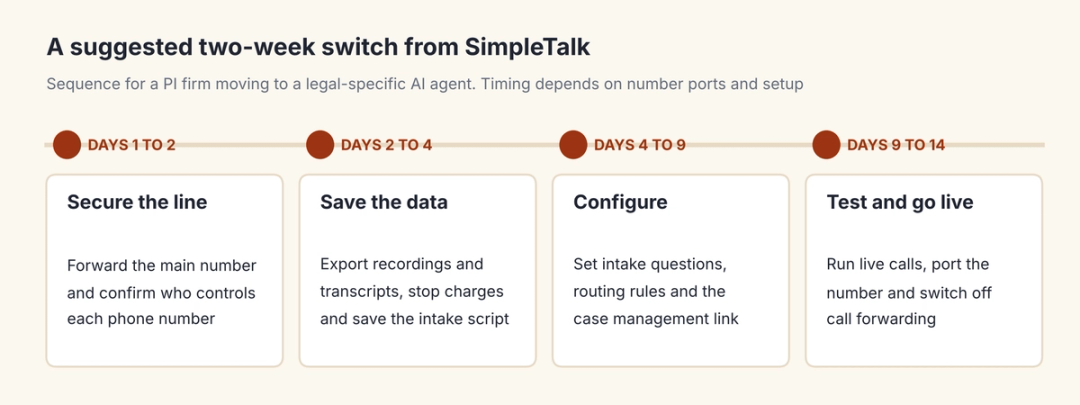
HelloCounsel reports that most firms go live in under two weeks, and setup includes configuring legal intake and routing for the firm. For a firm whose SimpleTalk agent stopped answering, that timeline runs from a forwarded line to full coverage.
See how HelloCounsel answers calls for a PI firm
Watch HelloCounsel answer a new-client call, recognize an existing client and write both calls to the case file. Book a HelloCounsel demo
Choosing a replacement without repeating the problem
Entry-level SimpleTalk pricing was low, and the reported closure showed what a low price can leave out. Firms replacing it should weigh the vendor's stability alongside its rates.
Ask any replacement who owns the phone numbers and the call data. A firm that holds both can move again without losing case history, whatever happens to the vendor.
Check the vendor's record with law firms as well. References from two PI practices of similar size will show how the agent handles accident callers and how the vendor responds when something breaks.
Ask too how the vendor bills for long calls. A model priced on completed tasks keeps an intake call that runs 20 minutes from costing more than one that runs five. Compare quotes against your old SimpleTalk pricing using the same call logs, so the decision rests on your own volume.
Last, test the agent on your own calls before signing. A week of live calls shows how it handles existing clients and Spanish speakers, along with the after-hours accident calls that matter most to a PI practice.
Talk with HelloCounsel's founders about replacing SimpleTalk Share your call volume and current setup with HelloCounsel's founders, and get a plan for moving your phone lines and intake to a legal-specific AI agent. Book a call with HelloCounsel's founders
Frequently asked questions
1. How much does SimpleTalk cost?
SimpleTalk's pricing page lists a Pay as you Go plan at $30 a month plus $0.45 per minute and a Business plan at $500 a month with 2,000 minutes at $0.25. Its agency tiers run from $1,299 to $1,799 a month.
2. Does SimpleTalk charge a setup fee?
SimpleTalk's pricing page mentions a one-time activation for some tiers without listing an amount. A competitor comparison cites customer reports of setup fees up to $5,000, and agencies reselling SimpleTalk could add their own fees.
3. Is SimpleTalk still operating?
Customer reviews posted in late September and early October 2026 report that the company stopped service and locked accounts. The company has posted no public response, so confirm your account status directly.
4. Does SimpleTalk integrate with legal case management software?
SimpleTalk connects through GoHighLevel and tools such as Zapier. A Smith.ai comparison updated in August 2026 lists no native integrations with Clio or Filevine.
5. What is a good SimpleTalk alternative for a PI law firm?
PI firms usually do best with an AI agent built for legal work, one that recognizes existing clients and writes calls to the case file. HelloCounsel prices on call and case volume and integrates with Filevine and Litify.
6. Is SimpleTalk pricing cheaper than a live answering service?
At low volume, yes, since Pay as you Go starts at $30 a month plus $0.45 per minute. At PI firm volume, long intake calls and agency markups can push SimpleTalk pricing close to or past the cost of a per-call service.
7. How do I move my phone number away from SimpleTalk?
Find out whether the number sits in your own account or a reseller's. Your new provider can then file a port request, and you can forward the line to staff phones while the port completes.
Share this article