
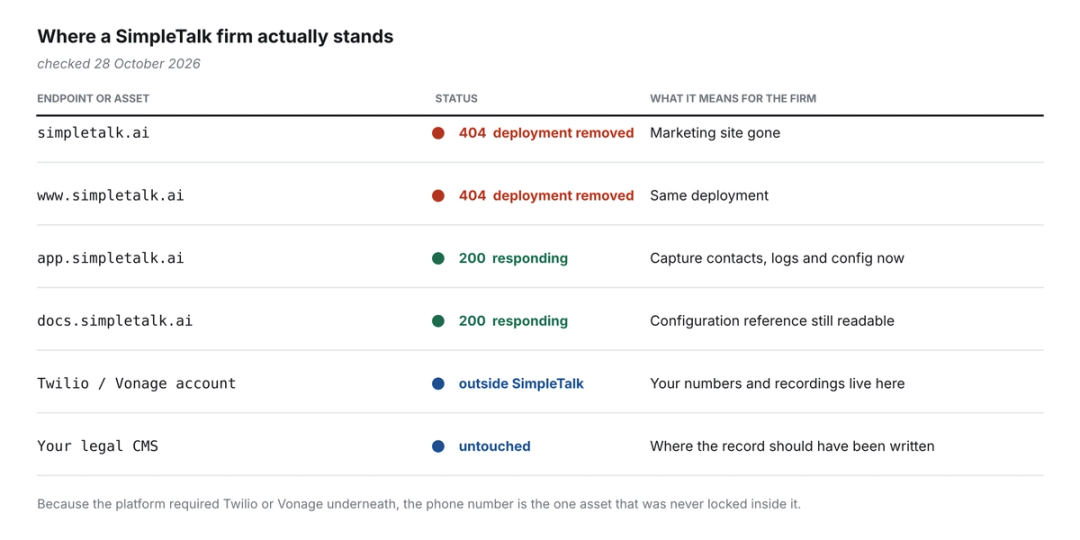
- The marketing site at simpletalk.ai returns a Vercel error indicating its hosting deployment has been removed, while the app and documentation subdomains were still reachable on 28 October 2026.
- Because the platform sat on top of Twilio or Vonage, a firm's phone numbers live in a carrier account and can be repointed or ported independently.
- The published integration list runs to GoHighLevel, Close and HubSpot. No legal case management system appears in it.
- A privacy option documented by the vendor suppresses transcript storage, so some firms will find recordings without any accompanying text.
- Public documentation sets out no bulk retrieval mechanism for customers.
- Intake call history is evidence of contact, so recovering it matters more at a PI firm than at the businesses SimpleTalk was built around.
A law firm that routes its intake line through a vendor has handed that vendor the first conversation every potential client has with the firm. The arrangement holds until the vendor stops answering, and the firm then learns how much of its own operation sits beyond its reach.
Firms searching for a SimpleTalk alternative in late 2026 are mostly in that position, with the shopping already forced on them. The useful question has shifted from which SimpleTalk alternative compares better to what is recoverable and how quickly a replacement can carry the line.
This piece covers the verified status of SimpleTalk's infrastructure, where a firm's assets actually sit, and what a plaintiff personal injury practice should require before pointing its intake number anywhere new.
The current state of SimpleTalk's infrastructure
Checked on 28 October 2026, simpletalk.ai and www.simpletalk.ai both return HTTP 404. The response header reads x-vercel-error: DEPLOYMENT_NOT_FOUND. That points to a removed hosting deployment behind the marketing site, as opposed to a routing fault or an expired certificate.
Two subdomains still respond. app.simpletalk.ai returns HTTP 200 and serves an application shell. docs.simpletalk.ai also returns 200 and continues to serve the full technical documentation.
That split matters for anyone evaluating a SimpleTalk alternative under time pressure. Pages offering a SimpleTalk alternative mostly still describe the product as live with current pricing, and several reproduce figures the company never published itself.
Treat the subdomains as working until proven otherwise, and act on that assumption today. A responding application today is an opportunity to retrieve something, and it carries no guarantee about tomorrow.
Your phone numbers are not inside SimpleTalk
This is the single most useful fact available, and it comes from SimpleTalk's own documentation.
Its technical overview states that "the underlying phone systems must be either Twilio or Vonage, which are essential for initiating the calls." SimpleTalk ran as a layer on top of a carrier account and was never the carrier itself.
A firm's numbers therefore live in Twilio or Vonage. If the firm holds those credentials, the numbers are reachable right now and can be pointed at a new destination without involving SimpleTalk at all.
If the account was provisioned on the firm's behalf, the number can still be ported to a carrier account the firm controls. Twilio documents the process in its porting guide, and porting is a regulated carrier-to-carrier transfer that does not depend on the original vendor's cooperation.
Start here before anything else. A firm that keeps its intake number keeps every billboard, every directory listing, and every referral card already in circulation.
Find out where your intake number actually sits
Send us the number and we will trace which carrier holds it and what it would take to point it somewhere that answers. Trace my intake line
Recovering call history before the lights go out
Call history divides into parts that behave differently, and the difference comes down to where each part was written.
Recordings and call metadata generated through Twilio or Vonage sit in that carrier account, subject to its own retention settings. A firm with carrier credentials can often retrieve far more than it expects.
Transcripts are the harder case. SimpleTalk's documentation describes a HIPAA setting that stops transcripts being written to the calls resource. A firm that enabled it, which a law firm handling medical information plausibly did, may hold recordings with no corresponding text.
Nothing in the published documentation describes a customer-facing export path. It covers logging call counts and durations for billing, and it never explains how a customer retrieves their own data in bulk.
Anything still visible in the application is worth capturing by hand today. Contact records, call logs and configured workflows matter, and the configuration itself tells a replacement vendor what the firm had built.
Why intake call history carries weight at a PI firm
These records function as evidence of contact at a plaintiff firm in a way they rarely do at a contractor or an insurance agency.
A retained client who says the firm never returned a call is answered by a log. A statute question that turns on when a potential client first made contact is answered by a timestamp. A fee dispute over when representation began is answered by the same record.
Documentation discipline around intake is a recurring weakness at firms that outsource the phone, and the weakness only becomes visible when the outsourced party stops existing.
Any firm choosing a SimpleTalk alternative should treat where records are written as a threshold question, well above any feature comparison. Records written into a system the firm owns survive a vendor's disappearance. Records written into a vendor's own dashboard do not.
The market SimpleTalk was actually built for
The company positioned itself horizontally. The verticals named on its site were real estate, health insurance, tech support, credit repair and AI agencies. Its company announcement described a target market of small and midsize US businesses, naming contractors and tax professionals among them.
Law firms appear nowhere in that list, and plaintiff personal injury appears nowhere across any of its public material.
The documentation reflects the same shape. GoHighLevel is named as the primary CRM, with Close and HubSpot reachable through webhooks, and that stack belongs to agencies and SMB sales teams.
Legal case management systems are absent from it entirely. A firm running Filevine, Litify, Neos, CASEpeer or SmartAdvocate was therefore operating a phone layer with no path into the system where its cases actually live.
| Capability | SimpleTalk, per its own documentation | What a plaintiff PI firm needs |
|---|---|---|
| Telephony | Twilio or Vonage required underneath | Carrier account the firm controls |
| CRM reach | GoHighLevel, plus Close and HubSpot via webhooks | Native write-back to a legal CMS |
| Target market | Real estate, insurance, tech support, credit repair, agencies | Plaintiff personal injury |
| Case creation | Not described | New matter opened from the intake call |
| Outbound work | High-volume calling described | Provider follow-up, records chasing, client check-ins |
| Languages | 12 claimed, three listed in the configuration table | Spanish handled mid-call |
That mismatch is worth naming plainly, because it was the real problem even while the product was running. A phone bot cut off from the case management system leaves someone retyping every call into the CMS by hand.
What to require from a SimpleTalk alternative
A firm picking a SimpleTalk alternative in a hurry tends to grab whatever answers the phone fastest, which is how the same situation repeats in two years.
Write-back to your case management system: The agent should create the matter and log the call inside the CMS the firm already runs, without a person retyping it. CMS write-back is what separates a phone product from an intake product.
Ownership of the carrier account: Insist the numbers sit in an account the firm controls. This is the lesson the current situation is teaching at the firm's expense.
PI-shaped intake questions: Date of loss, mechanism of injury, treatment status and prior injuries need capturing in the first conversation, which is where a generic AI receptionist falls down.
Spanish handled in the call: Mid-call language switching keeps a Spanish-speaking caller with the firm instead of routing them to a callback queue.
Outbound as well as inbound: Provider follow-up, records chasing and client check-ins are where the hours actually go at a PI firm.
An export you can test before signing: Ask any SimpleTalk alternative to run one during evaluation. A vendor unable to demonstrate export is a vendor whose data you do not hold.
Our guide to evaluating an AI voice agent covers the demo questions worth asking in more depth.
Where firms are moving the line instead
Before the list, a disclosure. We build HelloCounsel, so weigh what follows as an interested party's summary and no independent ranking.
The criteria above are the part worth keeping, and they apply to any SimpleTalk alternative a firm lands on.
HelloCounsel is built for plaintiff personal injury, mass torts, workers' compensation and Social Security disability. Agents write notes and tasks back into Filevine, Smart Advocate, Neos, Litify, Backdocket and Case Status, open matters from the intake call, and run outbound work including medical record follow-up. Billing runs per completed request instead of by the minute, with no setup fee. The platform is HIPAA compliant, with SOC 2 in observation.
General legal receptionist services such as Smith.ai, Answering Legal and Ruby cover legal intake broadly and offer human escalation. They suit firms that want people on the phone instead of agents inside the CMS, and they price per minute or per call. Our comparison of legal answering services goes through the trade-offs.
Horizontal voice AI platforms such as Retell, Vapi, Bland and Synthflow give developers direct control and will do whatever they are built to do. As a SimpleTalk alternative they also require someone to build and maintain the agent, which is the arrangement that just ended badly.
CMS-adjacent tooling is worth checking first if the firm already runs Litify or SmartAdvocate, since some capability may exist in a product the firm already pays for.
The roundup of AI voice agents built for PI practices covers the wider field.
For firms weighing options beyond plaintiff work, a broader survey of AI receptionists runs across practice areas.
A continuity plan for this week
Sequence matters here, because the first two steps protect assets while the rest can proceed at a normal pace.
Confirm who holds the Twilio or Vonage account and whether the firm has credentials. Point the intake number at a line a human answers, even a mobile, so nothing rings into silence while the rest of this happens.
Export or screenshot everything still visible in app.simpletalk.ai, including contacts, call logs and workflow configuration. Pull recordings and metadata from the carrier account against its retention window.
Write down what the old setup actually did, question by question, because that document is what a replacement vendor needs and it exists only in the heads of the people who used it.
Then evaluate each SimpleTalk alternative against the criteria above, and port the number once the new intake path is tested end to end.
How HelloCounsel handles this
HelloCounsel sells intake and case-work automation for plaintiff firms, so read this as a description of design choices and nothing more neutral.
Agents run as users inside the firm's own case management system, which means call notes, tasks, and new matters land where the case already lives. A vendor change does not take the record with it, because the record was written into the firm's system from the start.
The agents also work outbound. Medical record requests, insurance claim opening, crash report retrievals, and client check-ins carry a price per completed request, which is closer to how a records vendor bills than how an answering service does.
Setup runs on a configuration call instead of an implementation project, and there is no setup fee. For a firm currently pointing an intake line at a 404, the relevant number is how fast the line answers again.
Get your intake line answering again
Bring us the number, the CMS you run and what the old setup did, and we will map the fastest route back to a working intake path. Talk to the HelloCounsel founders
Frequently asked questions
1. Is SimpleTalk shut down?
As of 28 October 2026 the marketing site returns HTTP 404 with a DEPLOYMENT_NOT_FOUND error, while app.simpletalk.ai and docs.simpletalk.ai still respond. Those are the verifiable facts. Several pages assert a bankruptcy filing, and none of them cite a court record, so firms should rely on what they can check for themselves.
2. Can I keep my phone number?
Very likely yes. SimpleTalk's documentation required Twilio or Vonage underneath, so the number sits in a carrier account. With credentials a firm can repoint it immediately, and without them it can be ported.
3. Where would my call recordings be?
In the Twilio or Vonage account, subject to that account's retention settings. Transcripts are less certain. The vendor documented a privacy option that suppresses transcript storage, and a firm that switched it on will find audio without text.
4. How quickly can a SimpleTalk alternative take over the line?
Repointing a number a firm controls is close to immediate. Porting from another carrier runs on the carrier's timeline. The longer task is usually rebuilding the intake script, which is why writing down what the old setup did is worth doing first.
5. Why did a general voice AI product struggle at a law firm?
Its documentation names GoHighLevel, Close and HubSpot, with legal case management absent throughout. Call data stayed outside the case file, so a person had to move it by hand.
6. What should a SimpleTalk alternative cost?
Pricing models vary enough that a per-minute rate and a per-completed-request rate are hard to compare directly. Work out the monthly intake call volume first, then ask each vendor to price that volume, since a cheap per-minute rate on long intake calls often costs more than it appears.
Share this article