How AI-Enabled Personal Injury Intake Optimization Cuts the Time From First Call to Open Case

- Personal injury intake optimization works best when you measure the hours a file waits between stages, from first ring to open case, rather than polishing the intake script alone.
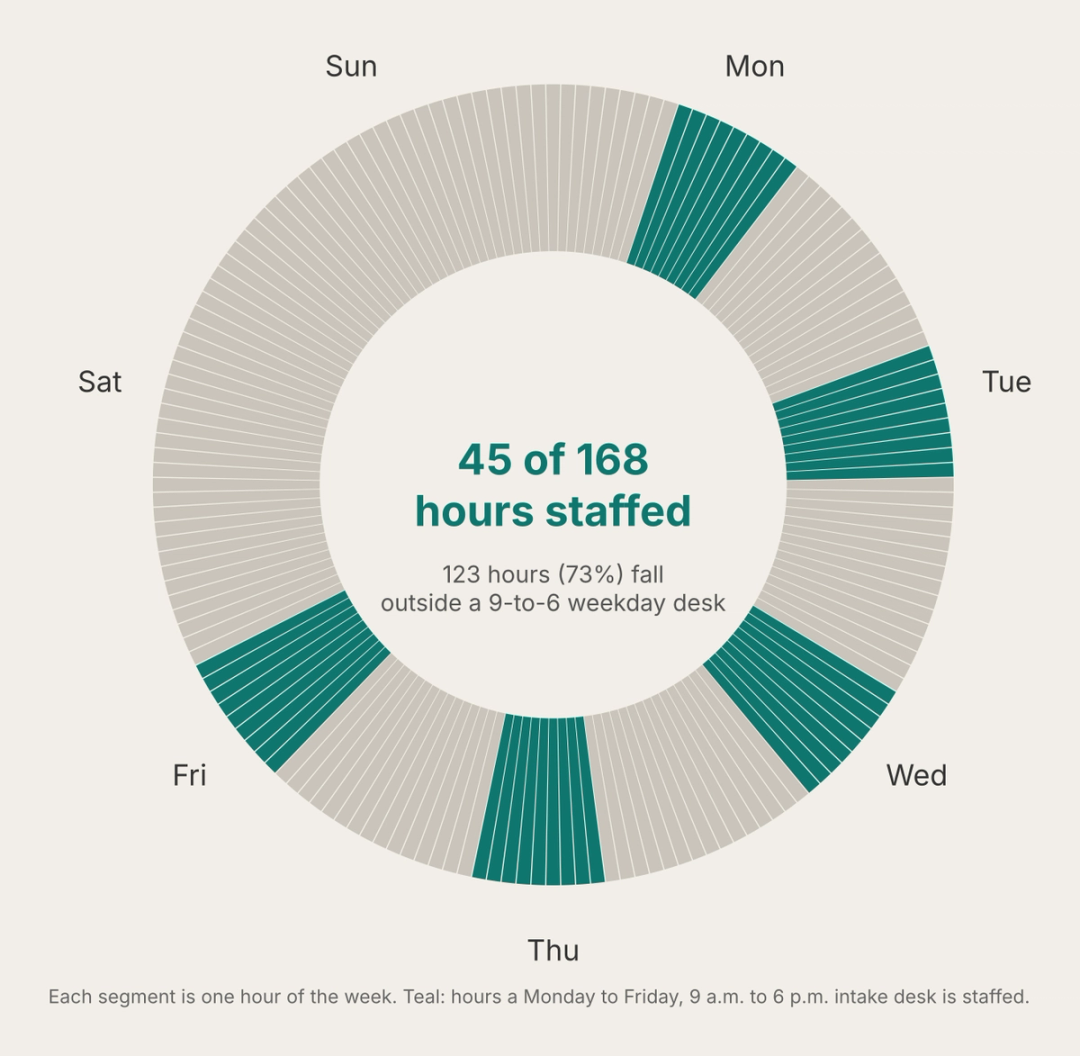
- A Monday-to-Friday, 9-to-6 intake desk covers 45 of the week's 168 hours, and Pew found that 80% of Americans don't answer calls from unknown numbers, so callbacks recover fewer callers than live answering does.
- Erlang C staffing math shows that a firm taking 20 calls an hour needs five intake specialists on the phones at once to answer 90% of calls within 20 seconds, which is why AI answering pays off first at peaks and after hours.
- ABA Formal Opinion 506 lets nonlawyers gather facts, run conflict searches, and collect retainer signatures, while legal advice and the final conflict determination stay with an attorney, so design an AI intake to gather and route rather than decide.
- Track six numbers in the first 90 days of AI intake: answer rate, time to answer, time to qualification, qualified-to-signed rate, signature-to-open time, and write-back completeness.
Personal injury intake optimization is the work of shortening the time between a caller's first ring and an open, staffed case in your case management system. AI shortens that time by taking the waiting out of intake: it answers every call live, qualifies the caller in the first conversation, and opens the case as soon as the client signs, while your attorneys keep the decisions the ethics rules reserve to them. The hours go into handoffs, since each stage waits for the next person to be free.
One ordinary sequence shows how those handoffs add up. A woman rear-ended on a Friday afternoon calls the firm at 7:40 p.m., reaches voicemail, and gets two callback attempts on Monday morning before an intake specialist reaches her at 11 a.m. The specialist qualifies her in half an hour, the file waits for attorney review, the retainer goes out Tuesday afternoon, and the case manager opens the matter on Wednesday morning.
Nobody in that sequence did slow work, yet the file sat idle for more than 100 of its 112 hours. Personal injury intake optimization therefore starts with a map of where the file waits, stage by stage.
Where does a personal injury intake file wait between the first call and an open case?
Intake at a plaintiff firm runs through seven stages, and a different role owns most of them. The work inside a stage takes minutes, while the gap before the next owner picks up the file can take hours or days.
| Stage | Owner without automation | What the file waits on |
|---|---|---|
| 1. First answer | Receptionist or answering service | A free line during staffed hours, or a callback after them |
| 2. Caller identification | Intake specialist | A search of the case management system for an existing matter |
| 3. Qualification | Intake specialist | The caller is staying on the line or picking up for the full screening. |
| 4. Conflict check and attorney review | Attorney | An open slot in the attorney's day |
| 5. Retainer signature | Intake specialist or paralegal | The caller opening and signing the agreement |
| 6. Case opening | Case manager | Re-entry of intake answers into the matter |
| 7. Records requests and first check-in | Case manager or records team | A caseload with room for one more file |
Three of those waits have nothing to do with how hard anyone works: the first answer when every line is busy or the office is closed, the caller's availability for a callback, and the re-entry between a signed retainer and an open case. Personal injury intake optimization goes after those three structural causes first, because extra effort from the same team removes none of them.
The first wait is the hardest to recover from, since a caller who doesn't reach you can call the next firm on her search results within a minute. Our analysis of the hidden cost of missed calls at a personal injury law firmput numbers on that loss. Much of the first wait happens in hours when nobody is on the phones at all.
A 9-to-6 intake desk leaves 123 of the week's 168 hours uncovered
The 123 uncovered hours are every weeknight from 6 p.m. to 9 a.m. plus the full weekend, about 73% of the week. A Monday to Friday desk staffed from 9 a.m. to 6 p.m. is on the phones for the other 45.
Car accidents happen at all hours, and a caller who has just left the emergency room on a Saturday has no reason to wait until Monday. A firm without after-hours coverage handles those calls with voicemail and a callback list, which moves the work to Monday morning and makes it depend on the caller picking up. A Pew Research Center survey of 10,211 US adults found that 80% don't generally answer cellphone calls from unknown numbers, and a firm's main line is an unknown number to almost every new caller.
Response timing compounds the problem. In their Harvard Business Review study, Oldroyd, McElheran and Elkington found that companies responding to a lead within an hour were nearly seven times as likely to qualify it as those responding later, and more than 60 times as likely as companies that waited 24 hours or longer. A separate figure, that a five-minute response makes a lead 21 times more likely to qualify, comes from vendor research, not from the HBR study, so the HBR numbers are the safer ones to plan around.
A Friday evening caller reached on Monday morning sits well past the 24-hour mark before anyone has asked her a qualifying question. Live answering after hours is the first lever of personal injury intake optimization, which raises a staffing question: how many people would it take to answer live at every hour?
How many intake specialists does live answering take at your call volume?
Call centers size their teams with the Erlang C queueing model, which estimates how many people must be on the phones at once to answer a set share of calls within a target time. Brown and colleagues' analysis of a working call center in the Journal of the American Statistical Association remains a standard reference on the statistics behind those queues.
We ran the model for a plaintiff firm with a six-minute average intake call. The results set a floor for live answering before breaks, training, sick days or turnover reduce the hours each person actually spends on the phones.
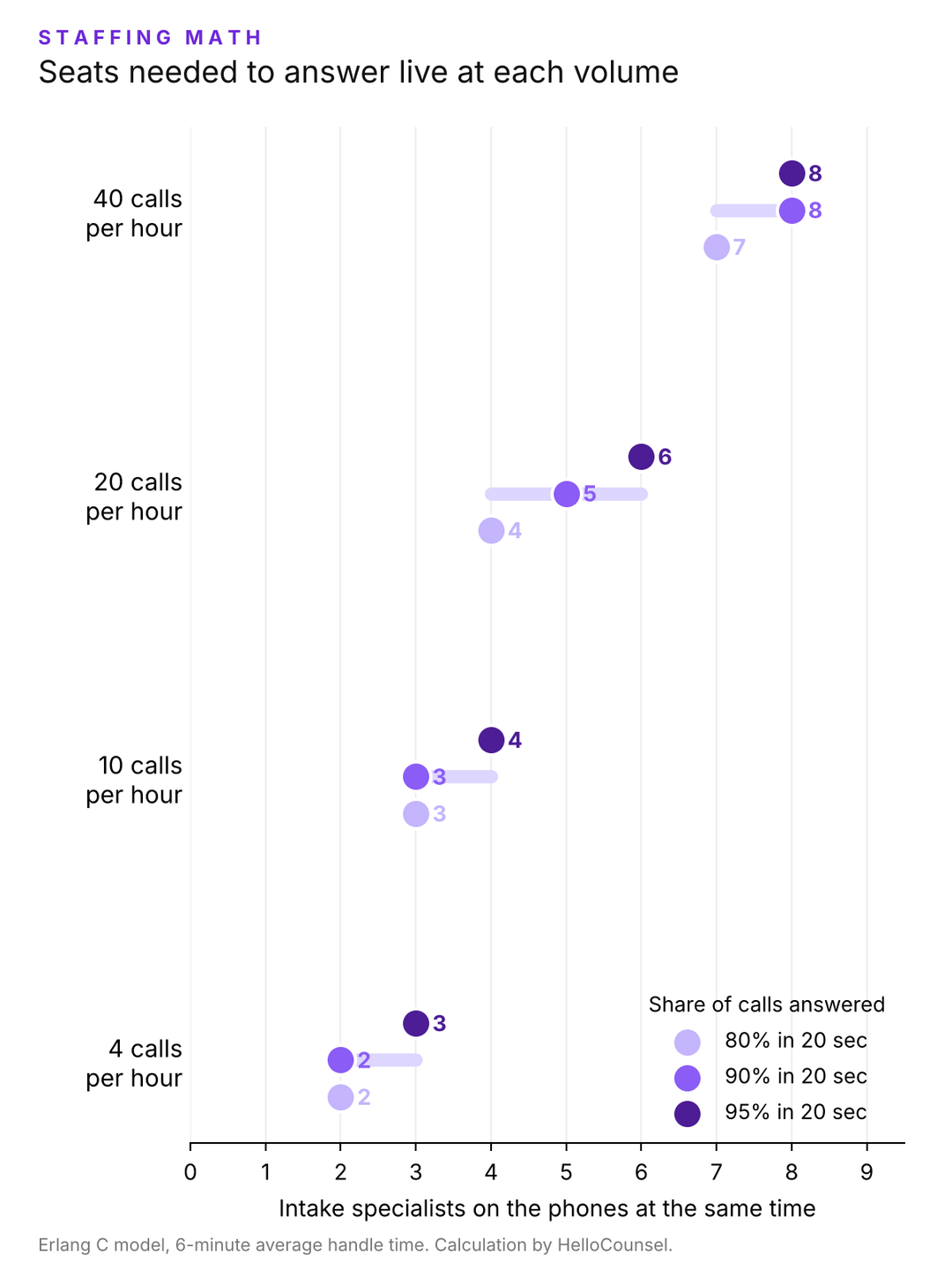
At 20 calls an hour, a firm needs five specialists on the phones at the same time to answer 90% of calls within 20 seconds, and six to reach 95%. A mass tort campaign that doubles volume to 40 calls an hour raises the requirement to eight, and those seats have to exist on launch day, before any new hire could be trained.
The same model shows the cost of that answer speed. With five specialists handling 20 six-minute calls an hour, each one spends about 40% of the hour on the phone, so a firm that staffs for live answering pays for idle time by design and still falls behind when a campaign or a bad-weather weekend spikes volume.
Volume also arrives unevenly through the day, so the 20-call hour sits next to quieter hours where the same five people wait. Personal injury intake optimization at the staffing level means matching seats to the hour, which a human team can only approximate with shift planning and an agent can match call by call.
Covering every hour of the week multiplies the cost. Holding the two specialists the model requires at four calls an hour through the 123 off-hours takes 246 staffed hours a week, which equals more than six full-time positions before anyone covers the weekday peaks.
The Bureau of Labor Statistics puts receptionist pay at $38,010 a year, so six positions come to about $228,000 in wages before benefits, recruiting or overtime. That arithmetic is why after-hours calls end up on a callback list at firms that staff by headcount, and it points to automating the first answer. Before doing that, a firm needs to know which parts of an intake call the ethics rules let software or any nonlawyer handle.
What live answering costs at your call volume?
Walk through HelloCounsel's fixed monthly pricing against your evening, weekend, and campaign-week call volume in a live demo. Request a pricing walkthrough
What does ABA Formal Opinion 506 allow AI and nonlawyer staff to handle at intake?
The ABA answered most of that question in June 2023. Formal Opinion 506 addresses client intake by nonlawyer assistants under Model Rule 5.3, and the firm carries the same supervision duty for an AI intake agent, since it deploys the agent and directs its work.
| Intake task | Nonlawyer or AI agent | Attorney |
|---|---|---|
| Gather incident, injury, treatment, and insurance facts | Yes, and decide whether the matter fits the firm's practice areas. | Reviews the complete file |
| Run the conflict search | Yes, across parties, witnesses, and opposing counsel. | Makes the final conflict determination (footnote 14) |
| Explain fees and how representation works | Yes, in general terms | Negotiates the fee and interprets the agreement |
| Collect the signature on the engagement agreement | Yes, once the client has had the chance to speak with a lawyer | Discusses fee and scope whenever the client asks |
| Answer "Do I have a case?" or "What is my case worth?" | No, because the answer applies the law to the caller's facts | Yes |
The line falls at legal advice: applying the law to the caller's facts, negotiating the fee, interpreting the agreement, or recommending which legal services to buy. An AI agent that tells a caller what her case is worth crosses that line exactly as an intake specialist would.
ABA Formal Opinion 512, issued in July 2024, adds the generative AI layer: lawyers who supervise these tools must set policies for their use and protect client information under the confidentiality rules. Model Rule 1.18 extends confidentiality to prospective clients, so a caller who never signs still has her intake conversation protected.
Supervising an AI intake agent looks much like supervising a new intake hire. An attorney or intake manager reviews a sample of call transcripts each week, confirms that escalations reached a person and that no call strayed into advice, and updates the call flow when a review turns up a gap.
Both opinions lead to the same design rule for AI-enabled personal injury intake optimization. The agent gathers facts, runs the search, routes the file, and collects signatures within limits an attorney has set, while the attorney decides conflicts, merits, and fee questions, and routing is the step that decides whether the attorney reviews a complete file or a partial one.
How should AI qualification route a personal injury caller on the first call?
An incomplete screening doubles the qualification work, because the file goes back to the caller for a second conversation. A first call that covers the firm's case criteria in one pass gives the attorney a complete file to review instead of a message slip.
- Liability facts: Collect how the incident happened, who was involved, whether police responded, and whether a report number exists.
- Injury and treatment: Record where the caller was treated, who her current providers are, and whether treatment is ongoing.
- Coverage: Capture the at-fault party's insurer, the caller's own policy, and any claim numbers already issued.
- Timing: Record the incident date so the attorney can check the limitations period for your state.
- Prior representation: Ask whether another firm already represents the caller on this matter.
- Conflict names: Gather the names of every party, driver, vehicle owner, and insurer for the conflict search.
A failed screening is easy to spot in the file afterward. The note says the caller was hit at an intersection and is "seeing a chiropractor," with no provider name, no insurer, and no incident date, so the attorney can't review it and the intake specialist has to reach the caller a second time, back in the callback queue described earlier.
Each set of answers routes the caller to one of three outcomes. A clear-liability motor vehicle case with treatment underway goes to the sign track, a file with a liability question, a prior attorney or a conflict hit goes to attorney review, and a matter outside the firm's practice areas gets a decline with a referral that the agent records so nobody calls the person again by mistake.
Existing clients need separate handling, and caller identification decides which path applies before the conversation starts. A client three weeks into treatment who calls about an adjuster's letter should reach her case manager's queue with the matter already open, without repeating her story to intake, a gap we cover in why a generic AI receptionist won't work for a personal injury firm.
The firm sets the routing rules, and the software follows them. Written criteria are the input every personal injury intake optimization project depends on, since an agent can only apply criteria someone has stated, and clearer criteria send more complete files to attorney review.
A first call that reaches attorney review complete
Watch HelloCounsel screen a new caller against a firm's case criteria and route the finished file to an attorney. Schedule a screening demo
How do you close the gap between a signed retainer and an open case?
The wait after the signature gets less attention than the wait before it, yet in the Friday example it cost almost a full day. The case manager re-entered information the intake specialist had already collected, then opened the insurance claim and sent the first records requests from that second copy.
Electronic signatures remove the delay at the signature itself. Under the federal ESIGN Act, a contract can't be denied legal effect solely because it's in electronic form, and the statute's exceptions cover items such as wills and court documents rather than legal services agreements. Where another law requires a written disclosure to a consumer, section 7001(c) adds a consent step before the electronic version satisfies it.
Re-entry is the larger gap, and it is the part of personal injury intake optimization that falls on case managers. When intake writes every answer directly into the matter, the signature can trigger case opening right away, with every step running from the same record: creating the client and matter, entering incident and claim details, confirming insurance, assigning the attorney and team, and setting the first tasks, deadlines, and follow-ups.
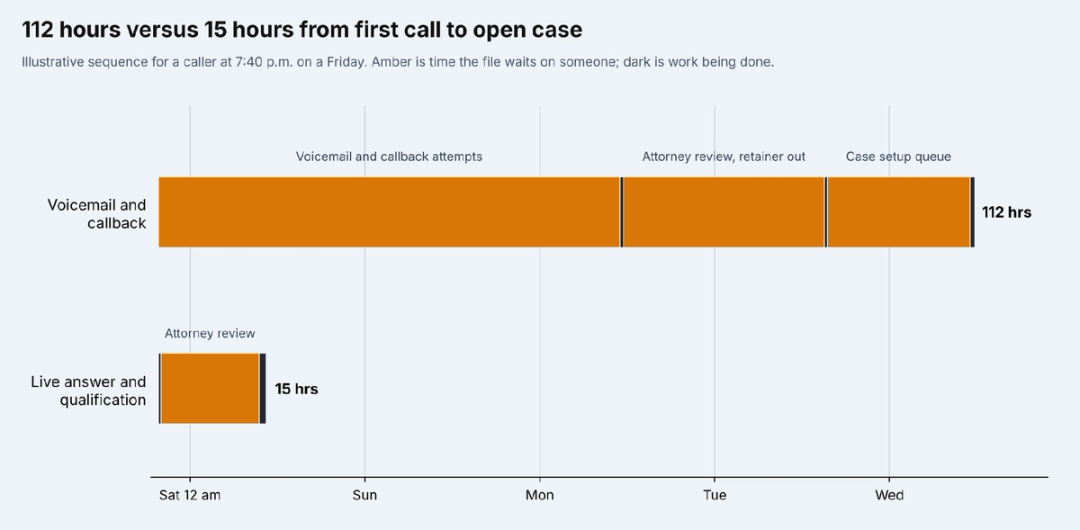
The timeline is illustrative and built from the Friday sequence in the introduction. The faster version still waits overnight for an attorney, the one wait that should stay, since the conflict determination and any merits question belong to a lawyer under Opinion 506; what it removes are the voicemail, the callback list, and the case setup queue.
Medical records belong at the end of intake, not weeks into the case. Once the case is open and the provider list is confirmed, records requests can go out the same day, and the team can organize the records into the file as they arrive, so the case manager starts the first treatment check-in with records already moving.
That last stage is where intake turns into case management. It is also the stage where an AI agent built around a plaintiff firm's workflow differs most from a general answering tool, which is the subject of the difference between AI intake and AI operations.
HelloCounsel runs personal injury intake inside your case management system
HelloCounsel builds AI voice agents for plaintiff personal injury firms, and its agent works across the seven stages mapped above while leaving attorney review with your attorneys. HelloCounsel is our own product.
- Answering and caller identification: HelloCounsel works as a 24/7 receptionist that answers in under two rings and identifies the caller and any existing matter before the conversation starts.
- Qualification: HelloCounsel runs AI intake against the firm's case criteria in English or Spanish with mid-call switching and routes each file to the sign track, attorney review, or a referral.
- Case opening: HelloCounsel opens the matter once the client signs the retainer, opens the insurance claim, and creates the first tasks and follow-ups.
- Case management: HelloCounsel carries the file between intake and demand, waits on hold with providers and adjusters, and completes tasks inside the matter.
- Medical records: HelloCounsel requests records from providers and organizes them into the file after intake qualification.
- Lead follow-up and client check-ins: HelloCounsel follows up with leads who haven't signed and runs client check-ins, including treatment check-ins, so clients hear from the firm between milestones.
- CMS write-back: HelloCounsel writes every call to the matter through direct integrations with SmartAdvocate, Filevine, Litify, Lead Docket, and Clio, and we build custom integrations for other systems.
- Escalation and reporting: HelloCounsel hands any call to a person when the flow calls for it and reports on call performance.
HelloCounsel has handled more than 25,000 calls and 500 hours of call time and has delivered a 48% improvement in call reception rates. We price on a fixed monthly fee starting at $500, scoped to expected call volume with 20% tolerance either way, with no per-minute billing and no setup fee, so normal month-to-month swings in volume don't change the invoice.
Onboarding takes about an hour and runs on 17 multiple-choice questions, and agents go live in SmartAdvocate in about a week. HelloCounsel has clear limits: it works in English and Spanish only, it runs inside your case management system rather than replacing it, and a firm tracking cases in spreadsheets isn't a fit.
Whichever tool a firm chooses, the decision to keep it should rest on numbers measured against a baseline, and the rollout order decides which numbers move first.
How should a plaintiff firm roll out AI intake?
Switching every call to an AI agent on the first day puts the whole intake desk on an untested process, so a phased rollout is the safer way to test personal injury intake optimization against your own baseline. Each phase widens the share of calls the agent answers first while your team keeps the calls that need a person.
1. After hours first: Route evenings and weekends to the agent for the first 30 days, since those 123 hours currently go to voicemail, and any answered call is a gain over the baseline.
2. Peak overflow next: Add business-hours overflow so the agent answers when every specialist is busy, which covers the campaign spikes the staffing math can't absorb.
3. First answer on every call: Move the agent to the first answer on all inbound calls once write-back audits come back clean, with intake specialists taking the escalations and attorney-review files.
Escalation rules belong in the plan from day one. Decide which calls go straight to a person regardless of the hour, such as a wrongful death inquiry, a caller in obvious distress or an existing client asking for her attorney by name, and test those paths in the pilot before widening the scope.
The phases also protect the team. Intake specialists move from answering phones to handling attorney-review files, sign-ups, and escalated callers, which is work where their judgment and experience count, and the after-hours phase gives them a month of data before anything changes in their own day.
Each phase ends with a decision about whether to widen the agent's scope, and personal injury intake optimization needs the same short list of numbers at every one of those decisions.
Six metrics show whether AI intake is working in the first 90 days
A baseline taken before launch is what makes a 90-day review of personal injury intake optimization meaningful, so pull the current figures from your phone system and case management system before the switch. Four of the metrics measure waits from the intake table, and two measure the quality of what intake produces.
| Metric | What it measures | Where the number comes from |
|---|---|---|
| Answer rate | Share of inbound calls answered live, split into business hours and after hours | Phone system |
| Time to answer | Seconds from first ring to a live voice, against the 20-second targets in the staffing math | Phone system |
| Time to qualification | Hours from first call to a complete screening | Case management system |
| Qualified-to-signed rate | Share of qualified callers who sign, by marketing source | Case management system |
| Signature-to-open time | Hours from the signed retainer to an open matter with the claim opened and first tasks set | Case management system |
| Write-back completeness | Share of calls with a complete note on the right matter | Monthly audit of 50 random calls |
Once you attach your average case value and marketing cost per lead, these six figures produce the ROI calculation for an AI voice agent at your firm. A firm whose answer rate and time to qualification move in the first 30 days, while signature-to-open time stays flat, has found its next constraint in case setup, since the phones are no longer the bottleneck.
Personal injury intake optimization ends where the case manager's first check-in begins, and a firm that measures the full sequence knows which handoff to fix next. Before your next vendor conversation, ask each tool to run your seven stages on a real call, and use our guide to evaluating an AI voice agent for your law firm for the questions that separate an answering tool from an intake system.
Find the slowest handoff in your intake
HelloCounsel's founders will go through your seven intake stages with you and identify which wait the agent would remove first. Arrange an intake review with our founders
Frequently asked questions about personal injury intake optimization
1. What is personal injury intake optimization?
Personal injury intake optimization is the work of shortening the time from a caller's first ring to an open, staffed case. It covers answering, caller identification, qualification, attorney review, signature, case opening, and the first records requests and check-ins.
2. Can an AI agent sign up a personal injury client?
Under ABA Formal Opinion 506, a nonlawyer may present the engagement agreement and collect the signature once the client has had the chance to speak with a lawyer. HelloCounsel sends the retainer for e-signature within the limits the firm's attorneys set.
3. Who decides whether a caller has a case when AI handles intake?
An attorney decides. Opinion 506 bars nonlawyers from applying the law to a caller's facts, so HelloCounsel gathers the facts, runs the conflict search, and routes the complete file to attorney review.
4. How many intake specialists does a PI firm need to answer every call live?
Erlang C math with six-minute calls shows that 20 calls an hour need five specialists on the phones at once to answer 90% within 20 seconds, and 40 calls an hour need eight.
5. Does AI intake work after hours and on weekends?
Yes. HelloCounsel answers 24/7 in English and Spanish, qualifies new callers, follows up with leads, and writes each call to the matter, so Monday starts with complete files instead of a callback list.
6. Which case management systems does HelloCounsel integrate with?
HelloCounsel integrates directly with SmartAdvocate, Filevine, Litify, Lead Docket, and Clio and builds custom integrations for other systems. HelloCounsel runs inside your case management system rather than replacing it.
Share this article