
- Of fourteen pages ranking for this question, twelve are published by companies that sell retrieval, so the answer arrives pre-decided.
- BLS puts the median paralegal wage at $30.24 an hour as of May 2025, which is the honest starting point for any in-house figure.
- Handing records work to a vendor discloses protected health information, which federal law permits only on satisfactory assurance from that vendor under 45 CFR 164.502(e).
- Supervision stays with the lawyer under Model Rule 5.3, which appears on none of the pages currently answering this question.
- Any model executes whatever request you hand it, so a wrong provider list produces a flawless wrong request and a second full cycle.
- Cost per completed case is decided at intake, which is the one input the vendor-versus-in-house comparison holds constant.
Search for guidance on whether to outsource medical record retrieval services and the answer arrives already made. Twelve of the fourteen pages ranking for that question are published by retrieval vendors, platforms selling retrieval, or staffing firms selling the same thing under another name.
Only one ranking page comes from a publisher with no stake in the answer. Among them, three pages exist whose whole premise is costing in-house staff against a vendor. Between those three sit one unsourced percentage and zero dollar figures.
HelloCounsel sells intake software, so we have a stake of our own and it sits somewhere else. That lets this piece say something the rest of the field finds awkward, which is that outsourcing is often the right call.
In-house, vendor and software-assisted retrieval compared
Firms who outsource medical record retrieval services describe this as a two-way choice between staff and vendor. Three exist in practice now, which makes naming each one worthwhile before comparing them.
In-house means a paralegal or records clerk on your payroll submitting requests, calling custodians and chasing silence. Fixed cost, full control, capacity set by headcount.
Retrieval vendors are companies with provider relationships and a portal, taking the whole function. Variable cost tracking case volume, with the work and the visibility both leaving your office.
Software-assisted means tooling that handles submission, tracking and escalation while your staff keep ownership. Lower cost per request, and the follow-up problem stays yours.
Choosing badly between them usually traces to one error. Software solves a submission problem and leaves a follow-up problem untouched, while a managed service solves a follow-up problem and leaves value on the table when most of the work stays in your office.
Putting a real number on the in-house side
Internal cost gets underestimated because payroll already exists, so retrieval work looks free once the salary is paid.
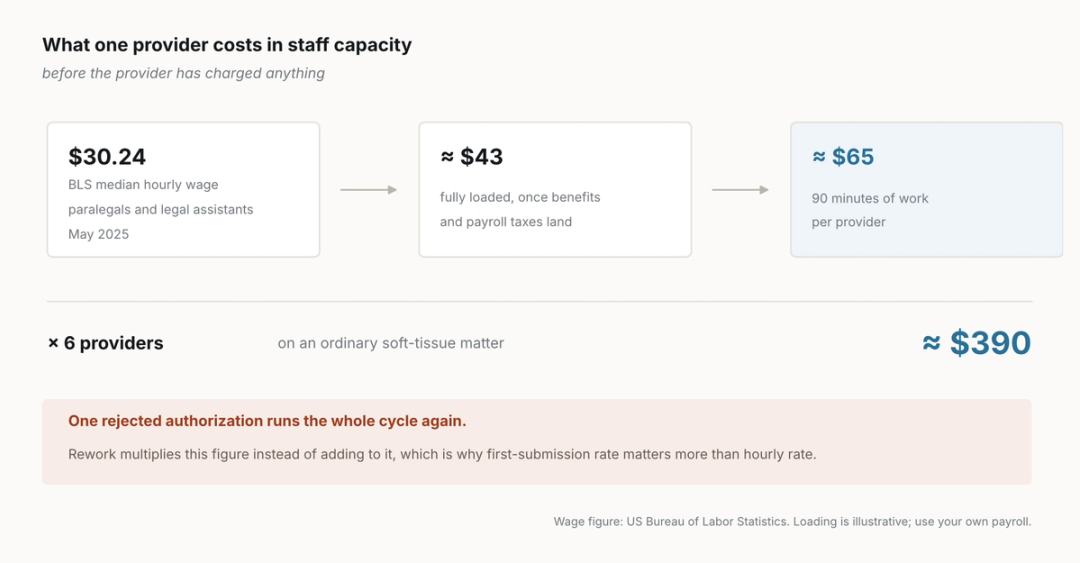
The Bureau of Labor Statistics reports median pay for paralegals and legal assistants at $62,890 a year, or $30.24 an hour, as of May 2025. Wages make up roughly seven tenths of total employer compensation once benefits and payroll taxes land, which puts a fully loaded hour somewhere above forty dollars.
Apply that to the work. Ninety minutes spent across one provider, counting the initial submission, two follow-up calls and a correction, costs about sixty-five dollars in staff capacity before the provider has charged anything.
Multiply by six providers on an ordinary soft-tissue matter and internal handling runs close to four hundred dollars of capacity per case. Swap the BLS median for your own payroll figures before deciding anything, since the number shifts with them.
Work out what retrieval is costing your firm in staff hours
Give us a week of your records-related tasks and we will price them against your own payroll instead of a national median. Price your internal retrieval
Three costs that sit outside the quoted price
Provider fees, rework, and carrying time all land on your ledger whichever model you run, and a vendor quote covers none of them. Leaving them out of the comparison is how firms reach the wrong answer confidently.
Provider fees arrive separately, whichever model you use, set by state schedule or federal cost-based standard, depending on who signed the request. Our breakdown of medical record retrieval costs covers why the same records carry two prices.
Rework multiplies everything above it. One rejected authorization costs a full cycle through the custodian's queue, well beyond the ten minutes needed to correct the form.
Carrying cost runs quietly. Every week a demand package waits on one outstanding provider, a week of capital tied up in a matter that could have closed.
Supervision stays with the lawyer who delegates
Work moves when you outsource. Supervision stays where it was, and no page currently answering this question says so.
Model Rule 5.3 applies "with respect to a nonlawyer employed or retained by or associated with a lawyer," which covers a retrieval vendor under contract. Rule 5.3(b) requires a lawyer with direct supervisory authority to "make reasonable efforts to ensure that the person's conduct is compatible with the professional obligations of the lawyer."
Rule 5.3(c) goes further, making a lawyer responsible outright for vendor conduct the lawyer ordered, ratified, or knew about while consequences could still be avoided. Contract terms assigning compliance to the provider move none of that.
Practically, supervision means knowing what your vendor sent and what came back. Where a model gives you a monthly summary and no request-level visibility, you are left unable to evidence reasonable efforts, which becomes a problem before it is ever a quality complaint.
The agreement you need before records move
Handing protected health information to a retrieval vendor is a disclosure, and federal law conditions it.
45 CFR 164.502(e) permits disclosure to a business associate where the disclosing party obtains "satisfactory assurance that the business associate will appropriately safeguard the information." That assurance is documented in a business associate agreement.
45 CFR 164.504(e)(2)(ii) sets what the agreement must require. Limits on use and disclosure, appropriate safeguards, reporting of impermissible uses including breaches of unsecured information, and flow-down so any subcontractor accepts the same restrictions.
Two further requirements matter at the end of a relationship. Two further obligations bind the vendor. Internal practices, books and records must be made available to the Secretary, and on termination all protected health information must be returned or destroyed, with no copies kept where that is feasible.
Read the subcontractor clause closely when a vendor uses offshore staff or a downstream copy service. Flow-down is the provision that reaches them, and verifying it is part of the diligence nobody on this topic describes.
Commercial terms the compliance paperwork leaves open
A business associate agreement satisfies the regulator and protects nobody's commercial position. Several things belong in the services contract alongside it, and the field answering this question stays quiet about every one.
Turnaround commitments need a remedy attached. A stated target with no consequence is an aspiration, so ask what happens to the invoice when the target slips and whether the clock pauses while a provider sits silent.
Breach notification needs an allocation. Your vendor reports impermissible uses to you under the agreement, and who notifies the affected individual, and within what window, is a commercial question the regulation leaves open.
Exit terms decide what a bad fit costs. Return or destruction of records is already required. What remains negotiable is the format you receive them in and whether open requests transfer or restart.
Ask about all four before signing, since each is cheap to negotiate at the start and expensive to raise once a matter is stuck.
A bad provider list costs the same under all three
Every page answering this question treats the request itself as a given. Both models execute whatever you hand them, which means the quality of that input decides the outcome under either one.
The strongest competitor pages name their two largest cost inputs as rework and provider identification. Neither asks where a rejected authorization or an incomplete provider list comes from.
Intake produces both. Clients who name four facilities after attending seven produce three requests nobody sends, and a date range opening at the collision produces records missing the prior treatment the defense will find.
Give that request to a vendor with a fifty-state network and a clean SOC 2 report and it executes flawlessly. You pay the full cycle, receive records covering the wrong period, and pay again.
| In-house | Retrieval vendor | Software-assisted | |
|---|---|---|---|
| Cost shape | Fixed headcount | Variable per matter | Per request or seat |
| Who chases the custodian | Internal staff | The vendor | Your staff |
| Request-level visibility | Complete | Depends on reporting | Complete |
| Rule 5.3 supervision | Direct | Yours, at a distance | Direct |
| BAA required | No | Yes | Usually yes |
| Effect of a wrong provider list | Full second cycle | Full second cycle | Full second cycle |
That final row is the one worth sitting with. Each model responds to a bad input identically, so the comparison everyone publishes holds the largest variable fixed.
Deciding which model fits
Volume and staffing answer most of whether to outsource medical record retrieval services, and the honest version favours doing so more often than a company in our position would prefer.
Outsource medical record retrieval services where volume swings, where mass tort or filing waves break a staffed model, or where your paralegals are leaving over the work. Vendors carry provider relationships and state-specific quirks no generalist keeps current.
Keep it in-house where volume is steady and modest, where you already have spare capacity, and where request-level control matters more than the hours it costs. Low-volume firms genuinely do this cheaper themselves.
Use software-assisted where submission and tracking are the bottleneck and follow-up is working. Tooling compounds an existing process and does little for one that is broken.
Find out which model your caseload actually supports
Send us your monthly request volume and provider mix and we will tell you which of the three fits, including when the answer is a vendor. Get a model recommendation
Intake changes the arithmetic under every model
Complete provider capture and accurate identifiers lower cost whether you staff retrieval or buy it. These belong inside the comparison, not beside it.
Complete provider capture on the first call removes the supplemental request entirely. Each provider missed at intake costs a full cycle later, and surfaces at the point a demand package is being assembled.
Accurate identifiers remove the most common rejection. Maiden names, dropped hyphens and transposed dates of birth return a facially valid request unfilled.
Bounding the treatment date range removes the second most common. Open-ended ranges invite the custodian to interpret, and ranges starting at the date of loss miss prior treatment.
Fewer requests also means less protected health information disclosed to a vendor and fewer vendor touches to supervise. Regulatory surface area and supervision burden both scale with request count, which makes a cleaner intake a compliance improvement alongside a cost one.
How HelloCounsel handles the upstream half
HelloCounsel sells intake software, so read this as a description of design choices and not a neutral assessment.
Our intake agent asks for facilities instead of physicians, then follows any named doctor with a question about where that doctor practices, because institutions hold records and clients name people.
Counting providers as a structured field is what lets a firm make the model decision before anyone drafts a request. Six custodians and two custodians are different economic problems.
Identifiers are read back for confirmation on the call, and the treatment date range is captured bounded at both ends with a separate question about prior treatment. Those two removals target the defects behind most rejections.
Everything writes to the case management system as fields, covered in our note on CMS write-back. Whichever retrieval model you run, it runs on what intake captured.
Measure these four before switching anything
Evaluations of this decision track cost per request, which hides the thing worth knowing.
Measure cost per completed case, since a cheap request that arrives incomplete costs more than an expensive one that lands right. Measure first-submission success rate, which is the clearest read on input quality.
Then measure providers added after the first request went out, telling you directly how often intake produced a partial list. And measure elapsed days from intake to complete records, which captures carrying cost the per-request number ignores.
Running those four for a quarter before switching models gives you a baseline. Switching without one leaves you unable to tell whether the change helped. We covered what those hours look like in practice in case manager workload.
Making the call
Whether to outsource medical record retrieval services is a real decision with a real answer, and for many firms that answer is a vendor.
What the current field obscures is that the choice sits downstream of a bigger one. Both models bill you for executing the request you wrote, and both bill you twice when it was wrong.
Run the four measures above for a quarter. If providers added after first request stays above zero on most matters, the model question is the second thing to fix.
Bring us the matter where records held up the demand
Tell us about the case where retrieval ran longest and we will trace whether the model or the intake caused it. Talk to the HelloCounsel founders
Frequently asked questions
1. Is outsourcing cheaper than handling retrieval in-house?
At steady low volume, firms that outsource medical record retrieval services often pay more in gross terms than they would in-house. Outsourcing pulls ahead where volume swings, where surge capacity matters, or where internal time carries a high opportunity cost. Cost both options using your actual payroll figures, not a published average.
2. Does outsourcing reduce payroll?
Usually only over time. Work leaves immediately while the salary stays until that person is redeployed or the role closes, so the first few months carry cost on both sides.
3. Do we need a business associate agreement with a retrieval vendor?
Yes. Federal law conditions the disclosure on obtaining satisfactory assurance from the vendor, and that assurance lives in a written agreement with specified contents, including flow-down to any subcontractor. Sections 164.502(e) and 164.504(e)(2)(ii) are the provisions to read.
4. Who is responsible if the vendor mishandles something?
Your firm, for supervision. Model Rule 5.3 places the duty on the lawyer with supervisory authority and makes the lawyer answerable outright for conduct ordered, ratified, or known in time to remedy. Contract terms allocate liability between the parties and move none of the ethical duty.
5. Will a vendor fix our turnaround problem?
Partly. Firms that outsource medical record retrieval services see submission and follow-up compressed, and providers remain the bottleneck. Any vendor executing a request built on a partial provider list delivers the same incomplete result your own staff would.
6. What volume justifies outsourcing?
Less a threshold than a pattern. Variable volume, growing caseload, or paralegal turnover tied to records work all argue for it. Steady volume with spare capacity argues for keeping it where it is.
Share this article