Best Medical Records Retrieval Companies for PI Law Firms in 2026

- Published turnaround across medical records retrieval companies spans 4 days at one end and 45 at the other, and several vendors claiming the fastest service publish no number at all.
- Four of the best-known names in this market work for hospitals rather than law firms, so a request you file there sits in a queue nobody chases on your behalf.
- Only two vendors publish anything resembling a rate, which makes the follow-up policy the line item to negotiate rather than the headline price.
- Ask every vendor whether re-requests, page counts, and no-record outcomes carry a separate charge, because that is where a flat fee stops being flat.
- Retrieval and follow-up are different purchases, and a firm that already has a retrieval contract can still be losing a paralegal day a week to the phone.
Medical records retrieval companies all promise the same outcome, which is a complete file without your team chasing it. What they actually sell varies more than the pitch suggests.
Some submit requests and hand back whatever arrives. Others keep calling a silent custodian for six weeks and treat that as the job. The difference shows up on your invoice and in your case cycle time.
A request that goes quiet is where you feel it. A case manager sends one to an orthopedic group in early March and hears nothing back.
She calls two weeks later, works the phone tree, and reaches a clerk who says the request is in the queue. She calls again in April and learns the fax never arrived. By the time the file lands, the demand is nine weeks behind.
Every firm running personal injury work recognizes some version of that. This comparison ranks ten options on what each publishes: turnaround, pricing model, follow-up protocol, record types, and whether it writes into the case management system your team already lives in.
Four of the biggest names in records work for the hospital, not for you
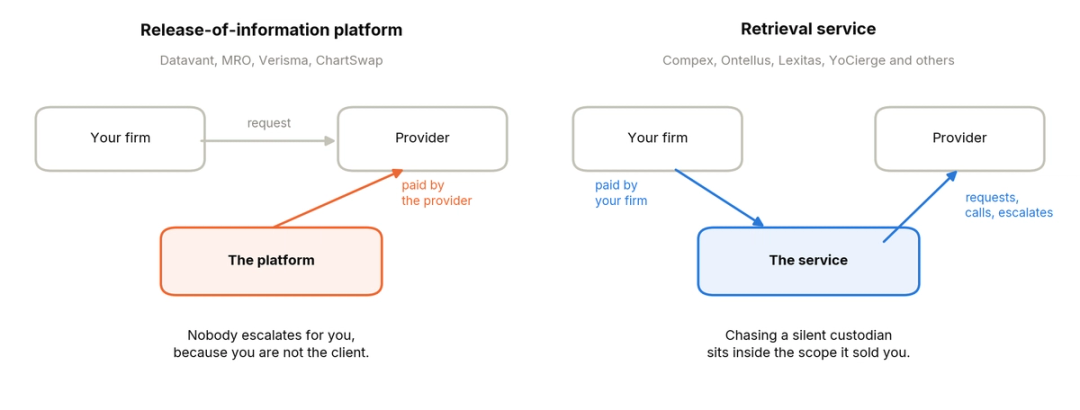
Several of the names that show up on lists of medical records retrieval companies are release-of-information platforms. Datavant, MRO, Verisma, and ChartSwap all sit in that group.
Their customer is the health system, and their job is to process the outbound disclosure a provider owes. A law firm shows up on the other side of that transaction as a requester.
You can file through those portals, and for a provider already contracted to one, that is often the fastest route into the queue. Nobody there escalates on your behalf, because you are not the client. ChartSwap is now a Datavant product, and Datavant also owns Ontellus, which is a retrieval service, so the same corporate name appears on both sides of the exchange.
A retrieval service is the opposite arrangement. You hire it, it works for you, and chasing a slow custodian is inside the scope it sold you. Every vendor in this ranking is the second kind.
What the published turnaround numbers actually look like
Turnaround is the number every buyer asks about, and the one most medical records retrieval companies decline to print.
Six vendors publish a figure. Ontellus, National Record Retrieval, ReleasePoint, Boomerang Legal, First Legal, and Esquire describe their speed in words alone, several of them claiming the best turnaround in the industry without a day count attached.
The orange band matters as much as the dots. Under 45 CFR 164.524(b)(2), a covered entity has 30 days to act on a request and may take one 30-day extension with written notice. A vendor publishing a 30 to 45 day average is reporting the regulation, not beating it.
The 10 best medical records retrieval companies in 2026
| Company | Best for | Published turnaround | Pricing model |
|---|---|---|---|
| HelloCounsel | Firms that want the follow-up loop run inside their own CMS | 15 days cut from client turnaround | Fixed monthly from $500 |
| Record Retrieval Solutions | A published per-request price | 15 days | $45 flat fee per request |
| YoCierge | Plaintiff case management integrations | Same-day submission | Volume-based flat fee, no per-page charge |
| Compex Legal Services | Breadth of record types | 15 to 20 days on authorization | Quote only |
| Ontellus | Firms working within Datavant's provider network | Not published | Quote only |
| U.S. Legal Support | National scale and security posture | 30 to 40 days | Quote only |
| Lexitas | Bundling records with depositions | 30 to 45 days | Quote only |
| American Retrieval | Sworn certifications and affidavits | Not published | Quote only |
| National Record Retrieval | A defined follow-up cadence | Not published | Quote only |
| ChartRequest CaseBinder | Network reach without a subscription | 30 days | No subscription fee |
1. HelloCounsel automates the follow-up loop instead of outsourcing it
We build HelloCounsel, so read this entry as our side of the argument.
Most vendors on this list sell you the whole records function as a service. HelloCounsel sells the part that consumes your staff, which is the calling.
An AI agent picks up a task created in your case management system, submits the request by phone, email, or fax, then works the provider's phone tree, waits in the hold queue, and confirms the request landed. It re-requests when a provider loses one. Firms running our medical records agent have cut 15 days from their records turnaround.
The agent validates the plaintiff, provider, and dates of service before closing a request, and flags missing records rather than returning an incomplete file. When a provider requires prepayment it creates a payment task for the right person, and it never touches firm card details.
Every call, status change, and next task writes back to the matter. Direct integrations cover SmartAdvocate, Filevine, Litify, and Lead Docket, with custom builds for other systems, so the chase list stops living in a paralegal's head and starts living in the file.
Pricing: from $500 a month, fixed to your expected volume with 20% tolerance either way, with no per-minute billing and no setup fee. Our records agent runs at roughly a quarter of what retrieval companies charge per record, based on our own market experience. Billing passes through by case as an itemized expense.
Where it falls short: hard-copy mail is outside scope, portal access needs credentials your firm provides, and provider prepayments stay with the firm. Outcomes still depend on how fast a given provider moves, so this removes the labor rather than the wait.
Work out what the chase is costing you
Count the records requests your team has open right now and multiply by four follow-up calls a month, which is the working assumption we use for volume planning. That number is the one worth pricing against a retrieval contract. Book a demo
2. Record Retrieval Solutions publishes a flat fee almost nobody else will
Record Retrieval Solutions charges a $45 fixed fee per request. That covers request preparation, HIPAA authorization review, follow-ups, status updates, progress notes, accuracy verification, and an automatic certificate when a provider returns no records.
Provider and copy-service fees sit outside that number, advanced and passed through on the invoice. If a provider insists on separate medical and billing requests, each one is $45.
Average delivery runs 15 days, and quality control includes following up with the provider when a file comes back incomplete. Integrations cover Filevine through RecordSync, and Needles. Indexing, hyperlinked treatment timelines, summaries, Bates stamping, and OCR are priced separately.
Where it falls short: the vendor publishes no SOC 2, ISO, or HITRUST certification, which matters if your security review asks for more than a HIPAA attestation.
3. YoCierge has the deepest plaintiff integration list
YoCierge connects to twelve legal systems, including SmartAdvocate, Filevine, Litify, MyCase, CASEpeer, Smokeball, Practice Panther, Neos, and Lawcus. No other vendor in this market comes close on that count.
Pricing runs on volume-based flat rates with no per-page charge, even when a request returns thousands of pages. Page charges are one of the common surprises on a records invoice, so removing them is a real commitment rather than a marketing line.
It handles radiology films on CD and DVD with DICOM viewer support, which most vendors leave unaddressed. Certifications cover SOC 2, ISO 27001, ISO 22301, HIPAA, and CARIN accreditation, the strongest set published in this category. Separate service lines serve plaintiff and defense firms.
Where it falls short: the site publishes same-day submission rather than an end-to-end delivery average, and it does not describe its follow-up protocol, so ask how escalation works before you sign.
4. Compex Legal Services covers the widest range of record types
Compex retrieves across all 50 states and goes well beyond medical charts, into X-rays and diagnostic images, workers' compensation, insurance, accident, employment, billing, banking, and school records. On a case where the story sits partly outside the treating file, that breadth saves you running a second vendor.
Authorization-based requests average 15 to 20 days and subpoena-based requests around 30. Rush legal document preparation often turns in 24 hours.
Compex describes its chasing more concretely than most, using proprietary data on the best time of day to reach a given custodian. Rush orders carry extra follow-up on top of that. It holds SOC 2 certification and runs penetration testing.
Where it falls short: pricing is quote only, and while the site references integrations and APIs, it names no case management system, so plaintiff firms should confirm the connection they need exists.
5. Ontellus suits firms already inside the Datavant network
Ontellus is Datavant's legal and insurance retrieval arm, and it handles provider portals, accounts, and retrieval end to end. Its platform adds SmartChron for chronologies and SmartOrg for organizing what comes back.
Coverage spans medical, pharmacy, and employment records, and the company is certified to SOC 2 Type II.
The integration list is the tell on fit. Ontellus names Guidewire and Duck Creek, which are insurance core systems rather than plaintiff case management software. The product serves carriers, third-party administrators, self-insureds, and law firms, and the stack reflects where the volume comes from.
Where it falls short: it publishes no turnaround figure while describing its times as industry-leading, and a plaintiff firm on SmartAdvocate or CASEpeer will need to ask what integration actually exists.
6. U.S. Legal Support brings the strongest security posture
U.S. Legal Support runs national retrieval at high volume and states a goal of delivering records in 30 to 40 days depending on hold periods and location compliance. It is also the parent company of American Retrieval, which appears separately below.
Security is where it separates from the field: SOC 2 Type 2, the NIST Cybersecurity Framework, HIPAA, and a 24/7 network and security operations center. If your firm handles records for a client base that triggers a serious vendor review, this is the easiest file to clear.
It is the only vendor publishing retrieval from facilities outside the United States, and it covers deposition transcripts alongside medical, billing, employment, and insurance records.
Where it falls short: that 30 to 40-day goal sits at the regulatory ceiling rather than under it, and the site names no plaintiff case management integration.
7. Lexitas fits firms that already buy depositions from one vendor
Lexitas runs retrieval inside a broader litigation services business covering court reporting and depositions. For a firm consolidating vendors, one contract and one account manager across both is a real operational saving.
The team manages follow-ups proactively and escalates delayed requests. Record types run wide, covering medical, billing, radiology, police reports, pathology, pharmacy, employment, school, workers' compensation, and financial records. Separate product lines serve plaintiff and defense work.
Where it falls short: the published average is 30 to 45 days, the slowest stated figure in this comparison, and the site names HIPAA compliance without a SOC 2 or ISO certification behind it.
8. American Retrieval handles sworn documents alongside records
American Retrieval pairs retrieval with certifications and affidavits, which matters when the evidentiary package needs a custodian declaration rather than just the chart. It also supports subpoena work and OCR delivery and runs the RecordsHub portal.
The company states that it does not double charge for follow-ups, which is a useful commitment given how often re-requests turn into line items.
Where it falls short: turnaround is described as a few days to a couple of weeks with the caveat that timelines depend on the provider, and the security page lists HIPAA and PCI-compliant servers without SOC 2, ISO, or HITRUST.
9. National Record Retrieval publishes an actual follow-up cadence
Most vendors say they follow up. National Record Retrieval says how: automated faxes and emails to providers, plus weekly live call center follow-up, on a three-touchpoint cycle.
For a firm whose real complaint is silence between status updates, a stated cadence is more useful than a turnaround claim. It holds SOC 2 Type II certification with 256-bit AES encryption and serves personal injury, disability, and mass tort work.
Where it falls short: it guarantees the best turnaround in the business without publishing a number, and it references integrations with popular case management systems without naming one.
10. ChartRequest CaseBinder trades a subscription for network reach
ChartRequest runs a release-of-information platform for providers and sells CaseBinder to law firms, so it sits on both ends of the transaction. That dual position gives it a network it puts at more than 12,000 healthcare organizations.
CaseBinder carries no subscription fee and runs a best-price algorithm across request routes. Published average turnaround is 30 days, and the company holds SOC 2 certification.
Where it falls short: the law firm page does not specify which record types are covered or name any case management integration, and a 30-day average tracks the statutory window rather than improving on it.
What separates these vendors once the demos are over
Four questions separate medical records retrieval companies more than the headline price does.
How the vendor charges for work that repeats. A flat fee is only flat when re-requests, extra pages, and empty results sit inside it. Record Retrieval Solutions publishes what its $45 covers, and YoCierge publishes that pages are never charged. Everywhere else, ask in writing.
Whether the follow-up loop is scoped or assumed. National Record Retrieval and Compex describe an actual mechanism. Several others use the word follow-up without defining who calls, how often, or what happens at day 30.
Which system the records land in. YoCierge names twelve legal platforms and Record Retrieval Solutions names two. Most name none, which means a paralegal is moving files by hand and the chase list lives outside the matter. Our guide to CMS write-back covers why that gap costs more than it looks.
Whether SOC 2 is on the table. HIPAA compliance is table stakes and every vendor claims it. SOC 2 splits the field, and it is the question a serious client security review will ask you.
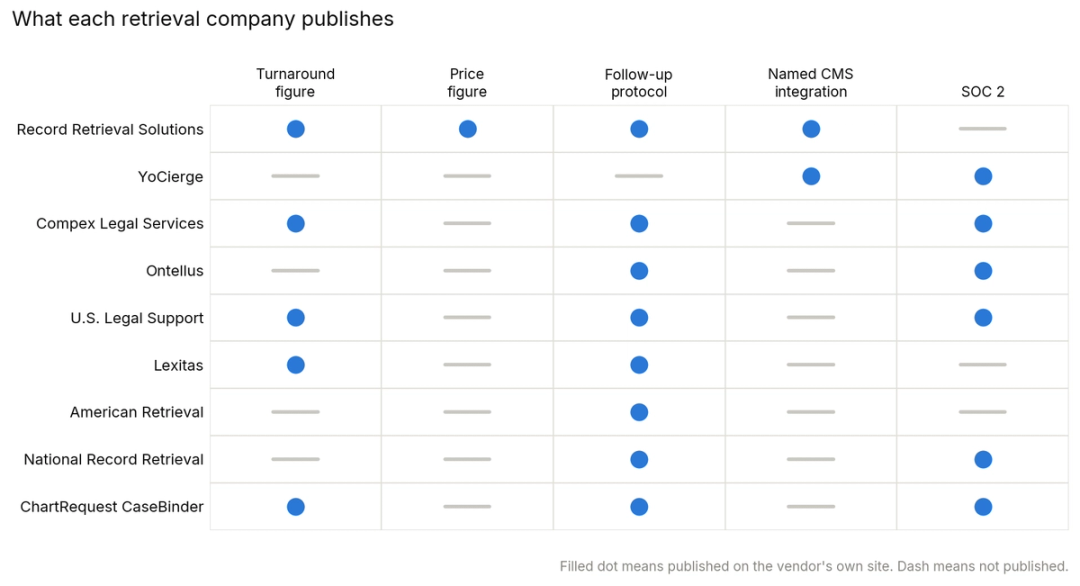
One row runs almost empty and one runs almost full, and neither is the most expensive option. Ask for anything a vendor leaves blank before the contract, because a gap on that grid becomes a question you cannot answer for a client later.
What retrieval contracts do not cover
Medical records retrieval companies take the records function. They do not take the rest of the phone work a personal injury case generates.
The same case manager waiting on that orthopedic group is also fielding a client asking why the adjuster has gone quiet, an adjuster calling back at 4:15pm, and a provider returning a call about a different file. None of that sits inside a records contract.
Firms solve records and still find the desk full, because the work was never only records.
Our treatment check-in agent runs on the same line as the records agent.
So does case opening, which starts the moment the fee agreement lands.
New callers reach the intake side, and all three agents write into the same matter.
Across 30,000 calls and 500 hours of call time, firms working with us have seen a 48% improvement in call reception rates and check-ins running twice as often as before. The mechanics of automating provider calls explain why the calling is a workflow rather than a feature.
How to choose between them
Start by deciding which problem you are buying out of, because medical records retrieval companies solve two different ones. A firm with no records process needs a full-service vendor, and Record Retrieval Solutions or Compex will cover it without a long procurement cycle.
A firm holding a retrieval contract that still loses staff hours to the phone has a different problem. The contract moved the requests, and the chasing stayed. That is the gap an agent closes, and it is worth pricing separately rather than renegotiating the same deal.
Ask for the follow-up protocol in writing, ask what a re-request costs, and ask which of your systems the vendor writes into.
Before committing to either route, run the volume. Our breakdown of how many calls a PI case generates gives you the denominator.
The guide to reducing case manager workload shows where those hours currently sit today.
See it run on your own records queue
Bring three open requests that have gone quiet and watch an agent work the provider's phone tree, confirm the request, and write the status into your case management system. Agents go live in SmartAdvocate in about a week after one hour of onboarding. Book a demo
Frequently asked questions
Short answers to what firms ask most when comparing medical records retrieval companies.
1. What do medical records retrieval companies actually do?
They prepare and submit records requests to providers, follow up until the records arrive, verify completeness, and deliver the file to your firm. Most also handle billing records, and some add chronologies or summaries as paid extras.
2. How much do medical records retrieval companies charge?
Most quote per request rather than publishing rates. Record Retrieval Solutions publishes $45 per request plus pass-through provider fees. HelloCounsel prices its records agent on a fixed monthly plan starting at $500.
3. How long should a medical records request take?
HIPAA gives a provider 30 days to act, with one 30-day extension available. Published vendor averages run from 4 days to 45 days, so anything quoted above 30 days is tracking the regulation rather than beating it.
4. Is Datavant a records retrieval company?
Datavant runs a release-of-information network serving health systems, and it owns both ChartSwap and Ontellus. Requests you file through its portal route through existing provider relationships, while Ontellus operates as a hired retrieval service.
5. Does HelloCounsel replace a records retrieval company?
HelloCounsel runs the submission and follow-up loop directly inside your case management system, which covers what most firms hire a retrieval vendor to do. Firms with unusual provider mixes sometimes run both.
6. Does HelloCounsel handle calls beyond records?
Yes. The same agents run reception, intake and qualification, case opening, insurance claims, lead follow-up and client check-ins, and treatment coordination, with human escalation available on any flow.
Share this article