
- Retrieval software lets a firm's own staff send and track record requests, with the firm keeping control of every provider relationship.
- Requests can go out under a HIPAA authorization or under the client's own right of access, and the second route carries a federal 30-day response deadline.
- The features that matter most are case management sync and authorization capture, followed by provider routing and automated follow-up.
- Software follow-up usually runs by fax or email, so phone calls to slow records departments still land on staff unless the firm automates them.
- Run a trial on live requests and compare median days to complete records against your last 90 days.
A records request sent from a personal injury firm passes through several hands before the chart comes back. Software decides how many of those steps a paralegal has to touch and how quickly anyone notices when a request stalls.
Firms that keep retrieval in-house have moved from spreadsheets to dedicated tools over the past few years. The tools range from add-ons inside case management systems to standalone platforms that send requests and chase providers on a schedule.
Choosing medical record retrieval software starts with the firm's case management system and its mix of providers. Feature lists look alike in demos, so the useful comparison is how each tool handles the slow requests that hold up a demand.
What is medical record retrieval software?
Medical record retrieval software is a platform the firm's own staff use to request and track medical and billing records. The firm stays the requester, and the software organizes the work around each case.
A retrieval service works differently. The vendor's team submits requests and handles follow-up on the firm's behalf, usually for a fee per request on top of provider charges.
Some vendors sell both, with software for routine requests and managed service for hard ones. Ask which parts of a demo show the software and which show work done by the vendor's staff, since the price and the control differ.
The daily users are usually records clerks and paralegals. A dedicated tool gives them one queue for every open request, sorted by age or by case, in place of the sticky notes and shared spreadsheets that break down past a few hundred requests.
The software sits inside a wider set of tools the firm already runs. Our overview of legal workflow automation covers where records work connects to intake and case management.
Which request route should the software support?
Records requests reach providers under one of two legal bases, and each one changes the deadline and the fee. Good medical record retrieval software lets the firm choose the route for each provider.
| Request basis | HIPAA authorization | Patient right of access |
|---|---|---|
| Who makes the request | The law firm, with the client's signed authorization | The client, for their own copy or as a directive to send records to the firm |
| Federal rule | 45 CFR 164.508 | 45 CFR 164.524 |
| Federal response deadline | None set by HIPAA, state law may apply | 30 days, with one 30-day extension |
| Fee rules | State copy-fee law | Patient-rate limits apply only when records go to the client |
| Best use | Hospitals with established attorney request queues | Small practices and providers that stall on attorney requests |
The right of access route has real teeth. Under 45 CFR 164.524, a provider must act on a patient's request within 30 days and may take one further 30 days if it explains the delay in writing.
The Office for Civil Rights has enforced that deadline since launching its Right of Access Initiative in 2019. It announced its 53rd enforcement action under the initiative in March 2025, and providers know it.
Software that tracks the right of access clock per request can flag day 30 automatically. Staff can then remind the provider of its obligation in writing, which often moves a request that sat untouched for weeks.
Plenty of firms use both routes. Hospitals with established attorney queues get authorization requests, while small practices that stall on law firm requests receive a right of access request signed by the client.
Fees follow the route as well. A 2020 federal court ruling in Ciox Health v. Azar limited the HIPAA patient-rate fee cap to requests patients make for their own records, so requests sent to a firm under a third-party directive fall under state fee law instead. The same ruling limited those directives to electronic copies of records held in an electronic health record.
The right of access route asks more of the client. They have to sign a request in their own name, and the request flow has to make that step simple enough to finish on a phone.
Which features matter in medical record retrieval software?
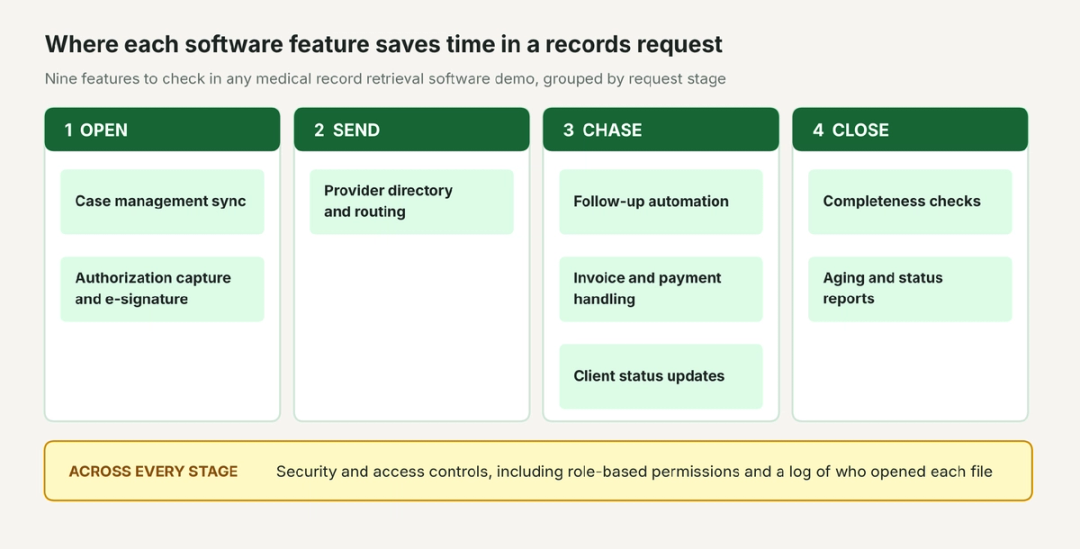
Demos tend to open with dashboards, though the features that save the most time sit earlier and later in the request. Nine of them separate useful tools from tidy trackers, and each one maps to a stage of the request.
Case management sync
Requests should start from the case file instead of a second data entry screen. When a case opens in Filevine or Litify, the software should pull the client's details and provider list without anyone retyping them.
Status should flow back the same way. A case manager working in the case file needs to see that a hospital chart is pending or delivered without logging into another system.
Ask how the sync behaves when a provider is added mid-case. A client who starts physical therapy three months after intake should trigger a new request from the case file, with the same authorization data attached.
Integration depth varies widely between vendors. Some tools offer a true two-way sync through the case management system's API, while others export a status file that staff upload by hand once a week.
Authorization capture and e-signature
Every request depends on a valid signed form, and missing signatures cause more delays than slow providers do at plenty of practices. Authorizations should go out for e-signature at sign-up, and the tool should flag any form that lacks an expiration date or a dated signature.
HelloCounsel's Case Opening agent collects provider names and treatment dates on the welcome call. The records team then has a complete provider list before the first request goes out.
Provider directory and routing
Each provider accepts requests through its own channel, and a request sent to the wrong fax line can sit for weeks. A shared directory stores the right channel for each provider, along with any provider-specific release form.
Hospitals often route requests through release-of-information vendors such as Datavant or ChartSwap. A good tool knows which provider uses which vendor portal, which saves staff from guessing on every new case.
Directories improve with use. Every time a records department changes its fax number or moves to a new portal, the update should reach every open and future request at that provider, instead of living in one paralegal's notes.
Follow-up automation
Standard medical record retrieval software automates follow-up by fax or email on a fixed schedule, such as every 48 hours. Automated reminders work well with providers that respond to written requests.
Small practices and busy hospital records desks often answer only the phone. Ask each vendor which follow-up channels the software uses and what happens when a provider ignores three written reminders in a row.
Cadence settings matter as well. A tool should let staff speed up reminders on requests tied to a demand deadline and slow them down for providers that have already confirmed a release date.
Invoice and payment handling
Providers frequently send an invoice before they release records. The software should capture that invoice against the open request and alert the person who approves payments, so a small copy fee never holds a chart for a month.
Affidavits and billing records often arrive separately from the chart. Good tools track each piece as its own line on the request until everything the case needs has arrived.
Payment approval rules keep the queue moving. A set dollar limit that staff can approve without an attorney prevents small invoices from waiting days for a signature.
Completeness checks
A delivery that covers half the requested dates of service looks finished in a basic tracker. The tool should compare each delivery with the request and flag missing visits or bills before the case manager files the records.
A few vendors now pair retrieval with AI record review that builds a medical chronology. That feature belongs to the demand stage, so evaluate it separately from the retrieval workflow.
Indexing helps both stages. Records tagged by provider and date of service let a paralegal assemble a demand package in hours, without paging through every delivery to find the right visit.
Security and access controls
Retrieval software stores every client's health history, so access controls deserve the same scrutiny as features. Ask whether permissions can be limited by role and whether the system logs who opened or downloaded each file.
Request the vendor's business associate agreement and security documentation before the first upload. Any vendor that stores records outside the firm's case file should also explain how long it keeps copies after a case closes.
Client status updates
Clients waiting on a demand call the firm to ask about records more than almost anything else. Some tools send clients automatic updates when a provider releases a chart, which cuts the number of status calls reaching case managers.
Automatic updates work best when they are specific. A message naming the provider and the date records arrived answers the client's question, while a generic progress note usually prompts a follow-up call anyway.
Phone updates still matter for clients who prefer a conversation. HelloCounsel's Client Communication agent handles routine check-ins, and firms using it have seen 2x more frequent check-ins with clients.
Aging and status reports
A weekly report should show every request open past 30 days, grouped by provider. The pattern tells the team which records departments deserve a direct call to the manager.
Reports by case matter just as much to attorneys. A case ready for demand except for one outstanding bill should rise to the top of the list.
How is retrieval software priced?
Pricing for medical record retrieval software falls into a few patterns, and provider copy charges sit on top of all of them:
- Monthly subscription: A flat monthly fee covers unlimited requests. One Filevine-integrated tool, Arctrieval, lists $239 a month with no per-request fees.
- Per-request pricing: The firm pays for each request sent, which suits firms with uneven monthly volume.
- Seat-based pricing: Each staff user carries a license fee, which grows with headcount instead of case volume.
- Hybrid managed plans: Software access comes bundled with vendor staff who handle difficult requests for an added fee.
Compare total cost per completed request across a full quarter. A cheap subscription that leaves staff making hundreds of follow-up calls can cost more than a pricier tool that closes requests faster.
Contract terms deserve a close read. Ask whether medical record retrieval software contracts run month to month or annually, and whether the firm can export every record and status history if it leaves.
Setup costs belong in the comparison too. Moving open requests out of a spreadsheet takes staff time, and authorization templates need review before the first batch goes out under a new tool.
Where rollouts of retrieval software go wrong
Firms usually buy on the dashboard and regret the follow-up. A clean status screen looks the same whether requests close in 20 days or 60, so the demo rarely shows the part that decides turnaround.
Generic authorization templates cause the next round of trouble. A provider that requires its own release form will reject the firm's standard version, and the software keeps sending reminders on a request the provider already returned.
Ownership slips when nobody is named for escalations. Good medical record retrieval software can flag a request at day 45, though the flag only helps when one staff member is responsible for calling the records manager that day.
Training gets cut short when the rollout lands during a busy month. Staff who learned only the request screen keep tracking follow-up in their own notes, and the aging reports stop reflecting reality.
Measuring averages hides the slow end. A median by provider type shows how long a typical request takes, and a separate count of requests past 60 days shows where cases are stuck.
Which follow-up still needs a phone call?
Written reminders stop working once a request reaches a provider that answers only by phone. As per our estimate, a single PI case generates about 150 calls over its life, and our breakdown of how many calls a PI case generates shows how much of that load comes from provider follow-up.
Those calls follow a repeatable pattern. The caller confirms the request arrived and asks for a release date, then checks whether an invoice or a corrected form is holding the chart.
A call also brings problems to light that a fax log hides. A provider may have closed the request after an unpaid invoice, or filed it under the wrong patient, and only a conversation with the records desk reveals it.
HelloCounsel builds AI voice agents for plaintiff personal injury firms, including agents that make those provider calls.
Its Medical Records workflow follows up on open requests through each provider's own channel and calls within each provider's callback window. Aging or urgent requests can move to a faster cadence, with escalation rules in place for requests that stall.
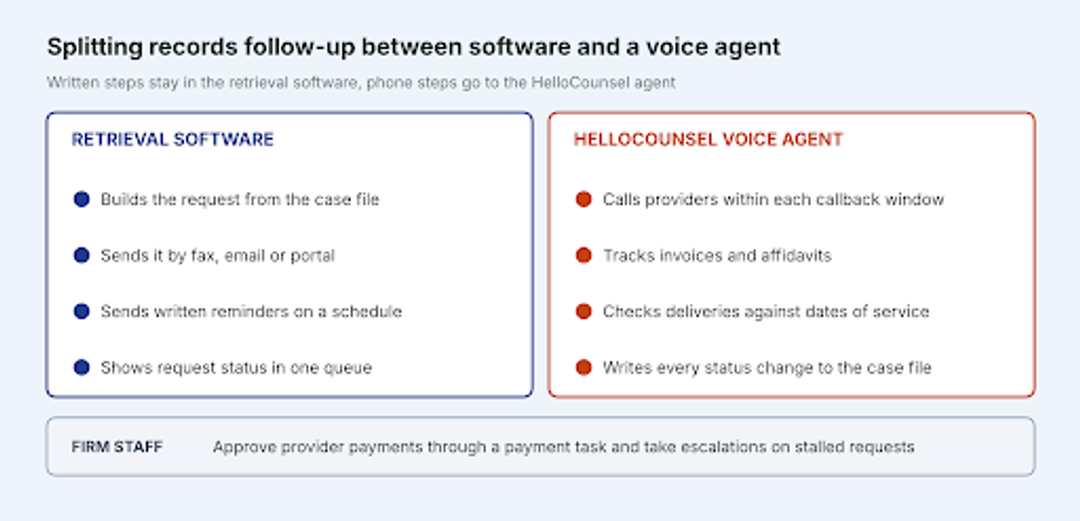
The agent tracks invoices and affidavits that arrive separately and creates a payment task for the firm when a provider asks for a fee. Card details stay with firm staff.
Each delivery is checked against the client and the dates of service on the request before it closes. Every status change is written back to the case in systems such as Filevine and SmartAdvocate.
Firms using HelloCounsel have seen 15 days cut from records turnaround, with results depending on how responsive each provider is. Pricing is custom and based on call and case volume, so firms pay for completed work instead of seats.
A rollout typically begins with a 60-minute setup call and three to five days of configuration. Follow-up then starts on 10 to 20 live requests after a 30-minute go-live session.
The agent works alongside existing medical record retrieval software. The phone layer suits firms already invested in a software platform, since nothing about their current request workflow changes. Our comparison of AI systems for medical provider calls covers how the voice options differ.
See HelloCounsel call providers on your open records requests Watch HelloCounsel follow up on stalled requests by phone and log each update to the case file alongside your current records software. Book a medical records demo
How to choose the right setup for your firm
The best setup depends on case volume and on the providers that slow your firm down today. Match your situation to the setup that addresses it first:
| Firm situation | Setup to start with | What to measure in month one |
|---|---|---|
| Fewer than 30 new cases a month, mostly local clinics | Case management add-on with right of access requests | Requests open past 30 days |
| Steady volume at a few hospital systems | Standalone software with portal routing to release-of-information vendors | Median days to complete by provider |
| Requests stall after written reminders | Software plus an AI voice agent for phone follow-up | Share of requests closed after a call |
| Staff spend hours keying requests | Software with case management sync and e-signature | Minutes of staff time per request |
The third row describes the firms that gain the most from adding a voice agent. Their software already sends requests cleanly, and the remaining delay sits with providers who respond only when someone calls.
Run any trial on live requests from your own providers. Pull the last 90 days of closed requests from the case management system as a baseline, then compare median days to complete records after 30 days of use.
Firms moving off spreadsheets should load open requests first, oldest at the top. New medical record retrieval software shows its value fastest on requests that are already late, and the team sees results in the first weeks.
Bring these questions to every demo:
- Which case management systems sync both ways, and how fast do status updates appear?
- Can staff choose between an authorization and a right of access request for each provider?
- Which follow-up channels does the software use after the first written reminder?
- How does the tool flag a partial delivery?
Medical record retrieval software earns its place when the firm's slowest providers start answering faster. Test each option on those providers first, since the fast ones would have sent records anyway.
Review the setup again after 90 days with the same baseline numbers. A tool that saved hours in month one may need a phone follow-up layer once the easy requests are cleared and the stubborn providers remain.
Talk with HelloCounsel's founders about your records follow-up Tell HelloCounsel's founders which providers slow your cases down, and get a plan for adding phone follow-up to your current records software. Book a call with HelloCounsel's founders
Frequently asked questions
1. What is medical record retrieval software?
It is a platform a law firm's own staff use to request and track medical and billing records. The firm stays the requester, while the software handles reminders and status tracking inside or alongside the case management system.
2. How is retrieval software different from a retrieval service?
Software is operated by the firm's staff, who keep control of provider contact. A retrieval service uses the vendor's own team to submit and follow up, usually for a fee per request.
3. What is a patient right of access request?
It is a request the client makes for their own records under 45 CFR 164.524. Providers must respond within 30 days and may extend once by another 30 days, and patient-rate fee limits apply when records go to the client.
4. Does retrieval software integrate with Filevine?
Several tools sync with Filevine and Litify, pulling client and provider details from the case and writing status updates back. Ask each vendor whether the sync runs both ways.
5. How much does medical record retrieval software cost?
Pricing ranges from flat monthly subscriptions to per-request and per-user fees. Provider copy charges are billed on top under state law, whichever model the firm picks.
6. Can AI make follow-up calls on records requests?
AI voice agents can call providers on open requests and log each answer, including the expected release date, to the case file. Payments and escalations stay with firm staff.
Share this article