
- Medical record retrieval services take on the request and follow-up work behind a personal injury file, often through to delivery of the finished chart.
- Options range from full-service vendors and self-service platforms to in-house teams and AI agents that handle provider follow-up calls.
- Vendors usually charge a fee per request, and provider copy charges are billed on top under state law.
- Ask for turnaround by provider type and a sample invoice before signing, along with the vendor's policy on failed requests.
- Measure any service by request age and the share of deliveries that arrive complete, reviewed every week.
A personal injury demand rests on the medical chart, and that chart sits with providers who answer law firm requests on their own schedule. A firm carrying 300 open cases with five providers each has 1,500 records requests in motion before anyone counts billing records or imaging.
Outside help exists to carry that load off the case manager's desk, and medical record retrieval services now come in several forms. The options differ in how much of the work they take on and how they bill for it.
Some vendors run the whole request from authorization to delivered chart. Others sell software that the firm's own staff operate, and a newer group of AI tools handles the provider follow-up calls that decide how fast records arrive.
Picking the right model affects settlement timing as much as margin. A demand held up by one missing hospital bill delays the whole case, while copy charges and vendor fees come straight out of case costs.
What do medical record retrieval services handle for a PI firm?
A retrieval service takes signed authorizations from the firm and turns them into complete, usable records. The scope covers several stages, and vendors differ in which of them they own.
Every request starts with the authorization, and its quality sets the pace for everything after. Under the HIPAA authorization rule, a valid form needs an expiration date or event plus a dated signature, and good medical record retrieval services check each form against that rule before it reaches a provider.
The first stage is submission. Each provider accepts requests through its own channel, from fax lines to release-of-information portals, and a request sent the wrong way can sit unread for weeks.
Follow-up comes next and takes the longest. Providers rarely send records on the first request, so someone has to call to confirm receipt and press for a release date until the chart arrives.
Requests also quietly die at this stage. A provider may close a request after one unanswered fee notice, and the firm learns about it only when someone calls to ask why the chart never came.
Payment and paperwork run alongside the follow-up. Providers often send an invoice before releasing records, and billing records or a records affidavit may arrive in a separate envelope from the chart itself.
The last stage is a completeness check. A good service confirms that the delivery matches the client and the requested dates of service before filing it to the case.
Firms that skip this check pay for it at the demand stage. Retrieval vendors that return partial charts without flagging them leave a case manager to find the missing visit weeks later, often after the adjuster has asked for it.
Which records should a retrieval service collect for a PI case?
A demand package needs more than the clinical chart. Adjusters weigh the treatment notes against the bills, so the request has to name each record type the case will rely on.
Itemized bills come on standard claim forms. Hospitals bill on the UB-04 and physicians bill on the CMS-1500, and an itemized statement from each provider supports the damages figure in the demand.
Imaging needs its own request at many facilities. The radiologist's report usually travels with the chart, while the films themselves sit with the imaging department and may carry a separate fee.
Affidavits matter when the case heads toward trial. In Texas, a Section 18.001 affidavit from the provider can support the reasonableness and necessity of the charges, so a retrieval request in a Texas case should ask for it alongside the bill.
Payment ledgers belong in the request as well. They show what health insurance or Medicare paid toward treatment, and the firm needs those figures to resolve liens before any settlement money reaches the client.
Pharmacy records round out cases with ongoing medication costs. Ask vendors whether their medical record retrieval services cover pharmacies and physical therapy clinics, since some focus only on hospitals.
What types of medical record retrieval services can a firm choose from?
PI firms generally pick from five models, and plenty of firms combine two of them. The right mix depends on case volume and on how much control the firm wants over provider contact.
| Service model | How it works | Best fit | Watch for |
|---|---|---|---|
| Full-service retrieval vendor | Vendor runs every step from submission to delivery | Firms short on records staff | Per-request fees on top of provider charges |
| Self-service retrieval platform | Firm staff submit and track requests in vendor software | Firms with a records team that needs better tracking | Follow-up calls still fall on firm staff |
| Provider release-of-information vendor | Works for the hospital, processing requests it receives | Every firm meets these on hospital requests | Represents the provider, so the firm still chases status |
| In-house records team | Paralegals or records clerks handle every step | Firms with steady volume and strong provider contacts | Staff hours spent on hold with records departments |
| AI follow-up agent | Voice agent works open requests by phone within each provider's process | Firms whose requests stall after submission | Payments and judgment calls stay with staff |
Self-service platforms suit firms that already employ records clerks. The software replaces spreadsheets with a shared queue, though the hours spent on follow-up calls stay with the same staff.
The release-of-information row confuses firms new to records work. Companies such as Datavant and MRO process requests on behalf of hospitals, so they answer to the provider, and a firm that hires a retrieval vendor will often see that vendor dealing with these same companies.
Case volume usually decides the starting point. A firm opening 20 cases a month can often manage with an in-house paralegal and a portal account, while a firm opening 200 a month needs medical record retrieval services that can absorb surges after a marketing push.
Hybrid setups are common at larger practices. One firm might send hospital requests to a full-service vendor and keep small clinics in house, where one phone call from a familiar paralegal moves faster than a vendor ticket. Whatever the mix, a single tracker should hold every request, so a case manager sees vendor requests and in-house requests on the same screen.
How do retrieval services price their work?
Vendor pricing usually comes as a flat fee for each request, with the provider's own charges passed through on the same invoice. Some vendors advance provider fees and bill the firm when the request closes, which keeps checks from stalling releases.
Copy charges and vendor fees are case costs, which the firm typically advances and recovers from the settlement under its fee agreement. Itemized invoices from medical record retrieval services make that accounting easier when the closing statement goes to the client.
Provider charges follow state law and can exceed the vendor's fee on a long hospital stay. Florida's rule for physician records, Fla. Admin. Code R. 64B8-10.003, caps copies for entities other than the patient at $1.00 per page, with X-rays billed at actual cost.
Federal law gives firms less fee protection than many expect. In Ciox Health v. Azar, decided January 23, 2020, a federal court in Washington, D.C. vacated the HHS rule that applied the lower patient-rate fee to records patients direct to third parties such as their lawyers.
The patient-rate limit still applies when patients request their own records. Some firms use that route for small providers, though it adds a step for the client and depends on state rules.
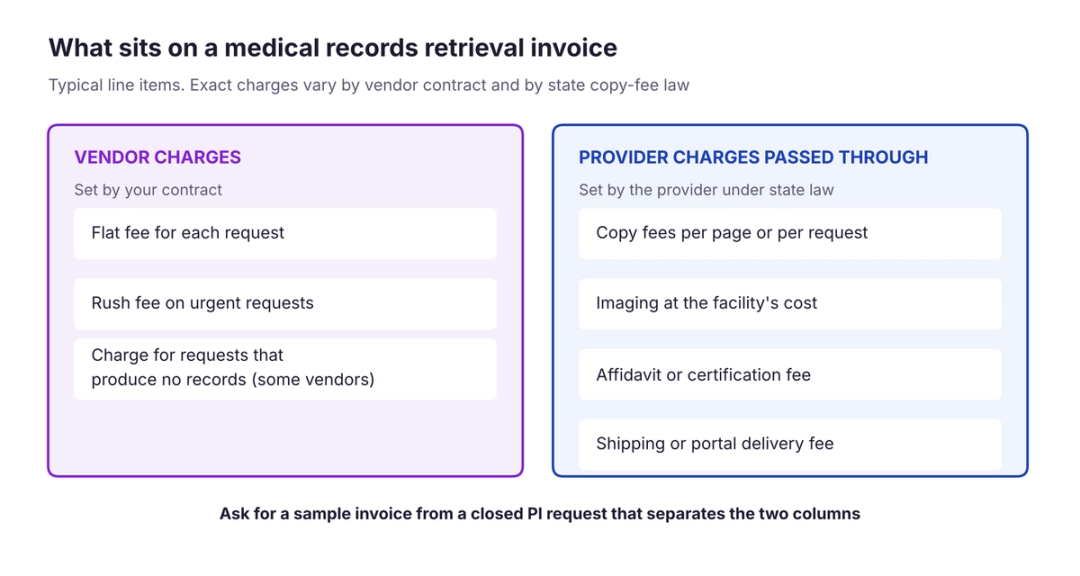
Line items beyond the base fee decide the real cost. Rush fees and charges for requests that never produce records can push the final bill well above a vendor's quoted price on a hard case.
Ask every vendor for a sample invoice from a closed PI request. The sample shows which charges belong to the vendor and which belong to the provider, and it reveals whether the vendor bills for attempts that produced nothing.
What should you ask a retrieval vendor before signing?
Sales demos show the best-case request. Six questions draw out how a vendor handles the slow providers that hold up real demands:
- Turnaround by provider type: Ask for median days to complete records for hospitals and small clinics separately, since one blended average hides the slow end.
- Failed-request billing: Confirm whether the firm pays when a provider has no records or the request is closed without delivery.
- Follow-up ownership: Find out who calls the provider after submission and when an open request gets escalated to the firm.
- Case management integration: Check that status updates and delivered records land in Filevine or Litify without manual uploads.
- Business associate agreement: Get the agreement and the vendor's security documentation before the first authorization goes out.
- Partial deliveries: Ask how the vendor flags a chart that arrives without billing records or with dates of service missing.
References matter more than feature lists. A ten-minute call with a PI firm of similar size will tell you how the vendor behaves when a request sits open for 60 days.
Security deserves its own set of questions, since a vendor will hold every client's health history. Ask where delivered records are stored and which vendor employees can open them.
Subcontractors raise the same concern one step removed. Some medical record retrieval services pass requests to offshore teams or local couriers, so ask for the full chain of companies that will touch a client's chart.
Audit logs close the loop. A vendor should be able to show who viewed or downloaded each file, along with how quickly it will notify the firm after a security incident.
Start any new vendor on a pilot batch of 25 to 50 requests before moving the full caseload. A pilot shows real turnaround on your own providers and brings billing problems to light while the stakes are small.
Watch HelloCounsel follow up on open records requests
See how HelloCounsel calls providers on open requests and logs each status update to the case file in your case management system. Book a medical records demo
When should a firm keep retrieval in house?
An in-house team pays off when volume is steady and providers are concentrated. Practices that send hundreds of requests a year to the same three hospital systems gain from staff who know each records manager by name.
Control is the other reason firms keep the work. Staff can reprioritize a request the moment an adjuster asks for a bill, without filing a ticket with an outside company.
Turnover adds risk to the in-house model. When the paralegal who knows every records manager leaves, the firm loses those relationships along with the shortcuts that kept requests moving.
Warning signs that the in-house model has stalled are easy to spot. Requests sitting past 45 days suggest the team needs outside help, and so do paralegals who spend their mornings on hold with records departments.
The cost shows up in phone time. As per our estimate, a single PI case generates about 150 calls over its life, and our breakdown of how many calls a PI case generates shows how much of that load comes from provider follow-up.
Case managers carrying that load fall behind on client updates first. Our guide to reducing case manager workload covers which tasks to move off their desks before hiring more staff.
How does AI follow-up work alongside a retrieval service?
AI agents take on the part of retrieval that eats the most hours, the repeat calls between submission and delivery. Firms can pair an agent with an in-house team or with a self-service platform, keeping submission and payment where they already sit.
HelloCounsel builds AI voice agents for plaintiff personal injury firms, including agents for the provider calls that slow down retrieval.
Its Medical Records workflow follows up on open requests through each provider's own channel, including portals such as Datavant and ChartSwap.
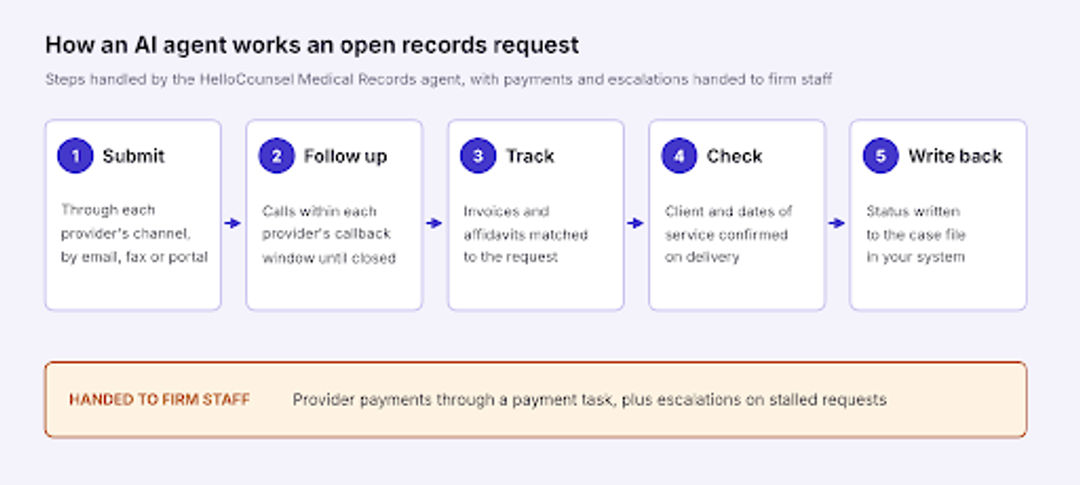
The agent calls within each provider's callback window and keeps calling until the request closes. Aging or urgent requests can move to a faster follow-up cadence.
A typical call confirms the provider received the request and asks for an expected release date. The agent also checks whether an invoice or a corrected authorization is holding the chart, then logs the answer and sets the next callback.
Invoices and affidavits that arrive separately are tracked against the open request. When a provider sends an invoice, the agent creates a payment task for the firm, and card details stay with firm staff.
Each delivery is checked against the client and the treatment dates on the request before closing it. Every status change is written back to the case in systems such as Filevine and Litify.
Firms using HelloCounsel have seen 15 days cut from records turnaround, with results depending on how responsive each provider is. A rollout typically begins with a 60-minute setup call and three to five days of configuration. Follow-up then starts on 10 to 20 live requests after a 30-minute go-live session.
Our comparison of AI systems for medical provider calls covers how the agent options differ. Pricing is custom and based on call and case volume, so firms pay for completed work instead of seats.
Firms already paying for medical record retrieval services can keep them in place. HelloCounsel can take over follow-up on the requests the vendor marks as stalled, or on providers the firm handles in house, so the two models run side by side.
How do you measure a retrieval service after launch?
A retrieval service earns its fee through faster complete files. Track these numbers from the first month, whichever model the firm picks:
| Service measure | How to calculate it | What it tells you |
|---|---|---|
| Requests open past 30 days | Count of requests without complete records at day 30 | Where follow-up has slipped |
| Median days to complete | Median time from request sent to complete records, by provider type | Whether the vendor beats your old baseline |
| First-delivery completeness | Share of deliveries with every requested date of service and bill | How often staff must re-request |
| Cost per completed request | Vendor fees plus provider charges, divided by completed requests | True cost after failed requests |
| Demands waiting on records | Cases ready for demand except for missing records | The cost of slow retrieval in settlement time |
Compare medical record retrieval services on the same measures, using requests sent in the same month. A vendor that clears hospital requests quickly may still lag on small clinics, and only a side-by-side test shows it.
Set a baseline before switching services. Pull the last 90 days of closed requests from the case management system, so the comparison rests on your own providers instead of a vendor's national average.
The last row matters most to the attorneys. A case that is ready for demand except for one outstanding bill carries the full cost of slow retrieval, since the settlement clock stops until that bill arrives.
Review the numbers weekly with the case management lead. A rising count of requests open past 30 days usually points to one or two slow providers, and those deserve a direct call to the records manager.
Client updates belong in the same review. A client waiting on a demand wants to hear that records are moving, and our guide to improving client communication covers how often to send those updates.
HelloCounsel's Client Communication agent takes on those routine status calls. Firms using it have seen 2x more frequent check-ins with clients while cases wait on records.
A launch checklist for a new retrieval service
The first month decides whether a new service works, and most of that depends on setup. Before the first request goes out, confirm the firm has these in place:
- An authorization template checked against the forms your largest providers require
- Each regular provider's preferred release channel loaded into the tracker
- A named staff member who takes escalations on stalled requests
- A dollar limit for provider invoices that staff can approve without an attorney
- Records status fields mapped into your case management system
- A review meeting on the calendar for day 30, with your baseline numbers attached
Medical record retrieval services pay for themselves when they shorten the time from treatment end to demand. The model that does that best for your firm is the one that clears your slowest providers, so test each option on those first.
Revisit the choice once a year with fresh numbers. Provider portals change, and medical record retrieval services that fit a 100-case practice may strain once the firm doubles its caseload.
Talk to HelloCounsel's founders about your records backlog
Share your open request count and slowest providers with HelloCounsel's founders, and get a plan for automating follow-up calls on those requests. Book a call with HelloCounsel's founders
Frequently asked questions
1. What are medical record retrieval services?
They are vendors and tools that obtain medical and billing records from providers on behalf of law firms. Depending on the model, they handle submission and provider follow-up through to delivery of complete records into the case file.
2. How much do medical record retrieval services cost?
Vendors usually charge a flat fee per request, with provider copy charges passed through on top. Provider charges follow state law, and some vendors add rush fees or bill for requests that produce no records.
3. Are law firms protected by the HIPAA patient-rate fee limit?
Generally only when the patient requests their own records. A 2020 federal court ruling in Ciox Health v. Azar vacated the HHS rule applying the patient rate to records sent to third parties such as law firms.
4. Should a PI firm outsource medical records retrieval?
Outsourcing helps when records staff are stretched or requests stall after submission. Firms with steady volume at a few hospital systems often keep retrieval in house and automate the follow-up calls instead.
5. How long should medical records retrieval take?
Turnaround depends on the provider. Ask each vendor for median days by provider type, then compare those figures with 90 days of your own closed requests before switching services.
6. Can AI handle medical records follow-up?
AI voice agents can call providers on open requests and log each status change to the case file. Payments and escalations stay with firm staff, along with decisions about which records a case needs.
Share this article