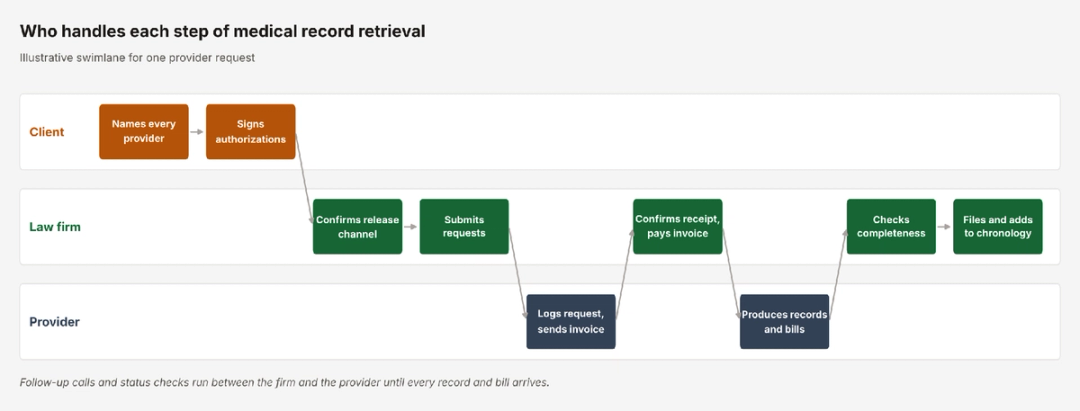
- A reliable medical record retrieval process runs in nine steps, starting with the provider list at intake and ending with a chronology the attorney can use for the demand.
- Signed authorizations, including provider-specific forms, belong in the file during the first week and should go out through each provider's current release channel.
- Receipts should be confirmed within five business days, with records of invoices approved on the day they arrive.
- Every delivery needs a completeness check on patient identity and dates of service before the request is closed.
- Custodian certifications requested alongside the records save a second round of requests if the case goes to litigation.
Ask five paralegals at five personal injury firms how they get medical records, and the answers will range from a shared spreadsheet to sticky notes on a monitor. Almost none of them learned the work from a written procedure.
Records retrieval runs longer than almost any other task in a PI case, starting in the first week after signing and often finishing only when the demand is ready. A provider nobody requested from, or a missing itemized bill, surfaces months later as a delayed demand or a lower settlement offer.
Writing the medical record retrieval process down gives new staff a path to follow and gives managers a clear view of every open request. It also turns work that depends on one person's memory into a routine the whole team runs the same way.
The procedure in this guide has nine steps, each with an owner and a defined finish line. Requests stay open until they meet that finish line, which keeps half-finished work out of the "done" column.
The medical record retrieval process at a glance
Each of the nine steps in the medical record retrieval process has a typical owner and a clear signal that the work is finished. The table doubles as the agenda for a weekly records review.
| Retrieval step | Typical owner | Done when |
|---|---|---|
| Build the provider list | Intake and case manager | Every provider since the incident is named, with dates |
| Collect authorizations | Case manager | Signed, unexpired forms exist for every provider |
| Identify the release channel | Records specialist | The current department or vendor for each provider is confirmed |
| Submit the requests | Records specialist | Requests for records and bills go out through the confirmed channel |
| Confirm receipt | Records specialist or agent | The provider confirms the request and gives an expected date |
| Handle invoices | Case manager or billing staff | Any prepayment invoice is paid, with the date logged |
| Follow up until delivery | Records specialist or agent | Records and bills arrive, or the request is escalated |
| Check completeness | Case manager or paralegal | Delivery matches the request on patient identity and dates of service |
| Secure and summarize | Paralegal | Records are filed securely and added to the medical chronology |
The nine steps, one at a time
Step 1. Build the provider list at intake
Every later request depends on a complete list of who treated the client. During the first onboarding call, ask about each type of care the client may have received since the crash:
- Emergency care: Whether an ambulance came to the scene and which hospital treated the client that day.
- Follow-up care: Primary care visits and any specialist referrals that came out of them.
- Imaging: The facility that performed each X-ray or MRI, which is often separate from the doctor who ordered it.
- Therapy: The name of the physical therapy or chiropractic clinic and how often the client attends.
- Pharmacy: The pharmacy that filled prescriptions for the injury.
- Prior treatment: Earlier care to the same part of the body, which the insurer will search for.
Ask again at each check-in, because a client who starts acupuncture in month four will rarely mention it unprompted. HelloCounsel's Case Opening agent gathers this list on the welcome call, so it sits in the case file from the first week.
Paperwork the client already holds can fill in the list. Bills and explanation-of-benefits statements from a health insurer each name a provider and a date of service, so ask the client to photograph and send every one they receive.
Step 2. Collect signed authorizations
Each provider needs a valid HIPAA authorization, and some large hospital systems accept only their own form. Have the client sign the firm's standard authorization at onboarding together with the forms for the systems the firm requests from most often, so a rejected form costs nothing later.
Minors and deceased clients need a different signer. A parent or personal representative signs in those cases, and 45 C.F.R. 164.508 requires the form to describe that person's authority to act for the patient.
Records with extra protection need their own paperwork. Psychotherapy notes require a separate HIPAA authorization, and substance use disorder records from federally assisted programs fall under 42 C.F.R. Part 2, which sets its own consent requirements.
Track expiration dates in the case file as well. An authorization that lapses in month eight sends the request back to the start, and a reminder set 30 days before expiry prevents that reset.
A short cover letter travels well with each authorization. It should name the patient and the date of the incident, then list the exact documents requested, which spares the records clerk a call back to the firm.
Step 3. Identify each provider's release channel
Large health systems commonly hand-record requests to an outside release-of-information vendor or a patient portal. Smaller practices may process them at the front desk, and some accept requests only by fax.
Confirming the channel takes a few minutes per provider and can save weeks spent waiting on a request sent to the wrong place. Record the fax number or portal address in the provider's profile, along with quirks such as a required cover sheet.
Those profiles grow into a provider directory shared across every case. A firm that requests from the same regional hospital dozens of times a year can then send each new request straight to the right desk, and the medical record retrieval process gets faster with every case added.
Step 4. Submit the requests
Send separate requests for clinical records and itemized bills, because the two often come from different departments. A single request for "records" may return treatment notes with no charges attached.
Add imaging reports and any affidavits the case will need, and ask for every date of service from the incident to the present. HIPAA exempts disclosures made under a valid authorization from its minimum necessary standard under 45 C.F.R. 164.502(b)(2), so the authorization and the request set the scope of what the provider sends.
Ask for electronic delivery wherever the provider offers it. A PDF through a portal or secure email skips the mailing time and the scanning work that paper copies add.
Save the tracking number that the portal or vendor issues. Any later follow-up, by a staff member or an AI agent, can quote it and reach the right file on the first call.
Step 5. Confirm receipt
Five business days after sending, call the provider or check the portal to make sure the request landed. Ask for an expected completion date and note the name of the person who gave it.
A useful log entry reads like "Confirmed April 3 with Dana in health information management, expected April 17, reference 88213." Anyone who picks up the request next week can act on that entry without calling to ask what happened.
That single call surfaces the problems that would otherwise cost a month. A rejected authorization or a recent switch to a new vendor shows up here, while a fix still takes only a day.
Step 6. Handle invoices and prepayments
Plenty of providers and vendors hold records until an invoice is paid. Send records invoices to one person with authority to approve them the same day, and log the amount and payment date against the request.
Compare each invoice with the copy rates set by state law before paying it. California's Evidence Code section 1158, for example, lists sample rates such as ten cents per page, and an invoice well above the local rate deserves a call.
Approval delays sit entirely within the firm's control. A two-week wait for a signature on a $40 invoice pushes the demand back by the same two weeks.
Step 7. Follow up until delivery
Set a seven-day follow-up rhythm once receipt is confirmed, and shorten it to three days for requests tied to a demand deadline. Each call should end with a status and a next follow-up date entered in the case file.
When a provider misses its own promised date twice, escalate to the records supervisor at that provider or try a different contact. A client who can download visit notes from a patient portal can also share them with the firm while the certified copies are pending.
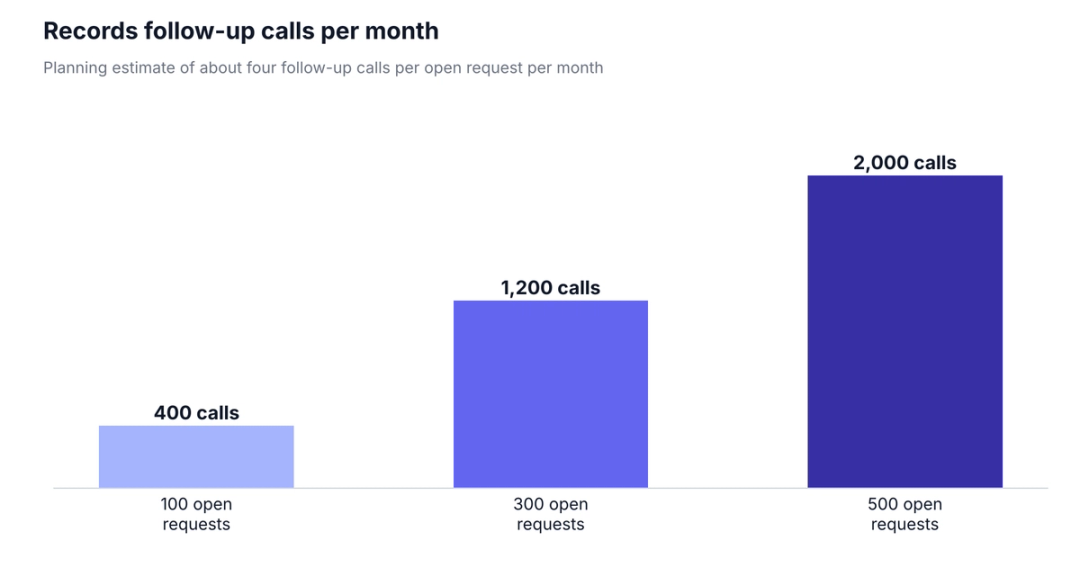
Follow-up takes more staff time than any other step in the medical record retrieval process. As a working planning assumption, we estimate about four follow-up calls per open request per month, and our comparison of AI systems for medical provider calls covers how firms automate that volume.
Match the channel to the provider as well. A current portal can replace a phone call, while a clerk who ignores voicemail may reply to email the same day, so the follow-up plan should record which channel each provider answers.
Keep each follow-up call short and focused. A 90-second call that quotes the reference number and asks for a firm completion date is usually enough to keep a request moving.
Step 8. Check completeness before closing the request
Completeness checks guard the end of the medical record retrieval process, just before records reach the chronology. Records can arrive incomplete in ways that only a line-by-line comparison reveals, so run the same six checks on every delivery:
| Completeness check | What to compare | Red flag |
|---|---|---|
| Patient | Name and date of birth on every page against the client | Another patient's pages mixed into the file |
| Provider | Facility and treating provider against the request | Records from a different location of the same practice |
| Dates of service | First and last visit against the treatment timeline | Records that stop before the last known visit |
| Bills | Itemized charges against the visits in the records | A summary balance with no itemization |
| Imaging | Radiology reports for every study mentioned in the notes | A referenced MRI with no report |
| Affidavits | Signed certification, if one was requested | An unsigned custodian certification |
Reopen the request the same day if anything is missing, and name the exact item, such as "itemized bill for March visits." Specific follow-ups get answered faster than requests to resend everything.
Duplicate pages and illegible scans count as defects too. A 300-page hospital file with 40 unreadable pages needs a corrected copy before the chronology work begins.
Track how often each provider's requests are reopened. A high rate at one hospital points to its own process, while a high rate everywhere suggests the firm's requests are too vague, and both patterns show where the medical record retrieval process needs tightening.
Step 9. Secure the records and build the chronology
File complete records in the case management system under one naming convention, by provider and date range. Anyone on the team can then open the right document on the first try.
Number every page with a prefix for the provider, such as MERCY-0001, so the chronology and the demand can cite exact pages. Opposing counsel and the adjuster will find the same page when they check a citation.
Medical records also need protection once they reach the firm. ABA Formal Opinion 477R, as summarized by OBLIC, calls for reasonable efforts to secure client information in electronic communications, which in practice means controlled access and encrypted transfer.
Request admissibility documents while the records are still being gathered. Federal Rule of Evidence 902(11) lets a custodian's certification authenticate business records, provided the other side receives written notice.
Some states add billing affidavit statutes of their own. Texas, for one, uses Civil Practice and Remedies Code section 18.001, and collecting these affidavits with the records avoids a second request if the case is litigated.
Add each provider's records to the medical chronology as they arrive. A running chronology shows the attorney the shape of the case early and flags missing providers while there is still time to request them, so each entry should capture at least these details:
- Date of service and provider name
- Diagnosis and treatment given
- Work restrictions or referrals
- Charges for the visit
- Page references to the source records
Built this way, the chronology is ready on the day the last record arrives. The attorney can start drafting the demand that same afternoon.
See HelloCounsel follow a records request through to a completeness check We'll show you how HelloCounsel confirms a request with the provider and tracks the invoice, then flags missing bills before the request closes in your case file. Book a records retrieval demo
Where the process breaks down without an owner
Breakdowns happen in the handoffs between steps. A request goes out and nobody confirms it, or records arrive and nobody checks them before the request is marked done.
Assign the medical record retrieval process to one named owner, even when several people do the work. That person reviews open requests each week by age and provider, and steps in when a request stalls. Our guide to reducing case manager workload covers how to free time for that review.
The handoff from intake to the records team is especially fragile. When the provider list sits in an intake record that never reaches the records tracker, the first requests go out a week late before anyone notices.
Clients feel the breakdowns as well. A client who hears "still waiting on records" for three months straight starts to doubt the firm, while an update naming the provider and the next step keeps their confidence, as our guide to improving client communication explains.
Setting targets for each step
Measurable targets turn the medical record retrieval process into something a manager can check at a glance. The numbers will vary by firm, but each one should reveal which requests are running late.
Steps inside the firm's control deserve tight targets. Authorizations signed in the first week and invoices paid within a day are goals the firm can meet whatever the provider's pace.
Provider-dependent steps need targets for discipline instead of delivery dates. A rule that no open request goes seven days without contact is easy to measure, and tracking each provider's average turnaround shows which ones to request from first on the next case.
Review the numbers in a 15-minute weekly meeting with the process owner. Requests older than 30 days get named one by one, along with the next action and the person responsible for it.
How HelloCounsel supports medical records retrieval
HelloCounsel builds AI voice agents for plaintiff personal injury firms. Its Medical Records workflow handles the repetitive middle steps of a medical record retrieval process, while the firm keeps control of payments and legal decisions.
The agent can submit requests by fax or through retrieval portals such as Datavant and ChartSwap or pick up follow-up on requests the firm has already sent. It calls providers according to each provider's callback window, and it tracks billing and records affidavits that arrive separately from the records.
Before closing a request, the agent compares the patient and dates of service with the request and flags anything missing. When a provider requires prepayment, it creates a payment task for the firm, and each status change is written back to the matter in systems such as Filevine.
Firms using HelloCounsel's Medical Records agent have seen 15 days cut from records turnaround, with results depending on how quickly each provider responds. A typical start covers follow-up on 10 to 20 live requests, and pricing is custom, based on call and case volume instead of seats.
Setup begins with a 60-minute workflow call and takes roughly three to five days of configuration. A 30-minute go-live session then reviews real activity with the team before the firm expands the agent's role.
Write the process down before you automate it
Automating an undefined process only produces confusion at a faster pace. The nine steps work best as a written procedure first, with a named owner and a tracker that mirrors each step.
Start with one provider type, such as imaging centers, and run the written medical record retrieval process for a month. Measure the days from authorization to complete delivery and the share of requests reopened after the completeness check, then extend the procedure to the next provider type.
Keep the written procedure to two or three pages, with one short paragraph per step and the target beside it. A document that long gets read during training and reopened when a request stalls, which is when it does its real work.
Once the steps hold steady, confirmation calls and routine follow-up are the natural place to add automation, as our piece on automating outbound calls explains. Judgment calls, such as escalating a stalled hospital or deciding whether prior records are needed, stay with the team.
Map your firm's records retrieval steps with HelloCounsel's founders Talk with HelloCounsel's founders about how your team handles records requests today and which follow-up calls an AI voice agent could take on first. Book a call with HelloCounsel's founders about records retrieval
Frequently asked questions
1. What is the medical record retrieval process for a law firm?
It is the procedure a firm follows to collect a client's records and bills, starting with a list of every provider and signed authorizations. Requests then go through each provider's channel with regular follow-up, and a completeness check comes before filing.
2. How long does medical record retrieval take?
Timing depends on the provider and the state. HIPAA gives providers 30 days to act on a patient's own access request, with one 30-day extension, while authorization requests follow state law. Weekly follow-up calls keep requests moving inside those windows.
3. Who should handle medical record retrieval at a PI firm?
One named owner should oversee the process, even when paralegals and case managers share the work. Repetitive follow-up calls suit automation well, while escalations and decisions about which records the case needs stay with experienced staff members at the firm.
4. What should a firm check when medical records arrive?
Confirm that every page belongs to the client and that the dates of service cover the full course of treatment. Then match itemized bills to the visits in the records and make sure every imaging study mentioned in the notes has a report.
5. Do medical records need a custodian certification?
A certification helps when the case may be litigated, since it can authenticate records without a live witness. Federal Rule of Evidence 902(11) allows this with written notice to the other side, and some states, including Texas, have billing affidavit statutes.
6. Can AI automate medical record retrieval?
AI voice agents can handle the repetitive work, such as confirming receipt with providers and following up on a set schedule. Payments and escalations stay with the firm's staff, along with judgment calls about which records the case actually needs.
Share this article