
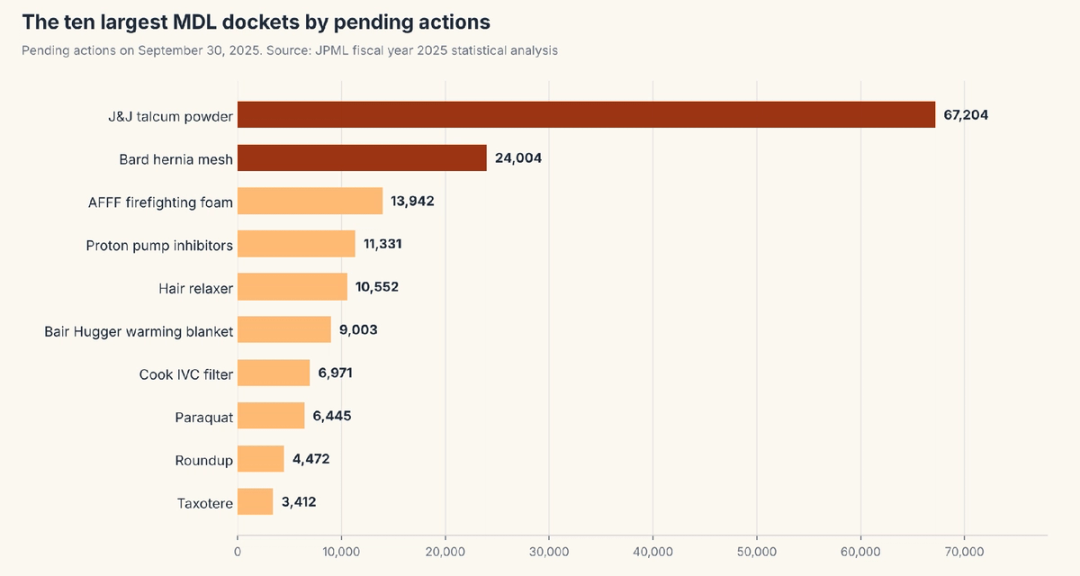
- Federal courts had 197,118 actions pending in 158 MDL dockets at the end of fiscal year 2025, and each plaintiff needs records proving product use and a qualifying diagnosis.
- Court orders set the pace, with plaintiff fact sheets and signed authorizations due on fixed schedules and short cure periods for deficiencies.
- High-volume firms triage requests by deadline and batch them by provider, so one hospital system receives one coordinated set of requests for every claimant it treated.
- Scale exposes weak points such as duplicate requests and authorizations that expire across thousands of files at once.
- Track requests open past 30 days and the share of claimants with complete proof packages, then automate the follow-up calls that consume the most staff hours.
The Judicial Panel on Multidistrict Litigation counted 197,118 pending actions across 158 MDL dockets on September 30, 2025. The talcum powder docket alone held 67,204 of them, and the hair relaxer docket held 10,552.
Behind each of those actions sits a claimant whose case depends on two things on paper. Their records have to show that they used the product and that they developed an injury the litigation recognizes.
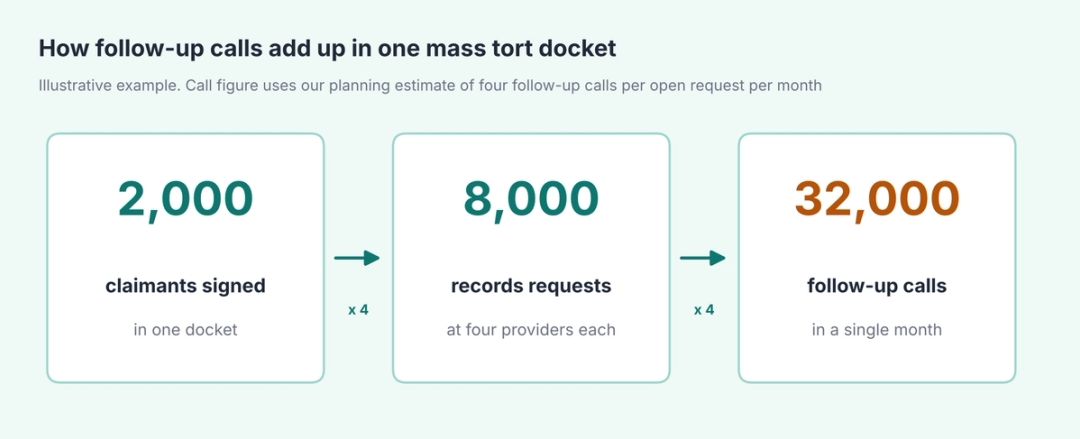
A firm with 2,000 hair relaxer claimants who each saw four providers is managing 8,000 record requests before a single bellwether trial begins. Mass tort record retrieval at that volume works like a production line, with deadlines set by court orders instead of the firm's own calendar.
The firms that keep up treat records as an operations problem with dedicated staff and measured results. Their methods follow the way MDL court orders structure the work, and they plan for the specific points where volume breaks a single-case process.
What makes mass tort record retrieval different from a single PI case?
Volume is the obvious difference, though it changes far more than the size of the to-do list. The proof standard and the source of deadlines both shift when thousands of claimants share one docket.
| Factor | Single PI case | Mass tort docket |
|---|---|---|
| Volume | A handful of providers per case | Thousands of requests across one firm's inventory |
| Deadline source | Demand timing and the statute of limitations | Case management orders with fixed due dates |
| Proof focus | Treatment and damages after one incident | Product use plus a qualifying diagnosis |
| Lookback | From the incident forward | Often a decade or more before diagnosis |
| Cost of a miss | A delayed demand | Deficiency notices and possible dismissal |
The lookback row catches firms moving into mass torts off guard. Product use may date back years before the diagnosis, so pharmacy and purchase history from long-closed stores can matter as much as the oncology chart.
The four record jobs in a mass tort
Every claimant file needs records that do four separate jobs. Each job draws on different providers and fails in different ways.
Proving product use or exposure
Proof of use comes from wherever the product left a paper trail. Pharmacy dispensing records cover prescription drugs, while purchase receipts and loyalty program histories can support consumer products such as hair relaxers.
Medical devices need the implant record. For hernia mesh claims, the operative report and the device sticker logged in the hospital chart identify the product and lot number, which defendants will check against their own records.
Exposure cases work differently. A firefighter in the aqueous film-forming foam litigation may prove exposure through fire department training logs and employment records, which come from employers instead of medical providers.
Over-the-counter products leave the thinnest trail. When no pharmacy record exists, photographs of product containers and a sworn statement from the claimant may have to carry proof of use, and the firm should collect them at sign-up while the claimant still has them.
Proving the injury and the diagnosis date
The diagnosis record carries the most weight in a mass tort file. A signed pathology report that confirms the cancer type does more for a claim than dozens of pages of follow-up visits.
Diagnosis dates also drive limitations questions. Pull the first record that mentions the condition, even when it comes from a primary care visit years before the specialist confirmed it.
Treatment records after diagnosis still matter for damages. Surgery reports and chemotherapy records show the severity of the injury, and settlement grids often weigh them alongside the diagnosis itself.
Meeting plaintiff fact sheet deadlines
Plaintiff fact sheets turn records into court obligations. In the Xarelto MDL, Case Management Order 8A and the related pretrial orders required each plaintiff to serve the fact sheet with signed authorizations and responsive documents within 60 days of filing or transfer.
The same orders gave plaintiffs 20 additional days to cure a deficiency after notice and warned that failure to comply could lead to dismissal. Each listed provider or pharmacy needed its own authorization, with records reaching back 12 years for medical history.
A firm with 500 claimants filed in the same month faces 500 fact sheets due on nearly the same day. Records requests for those claimants have to start at sign-up, well before the complaint is filed.
Defendants use the same authorizations to collect records on their own. Mass tort record retrieval on the plaintiff side should produce the firm's own copy of every chart, so the team reads what the defense will read before any deposition or bellwether pick.
Amendments add their own paperwork. When a claimant recalls a new pharmacy or provider after the fact sheet is served, the amended sheet needs a fresh authorization for that provider, and the records request should go out the same day.
Documenting settlement claims
Settlement programs reward complete files. Claims are commonly sorted into tiers by diagnosis and proof of use, so a claimant missing a pharmacy history may land in a lower tier than their facts support.
Records gathered for the fact sheet rarely satisfy a claims program on their own. Programs often ask for specific documents, such as a pathology report within a set date range, and the firm that indexed its records by proof element can assemble those packages in days.
Liens follow the claimant into the claims program as well. Health insurers and government programs that paid for treatment will expect repayment from any award, so billing records and payment ledgers belong in the file alongside the clinical proof.
Who handles records on a mass tort team?
Records work at volume splits across roles that a single-case practice combines in one person. The sign-up team gathers provider names and authorizations during the first call, often within days of a television campaign.
A dedicated records team owns requests and follow-up, while paralegals assigned to the fact sheets turn received records into answers. Attorneys stay focused on case strategy and step in on escalations, such as a provider refusing to honor a valid authorization.
Sign-up is where the work is won or lost. HelloCounsel's Case Opening agent collects provider names and dates on the welcome call, which gives the records team a complete list before the first request goes out.
The sign-up questionnaire should ask product-specific questions. A hair relaxer claimant should be asked which brands they used and for how many years, while a device claimant should be asked where the implant surgery took place.
Spanish-language advertising brings in Spanish-speaking claimants, and a sign-up call in their language captures provider names an English-only form would miss. HelloCounsel's agents speak English and Spanish and can switch languages mid-call.
How high-volume firms organize retrieval
Scale rewards structure over effort. Firms that handle thousands of claimants build their mass tort record retrieval around a few operating habits:
- Deadline triage: Every request carries the fact sheet or claims deadline it supports, and the queue sorts by that date instead of by sign-up order.
- Provider batching: Requests to the same health system go out together, with one contact managing the full list of claimants treated there.
- Docket-specific authorizations: Authorization templates match the lookback periods and record types each case management order requires.
- Proof-element indexing: Incoming records get tagged by the element they prove, such as use or diagnosis, so a claim package can be assembled from the tags.
- Provider profiles: Each provider's release channel and typical turnaround live in one shared record that every team member uses.
Batching does the heaviest lifting. A regional health system that treated 300 of a firm's claimants answers faster when it receives one organized submission with a named contact than when it receives 300 separate requests over six months.
Provider profiles pay off at the same scale. Once the team knows that a pharmacy chain routes requests through a central records office, every later request for that chain skips the trial and error.
Outside vendors carry part of the load at plenty of high-volume practices. A records retrieval vendor priced per request can absorb a surge after a new docket opens, though the firm still needs its own tracker to see which requests are late and which proof elements are missing.
Contracts with vendors should name turnaround targets and reporting. A weekly file showing each request's status lets the firm merge vendor work into its own dashboard instead of chasing updates by email.
Where retrieval breaks at scale
Duplicate requests are the first problem volume creates. Two staff members requesting the same pharmacy history for the same claimant double the copy charges and confuse the provider about which request to fill.
Authorization expiry is the second. A batch of 1,000 authorizations signed in the same month can expire in the same month too, and a tracker that flags expiry 30 days ahead keeps the whole batch from bouncing at once.
Rejected authorizations cause quieter delays. Under the HIPAA authorization rule, a valid form needs an expiration date or event plus the signature and its date, and a provider will return any form missing those elements.
Some health systems also insist on their own release form. Experienced teams keep those provider forms on file for mass tort record retrieval and send them with the first request, which saves a rejection cycle of two or three weeks.
Deceased claimants add a third layer of paperwork. Their requests need an authorization from the estate's personal representative, along with proof of that person's authority, before any provider will release records.
Unreachable claimants stall renewals. A claimant who changed phone numbers since sign-up is out of reach when an authorization needs re-signing, so the team needs a routine contact check every few months, such as a text asking the claimant to confirm their number.
Closed practices and merged health systems cause the slowest requests. A clinic that shut down in 2019 may have transferred its charts to a storage vendor, and tracing that vendor takes calls that a busy records team rarely has time to make.
Pharmacy retention limits create a quieter risk. Pharmacies keep dispensing records for a period set by state law, so a claimant whose use ended long ago may need alternative proof, and the firm learns that only if it requests early.
Release-of-information vendor queues add delay at the busiest hospitals. A large system may log hundreds of attorney requests a week, and a batch that arrives with clean authorizations moves through that queue faster than scattered single requests.
What a mass tort records tracker should hold
Spreadsheets break somewhere past a few hundred claimants. A tracker built for mass tort record retrieval needs one row per request, tied to the claimant and the deadline it serves, with fields that any team member can read without asking around:
- Claimant and docket: The claimant's ID and docket, plus the filing date that starts the fact sheet clock.
- Provider and record type: The provider name and the record category requested, such as a pathology report.
- Authorization dates: The signature date and the expiry date, so the tracker can flag renewals a month ahead.
- Deadline supported: The fact sheet or claims program date that this request feeds.
- Status and next follow-up: The latest response from the provider and the date of the next call.
Case management systems such as Filevine can hold these fields as a custom section on each matter. Keeping them inside the case file lets the attorney see records status during a settlement conference without opening a separate spreadsheet.
How to measure a mass tort records operation
A dashboard for mass tort record retrieval should answer one question quickly. Which claimants are at risk of missing their next deadline, and why?
| Operations metric | How to calculate it | What it reveals |
|---|---|---|
| Requests open past 30 days | Count of requests without complete records after 30 days | Where follow-up has slipped |
| Proof-complete claimants | Share of claimants with both use and diagnosis proof on file | Readiness for fact sheets and settlement |
| Cure notices received | Deficiency notices per 100 fact sheets served | Quality of the records behind each fact sheet |
| Provider turnaround | Median days from request to complete records, by provider | Which providers to request from first |
| Cost per completed request | Copy charges plus staff time, divided by completed requests | Whether outsourcing or automation pays off |
Review the numbers weekly with the attorney leading the docket. A rising count of cure notices usually traces back to records that were requested late, and the fix sits at sign-up instead of at the fact sheet.
Set targets per docket instead of across the whole firm. A hair relaxer docket that leans on pharmacy history will show slower turnaround than a device docket built on hospital operative reports, and a single firm-wide average would hide both.
Break the numbers down by provider as well as by claimant. A single health system holding 400 open requests is a better target for a meeting with its records manager than 400 individual follow-up calls.
Claimants feel the operation too. A client in a mass tort can wait years for resolution, and regular updates about their file, as our guide to improving client communication describes, keep them engaged when the firm needs a new authorization signed.
Where call automation helps high-volume retrieval
Follow-up calls consume the largest share of staff time in mass tort record retrieval. As per our estimate, a firm should plan for about four follow-up calls per open request per month, so a firm with 8,000 open requests faces roughly 32,000 calls in a month.
Staffing that volume by phone alone would take a team few firms can afford. Our comparison of AI systems for medical provider calls covers how firms automate those calls.
Outbound work is where automation pays off first, as our piece on automating outbound calls explains. Provider follow-up fits that pattern because each call has a clear goal and a short script.
The calls in mass tort record retrieval repeat across thousands of files. Each call confirms that the request arrived and asks for the expected release date, and the answer goes into the file with a scheduled callback. Calls also surface problems a portal status page hides, such as a request stuck while the provider waits on a fee or a corrected authorization.
HelloCounsel builds AI voice agents for plaintiff personal injury firms.
Its Medical Records workflow works multiple open requests in parallel. Urgent or aging requests can run on a more frequent follow-up cadence, while escalation rules stay in place.
The agent follows each provider's own channel and callback requirements, including retrieval portals such as Datavant and ChartSwap. It tracks invoices and affidavits that arrive separately, then checks each delivery against the claimant and dates of service before closing the request.
Every status change is written back to the matter in case management systems such as Filevine, and prepayments stay with the firm through payment tasks. Firms using HelloCounsel have seen 15 days cut from records turnaround, with results depending on provider responsiveness.
A typical rollout starts with follow-up on 10 to 20 live requests, reviews the activity with the team and then expands toward full portfolios. Pricing is custom, based on call and case volume instead of seats.
See HelloCounsel work a queue of open records requests
We'll show you how HelloCounsel follows up on several open provider requests at once and writes each status update and next follow-up date to the claimant's file. Book a high-volume records demo
Start with the next court deadline
Thousands of open requests can feel too large to start on. The case management orders make the starting point for mass tort record retrieval clear, since the claimants with the earliest fact sheet or claims deadline need complete proof first.
Pull that group into its own queue, batch its requests by provider and measure how many reach proof-complete status each week. The same routine then rolls forward to the next deadline group, a cycle our guide to reducing case manager workload supports with staffing ideas.
Firms that run mass tort record retrieval this way spend less time reacting to deficiency notices. Their staff time goes into building claim packages that hold up when the settlement program reviews them, and their claimants reach payment sooner.
Plan your mass tort records follow-up with HelloCounsel's founders Talk with HelloCounsel's founders about your claimant volume and open records requests, and see how an AI voice agent could handle provider follow-up for a deadline group. Book a call with HelloCounsel's founders about mass tort records
Frequently asked questions
1. What is mass tort record retrieval?
It is the collection of medical and pharmacy records for large numbers of claimants in a mass tort or MDL docket. Each file needs proof of product use and a qualifying diagnosis, gathered on schedules set by case management orders.
2. How do plaintiff fact sheets affect record retrieval?
Fact sheets turn records into court deadlines. In the Xarelto MDL, plaintiffs had 60 days after filing or transfer to serve the fact sheet with signed authorizations and documents, and 20 days to cure a deficiency after notice.
3. How do high-volume firms speed up mass tort record retrieval?
They triage requests by the deadline each one supports and batch requests to the same health system. Shared provider profiles help, and automation takes on the follow-up calls that consume the most staff time.
4. Which records prove product use in a mass tort?
Pharmacy dispensing records cover prescription drugs, and purchase receipts can support consumer products. Device cases rely on operative reports and implant stickers, while exposure cases may need employment or training records from an employer.
5. What metrics should a mass tort records team track?
Track requests open past 30 days and the share of claimants with complete proof of use and diagnosis. Cure notices per 100 fact sheets and median provider turnaround round out a weekly dashboard, with cost per completed request reviewed monthly.
6. Can AI handle mass tort records follow-up?
AI voice agents can work many open requests in parallel and log every status change to the claimant's file. Payments and escalations stay with the firm's staff, along with decisions about which records a claim needs.
Share this article