7 LlamaLab Alternatives for Plaintiff Law Firms (2026)

- HelloCounsel: HelloCounsel is the strongest LlamaLab alternative for firms whose records backlog lives on the phone. Its agent submits requests, works provider phone menus, waits on hold, and writes each outcome to the matter, from $500 a month.
- What LlamaLab does: LlamaLab is a medical records retrieval and clinical analysis platform for PI, mass tort, and med mal firms, with a 4-day average turnaround and 30 to 40% of records back the same day.
- LlamaLab pricing: Basic charges $50 per medical request, $50 per billing request, and a $150 case setup fee, while Core Unlimited covers unlimited requests at a quoted per-case price.
- What per-request pricing does: A six-provider file costs $750 on LlamaLab Basic and a twelve-provider file reaches $1,350, before a single provider copy fee.
- The fee rule changed: Since a 2020 federal court ruling, the HIPAA patient-rate fee cap no longer applies when records go to a law firm, so copy fees on firm requests run higher than clients expect.
- Why firms compare: Filevine is still listed as coming soon, a pending Epic lawsuit raises diligence questions, and follow-up on non-connected providers stays with the firm.
- Before you switch: Ask what each turnaround average includes, which providers fall outside connected networks, and where status lands in your case file.
A records request goes out on Monday. The vendor quotes four days. Three weeks later, a case manager is still on hold with an imaging center's records line, and the demand package waits on one missing file.
LlamaLab is one of the fastest medical records retrieval platforms you can buy. Vendor speed is only half of the records problem, though, and it is the half every LlamaLab alternative also competes on. The other half is who keeps calling the providers that do not answer, and that is the half HelloCounsel was built for.
Disclosure
HelloCounsel publishes this list and ranks its own product first. We checked each vendor's product, pricing, and integration pages in September 2026, looked for reviews on G2, Capterra, and Trustpilot (thin across this category), and scored every option on the work a records request creates after it leaves your office.
What LlamaLab Does Well for Plaintiff Firms
LlamaLab earns its place on most shortlists, so it deserves a fair hearing before you weigh any LlamaLab alternatives. It pairs fast retrieval with provider discovery and clinical review in one platform.
Speed, provider discovery, and clinical review
Records come back in 4 days on average, with 30 to 40% arriving the same day. Reverse provider search runs insurance claims data across a network of more than 4 million facilities, which can surface a specialist or urgent-care visit your client forgot to mention at intake.
The analysis layer goes further than most retrieval vendors: timelines, summaries, chronologies, AI chat over the records, and a billing itemizer. A licensed clinical team confirms proof of injury in under 7 days, which matters most to mass tort operators qualifying large dockets. Retrieval launches from the matter in Litify, SmartAdvocate, Clio, and Needles, with an API for other systems, and if a client never authorizes the request, you do not pay for it.
LlamaLab pricing and what a typical case costs
LlamaLab shows its rate card, which is rare in this category, and treats retrieval as a recoverable case expense with no platform or license fees.
| LlamaLab plan (September 2026) | Basic | Core Unlimited |
|---|---|---|
| Medical record requests | $50 per request | Unlimited |
| Billing record requests | $50 per request | Unlimited |
| Case setup fee | $150 | Waived |
| Uploaded documents | 12 cents per page | 1,000 pages free, then 10 cents per page |
| Per-case price | Sum of requests | Quoted |
Run the math on a common PI file. A client treated by six providers needs six medical and six billing requests on Basic, which comes to $600 plus the $150 setup fee, or $750 for the case. A catastrophic injury file with 12 providers reaches $1,350, which is the file Core Unlimited is priced for, and the number any LlamaLab alternative has to beat.
How per-request pricing behaves as providers stack up
Every treating provider on a file is a new line on the invoice, so the cost of a case is set by the client's treatment history rather than by anything your team controls. The chart below plots the two vendors here that publish a rate card. Vendors billing a fixed monthly fee, including HelloCounsel, sit outside this axis entirely, since their price moves with call volume instead of provider count.
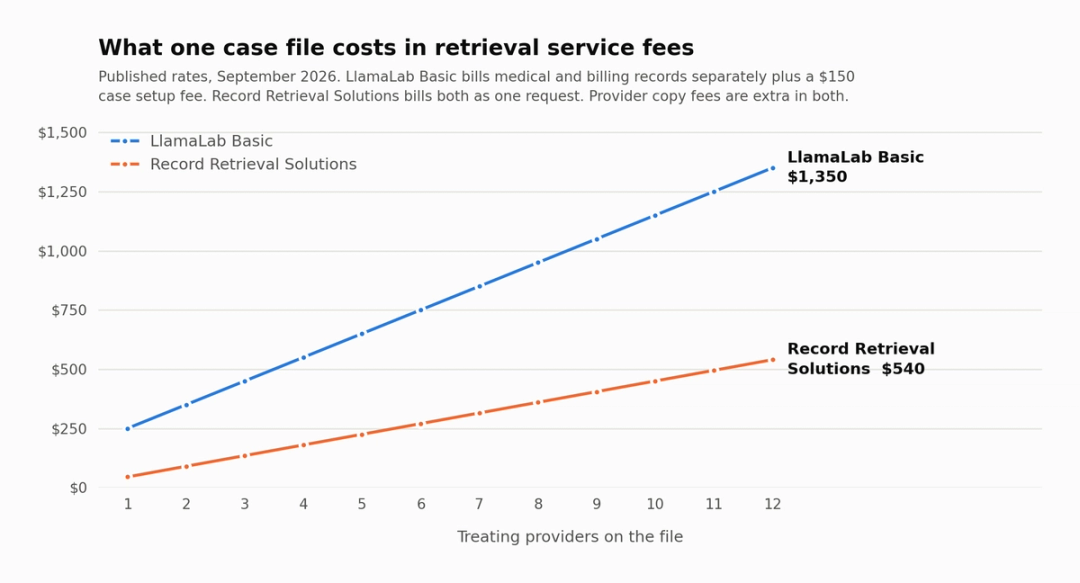
| Pricing model | Six-provider file | Twelve-provider file | What drives the bill |
|---|---|---|---|
| LlamaLab Basic | $750 | $1,350 | Each provider needs a medical and a billing request, plus a case setup fee |
| Record Retrieval Solutions | $270 | $540 | One $45 fee per provider when records and billing share a department |
| Tavrn | $240 and up | $480 and up | $40 per request, so split departments add requests |
| LlamaLab Core Unlimited | Quoted | Quoted | Unlimited requests at a per-case price |
| YoCierge | Quoted | Quoted | Volume-based flat fee per request |
| HelloCounsel | Included | Included | Fixed monthly from $500, scoped to call volume rather than provider count |
Provider copy fees are extra in every case. Pricing as of September 2026.
Why Firms Look for a LlamaLab Alternative
LlamaLab is strong at the vendor end of the request. The friction shows up at your end: the systems you run, the costs you front, and the calls your staff still make.
Same-day speed depends on the provider
Read the speed figure closely. If 30 to 40% of records arrive the same day, most requests still take longer, and providers outside connected networks fall back to fax, phone, and waiting. Those providers work to a deadline of their own, and it is not four days.
A records department working to a 30-day clock does not move faster because your vendor is fast. Someone has to call, confirm the request arrived, and call again. As per our analysis, a typical PI case generates about 150 calls over its life, and provider follow-up is a steady share of them, as our breakdown of how many calls a PI case generates shows.
Filevine is still listed as coming soon
LlamaLab's integrations page marks Filevine as coming soon. Filevine is common among mid-size PI firms, so this gap alone can send a firm looking for a LlamaLab alternative. Launching a request from the matter is useful, and writing each follow-up outcome back to the same matter is what stops a case manager from calling the provider twice, which is why CMS write-back belongs in every records evaluation.
Recoverable costs are still costs
Billing retrieval as a recoverable case expense carries real weight, since an outsourced invoice can be charged to the case while a paralegal's salary sits in overhead. There is a catch, though. Your firm fronts that expense and recovers it only when the case resolves, and depending on your fee agreement, it may come off the settlement before the client's share is calculated. On a 12-provider file, $1,350 in retrieval fees is money your client ultimately feels.
Worth Knowing
In Ciox Health, LLC v. Azar, No. 18-cv-0040 (D.D.C. Jan. 23, 2020), a federal court vacated the HITECH third-party directive. HHS confirmed afterward that the fee limitation at 45 CFR 164.524(c)(4) applies only when an individual requests their own records, not when records are sent to a third party such as a law firm. Provider copy fees on firm requests therefore run above the patient rate, which is why a vendor that checks invoices against state fee schedules earns its place.
Questions a pending lawsuit raises
In January 2026, Epic and several health systems sued Health Gorilla and a group of its clients, including LlamaLab, alleging improper access to patient records through a health information exchange, as Healthcare Dive reported. LlamaLab denies the allegations, has said it has never sold patient data, and asked the court to dismiss the case in February 2026.
Note
The Epic complaint alleges that defendants retrieved nearly 300,000 patient records through Health Gorilla. In March 2026, co-defendant GuardDog Telehealth admitted improper access and agreed to be barred from HIE participation, according to The HIPAA Journal. Neither development resolves the claims against LlamaLab.
For your firm, the useful takeaway is a diligence question for every LlamaLab alternative on your list: where do your records come from, and what happens to open requests if a network access dispute changes that source?
How We Evaluated These LlamaLab Alternatives
We scored every LlamaLab alternative on seven questions a COO or records lead at a 10 to 200 person plaintiff firm raises during a trial. Our guide on how to evaluate an AI voice agent covers the test calls behind the first one.
- Follow-up ownership: Who makes the calls when a provider does not respond?
- Provider coverage: What happens with providers outside connected networks?
- CMS write-back: Does status land in the matter your team already works in, including Filevine?
- Pricing model: Per request, per case, or a fixed monthly rate?
- Analysis layer: Does it produce chronologies or summaries, or only records?
- Other call work: Does it also cover adjuster calls, client check-ins, and reception?
- Security documentation: Can the vendor produce a BAA and an audited security report?
TL;DR: 7 Best LlamaLab Alternatives in 2026
Each option below removes a different part of the records problem. Read the one-line fits first, then the table, which scores every tool on who makes the follow-up calls and where the status lands.
- HelloCounsel: Best for firms whose records backlog lives on the phone, plus reception and client check-ins
- Record Retrieval Solutions: Best for a published flat fee and Filevine tracking
- YoCierge: Best for flat-fee retrieval with wide CMS coverage
- ChartRequest (CaseBinder): Best for a coordinator who owns follow-up
- American Retrieval: Best for an established portal with cost controls
- Codes Health: Best for litigation-focused analysis with retrieval inside Filevine
- Tavrn: Best for retrieval, chronologies, and demand drafting together
| Option | Provider follow-up calls | Status written to your CMS | Handles client and adjuster calls | Published pricing |
|---|---|---|---|---|
| HelloCounsel | Yes. AI agent works menus and holds | Yes. Direct write-back plus custom builds | Yes. Reception, check-ins, and claim opening | Yes. From $500 per month, fixed |
| LlamaLab | Yes. Automatic follow-ups and escalations | Yes, on Litify, SmartAdvocate, Clio, and Needles | No | Yes. $50 per request on Basic |
| Record Retrieval Solutions | Yes. Service team follows up | Yes. RecordSync with Filevine | No | Yes. $45 per typical request |
| YoCierge | Yes. Service team follows up | Yes. Wide integration list | No | No. Flat fee, quoted |
| ChartRequest | Yes. Dedicated coordinator | No. CaseBinder dashboard | No | No. Fees scale with volume |
| American Retrieval | Yes. Account team follows up | Yes. Client database integrations | No | No. Quoted on a demo |
| Codes Health | Yes. Multi-channel retrieval | Yes, inside Filevine | No | No. Quoted on a demo |
| Tavrn | Yes. AI agents with saved transcripts | Yes. Litify, Clio, and Filevine | No | Yes. $40 per request plus provider fees |
LlamaLab vs the Top Alternatives on Follow-Up Work
Retrieval vendors look alike on a feature grid. They separate on who owns the phone work a request creates, so this table scores the four closest options on exactly that.
| Capability | HelloCounsel | LlamaLab | Record Retrieval Solutions | ChartRequest |
|---|---|---|---|---|
| AI voice agent on the call | Yes. Part of the core records workflow | No. Digital integrations plus a service team | No. Service team | No. Retrieval coordinator |
| Tasks assigned from your CMS | Yes. Counsel picks up the task like a teammate | Yes. Retrieval launches from the matter | Yes. RecordSync inside Filevine | No. Requests run through CaseBinder |
| Filevine write-back today | Yes. Direct integration | No. | Yes. RecordSync | Not listed |
| Case opening after intake | Yes. Matter setup and first records requests | No | No | No |
| Inbound provider and adjuster calls | Yes. Caller pre-identification routes by case phase | No | No | No |
| Client treatment check-ins | Yes. Calls after each visit | No | No | No |
| Insurance claim opening | Yes. Part of case development | No | No | No |
| Call performance measurement | Yes. Recordings, transcripts, sentiment, and transfer rates | No. Request status tracking | No. Request status tracking | No. Request status tracking |
| Fixed monthly pricing | Yes. Scoped to volume with 20% tolerance | No. Per request or quoted per case | No. $45 per request | No. Fees scale with volume |
The 7 LlamaLab Alternatives, Reviewed
HelloCounsel leads because it takes the calls every retrieval vendor still leaves somewhere in your firm. The six vendors after it retrieve and deliver records, and three of them add analysis.
1. HelloCounsel: Best LlamaLab Alternative for Provider Follow-Up Calls
As a LlamaLab alternative, HelloCounsel builds AI voice agents for plaintiff firms. Counsel, the agent, runs the records workflow from the request through every follow-up call, then writes each outcome into the matter. Chronologies, clinical review, and reverse provider search are not part of the service, so pair it with the analysis tools you already use.

How Counsel runs a records request
- Submit the request: Counsel sends the request by email, fax, or through portals such as DataVant, MRO, and ChartSwap. Firms that prefer to submit requests themselves can hand Counsel the follow-up only
- Follow up on the provider's terms: Counsel calls the records department, works the phone menu, waits on hold, checks portals, and monitors your inbox and fax line, following each provider's stated callback window
- Track every piece: Records, bills, billing affidavits, and medical-record affidavits are tracked separately, since they often arrive on different days
- Check completeness: Counsel confirms the plaintiff, provider, and dates of service match, and flags missing records or discrepancies before closing the request
- Handle the invoice: When a provider needs prepayment, Counsel obtains the invoice and creates a payment task for your team
- Log and escalate: Every call, status change, and next step is written to the matter, and stalled providers or anything needing judgment go to your team
Key features
HelloCounsel runs as the backbone of a plaintiff firm's call and case operations, from the first ring through intake, case opening, and every follow-up until demand, all inside your existing CMS.
Inbound calls, in English and Spanish
- Caller pre-identification: The agent checks the caller against the case management system before handling the call, so it knows whether it is speaking with a client, provider, adjuster, or new prospect, which matter is involved, and which case staff to route to
- Custom call flows: Separate flows for new callers, current clients, providers, adjusters, attorneys, and after-hours traffic, each following your firm's SOP
- 24/7 answering: Picks up every call on the main line, including nights, weekends, holidays, and campaign spikes
- Bilingual on one line: Callers can switch between English and Spanish mid-conversation with no transfer
Intake and qualification
- AI intake: Runs your intake script, captures the case-deciding details, and writes intake notes directly into the case management system
- Qualification: Screens every new caller against your case criteria in seconds, so qualified leads move to signing and the rest are routed under your rules
- Case opening: Once a lead qualifies, creates the matter, enters contact, incident, and insurance details, sends the retainer, and organizes the first records requests
Medical coordination
- Medical records retrieval and organization: Submits requests by email, fax, or portals such as DataVant, MRO, and ChartSwap, follows up across every channel until each request is complete, and flags missing records or mismatched dates before closing
- Treatment check-ins: Calls clients the day after each scheduled visit to confirm attendance, capture new providers, and escalate anything the case manager needs to see
- Client check-ins: Runs monthly status calls so clients hear from the firm on a schedule, and follows up with new leads who did not sign on the first call
Legal coordination
- Adjuster and lien holder calls: Handles the routine outbound calls, confirms claim numbers and balances, and logs each exchange to the matter
- Insurance claim opening: Opens claims with carriers through outbound calls
- Hold-time handling: A teammate starts the call and hangs up; the agent works the phone menu, waits in the queue, and connects them when a person answers
Case management, inside your CMS
- Task completion: Picks up tasks assigned in your CMS, runs the calls each one needs, and closes the loop in the file
- CMS write-back: Direct integrations with SmartAdvocate, Filevine, Litify, Lead Docket, and Clio, with custom integrations available for other systems
Reporting and escalation
- Call reporting: A dashboard measures call volume, caller type, transfers, and script adherence, so you can size the phone load before and after launch
- Human escalation: Your transfer rules send sensitive, judgment-heavy, or out-of-scope calls to the right person with context loaded
The follow-up loop, run from your CMS
LlamaLab today: The vendor handles its own follow-ups, and providers outside its connected networks still generate calls for your team.
A case manager with 90 open files might have 30 waiting on providers. Instead of working a chase list, she assigns a task in the CMS: chase the orthopedic group on the Alvarez file. Counsel calls, works the phone menu, holds until it reaches the records department, confirms the request is in the queue, emails the confirmation, and writes it to the file, so the status is waiting the next time she opens the matter. Our walkthrough of AI on medical provider calls covers the full sequence.
Filevine and SmartAdvocate write-back today
LlamaLab today: Filevine is listed as coming soon.
HelloCounsel writes directly into SmartAdvocate, Filevine, Litify, Lead Docket, and Clio, and our team builds custom integrations for other systems. Counsel pulls matter context during the call and writes notes, fields, and summaries back when it ends, so nobody retypes a provider's confirmation. See our guides for Filevine voice agents and SmartAdvocate intake.
The rest of the calls a records request creates
LlamaLab today: Retrieval ends at the record, so the client call that reveals a new provider, the billing department callback, and the adjuster asking for status all land back at your firm.
A traditional answering service takes a message on those calls and emails it to your team, which adds a callback and a manual note, the root of the answering service documentation problem. Counsel handles them itself, with caller pre-identification routing providers and adjusters by case phase.

What the follow-up actually costs today
HelloCounsel plans records volume around four follow-up calls per open request each month, a figure worth testing against your own request log. Staff describe provider hold times running 30 to 90 minutes, and requests sitting open for weeks when nobody calls back.
Run that against 30 open requests. At four calls a month and 15 minutes each with menus and hold time, that is 30 hours. At the BLS median paralegal wage of $30.24 an hour, loaded to about $43.20 with benefits, those calls cost roughly $1,300 a month in staff time before a single case moves forward. These figures are illustrative, so use your own numbers.
What changes for your team
- Faster case onboarding: Firms onboard new cases up to 60% faster, because the matter opens and the first records requests go out once intake qualifies
- No chase list in anyone's head: Every request's status sits in the matter
- Faster demands: Records land sooner when follow-up never slips
- Automated check-ins: New providers surface before a gap holds up the demand
- Intake notes straight to the CMS: Qualification happens during the call, and the notes land in the file without re-entry
- Faster speed to answer: Provider and adjuster callbacks reach the right file on the first ring
- Lower overhead: Case managers stop spending afternoons on hold, the most direct way to reduce case manager workload
HelloCounsel by the Numbers
25,000+ calls handled 500+ hours of call time handled 93% SOP precision in every call 48% improvement in call reception rates Figures reported by HelloCounsel.
“Working with HelloCounsel has been an outstanding experience. Their commitment to client service and innovation is evident in everything they do. We've been extremely impressed with our new AI receptionist, Kate, and the impact it's already making for our firm. I'm excited to continue exploring additional solutions that allow our case managers to focus more time on delivering exceptional client care.”
Anthony Ramos, COO, Pendergast Law
Treatment check-ins close another gap. Counsel calls your client after each visit, and when she mentions a new specialist, that provider reaches the file before anyone requests records, which keeps client communication and records work in step. The case for automating outbound calls covers the wider outbound load.
HelloCounsel pricing
Per-request fees scale with every provider on every file, while a fixed monthly price stays flat when a mass tort docket doubles your open requests. HelloCounsel starts at $500 a month (pricing as of September 2026) and does not bill by the minute. The price is scoped to your licence count and expected volume with a 20% tolerance either way, there is no setup fee, onboarding is one hour-long call built around 17 multiple-choice questions, and the agent build takes about a week, with a testing agent shared in three to five days. That makes HelloCounsel the LlamaLab alternative whose cost stays flat as requests grow.
| Pros | Cons |
|---|---|
| Runs records requests from submission through a complete response, with every call logged to the matter | Does not produce chronologies or run reverse provider search |
| Direct write-back to SmartAdvocate, Filevine, Litify, Lead Docket, and Clio, plus custom builds | Built for plaintiff firms with case managers and a production CMS |
| Covers reception, client check-ins, and claim opening on the same fixed price | Provider prepayments stay with the firm, hard-copy mail is not supported, and portal requests need firm-provided credentials |
See how Counsel runs a records follow-up from CMS task to logged confirmation on the HelloCounsel product page.
2. Record Retrieval Solutions: Best LlamaLab Alternative for a Published Flat Fee
Record Retrieval Solutions (RRS) is a retrieval company that handles each request from authorization review through follow-up and delivery, across the US and in Canada, Mexico, and Puerto Rico. Its RecordSync portal connects with Filevine, Neos, Needles, and TrialWorks, so you can order and track records from the case file.
Record Retrieval Solutions key features
- Flat fee: $45 per typical request, recoverable as a case expense, with provider fees passed through without markup
- Turnaround: A 15-day average, with some pages citing 16 days
- Certified records: Certified copies and No Records Found certificates for litigation
- RecordSync: Tracking inside Filevine, Neos, Needles, and TrialWorks
- Scope: Serves law, insurance, and life sciences clients
| Pros | Cons |
|---|---|
| A published flat fee makes case costs easy to estimate | A 15-day average is well behind LlamaLab's 4-day figure |
| Filevine integration is live | Its medical record summary service is paused during a system upgrade |
| Certified records and No Records Found certificates | Multi-department providers need split requests, each billed |
Fit: As a LlamaLab alternative, RRS suits Filevine firms that want a published price. Provider calls about billing, status, and new treatment still reach your team, which is the work HelloCounsel takes off the desk.
3. YoCierge: Best LlamaLab Alternative for Flat-Fee Retrieval
YoCierge is a medical records retrieval platform for plaintiff and defense firms with flat-fee pricing, live tracking, and e-authorization through YoSign.
YoCierge key features
- Flat fee: A volume-based fee per request with no per-page service charges, plus control over custodial charges
- YoSign: E-authorization that cuts back-and-forth with clients
- EHR download: Pulls records digitally where providers support it
- Same-day processing: Orders placed before 4 p.m. go out that day
- AI tools: Chronological reordering, summaries, medical expense tables, and invoice checks against state copy-fee rules
- Integrations: Clio, Filevine, Litify, CasePeer, MyCase, Neos, SmartAdvocate, and more, plus a retrieval API
| Pros | Cons |
|---|---|
| Broad case management integration list | The rate is quoted, so case math waits for a sales call |
| Flags provider invoices above state fee limits, which matters most on third-party requests outside the patient rate | Client check-ins and adjuster calls stay with your team |
Fit: As a LlamaLab alternative, YoCierge suits firms on Filevine or SmartAdvocate that want flat fees and AI summaries alongside retrieval.
4. ChartRequest (CaseBinder): Best LlamaLab Alternative for a Dedicated Coordinator
ChartRequest runs CaseBinder, a managed retrieval service for law firms that retrieves from any US provider. A dedicated retrieval coordinator handles follow-up and escalation, and your team tracks progress in a central dashboard.
CaseBinder key features
- Coordinator: A named person owns follow-up and escalation
- eAuthorization: A digital patient authorization workflow
- Tracking: Real-time status updates and reports
- Litigation options: Subpoena-oriented retrieval and certified-record options
- Pricing model: No monthly subscription, with request fees that scale with volume
| Pros | Cons |
|---|---|
| A named coordinator owns follow-up | No published turnaround standard |
| No subscription fee to start | Status lives in the CaseBinder dashboard rather than your case file |
Fit: As a LlamaLab alternative, CaseBinder suits firms that want a person on follow-up. Counsel gives you the same ownership from inside your CMS, with each outcome logged to the matter your team already opens.
5. American Retrieval: Best LlamaLab Alternative for an Established Portal
American Retrieval has served law firms and insurers since 1993. Its RecordsHub portal lets your team order, track, search, highlight, and annotate records in one place.
American Retrieval key features
- RecordsHub: A HIPAA-compliant portal with search, highlighting, and annotation for multiparty litigation
- OCR search: Every digital record is searchable by keyword and date, linked to the page
- Cost controls: Provider copy fees held to state statutes, upfront cost approval limits, and no double charges for follow-ups
- Integrations: Connects with client databases for real-time request updates
- Storage: Unlimited secure record storage
| Pros | Cons |
|---|---|
| Cost controls on provider copy fees | Serves insurers too, so workflows are not plaintiff-only |
| Collaborative portal for multiparty litigation | No published turnaround figure to benchmark |
Fit: As a LlamaLab alternative, American Retrieval suits mass tort and multiparty teams that want a mature portal and cost controls. Pricing is quoted on a demo.
6. Codes Health: Best LlamaLab Alternative for Analysis Inside Filevine
Codes Health pairs medical records retrieval with litigation-focused AI analysis and human verification, and since a July 2026 partnership it runs inside Filevine projects.
Codes Health key features
- Multi-channel retrieval: Clearinghouses, custodian integrations, provider networks, fax, and patient uploads
- Authorization checks: Catches authorization errors before submission
- Analysis: Chronologies, case summaries, missing-record review, and breach-of-care flags
- Filevine embed: Submit, track, and receive records inside the Filevine project
| Pros | Cons |
|---|---|
| Litigation analysis with human verification | A 1 to 2 week average turnaround |
| Runs inside Filevine | You will not find G2, Capterra, or Trustpilot reviews yet |
Fit: As a LlamaLab alternative, Codes Health suits Filevine firms that want records and chronologies from one vendor. Pricing is quoted on a demo, and our roundup of Codes Health alternatives goes further.
7. Tavrn: Best LlamaLab Alternative for Retrieval Through Demand
Tavrn is an AI case preparation platform for PI, med mal, SSDI, and workers' comp firms. Its agents work provider phone trees, handle objections using notes from earlier calls, and pay required invoices, then Tavrn turns the records into a chronology in under 24 hours and drafts the demand.
Tavrn key features
- Retrieval agents: Nationwide follow-up with every provider call saved as a transcript
- Missing records reports: Flags absent providers, dates, and bills
- Chronologies and demands: Chronologies in under 24 hours, then demand drafts
- Integrations: Litify, Clio, and Filevine
- Pricing: $40 per request plus provider fees (as of August 2026)
| Pros | Cons |
|---|---|
| Retrieval, review, and demand drafting from one vendor | Per-request fees grow with every provider |
| Readable call transcripts for stalled requests | Security program is aligned with SOC 2 rather than certified |
Fit: As a LlamaLab alternative, Tavrn suits firms that want the document pipeline in one place. Firms weighing records tools against demand platforms can also review our EvenUp alternatives and top AI tools for PI lawyers.
What to Check Before Choosing a LlamaLab Alternative
Every vendor here will show you a fast demo. These five checks tell you how a LlamaLab alternative holds up on your hardest files.
Test on live cases, including a slow provider
Submit a mix of requests, including one provider known for delays, and count how many follow-up calls your team still makes with each LlamaLab alternative during the trial.
Ask what the turnaround average includes
A 4-day or 15-day average can hide a long tail. Ask for the share of requests completed within 30 days, and how the vendor handles providers outside its connected networks.
Practical Tip
Under 45 CFR 164.524, a provider must act on an access request within 30 calendar days and may take one extension of up to 30 more with written notice. Benchmark every vendor average against that clock rather than against each other, since the clock is what a stalled provider is actually working to.
Ask for the BAA and security report
Any vendor touching your clients' health information should produce a Business Associate Agreement and an audited security report. Ask for both, and ask whether SOC 2 is certified or only aligned.
Confirm write-back to the matter
Watch where a completed follow-up lands. A status in a vendor dashboard still needs someone to check it, while a note in the matter sits where your team already works.
Ask who pays the provider invoice
Some vendors front provider copy fees and bill them back, while others create a payment task for your team. Confirm which applies before the first prepayment request arrives, since copy fees on firm requests are not capped at the patient rate.

Choose the LlamaLab Alternative That Fixes Where Your Records Stall
LlamaLab is a strong choice when speed, provider discovery, and clinical qualification are the priority, and it fits Litify, SmartAdvocate, Clio, and Needles firms well. If your records stall at the vendor, compare it with RRS, YoCierge, and Codes Health on turnaround and cost.
If your records stall on the phone, the fix sits inside your firm, and that is the gap HelloCounsel closes as a LlamaLab alternative. It runs the request and the follow-up from a CMS task, writes back to Filevine or SmartAdvocate, opens the case once intake qualifies, and makes client check-ins that catch new providers early, starting at $500 a month with no per-minute billing. Slow follow-up also shows up at the front door, where it is a common reason firms lose cases before signing.
Book a call with the HelloCounsel founders and bring your longest-open records request. The team will show you how Counsel would chase it and where the status lands.
Frequently Asked Questions
Seven questions come up in almost every records evaluation, so here are the short answers.
What is the best LlamaLab alternative for personal injury firms?
HelloCounsel is the strongest fit when provider follow-up calls are the bottleneck. Counsel works phone menus, waits on hold, confirms requests, and writes outcomes to your case management system, starting at $500 a month.
What is LlamaLab?
LlamaLab is a medical records retrieval and clinical analysis platform for PI, mass tort, and med mal firms, with a 4-day average turnaround, reverse provider search, chronologies, and clinical review.
How much does LlamaLab cost?
As of September 2026, LlamaLab Basic charges $50 per medical request, $50 per billing request, and a $150 case setup fee. Core Unlimited includes unlimited requests at a quoted per-case price. HelloCounsel starts at $500 a month, fixed.
Does LlamaLab integrate with Filevine?
As of September 2026, LlamaLab lists Filevine as coming soon. HelloCounsel writes directly into Filevine, SmartAdvocate, Litify, Lead Docket, and Clio.
Does HelloCounsel handle inbound and outbound follow-up?
Yes. HelloCounsel answers inbound calls 24/7, opens the case once intake qualifies, and places outbound calls for records, treatment check-ins, claim opening, and lead follow-up, logging every outcome to the case file.
How long do providers have to send medical records under HIPAA?
Providers have 30 days to act on an access request, with one possible 30-day extension. State laws can add their own timelines, so check the rules where the provider is located.
Who pays provider copy fees on a records request?
The firm does, with every vendor here. Copy fees on firm requests are not capped at the HIPAA patient rate, so check each invoice against your state's fee schedule.
Share this article