
- HelloCounsel: HelloCounsel is the Codes Health alternative for firms that want records requests and provider follow-up run inside their own case management system, from $500 a month.
- Start with the stall: The best Codes Health alternative depends on where your records process stalls: the request, the follow-up calls, or the review after the records land.
- What Codes Health does: Codes Health is AI-native medical records retrieval with human-verified case insights, 50-state coverage, and a live Filevine partnership.
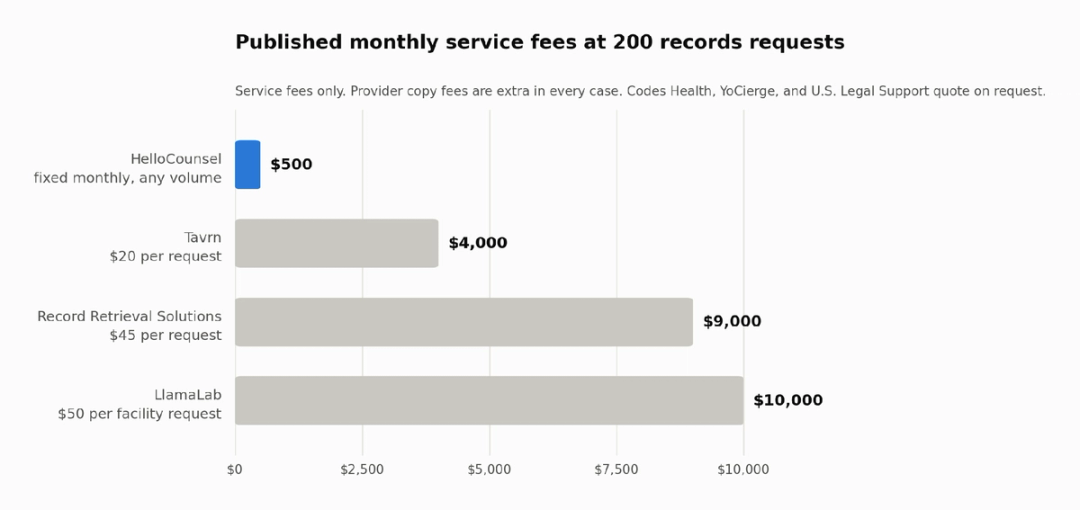
- Published pricing: Tavrn lists a flat $20 per request, Record Retrieval Solutions $45, and LlamaLab $50 per facility request plus a case setup fee.
- What the unit costs you: At 200 requests a month, published per-request fees run from $4,000 to $10,000 in service charges before a single provider copy fee.
- The fee rule changed: Since a 2020 federal court ruling, the HIPAA patient-rate fee cap no longer applies when records go to a law firm, so copy fees on firm requests run higher.
- Before switching: Ask any vendor where request status lives and who places the fourth follow-up call.
A records request rarely stalls on the day it goes out. It stalls three weeks later, when the orthopedic group still has not responded, your case manager is on hold with its records desk for the second time that week, and the demand date keeps slipping.
Codes Health was built for that problem, and it solves a lot of it. Firms still look for a Codes Health alternative for one of three reasons: a different pricing model, faster turnaround, or more control over the follow-up without handing the whole process to a vendor. That third reason is where HelloCounsel fits.
Codes Health Alternatives at a Glance
Six options are worth pricing against Codes Health, and each one removes a different bottleneck. Read the summary list first, then the table underneath, which scores every tool on where follow-up happens and where status lives.
- HelloCounsel: Best for firms that want records follow-up run in-house
- LlamaLab: Best for speed
- YoCierge: Best for many CMS integrations
- Tavrn: Best for retrieval plus overviews at a low per-request fee
- Record Retrieval Solutions: Best for a long-established vendor
- U.S. Legal Support: Best for retrieval inside a litigation-support contract
| Tool | Follow-up logged in your CMS | Chronologies or summaries | Published turnaround | Published pricing |
|---|---|---|---|---|
| HelloCounsel | Yes. Written to the matter at call end | No. Focused on call operations | Yes. Calls placed as soon as the task is assigned | Yes. From $500 per month, fixed |
| Codes Health | Yes. Filevine partnership plus custom builds | Yes. Human-verified insights | Yes. 1 to 2 week average | No. Per-case quote |
| LlamaLab | Yes, on Litify, SmartAdvocate, Clio, and Needles | Yes. Timelines and summaries | Yes. 4-day average | Yes. $50 per facility request |
| YoCierge | Yes. Many CMS integrations | Yes. ReChron and AI summaries | Yes. Same-day order processing | No. Volume-based flat fee |
| Tavrn | No. Tracked in Tavrn unless connected | Yes. Overviews in under 24 hours | Yes. Most records in 2 to 4 weeks | Yes. $20 per request |
| Record Retrieval Solutions | Yes. RecordSync with select integrations | Yes, as a paid add-on | Yes. 15-day average | Yes. $45 per typical request |
| U.S. Legal Support | No. Client portal | Yes. RecordSummary Pro | No. Varies by request | No. Quote-based |
What each pricing model costs at 200 records requests a month
Headline pricing hides the thing that decides your annual spend, which is the unit each vendor bills on. Per-request and per-case fees both rise with your docket, so the month your intake team signs the most cases is the month your records bill peaks. Fixed monthly pricing moves with call volume instead.
| Tool | Pricing model | Service fees at 200 requests | What happens when volume doubles |
|---|---|---|---|
| HelloCounsel | Fixed monthly, from $500 | $500 | Unchanged within a 20% tolerance either way |
| Tavrn | $20 per request | $4,000 | $8,000 |
| Record Retrieval Solutions | $45 per typical request | $9,000 | $18,000 |
| LlamaLab | $50 per facility request, plus $150 per case setup | $10,000 plus setup fees | $20,000 plus setup fees |
| Codes Health | Flat fee per case, quoted | Quoted on request | Rises with every new plaintiff |
| YoCierge | Volume-based flat fee per request, quoted | Quoted on request | Rises with request count |
| U.S. Legal Support | Quoted by contract | Quoted on request | Depends on contract terms |
Provider copy fees are extra in every case. Pricing as of September 2026.
What Codes Health Does Well, and Why Firms Compare Alternatives
Codes Health is AI-powered medical records retrieval, chronologies, and case insights for PI firms, with HIPAA-compliant coverage in all 50 states and a 1 to 2 week average turnaround.
The workflow starts at intake: Codes Health validates new requests, locates the client's care sites, and picks the fastest route through its provider network. Retrieval mixes AI with human intervention to pull medical records, billing records, imaging, and affidavits.
The review layer is where it stands out. Codes Health extracts case insights such as breaches in care, diagnoses, and future expenses, and people verify them before delivery. You also get visit-by-visit summaries and chronologies that flag missing records, which is real value on med-mal and complex injury files. Since a July 2026 partnership, retrieval also runs inside Filevine, where many legal teams already work.
Why firms still look for a Codes Health alternative
- Pricing scales with cases: A per-case flat fee, quoted on request, grows with every new plaintiff on a mass tort docket
- Proof is mostly first-party: Figures such as 80% less manual review, 2.5x faster retrieval, and 1.7x larger settlements come without a published methodology, and you will not find Codes Health on G2 or Capterra to cross-check them
- Records are one workflow: Reception, intake calls, treatment check-ins, and client status calls stay with your team
- Follow-up happens outside your walls: Status is visible, but the chasing is not logged as work in your own CMS unless you run Filevine or a high-volume custom integration
None of these make Codes Health a bad choice. They explain why the right Codes Health alternative depends on which constraint hurts most.
How We Evaluated These Codes Health Alternatives
Retrieval tools get compared on speed, and speed alone does not tell you whether your case managers still end up on the phone. We scored each Codes Health alternative on the questions that decide that.
| Criterion | Why it matters for a PI firm |
|---|---|
| Who places follow-up calls | Decides whether case managers still chase providers |
| Where status lives | A vendor portal and your case file are different places to check |
| Turnaround | Sets the earliest date for demand work |
| Review and chronology | Needed for complex or high-page-count files |
| CMS fit | Whether updates land in your system of record |
| Pricing model | Per request, per case, or fixed monthly changes docket math |
| Other calls covered | Treatment and client calls decide which records you even need |
Worth Knowing
On August 27, 2026, the HHS Office for Civil Rights announced its 55th Right of Access enforcement action, a $50,000 settlement with a provider that failed to give a patient her records within 30 days. Many firm requests run on HIPAA authorizations instead, so confirm which route each request uses.
1. HelloCounsel: Best Codes Health Alternative for In-House Follow-Up
Most records delays trace back to the follow-up loop. The request goes out, and then somebody has to keep calling the provider until the records arrive. Across 90 open files, that is a full-time job nobody was hired to do.
HelloCounsel builds AI voice agents for plaintiff firms that take over that loop. The agent answers your inbound calls, places outbound calls, and writes every outcome into your case management system. It runs the request and the phone work behind it, which is what decides how fast records actually arrive. Chronologies and case insights are not part of the service, so pair it with the review tools you already use.
How the records workflow runs
- Submit the request: Counsel sends the request by email, fax, or through portals such as DataVant, MRO, and ChartSwap. Firms that prefer to submit requests themselves can hand Counsel the follow-up only
- Follow up on the provider's terms: Counsel calls the records department, works the phone menu, waits on hold, checks portals, and monitors your inbox and fax line, following each provider's stated callback window
- Track every piece: Records, bills, billing affidavits, and medical-record affidavits are tracked separately, since they often arrive on different days
- Check completeness: Counsel confirms the plaintiff, provider, and dates of service match, and flags missing records or discrepancies before closing the request
- Handle the invoice: When a provider needs prepayment, Counsel obtains the invoice and creates a payment task for your team
- Log and escalate: Every call, status change, and next step is written to the matter, and stalled providers or anything needing judgment go to your team
[IMAGE PLACEHOLDER]
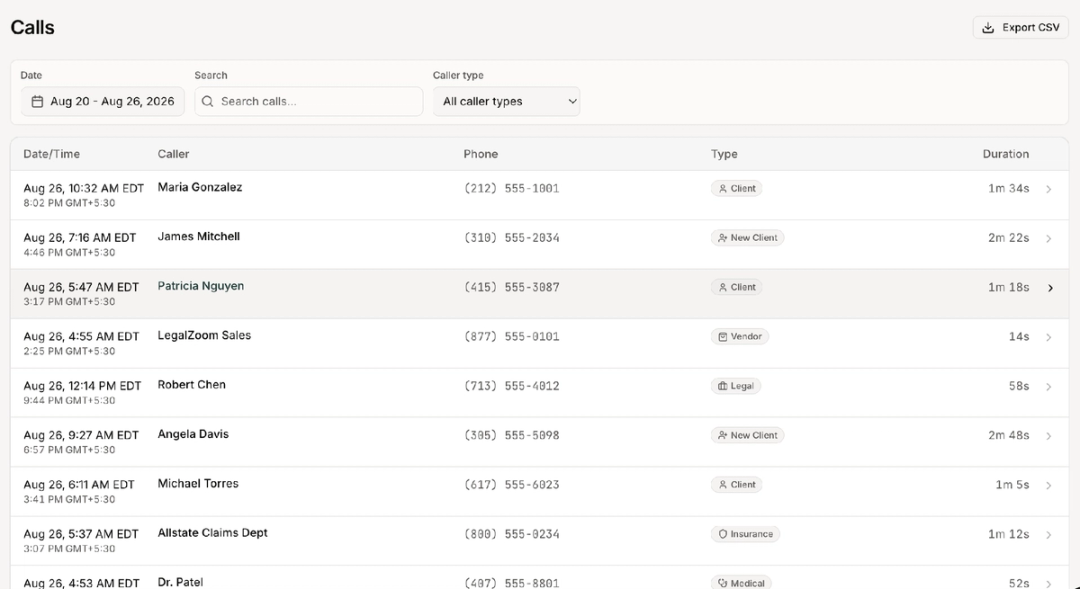
Alt text: HelloCounsel call log showing outbound provider calls with status, case type, and duration
Caption: Outbound records calls tracked by status and case type (demo mode, caller details blurred).
Our guide to AI on medical provider calls covers the mechanics in more detail.
Key features
HelloCounsel runs as the backbone of a plaintiff firm's call and case operations, from the first ring through intake, case opening, and every follow-up until demand, all inside your existing CMS.
Inbound calls, in English and Spanish
- Caller pre-identification: The agent checks the caller against the case management system before handling the call, so it knows whether it is speaking with a client, provider, adjuster, or new prospect, which matter is involved, and which case staff to route to
- Custom call flows: Separate flows for new callers, current clients, providers, adjusters, attorneys, and after-hours traffic, each following your firm's SOP
- 24/7 answering: Picks up every call on the main line, including nights, weekends, holidays, and campaign spikes
- Bilingual on one line: Callers can switch between English and Spanish mid-conversation with no transfer
Intake and qualification
- AI intake: Runs your intake script, captures the case-deciding details, and writes intake notes directly into the case management system
- Qualification: Screens every new caller against your case criteria in seconds, so qualified leads move to signing and the rest are routed under your rules
- Case opening: Once a lead qualifies, creates the matter, enters contact, incident, and insurance details, sends the retainer, and organizes the first records requests
Medical coordination
- Medical records retrieval and organization: Submits requests by email, fax, or portals such as DataVant, MRO, and ChartSwap, follows up across every channel until each request is complete, and flags missing records or mismatched dates before closing
- Treatment check-ins: Calls clients the day after each scheduled visit to confirm attendance, capture new providers, and escalate anything the case manager needs to see
- Client check-ins: Runs monthly status calls so clients hear from the firm on a schedule, and follows up with new leads who did not sign on the first call
Legal coordination
- Adjuster and lien holder calls: Handles the routine outbound calls, confirms claim numbers and balances, and logs each exchange to the matter
- Insurance claim opening: Opens claims with carriers through outbound calls
- Hold-time handling: A teammate starts the call and hangs up; the agent works the phone menu, waits in the queue, and connects them when a person answers
Case management, inside your CMS
- Task completion: Picks up tasks assigned in your CMS, runs the calls each one needs, and closes the loop in the file
- CMS write-back: Direct integrations with SmartAdvocate, Filevine, Litify, Lead Docket, and Clio, with custom integrations available for other systems
Reporting and escalation
- Call reporting: A dashboard measures call volume, caller type, transfers, and script adherence, so you can size the phone load before and after launch
- Human escalation: Your transfer rules send sensitive, judgment-heavy, or out-of-scope calls to the right person with context loaded
How HelloCounsel covers what Codes Health leaves to your team
Four gaps come up in every procurement conversation, and each one maps to work your team is doing today.
Status stays in your file
Codes Health today: Status sits with the vendor unless you run Filevine or a custom integration.
Notes, fields, and call summaries write back when each call ends. HelloCounsel writes directly into SmartAdvocate, Filevine, Litify, Lead Docket, and Clio, and our team builds custom integrations for other systems. That is how CMS write-back keeps follow-up visible to everyone on the case, with guides for Filevine voice agents, SmartAdvocate intake, and Litify firms.
The calls around records
Codes Health today: Treatment, client, and reception calls stay with your team.
A treatment gap changes which records you need. The agent calls clients the day after each scheduled visit to confirm attendance and capture new providers, and it also opens insurance claims, runs monthly check-ins, and answers your main line with case context a generic AI receptionist does not have. As per our analysis, a single PI case generates about 150 calls, and records follow-up is only one slice, as our breakdown of how many calls a PI case generates shows.
A bill that does not grow with your docket
Codes Health today: A per-case fee rises with every plaintiff.
HelloCounsel starts at $500 per month (pricing as of September 2026) on a fixed price scoped to your licences and expected volume, with a 20% tolerance either way, no setup fee, and no per-minute charge. Adding 200 plaintiffs to a mass tort campaign changes your call volume, not a per-case invoice. Onboarding is one hour-long call.
Hold time comes off your team
When a paralegal needs to reach an adjuster personally, she starts the call and hangs up. The agent waits in the queue and connects her when a person answers.
What the follow-up actually costs today
HelloCounsel plans records volume around four follow-up calls per open request each month, a figure worth testing against your own request log. Staff describe provider hold times running 30 to 90 minutes, and requests sitting open for weeks when nobody calls back.
Run that against 30 open requests. At four calls a month and 15 minutes each with menus and hold time, that is 30 hours. At the BLS median paralegal wage of $30.24 an hour, loaded to about $43.20 with benefits, those calls cost roughly $1,300 a month in staff time before a single case moves forward. These figures are illustrative, so use your own numbers.
What changes for your team
- Faster case onboarding: Firms onboard new cases up to 60% faster, because the matter opens and the first records requests go out once intake qualifies
- No chase list in anyone's head: Every request's status sits in the matter
- Automated check-ins: New providers surface before a gap holds up the demand, keeping client communication current
- Faster speed to answer: Provider and adjuster callbacks reach the right file on the first ring
- Intake notes straight to the CMS: Qualification happens during the call, and the notes land in the file without re-entry
- Workflows carried through: Agents work inside your existing CMS and close each task in the file
Lower overhead: Case managers stop spending afternoons on hold, the most direct way to reduce case manager workload
HelloCounsel by the Numbers
25,000+ calls handled 500+ hours of call time handled 93% SOP precision in every call 48% improvement in call reception rates Figures reported by HelloCounsel.
“Working with HelloCounsel has been an outstanding experience. Their commitment to client service and innovation is evident in everything they do. We've been extremely impressed with our new AI receptionist, Kate, and the impact it's already making for our firm. I'm excited to continue exploring additional solutions that allow our case managers to focus more time on delivering exceptional client care.”
Anthony Ramos, COO, Pendergast Law
HelloCounsel pros and cons
| Pros | Cons |
|---|---|
| Runs records requests from submission through a complete response, with every call logged to the matter | Does not produce chronologies or case insights |
| Covers treatment check-ins, claim opening, reception, and intake alongside records | Provider prepayments stay with the firm; the agent collects the invoice and creates a payment task |
| Fixed monthly pricing that does not rise with case count | Hard-copy mail is not supported, and portal requests need firm-provided credentials |
Best for: Mid-market PI, workers' comp, and mass tort firms with case managers who want records work run inside their own system rather than outsourced to a portal.
2. LlamaLab: Best Codes Health Alternative for Speed
If turnaround is why you are comparing, LlamaLab competes hardest on it. Records come back in 4 days on average, with 30 to 40% returned the same day, and providers without direct digital access go through alternative retrieval methods.
LlamaLab key features
- AI-automated retrieval: With alternative routes for non-digital providers
- Analysis: Interactive timelines, automated summaries, and AI chat over the records
- Provider discovery: Reverse search surfaces treatment clients did not list
- Integrations: Litify, SmartAdvocate, Clio, and Needles, plus an API, with Filevine listed as coming soon
- Billing: Structured as a recoverable case expense
Pricing (September 2026): Basic rates are $50 per facility request plus a $150 case setup fee. A per-case option covers per-page and copy costs.
| Pros | Cons |
|---|---|
| The fastest turnaround on this list | The 4-day average is company-reported |
| Clear per-request and per-case pricing | The $150 setup fee adds up on high-volume dockets |
| Provider discovery catches forgotten treatment | Named in a pending Epic Systems lawsuit, which LlamaLab denies |
Best for: PI and mass tort firms that want the fastest outsourced retrieval and can budget per case.
3. YoCierge: Best Codes Health Alternative for CMS Integrations
YoCierge fits firms that want an outsourced vendor wired into their CMS, with connections to Clio, Filevine, Litify, SmartAdvocate, Neos, CasePeer, and more.
YoCierge key features
- Same-day processing: Orders placed before 4 p.m. are processed that day, for plaintiff and defense counsel
- EHR download: Skips paper requests where the provider supports it
- Review tools: ReChron chronological reordering, AI summaries, and a medical expense table with CPT codes
- Fee review: Checks provider invoices against state-mandated fees, which matters most on third-party requests that fall outside the HIPAA patient rate
- Spending limits: Per-location caps, so you approve any provider fee above your set amount
- Bates numbering: Included at no extra charge
Pricing: A volume-based flat fee per request, with no per-page service charge.
| Pros | Cons |
|---|---|
| Broad CMS integration list | Provider release-of-information fees still vary by page count and jurisdiction |
| Fee review and spending caps control provider invoices | Serves defense firms too, so the product is not plaintiff-specific |
| No per-page service fee | The medical record locator runs only in select states |
Best for: Firms that want outsourced retrieval with tight cost controls and a native CMS connection.
4. Tavrn: Best Codes Health Alternative for Low Per-Request Pricing
Tavrn handles retrieval and chronology work in one platform. It runs daily follow-ups with providers, tracks every request, and delivers most records in 2 to 4 weeks.
Tavrn key features
- One inbox: Manage retrieval requests and inbound faxes and emails in one place
- Agentic workflows: Pull records from thousands of providers, with daily follow-up
- Tracking: Real-time request status
- Overviews: Structured medical overviews in under 24 hours, plus chronologies and demand drafting
- Integrations: Litify, Clio, and Filevine
Pricing (September 2026): Retrieval is a flat $20 per request.
| Pros | Cons |
|---|---|
| Lowest per-request fee on this list | Most records take 2 to 4 weeks, slower than Codes Health's 1 to 2 week average |
| Daily provider follow-up | Records share the platform with intake and demand features |
| Fast overviews once records arrive | Status lives in Tavrn unless your CMS is connected |
Best for: Cost-conscious PI firms that want retrieval and summaries at a low per-request fee.
5. Record Retrieval Solutions: Best Codes Health Alternative for a Fixed Service Fee
Record Retrieval Solutions (RRS) is the conservative pick: a long-running vendor with a fixed fee and a documented follow-up process. Its $45 flat fee for a typical request covers request preparation, HIPAA authorization review, follow-up until completion, and progress notes in an online portal.
Record Retrieval Solutions key features
- Turnaround: About 15 days on average, depending on the facility
- Certified records: Admissibility-ready sets, including No Records Found certificates
- RecordSync: Authorized users submit requests, track status, receive records, and keep a chain of custody, with Filevine, Neos, Needles, and TrialWorks connections
- Add-ons: OCR, Bates numbering, certified copies, summaries, and chronologies
Pricing (September 2026): $45 per request. Medical and billing records from the same department share one fee, and provider copy fees pass through at cost.
| Pros | Cons |
|---|---|
| Simple, fixed service fee | A 15-day average is slower than AI-native vendors |
| Progress notes show each contact attempt | Summaries and chronologies are paid add-ons |
| Certified records for litigation | Serves several industries rather than plaintiff firms alone |
Best for: Firms that value certified records and predictable fees over speed.
6. U.S. Legal Support: Best Codes Health Alternative for Enterprise Contracts
U.S. Legal Support is the enterprise option, with retrieval alongside court reporting, depositions, and trial services. It handles more than 27 million pages of medical records a year across over 1.1 million provider relationships, and its RecordSummary Pro turns large record sets into one summary with an executive overview, a chronological timeline, ranked provider insights, and flagged gaps in care.
U.S. Legal Support key features
- Hyperlinked chronologies: Linked to the underlying records, including images and handwritten notes
- Security: A SOC 2 Type 2 and HIPAA-compliant client portal
- Data use: Case data is not used to train open AI models
- Bundled services: Retrieval alongside broader litigation support
Pricing: Quoted on the services and volume in your contract.
| Pros | Cons |
|---|---|
| Deep summary product for large record sets | Built for a broad litigation market, not plaintiff operations |
| Documented SOC 2 Type 2 security | Best value comes from bundling several services |
| One vendor for records, depositions, and court reporting | Turnaround depends on the provider and request type |
Best for: Larger firms already buying litigation support that want records on the same contract.
Codes Health Alternatives Compared Side by Side
Retrieval is one workflow inside a records process that runs on phone calls. This table scores each tool on the calls that surround a request rather than the request itself.
| Tool | Treatment check-ins and client updates | Reception and intake calls | Call performance reporting | Fixed monthly pricing |
|---|---|---|---|---|
| HelloCounsel | Yes. Part of the core workflow | Yes. 24/7 with caller pre-identification | Yes. Volume, caller type, and transfer rates | Yes. From $500 per month |
| Codes Health | No | No | No | No. Per case, quoted |
| LlamaLab | No | No | No | No. Per request or per case |
| YoCierge | No | No | No | No. Flat fee per request |
| Tavrn | No | No | No | No. $20 per request |
| Record Retrieval Solutions | No | No | No | No. $45 per request |
| U.S. Legal Support | No | No | No | No. Quoted |
Only HelloCounsel covers the calls around records as well as the follow-up itself.
Why Records Still Stall After the Request Goes Out
Every Codes Health alternative on this list competes on days, which is fair, since the demand date depends on it. What the turnaround number hides is who is still making calls around the request.
A rejected authorization sends the request back to your team. A client who stopped attending physical therapy changes which records you need. A provider the client forgot to mention adds a request nobody knew to send. All three show up as phone calls, and none of them sit inside a retrieval vendor's per-request fee.
Incomplete production is its own failure mode. One of the most persistent right-of-access problems is a provider that does not send the full designated record set on time, according to Hall Render's analysis of OCR's 55th settlement. A completeness check catches it, and it only helps if somebody follows up quickly.
That is also why outsourcing can feel slower than it is. The vendor may be chasing hard, and if your case manager cannot see that in the matter, she calls the vendor or the provider to check, so two people end up doing one follow-up. Keeping follow-up visible in your own system fixes that, which is the core of the case for automating outbound calls.
What to Ask Before You Switch From Codes Health
A demo answers the easy questions. These five surface the ones that decide your monthly invoice and your demand dates.
Where will the request status show up?
Ask to see a live request in your own CMS, not a demo portal. If your case managers work in SmartAdvocate or Litify rather than Filevine, confirm how updates reach the matter.
Who handles rejected authorizations?
Find out who fixes the form, who gets the client's new signature, and how long a corrected request takes to go back out.
Note
In Ciox Health, LLC v. Azar, No. 18-cv-0040 (D.D.C. Jan. 23, 2020), a federal court vacated the HITECH third-party directive. HHS confirmed afterward that the fee limitation at 45 CFR 164.524(c)(4) applies only when an individual requests their own records, not when records are sent to a third party such as a law firm. That is why provider copy fees on firm requests often run well above the patient rate, and why a vendor that reviews invoices against state fee schedules is worth asking about.
What does a 200-case docket cost?
Run the math on your next mass tort campaign. Per-request and per-case pricing both scale with plaintiffs, while fixed monthly pricing scales with call volume.
What happens with the calls around records?
Treatment gaps, missing providers, and client questions about records all reach your phones. Ask whether the vendor touches any of them, and use our guide on how to evaluate an AI voice agent to test the ones that do. An unlogged call on any of them turns into a documentation problem later.
What security documentation can you review?
Ask for BAAs, encryption details, and audit trails before any PHI moves, and review them with your firm's counsel.
Practical Tip
Under 45 CFR 164.524, a provider must act on an access request within 30 calendar days and may take one extension of up to 30 more with written notice. That clock only works in your favor if somebody keeps calling. Pull your 20 oldest open records requests and tag each by what is blocking it: no response, rejected authorization, missing provider, or waiting on the client. The mix tells you whether you need a faster Codes Health alternative or more follow-up capacity.
Choose the Codes Health Alternative That Removes the Right Bottleneck
If your firm needs deep record review on complex files, Codes Health, Tavrn, and U.S. Legal Support are the strongest fits. If turnaround and clear per-request pricing matter most, LlamaLab, YoCierge, and Record Retrieval Solutions are practical choices.
If the drag is the follow-up itself, with providers who do not call back, status nobody can see, and case managers spending afternoons on hold, a faster vendor moves only part of the problem. HelloCounsel runs requests and follow-up as tasks in your CMS, logs every outcome to the matter, and covers the treatment, client, and reception calls around records for a fixed monthly price from $500. See how it fits with other tools in our roundup of AI tools for PI lawyers, or review the HelloCounsel product.
Book a call with the HelloCounsel founders and bring your open records list. The team will show you how the agent would work through it.
Frequently Asked Questions About Codes Health Alternatives
Seven questions come up in almost every evaluation call, so here are the short answers.
What is the best Codes Health alternative for plaintiff firms?
HelloCounsel is the best Codes Health alternative for firms that want records work run inside their CMS. LlamaLab suits firms prioritizing speed, and YoCierge suits firms that want flat-fee outsourced retrieval with many integrations.
Does HelloCounsel handle inbound and outbound follow-up?
Yes. HelloCounsel answers inbound calls, opens the case once intake qualifies, and places outbound calls for medical records, treatment check-ins, claim opening, and client updates, writing each outcome into your case management system.
How much does Codes Health cost?
Codes Health charges a flat fee per case, quoted on request. LlamaLab lists $50 per facility request, RRS charges $45 per typical request, Tavrn charges $20 per request, and HelloCounsel starts at $500 a month, fixed.
Does Codes Health integrate with Filevine?
Yes. Filevine and Codes Health partnered in July 2026 to bring records retrieval into Filevine, and Codes Health builds custom integrations for high-volume customers. HelloCounsel writes directly into Filevine too.
How long does medical records retrieval take?
It varies by vendor and provider. Published averages run from 4 days (LlamaLab) and 1 to 2 weeks (Codes Health) to 15 days (RRS) and 2 to 4 weeks for most Tavrn requests.
Can I keep records requests in-house and still automate follow-up?
Yes, and either split works. Your team can submit the request and assign follow-up as a CMS task, or the agent can submit it by email, fax, or portal and run it through to a complete response.
Who pays provider copy fees and prepayments?
The firm does, in every option here. With HelloCounsel, the agent obtains the invoice and creates a payment task for your team, so no card details sit with the agent.
Share this article