The Best Legal Intake Companies for Law Firms in 2026

- Legal intake companies sell three different products, and buyers routinely compare an outsourced call center against software and an AI agent as though the three were interchangeable.
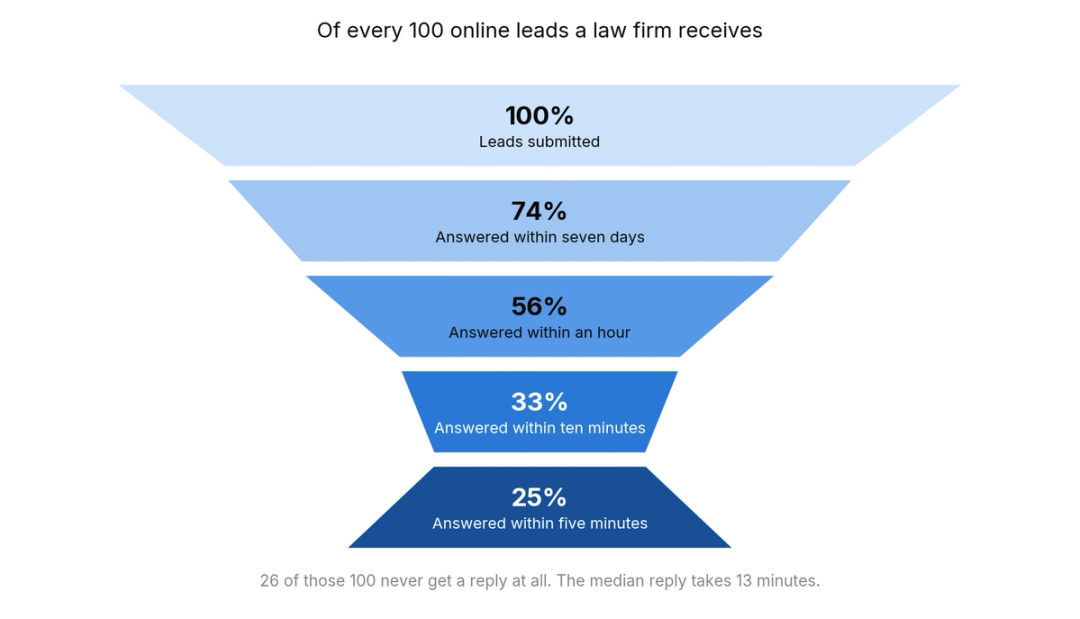
- A quarter of law firms answer an online lead within five minutes, a quarter never answer at all, and the median reply takes 13 minutes.
- Only four of the nineteen vendors reviewed here publish a real price on their own site, and three of those four are the newer AI or per-seat entrants.
- No published research connects legal response speed to signed-case rates, so treat any vendor conversion claim as a testimonial rather than a finding.
- Decide which of the three you are buying before you compare prices, because per-call, per-seat, and per-user rates do not convert into each other.
A quarter of law firms reply to an online lead within five minutes. A quarter never reply at all.
Those figures come from Hennessey Digital's 2025 lead form response time study, which submitted inquiries to 1,333 law firms in the first quarter of 2025. The median firm took 13 minutes.
That spread is the reason legal intake companies exist, and it explains why the category sells so well. It also explains why so many firms buy one and still lose leads, because the number on the invoice and the number on the report measure different things.
Phone coverage tells a similar story. Secret shoppers contacted 500 US firms for Clio's 2024 Legal Trends Report, and as the Illinois Supreme Court Commission on Professionalism records, 40% answered the phone, down from 56% in 2019, while 48% were unreachable by phone entirely.
Three different products share one name
Search for legal intake companies, and the results mix three businesses that do not compete with each other.
| What you are buying | Who does the work | How it prices | Examples |
|---|---|---|---|
| Outsourced intake team | Their staff, on your script | Per minute, per call, or per dedicated seat | Alert Communications, Answering Legal, Legal Intake Professionals |
| Intake software | Your staff, in their system | Per user or per contact record, monthly | Lead Docket, CASEpeer, Lawmatics, Law Ruler |
| AI intake agent | Software, autonomously | Per call or fixed monthly | HelloCounsel, Smith.ai AI, Intaker |
The distinction is not academic. An outsourced team fixes the 9pm call and leaves your intake reporting where it was. Software fixes your reporting and leaves the 9pm call ringing, which is the hidden cost of missed calls in a different shape.
Firms usually discover this after signing. They solve coverage, then find the qualification still inconsistent, or they solve tracking and still have nobody picking up on Saturday.
One vendor selling two of the three makes the price gap visible.
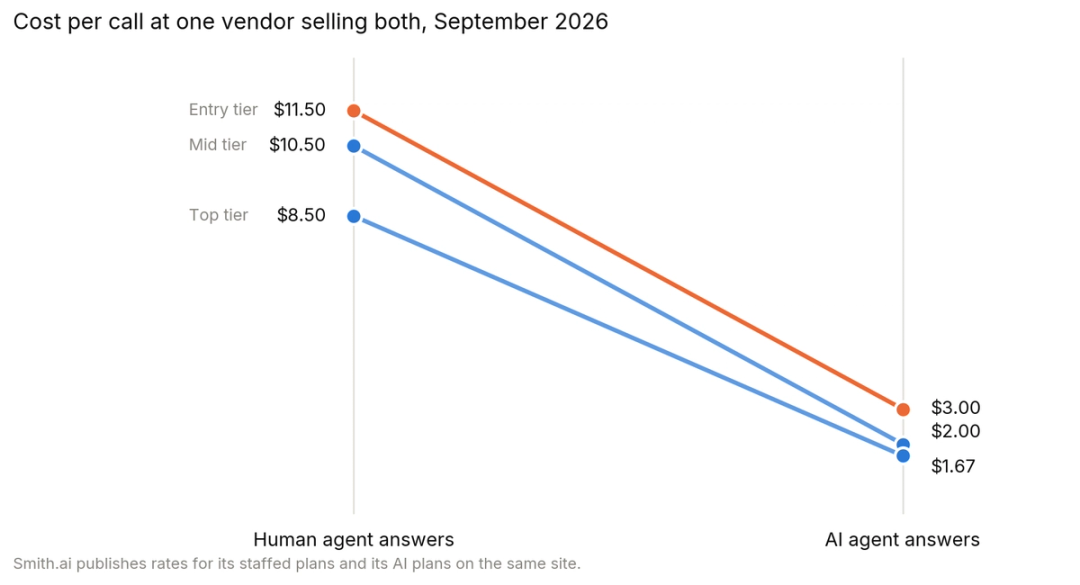
Smith.ai prices a staffed call between $8.50 and $11.50 and an AI call between $1.67 and $3.00. Same company, same site, roughly a fivefold difference. The gap is what a human voice costs, and whether that premium is worth paying depends entirely on which calls you are spending it on.
The 10 best legal intake companies in 2026
| Company | Type | Published pricing | Qualifies to your criteria | Sends a retainer |
|---|---|---|---|---|
| HelloCounsel | AI agent | Fixed monthly from $500 | Yes, against your own criteria | Yes, at case opening |
| Alert Communications | Outsourced team | Quote only | Yes, stated explicitly | Yes, e-signature dispatch |
| Lead Docket | Software | Quote only | Yes, AI lead scoring | Collects retainers and payments |
| Smith.ai | Team and AI agent | $300 to $2,100 staffed, $0 to $500 AI | Configurable scripts | Not published |
| Legal Intake Professionals | Outsourced team | Quote only | Yes, tailored scripts | Yes, sends on your behalf |
| CASEpeer | Software | $90 to $160 per user monthly | Yes, on higher tiers | Yes, e-signature |
| Answering Legal | Outsourced team | Quote only | Trained on legal intake | Not published |
| Intaker | AI agent, chat and text | Quote only | Yes, on case type and urgency | Partial |
| Legal Conversion Center | Outsourced team | Quote only | Customizable scripts | Yes, retainer agreements |
| Legal Soft | Dedicated remote seat | $13 per hour, $2,227 monthly | Yes, to your intake criteria | Not stated |
1. HelloCounsel answers, qualifies, and opens the file
HelloCounsel is our own product.
The agent answers the main line in under two rings at any hour and identifies the caller against the case file before the call is handled. New callers run through your qualification criteria, not a generic script.
What separates it from the rest of this list is the work that starts once a caller qualifies. Case opening starts the moment the fee agreement lands, pulling the crash report, opening the insurance claim, sending the Letter of Representation, and collecting the missing documents.
The same agents then run medical records retrieval, treatment check-ins, and lead follow-up, so intake becomes one stage in a workflow rather than a handoff to a queue. Everything writes back to the matter, with direct integrations to SmartAdvocate, Filevine, Litify, and Lead Docket plus custom builds.
Pricing: from $500 a month, fixed to expected volume with 20% tolerance either way. No per-minute billing, no setup fee, billed by case as an itemized pass-through.
Why choose it: across 30,000 calls and 500 hours of call time, firms working with us have seen a 48% improvement in call reception rates, and onboarding runs one hour with agents live in SmartAdvocate in about a week.
Where it falls short: English and Spanish only, it works inside your case management system rather than replacing it, and firms tracking cases in spreadsheets are not a fit.
Find out where your leads are actually going
Pull last month's inbound and split it by hour. If the calls you lost arrived outside business hours, coverage is your problem. If they arrived at 2pm and still went nowhere, qualification is. Book a demo
2. Alert Communications runs intake through to a signed retainer
Alert staffs human legal intake specialists 24/7 and screens every inquiry against your firm's own case criteria rather than a generic qualification script.
The differentiator sits at the end of the call. Its retainer workflow includes e-signature dispatch and follow-up, moving a qualified caller to a signed agreement without a second conversation.
It connects directly to Clio Grow, Filevine, Lead Docket, and CASEpeer, and runs bilingual specialists overnight and on weekends at no extra charge.
Pricing: not published. Quoted per firm, with a refundable deposit upfront.
Why choose it: mass tort surge capacity and a genuine retainer workflow, backed by a stated 1,000-plus law firm client base.
Where it falls short: no published rates and no independent review base to check the pitch against, since it carries no G2 reviews at all.
3. Lead Docket scores leads before your team touches them
Lead Docket is intake software rather than a service, which means your staff still answer the phone. What it changes is what happens to the lead afterward.
Its Lead Viability feature assesses every lead the moment it opens, so an intake coordinator knows which cases merit a callback first. It collects retainers and payments directly, and syncs with Filevine, its parent company.
Pricing: not published.
Why choose it: the strongest lead-triage tooling in this group, with a client reporting a 49% increase in converted leads.
Where it falls short: nothing here touches the 9pm call, and the integration story is essentially Filevine.
4. Smith.ai sells the staffed and the automated version side by side
Smith.ai is the only vendor here publishing rates for both models, which makes it useful for pricing the trade-off even if you buy elsewhere.
Staffed plans run $300 a month for 30 calls, $810 for 90, and $2,100 for 300, with per-call overage from $8.50 at the top tier up to $11.50 at entry. The AI receptionist starts free at 25 calls a month, then $150 monthly from $2.00 per call and $500 from $1.67.
Coverage is 24/7 on every plan with no after-hours surcharge. Integrations cover Clio Grow, Clio Manage, HubSpot, Salesforce, and several thousand apps through Zapier.
Pricing: published in full, which is rare in this category.
Why choose it: you can run the AI plan and the staffed plan against each other on your own call mix before committing.
Where it falls short: Spanish is a paid add-on at $1.00 per call on the staffed plans, and reviewers on Capterra report agents who fail to follow firm instructions.
5. Legal Intake Professionals builds the script around your case types
Legal Intake Professionals runs a US-based team 24/7/365 on fully tailored scripts and call handling protocols, built to identify and prioritize the matters your firm actually wants.
It sends retainer documents on your behalf, and staffs bilingual specialists fluent in English and Spanish.
Pricing: not published.
Why choose it: script depth and retainer dispatch without the enterprise footprint of the larger vendors.
Where it falls short: no specific case management integration is named, which matters when you ask where the lead record lands.
6. CASEpeer publishes what the software actually costs
CASEpeer is the rare legal software vendor that prints its rate card. Plans run $90, $130, and $160 per user per month, with no setup fees and no long-term contract.
Intake management arrives on the Pro tier. Case grades and the intake investigator portal sit on Advanced, so the qualification tooling most firms want is gated to the top plan.
Pricing: published per user, monthly or annual.
Why choose it: predictable cost and a clean upgrade path for a PI firm already running case management in-house.
Where it falls short: e-signature costs extra on Basic, and the platform answers no calls.
7. Answering Legal trains receptionists on legal calls only
Answering Legal staffs 100% US-based receptionists who work exclusively on law firm calls, trained over months rather than briefed on a script.
The free trial is the strongest reason to shortlist it. Four hundred minutes with no credit card lets you hear the team handle real callers before committing to anything.
Integrations are named and numerous, covering MyCase, Clio, PracticePanther, Smokeball, Lead Docket, Lawmatics, SmartAdvocate, Litify, and Salesforce.
Pricing: quote only, billed per minute, with an average call under three minutes.
Why choose it: legal-only staffing and a real trial period.
Where it falls short: it does not state that it screens against your case criteria, and a Trustpilot reviewer describes agents who were "robotic and not welcoming and couldn't think outside the script."
8. Intaker works the channels the phone misses
Intaker qualifies over chat, text, and Google Local Services messages rather than voice, which makes it a complement to a phone vendor rather than a replacement.
Its agents capture case type, urgency, and location, and one of them replies automatically to Local Services leads, a channel most firms leave sitting overnight.
Pricing: quote only, with no figures anywhere on the site.
Why choose it: the fastest route to covering text and chat leads if your phone is already handled.
Where it falls short: no case management integration is named anywhere on the site, and Spanish capability is not published.
9. Legal Conversion Center pairs intake with contract acquisition
Legal Conversion Center runs a US-based bilingual team around the clock and treats the signed agreement as part of intake rather than a separate step, sending retainers through digital and traditional methods.
Pricing: quote only.
Why choose it: volume experience, with a stated 1,000-plus firms served.
Where it falls short: compatibility is described against any cloud-based case management system without one being named, which is the answer to press hardest during diligence.
10. Legal Soft rents you a dedicated intake seat
Legal Soft is a different purchase from everything above it. Rather than a shared call pool, you get named remote intake specialists at an hourly rate, directed by your team.
Pricing starts at $13 an hour or $2,227 a month full-time, month to month. Specialists pre-qualify against your firm's intake criteria and work inside Clio, Lawmatics, Lead Docket, PracticePanther, Filevine, or MyCase.
Pricing: published, which almost nobody else in the staffing model does.
Why choose it: you get consistent people who learn your case types, rather than whoever picks up.
Where it falls short: coverage hours are not published, so after-hours capability needs confirming before you sign.
What the conversion numbers on vendor sites are worth
Several legal intake companies publish impressive figures. Captorra cites a 27% average increase in new clients, Lead Docket a client reporting 49% more converted leads, and Nexa up to 40% better conversion from text messaging.
Treat all of them as testimonials rather than findings. No published research ties how fast a firm answers to how many cases it signs, which is a genuine gap in the literature rather than an oversight here.
The widely quoted claim that fast responders are twenty-one times more likely to qualify a lead comes from cross-industry sales research conducted in 2007. It did not study law firms, and nothing since has replicated it in a legal setting.
What is verified is narrower and more useful. Martindale-Avvo's State of the Legal Consumer 2026 reports that 47.6% of consumers name responsiveness as a key criterion when choosing a lawyer, and 92.4% research their issue before contacting anyone.
What to measure once the vendor is live
Most firms hire one of these legal intake companies and then grade it on gut feel. Five numbers make the review objective, and any vendor worth keeping will report them without being asked.
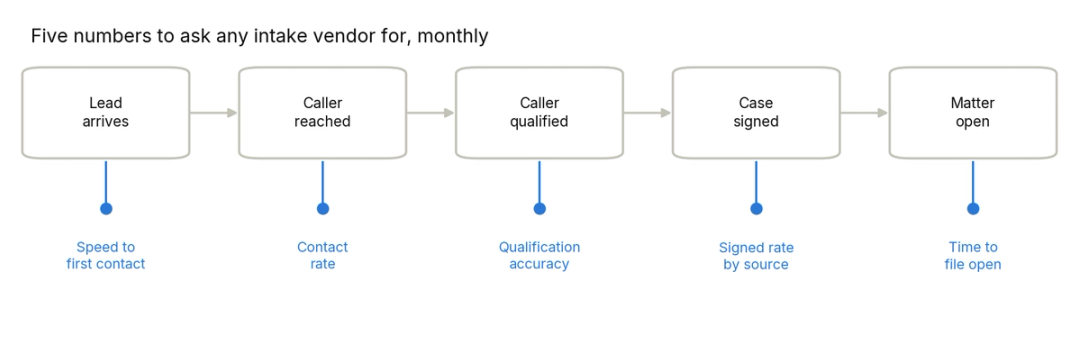
Speed to first contact. Not average handle time. The minutes between the lead arriving and a human or agent reaching the caller, measured separately for business hours and after hours.
Contact rate. The share of leads reached at all. Fast first contact means little if the callback never connects, so track the two numbers together.
Qualification accuracy. Pull ten calls the vendor marked unqualified and listen to them. This is the single most revealing audit available, and it catches the failure reviewers describe most often, where the script the firm designed is not the script that runs.
Signed rate by source. Qualified leads that become signed cases, split by where the lead came from. A drop here with a healthy contact rate points at the handoff rather than the intake, and usually at case manager workload on the receiving end.
Time to file open. How long between signature and an open matter carrying the incident details. Most of the delay sits at the handover between intake and case opening.
Run those five monthly against your own call volume and the vendor conversation stops being about price.
How to choose
Start by naming which of the three products you actually need, because legal intake companies price in units that do not translate. A per-call rate and a per-user rate describe different purchases, and comparing them produces a number that means nothing.
If your losses cluster outside business hours, you need coverage, which is an outsourced team or an AI agent. If your losses happen at 2pm with staff at their desks, you need process, which is software or better scripts.
Then ask the three questions legal intake companies answer least willingly.
- Which case management system do you write into, named rather than described as compatible?
- What happens on the calls you mark unqualified?
- What does month four cost at my real volume, rather than the plan minimum?
Our guide to choosing a phone answering service covers the procurement side.
For the model choice itself, AI receptionist versus virtual receptionist goes deeper on where each one breaks.
Where does this leave you
Legal intake companies are easier to shop once you stop treating them as one market. An outsourced team adds staffed hours, software adds visibility into what happens to each lead, and an AI agent covers both at a lower unit cost with a narrower range of judgment.
For a plaintiff firm, the decision usually turns on where the vendor's responsibility stops. Intake that ends at a qualified lead still hands your team a file to open, and that handover is where the delay accumulates.
See it handle your own intake calls
Bring three recordings, one after-hours new caller, one existing client, one that should have been screened out, and watch an agent work all three with your case management system open. Book a demo
Frequently asked questions
1. What do legal intake companies actually do?
They answer inbound inquiries, screen callers against your case criteria, collect the details a new matter needs, and pass qualified leads to your team. Some also send retainer agreements and open the file.
2. How much do legal intake companies charge?
Published rates range from $90 per user monthly for software to $2,100 monthly for staffed call plans. Most quote instead of publishing. HelloCounsel starts at $500 monthly on a fixed plan.
3. What is the difference between legal intake and an answering service?
An answering service takes a message and routes it. Legal intake qualifies the caller against your case criteria, captures the facts a matter needs, and delivers a lead your team can act on immediately.
4. Should a law firm outsource intake or keep it in-house?
Outsource when losses cluster outside staffed hours or volume swings with marketing spend. Keep it in-house when your case types need judgment; a script cannot carry, and either way run qualification against written criteria rather than instinct.
5. Can an AI agent qualify as a personal injury lead?
Yes. HelloCounsel runs your qualification criteria on the call, captures the incident details, and opens the matter in your case management system, with human escalation available on any flow.
6. How fast should a firm respond to a new lead?
Answering inside the hour already puts a firm ahead of 44% of the market, and a quarter of firms never reply at all. Faster is better, though no legal study quantifies the gain.
Share this article