
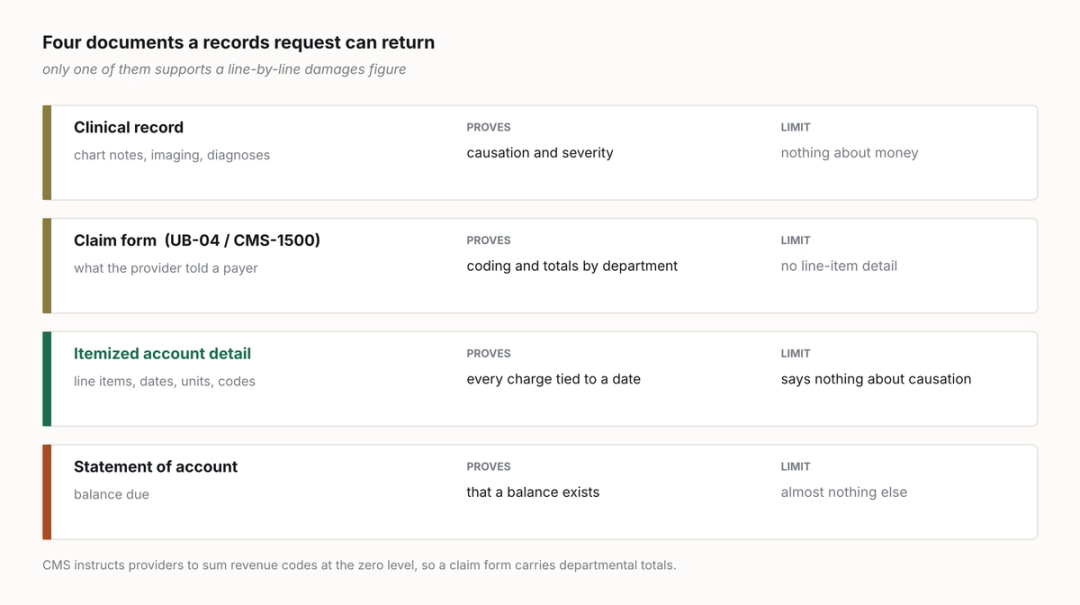
- A UB-04 claim form is an aggregate document. CMS instructs providers to sum revenue codes at the zero level, so the charges field holds totals per department instead of line items.
- Billing records sit inside the HIPAA designated record set at 45 CFR 164.501, named alongside medical records in the same clause.
- A provider may substitute a summary for the records only where the individual agreed to that summary in advance, and agreed to the fee for it.
- One emergency department visit generates a facility claim plus separate professional claims from the physician, the radiologist and anyone else who read or interpreted anything.
- Five different dollar figures describe the same treatment, and they live on four different documents.
- Everything here is indexed by provider, so a firm can only request from a provider it already knows about.
Firms request itemized medical bills and receive four different kinds of document, often without noticing the difference. A claim form, a statement of account, a patient ledger and occasionally the thing they actually wanted.
Which one you hold decides whether a demand package survives an adjuster who wants to call treatment unrelated or excessive. A balance-due figure proves a balance is due. It proves nothing about what was done, on what date, or whether it had anything to do with the collision.
This piece covers what each artifact is, what federal law entitles a client to, and why itemized medical bills behave differently from everything else in a records file.
Four documents, four different jobs
Separating itemized medical bills from the other three matters more than any request-letter wording, because asking for the wrong one produces a compliant response that proves nothing. Only one of the four amounts to itemized medical bills in the sense a damages argument needs.
The clinical record holds chart notes, imaging, diagnoses, and treatment plans. It proves causation and severity and says almost nothing about money.
The claim form is what a provider submitted to a payer. Facility charges travel on a UB-04, professional charges on a CMS-1500, and both describe the encounter in coding terms aimed at reimbursement.
The itemized patient account detail carries line-item charges with dates of service and units, each line carrying its own codes. This is the artifact that supports a damages figure.
The statement of account shows a balance. Firms receive this most often when they ask for a bill, and it is the least useful of the four.
UB-04 and CMS-1500, and why one visit produces both
Two standard claim forms exist, and neither one amounts to itemized medical bills. Knowing which covers what explains a recurring hole in PI billing files.
The CMS-1500 is described by CMS as "the standard claim form used by a non-institutional provider or supplier to bill Medicare carriers." Design and maintenance belong to the National Uniform Claim Committee.
The UB-04 is also called Form CMS-1450. CMS's Medicare Claims Processing Manual calls it "a uniform institutional provider bill suitable for use in billing multiple third party payers," with the National Uniform Billing Committee maintaining the approved coding.
Here is the consequence firms miss. An emergency department visit produces a UB-04 from the hospital for the facility charge and separate CMS-1500 claims from the treating physician, the radiologist who read the films, the anesthesiologist, and the pathologist.
A client who says they went to the hospital has named one of those billing entities. The professional charges arrive as separate bills from names the client has never mentioned, and they surface when a demand package is being assembled around specials that fail to add up.
Revenue codes are not procedure codes
Two coding systems appear on a facility claim, and they answer different questions.
A revenue code is a four-digit NUBC code identifying the department or category of charge, which CMS's manual describes as identifying "specific accommodation and/or ancillary charges." Room and board, pharmacy, laboratory, and radiology each carry their own.
A CPT or HCPCS code identifies the specific procedure or item furnished. On outpatient facility claims the two appear paired, with the revenue code in form locator 42 and the HCPCS code in form locator 44 on the same line.
Reading a facility claim without that distinction produces a familiar error. A reader sees a pharmacy revenue code against a four-figure charge and has no way to tell what was dispensed or how much of it.
Find out which billing artifacts your files actually contain Give us the billing paperwork from one closed matter and we will tell you which of the four you have and which are missing. Have a billing file reviewed
The UB-04 is itself a summary
This is the finding that reorders the whole topic, and it comes from CMS's own instructions to providers.
The Medicare Claims Processing Manual tells providers filling in form locator 42 that "to limit the number of line items on each bill, it should sum revenue codes at the 'zero' level to the extent possible." It also explains that revenue code 0001 replaces any total line, so "the adjacent charges entry in FL 47 is the sum of charges billed."
Read those two instructions together and the UB-04 turns out to be a departmental roll-up by design. Charges arrive summed per revenue code, with a grand total on the 0001 line.
A firm that obtains the UB-04 and believes it now holds itemized medical bills is holding something else. The line-item detail lives in the provider's patient account detail, derived from the chargemaster, which is a separate artifact that has to be requested separately.
The distinction explains a common experience. A paralegal requests billing records, receives a claim form that looks dense and official, then finds at demand time that nothing on it ties a charge to a documented encounter.
What HIPAA actually entitles your client to
Federal law names them in the first clause of the definition.
45 CFR 164.501 defines the designated record set as including "the medical records and billing records about individuals maintained by or for a covered health care provider." Co-equal, in the same sentence.
The access right at 45 CFR 164.524 therefore reaches them. An individual may inspect and obtain a copy of protected health information in a designated record set, and the covered entity must act within 30 days of receiving the request, with one extension available on written notice.
One provision in that section deserves far more use than it gets.
Under 164.524(c)(2)(iii), a covered entity may provide a summary in lieu of access only where two conditions hold. Advance agreement to the summary itself, and advance agreement to any fee charged for it.
A provider that answers a billing records request with a one-line balance-due statement has substituted a summary. Absent advance agreement to that substitution, the regulation does not permit it, and citing the subsection by number changes the conversation with a records department.
Worth keeping the scope straight. This is the individual's right of access, exercised through the client or on a signed authorization, and a request your firm sends under its own letterhead runs on different rules. Our breakdown of how long medical records take covers which deadline attaches to which instrument.
Two statutes worth knowing
Federal law creates no general requirement that an itemized statement contain particular fields. Two provisions come closer than anything else.
For Medicare-paid items, 42 U.S.C. 1395b-7(b) lets an individual submit a written request to a provider or supplier for an itemized statement describing each item or service furnished. The recipient has 30 days, a knowing failure carries a civil money penalty of up to $100 per failure, and the individual may ask the Secretary to review the statement within 90 days.
That right attaches to items Medicare paid for, so it reaches cases with a Medicare lien and older claimants and leaves everyone else outside it.
Texas went further. Health and Safety Code chapter 185, effective September 2023, requires a facility requesting payment from a patient to submit a written itemized bill of the alleged cost of each service and supply.
The content requirement is where it earns attention. The bill must include a plain language description of each service, any billing code submitted to a third party alongside "the amounts billed to and paid by that third party," and the amount alleged due from the patient.
A state statute therefore mandates disclosure of the exact billed-versus-paid spread that drives the damages fight, and bars debt collection where the provider has failed to comply. Other states legislate in this area differently, so check your own before relying on the pattern.
What the No Surprises Act does not do
Good faith estimate rules get cited in itemized-bill discussions and they answer a different question.
45 CFR 149.610 sets requirements for good faith estimates of expected charges "for uninsured (or self-pay) individuals," issued "upon request or upon scheduling an item or service."
Three limits make it the wrong tool for a PI file. Estimates are prospective and cover scheduled or requested services, leaving treatment already rendered untouched.
Coverage reaches uninsured or self-pay individuals only, and the content specification lists CPT, HCPCS, DRG and NDC codes without revenue codes.
One wrinkle does apply. Clients treating under a letter of protection may count as self-pay, since the definition reaches people holding coverage who choose against submitting a claim. That opens the estimate right on treatment still to come.
Five numbers, four documents
Damages arguments turn on which dollar figure a jurisdiction lets you claim, and itemized medical bills carry only the first of the five.
| Number | What it represents | Where it appears |
|---|---|---|
| Billed charge | The provider's gross charge drawn from the chargemaster | Itemized account detail, claim form |
| Allowed amount | What the payer's contract permits | Remittance advice, explanation of benefits |
| Paid amount | What the payer actually sent | Remittance advice |
| Write-off | The difference the provider contractually absorbs | Remittance advice, account ledger |
| Outstanding balance | What remains against the patient | Provider ledger, lien notice |
Those five numbers sit across four documents, and a statement of account carries one of them. Whether billed or paid governs recoverable specials varies by state and has generated substantial case law, which the Matthiesen Wickert and Lehrer survey of write-offs and the collateral source rule covers at length.
Work out which of the five numbers your files support
Send us the billing documents from an open matter and we will map what you have against what a damages argument needs. Map your damages documentation
Requesting the right artifacts
Request letters usually ask for medical records and itemized medical bills, which invites a records department to send whichever it finds easiest.
Name the artifacts instead. Itemized patient account detail showing dates of service, units, revenue codes and CPT or HCPCS codes for each line.
All UB-04 or CMS-1450 and CMS-1500 claim forms submitted on the account. All remittance advices and explanations of benefits, plus the current account ledger showing adjustments and write-offs.
Name each of the four separately, because a request for billing records produces a statement of account more often than anything else.
Where a summary arrives in place of itemized medical bills, cite 164.524(c)(2)(iii) and ask whether the client agreed in advance to that substitution and to its fee. Records departments understand that provision even when billing departments have never heard of it.
Why completeness is decided at intake
Everything above shares one property. Each artifact sits with a specific provider, and the access right runs per covered entity.
No central index of a claimant's itemized medical bills exists. Requests go to providers a firm already knows about, which makes the provider list the limiting factor on the entire billing picture.
That list comes from the intake call. A client who names four facilities after attending seven produces three provider accounts nobody requests, and the professional-side claims from each encounter go unrequested along with them.
Retrieval speed does nothing about this. A vendor with a fifty-state network will execute requests against the list it was given, which means a fast route to the same discount at demand time.
How HelloCounsel handles the upstream half
HelloCounsel sells intake software and no retrieval or billing product, so read this as a description of design choices.
Our intake agent asks for facilities instead of physicians, then follows any named doctor with a question about where that doctor practices, because institutions hold records and clients name people.
Emergency department visits get a follow-up question about who else was involved, since clinicians bill under their own names and clients rarely volunteer them.
Payment questions sit in the script as well. Who sent a bill, what was paid out of pocket, whether any provider is treating on a letter of protection, and whether Medicare or Medicaid is involved, since each one changes which documents matter.
All of it writes to the case management system as structured fields, covered in our note on CMS write-back.
What to do with this
Pull one closed file and check which of the four artifacts it holds, starting with whether itemized medical bills are among them. Claim forms and statements turn up in most files, with no itemized account detail among them.
Then compare the provider list on that file against the encounters in the clinical record, since itemized medical bills exist for every biller the list omits. Professional-side billers who treated the client without appearing on the provider list are the recurring absence, and they trace to intake instead of retrieval.
Fixing the request letter helps once. Fixing the first call helps on every matter after it.
Bring us a demand package that came in light
Tell us about a matter where the specials fell short and we will trace whether the documents or the provider list caused it. Talk to the HelloCounsel founders
Frequently asked questions
1. Are billing records part of the medical record under HIPAA?
Yes. The regulation lists them beside clinical records when it defines what a provider holds about a patient, which is what brings them inside the access right.
2. Is a UB-04 an itemized bill?
No, and this catches firms out. Providers are asked to roll charges up by department when they complete the form, so what arrives is a set of category totals. Line-item detail comes from a different document that has to be asked for by name.
3. What is the difference between a revenue code and a CPT code?
One names the department that generated a charge, the other names what was actually done. They occupy adjacent fields on a facility claim and appear together on outpatient lines, so neither answers the other's question.
4. Can a provider send a summary instead of the records?
Only with advance agreement from the patient, covering both the substitution and whatever it costs. Section 164.524(c)(2)(iii) sets that condition, and a balance-due statement arriving unrequested fails it.
5. Does the No Surprises Act give my client a right to an itemized bill?
It does not. Those estimates look forward at care being scheduled, and they reach people paying their own way. Neither condition fits a claimant documenting treatment already received, though a client on a letter of protection may qualify for estimates on care still to come.
6. Why do we get bills from doctors the client never mentioned?
Hospitals bill for the room and the equipment. Everyone who treated or interpreted anything during that visit bills separately under their own name. Clients recall the building, so the individual clinicians show up weeks later as unexplained invoices.
Share this article