How to Reduce Missed Calls at Your Law Firm

- Work out how to reduce missed calls by separating the four events the phrase covers, because a caller who hung up waiting and a caller who reached voicemail at 9pm need different fixes.
- Your phone system already holds the hourly and weekday breakdown that tells you when calls go unanswered, and almost nobody pulls it before buying anything.
- Erlang C says a firm taking 20 calls in its peak hour needs four people to answer 84% of them within 20 seconds, and the fifth person buys only ten points more.
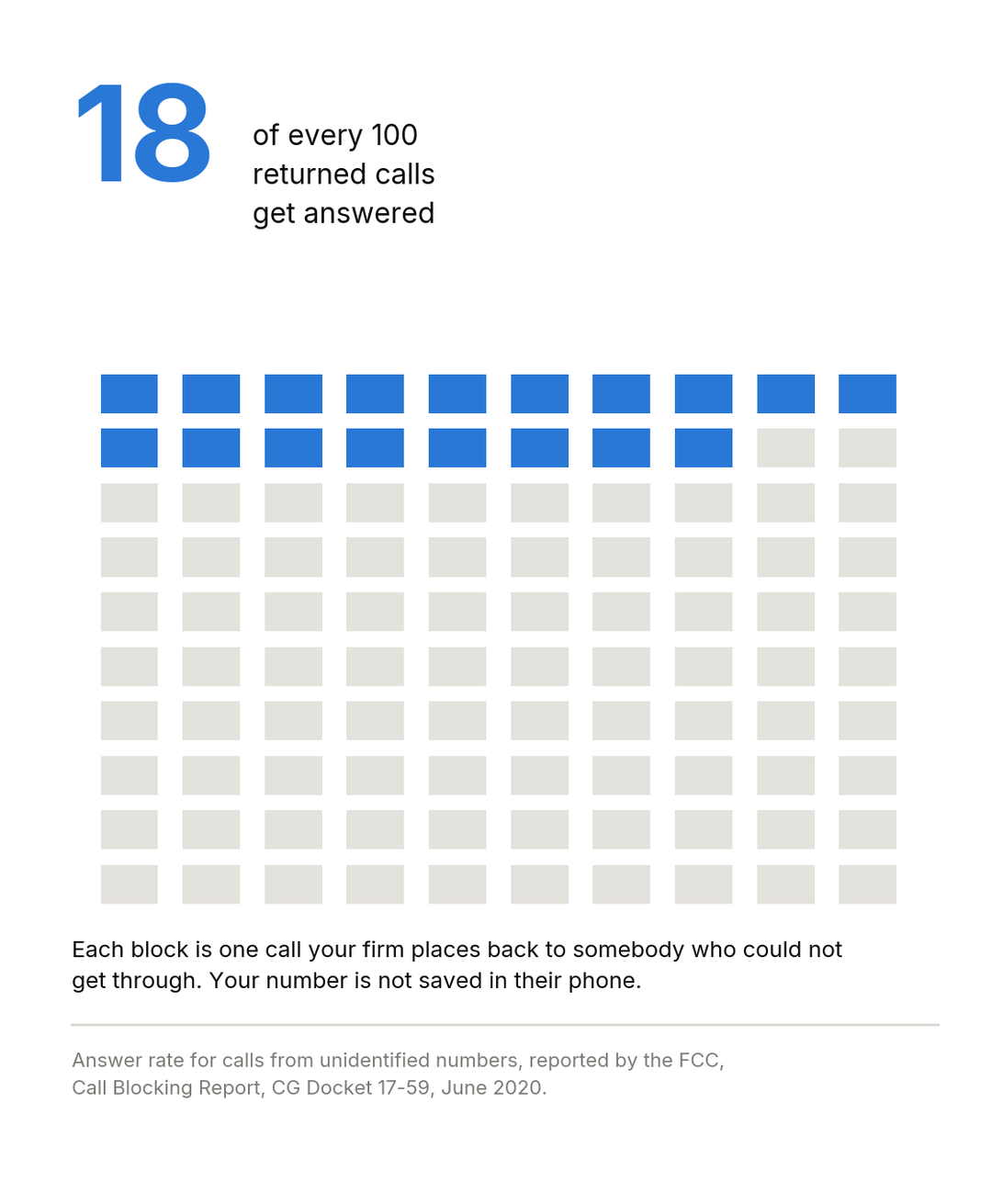
- The FCC reports that calls from numbers a recipient has not saved get answered 18% of the time, which is what a callback to a missed lead actually faces.
- Set the target as the answer rate within a defined number of seconds, measure it before and after, and treat anything you cannot measure as a claim rather than a result.
Every firm knows it misses calls. Very few can say how many, at what hours, or what happens to the people on the other end afterwards, which is why how to reduce missed calls is usually answered by buying something rather than by measuring anything.
That gap matters because how to reduce missed calls depends entirely on the answer. A firm losing calls at 1pm on Tuesdays has a capacity problem, and a firm losing them at 9pm has a coverage problem.
A firm whose callers hang up after forty seconds in a queue has neither, and buying more coverage will not move its number at all.
Before any of that can be diagnosed, though, there is a definitional problem in the way, and it is the reason most firms cannot measure this even when they try.
Four different things get called a missed call
Anyone asking how to reduce missed calls is asking about at least four separate events, and phone systems report them under different labels.
A call can ring out to voicemail because nobody picked up. A caller can enter a queue and hang up before anyone answers, which the literature on call centers calls abandonment.
A caller can reach voicemail and leave a message. Or a caller can reach voicemail, leave nothing, and go elsewhere.
Those are not degrees of the same problem. Abandonment means somebody was answering, just not fast enough, so the fix is speed or headcount at that hour, while a ring-out means nobody was available at all and the fix is coverage.
A voicemail left is a lead you still have. A voicemail not left is a lead you never knew about, and it will not appear in any report your intake team reviews.
The distinction matters enough that it is standard in the operations research on call centers. Brown and colleagues, writing in the Journal of the American Statistical Association in 2005, record three data points for every queued call: when it entered the queue, when it left, and whether it left by being served or by abandoning. In the center they studied, about 80% of callers were served and about 20% abandoned before anyone reached them.
Your phone system records the same distinction. The question is whether anyone at the firm has ever asked it for the split.
The labels vary by platform, which is part of why nobody does. One system calls an abandoned call "caller hung up", another files it under "missed", and a third folds it into the same bucket as calls that rang out overnight. Find out which label your own system uses for each of the four events before you trust any number it gives you.
The one that hides best is the voicemail nobody left. It appears in a call report as a completed call, because the system did what it was asked to do, and it appears nowhere at all in the intake queue your team works from.
What your call log shows when you break it down by hour
The data you need already exists inside your phone system. Pull the last 90 days of inbound calls and group them three ways: by hour of day, by day of week, and by whether the call was answered, abandoned or rang out.
Three patterns show up in plaintiff firms often enough to look for specifically. The first is a midday trough, where calls peak at the same hours your case managers are on other calls.
The second is a Monday spike, which is the weekend's accidents arriving at once. The third is the after-hours band, where the answer rate is not low but zero.
Each of those carries a different cost. The midday trough loses calls from people who will probably ring back because they are mostly existing clients with a reason to persist.
The after-hours band loses new claimants who have no relationship with your firm and a list of other firms to try. Our breakdown of what missed calls cost a PI firm runs the revenue arithmetic on that difference.
Run one more cut while you have the data open. Separate first-time callers from numbers already in your system, because the two groups behave differently and are worth different amounts. An existing client who cannot get through will try again, and a new claimant usually will not.
The exercise takes an afternoon, and it changes what you buy. A firm that discovers its losses are concentrated between 11am and 2pm does not need an after-hours service, and a firm that discovers the opposite does not need more daytime staff.
Undocumented early contact compounds the problem, since a caller nobody logged is a caller nobody follows up. That is one of the ways firms lose cases before they sign them.
Once you know which hours you are losing calls in, the next question is arithmetic: how many people would it actually take to answer them.
The staffing arithmetic almost nobody runs
Call centers have modeled this problem for a century, and law firms have generally not borrowed the model.
The standard approach is Erlang C, which the operations literature also calls M/M/N. As Robbins put it in a 2019 paper for the International Journal of Applied Science and Technology call centers "are typically modeled using the M/M/N queuing model, or in industry standard terminology, the Erlang C model." It takes your call arrival rate, your average handling time, and the number of people answering and returns the share of calls answered within a given number of seconds.
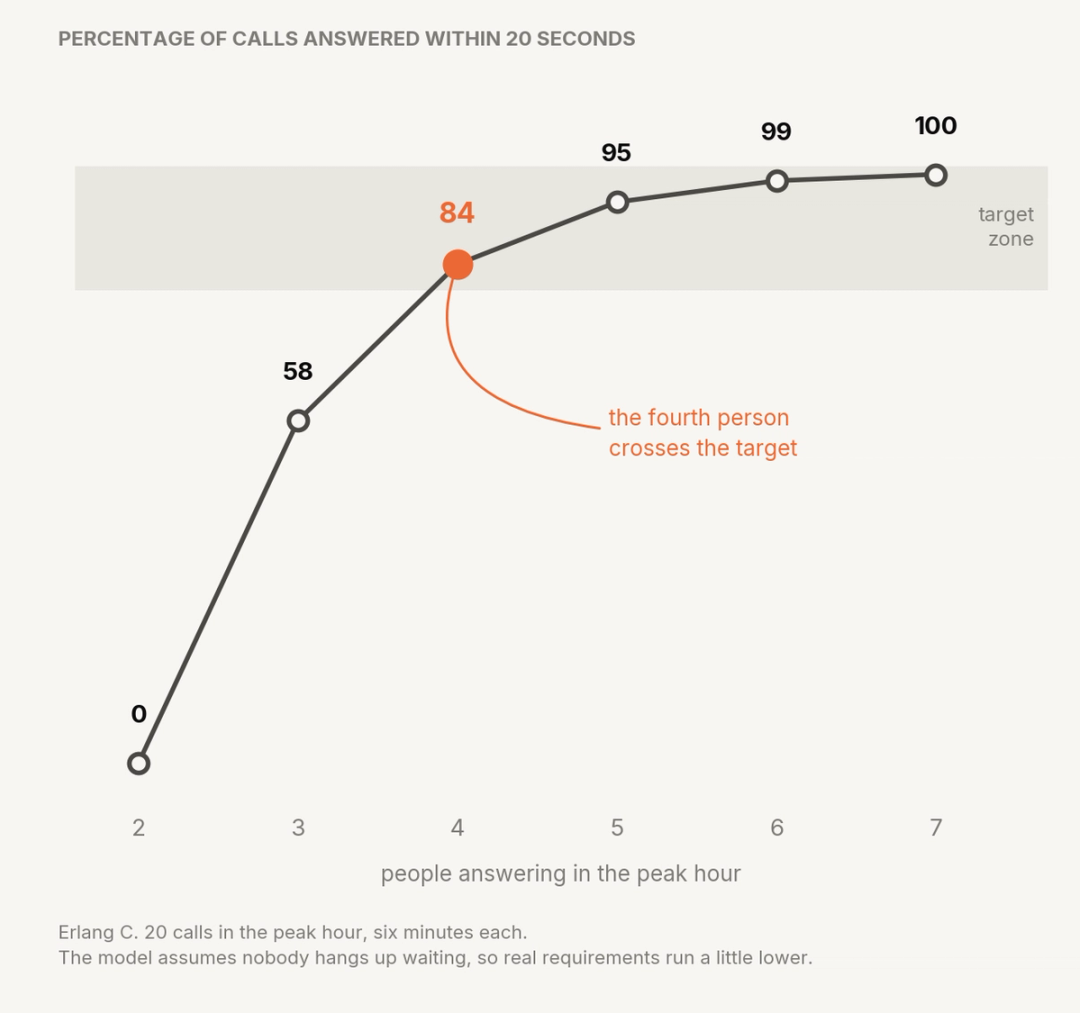
Run it on a firm handling 20 calls in its busiest hour at six minutes a call. Two people cannot hold that hour at all, and three answer 58% of calls within 20 seconds.
The fourth takes it to 84%. The fifth takes it to 95%, and the sixth to 99%.
Read that as money and the shape of the problem changes. The Bureau of Labor Statistics puts the median receptionist wage at $18.27 an hour, or $38,010 a year, as of May 2025.
The fourth person on that line buys 26 percentage points for roughly $38,000. The fifth buys ten more for the same money, and the sixth buys four.
One honest caveat belongs here, because it cuts against the model. Erlang C assumes nobody hangs up while waiting, which is why Brown and colleagues describe the refinement that allows for abandonment as a separate model. Real staffing requirements usually come in slightly below what Erlang C suggests, so treat the curve as an upper bound rather than a quote.
The practical conclusion is the same either way. Covering a peak hour properly costs real headcount, and covering every hour of the week costs several times that. Which is why most firms do not try, and rely instead on calling people back.
Why the callback rarely lands
The callback is the recovery plan almost every firm assumes it has. It is considerably weaker than it looks, and the reason has nothing to do with how quickly your team dials.
When your firm returns a missed call, your number is not in that person's phone. The FCC's June 2020 report on call blocking sets out what happens to calls in that position.
Drawing on industry data, it records that people answer 71% of calls from numbers saved in their contacts and 65% from numbers identified as a business, but only 18% of calls from unidentified numbers and 9% of calls marked as spam. The report opens by noting that many consumers have simply stopped answering their phones because of the volume of unwanted calls.
Pew Research Center found the same behavior from the other direction. In a survey of 10,211 US adults conducted in July 2020, eight in ten said they do not generally answer their cellphone when an unknown number calls. Two-thirds said they would check a voicemail if one was left, and 14% said they ignore the voicemail too.
Put those together and the recovery path a firm is counting on looks thin. Of 100 returned calls to missed leads, something close to 18 get picked up. Of the rest, a voicemail reaches two-thirds of those who received one, and a plaintiff who called three firms on the day of an accident has usually signed with one of them by the time your second attempt goes out.
Speed does not rescue this either, though it helps. Writing in Harvard Business Review in 2011, Oldroyd, McElheran and Elkington audited 2,241 US companies and found that 23% never responded to a test lead at all, while the average response among those that did took 42 hours. Across 1.25 million leads they found firms making contact within an hour were nearly seven times as likely to qualify the lead as those trying an hour later, and more than sixty times as likely as those waiting a day.
One correction is worth making here, because the error is everywhere. The widely repeated claim that responding within five minutes makes a firm 21 times more likely to qualify a lead does not come from that study. It comes from vendor research, and the Harvard figures are the seven-fold and sixty-fold ones above.
Either way the direction holds, and it compounds the problem rather than solving it. Fast callbacks beat slow ones, but they are still callbacks from an unsaved number, and that changes what reducing missed calls has to mean. If recovery is weak, the number has to move at the moment the call arrives rather than afterwards.
Where the three fixes actually apply
Calls get lost at three points, and each one has a different remedy. Matching the remedy to the point is most of how to reduce missed calls without wasting money, and firms get this wrong often enough that it is worth taking one at a time.
Lost before anyone picks up. This is abandonment, and it is a speed problem rather than a coverage one. Shortening the queue is the fix: fewer menu layers before a human, a shorter ring group, and routing that does not send every caller to the same overloaded extension first.
Two specifics are worth checking. Count the keypresses between dialling and reaching a person, because each layer of menu sheds callers who are in pain and holding a phone in one hand. Then check how many extensions a call passes through before it is answered, since a caller who hears four rings, a transfer, and four more rings has waited longer than the log suggests.
Check your average time to answer during the hours you identified. If it exceeds about 30 seconds, you will keep losing callers regardless of how many people you hire.
Lost because nobody was available. This is capacity during staffed hours, and the Erlang curve above prices it. The honest options are more people at the peak, moving non-call work off the people answering, or handing the overflow to something that does not queue. Our guide to reducing case manager workload covers the second of those.
Lost because the office was closed. This is pure coverage and the simplest of the three to fix, because anything that answers beats voicemail. It is also where the loss is most expensive, since after-hours callers are disproportionately new claimants rather than existing clients checking a status.
What answers matters as much as whether anything does. Our guide to choosing a phone answering service covers what each model can finish on the call.
Firms usually apply the wrong remedy to the first of these. Adding staff to fix an abandonment problem raises cost without moving the number, because callers were hanging up on the wait rather than on the absence of a person. That is also the failure most likely to look like a solved problem in a report, which is why the measurement below matters more than the tactic.
Price the coverage before you commit to headcount
Send us your peak hour volume and your average call length and we will run the same curve against your firm, including what full coverage costs against an extra person on the payroll. Get your coverage math
What to measure before and after
A fix you cannot measure is a claim, and how to reduce missed calls is a subject where claims are easy to make.
Three numbers cover it. The first is answer rate against a stated time threshold, which is the industry's own standard and far more useful than a raw count of answered calls.
The second is abandonment rate, kept separate from ring-outs so you can tell the two failures apart. The third is after-hours answer rate on its own line, since averaging it into the daytime figure hides the problem that costs most.
Take the baseline before anything changes, from the same 90-day pull, because how to reduce missed calls is only answerable against a number you recorded first. Take it again 30 days after, from the same report. Any comparison drawn from different reports or different periods will be argued about rather than acted on.
Attorney at Work makes one further recommendation that no dashboard replaces, which is to listen to your own calls. Reading a report tells you the answer rate. Listening tells you what happened on the calls that were answered, which is often where a second and larger problem is sitting.
With the baseline in place, the question becomes what kind of coverage is worth buying against it.
Where an always-on line changes the arithmetic
HelloCounsel is our own product, so this section describes what it does to the numbers above rather than arguing it fits every firm.
Counsel answers the main line in under two rings at any hour, which removes the after-hours band and the peak-hour queue at the same time, because software does not form a queue in the way a three-person ring group does. The Erlang curve stops applying, since the constraint it models is the number of people available.
It also changes what happens to the calls that would have become callbacks. A caller who reaches an agent on the first attempt never enters the 18% problem above, which is the largest single effect and the hardest one to get from staffing alone.
Every call writes back to the case management system as a structured record with the transcript attached, so the answer rate you measure afterwards comes from your own system rather than a vendor dashboard. For the documentation side of that, our explainer on CMS write-back covers what the record has to carry.
Pricing is fixed monthly at $500, scoped to expected volume with 20% tolerance either way, with no per-minute billing and no setup fee. Direct integrations cover SmartAdvocate, Filevine, Litify, Lead Docket, and Clio, with custom builds for other systems. Across 25,000 calls and 500 hours of call time, firms working with HelloCounsel have seen a 48% improvement in call reception rates.
The limits are worth stating. It covers English and Spanish and stops there; it runs inside your case management system rather than replacing it, and firms tracking cases in spreadsheets are not a fit.
Setting a target you can hold
The last decision is what number you are actually aiming at, and most firms never set one.
Pick an answer rate and a threshold together, since one without the other means nothing, and the pair is what turns how to reduce missed calls into a question with a yes or no answer. Eighty percent of calls answered within 20 seconds is the convention call centers use and a reasonable place for a plaintiff firm to start. Write it down, because a target nobody recorded is a target nobody is accountable to.
Then decide the hours it applies to. A firm that holds 80% between 9am and 6pm and zero overnight has a coverage decision to make, not a staffing failure to fix, and separating those two conversations keeps the second one honest.
Review it against the same three numbers each quarter, and treat any month where the target slips without an obvious cause as a signal to pull the hourly breakdown again. Call patterns move with marketing spend, and how many calls a PI case generates explains why the volume climbs as the caseload does.
Send us a week of your call log
We will come back with your answer rate by hour, where the abandonment sits, and a fixed monthly price for covering the hours you are losing. Book a working session with the founders
Frequently asked questions
1. What counts as a missed call?
Four different things do: a call that rang out to voicemail, a caller who abandoned the queue before being answered, a voicemail left, and a voicemail not left. Phone systems report them separately, and the fixes differ.
2. What is a good answer rate for a law firm?
Eighty percent inside 20 seconds is the standard call center work too. What matters more is setting a threshold at all, since a rate with no time attached can be met by answering slowly.
3. How many people does it take to answer a busy hour?
On Erlang C, twenty calls an hour at six minutes each takes four people to clear 84% inside 20 seconds. The fifth adds ten points, and the sixth adds four.
4. Does calling people back recover the lead?
Rarely. The FCC reports an 18% answer rate for calls from numbers the recipient has not saved, and a new claimant who called several firms has usually signed elsewhere before a second attempt.
5. Should a firm fix daytime or after-hours first?
Whichever the call log says is losing more new claimants. After-hours losses skew toward new callers and daytime losses toward existing clients, so the same raw count carries different value.
6. How long before a change shows up in the numbers?
Thirty days on the same report you used for the baseline. Comparing across different reports or periods produces an argument rather than an answer.
Share this article