How to Choose a Legal Answering Service Before Switching Providers

- When your firm already has a provider, choosing a new legal answering service starts with the calls the current one mishandles, so list those failures first and test every new vendor against them.
- Request your call recordings, transcripts, call logs, scripts, and contract terms in writing before giving notice, since recordings in original format can belong in the client file you owe a client under the ethics rules.
- Read the notice period, auto-renewal date, and data-return clause in the current contract before signing a new one, so the two agreements overlap by days instead of months.
- Keep your published phone number by forwarding calls to the new provider or porting the number, and never cancel the old service before the new one answers live.
- Run both providers in parallel for at least a week, with the new one taking after-hours calls first, and cancel the old service only after the first two weeks of numbers look right.
Switching legal answering services is a different decision from choosing one for the first time. A firm that already has a provider knows exactly which calls go wrong, and it also has recordings, call logs, scripts, and a contract that all need handling before anyone forwards a phone line. The difficulty is that the selection and the transition run at the same time, and mistakes in the transition reach clients before the new provider has answered a single call.
You have probably watched this happen with a provider you outgrew. Messages arrived without a matter name; existing clients asked for their case manager and got a callback. slip, the invoice crept up with every campaign, and the intake script still asked questions the firm stopped using a year ago.
Each of those failures is a specification for the next provider. Knowing how to choose a legal answering service the second time means turning them into test calls, contract questions, and a switch plan, in that order, so the new service fixes what the old one missed without dropping calls in between.
What signs show a law firm has outgrown its current answering service?
The clearest signs show up in the work the service leaves behind. When case managers spend the first hour of each morning turning overnight messages into case notes, or when the same client calls back twice because the first message never reached her case manager, the service has stopped matching how the firm runs.
1. Messages don't reach the matter: Notes arrive by email or in a vendor portal, and someone at the firm retypes them into the case management system.
2. Existing clients get callback slips: The service can't see the matter, so every client question turns into a callback for the case manager.
3. Transfers fail during the day: Warm transfers ring through to staff who are already on calls, and callers end up in voicemail.
4. The bill rises with volume: Per-call or per-minute charges climb in campaign months, which is when the firm is already paying for the media that drove the calls.
5. After-hours quality drops: Night and weekend calls get shorter screenings, fewer Spanish-speaking agents, or longer rings than daytime calls.
Write down which of these apply and pull three recent examples of each from the call log. That list does most of the work in deciding how to choose a legal answering service that fits the firm better than the last one. The examples become the test calls for every vendor you consider, and the documentation gap in particular is the one we trace in why your PI answering service is creating a documentation problem.
Growth can be the trigger even when nothing else has failed. A firm that has added a mass tort docket, a second office, or a TV campaign can outgrow a plan sized for half its current volume, and the overage charges show up before anyone notices the shorter screenings.
The list also prevents a switch that only changes the price. A new provider that is cheaper but still sends emailed messages fixes the invoice and leaves the morning retyping in place, so the failures you list decide what the new service has to do differently.
What should a firm collect from its current provider before giving notice?
The current provider holds months or years of your firm's calls, and some of that material belongs in client files. Request it in writing while the relationship is still active and the vendor still has a reason to respond quickly.
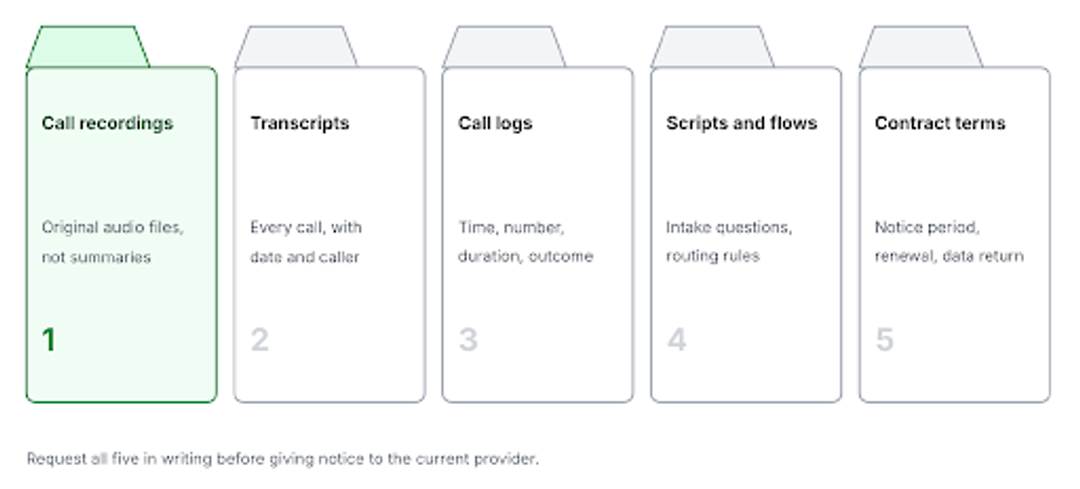
Recordings deserve the most attention. ABA Formal Opinion 471, issued in 2015, explains that Model Rule 1.16(d) requires a lawyer to surrender the materials a client needs when a representation ends.
State bars have applied the same duty to electronic records. The North Carolina State Bar's 2013 Formal Ethics Opinion 15 says a video recording "must be provided to the client in its original format."
A call recording of a client describing her accident can become part of that file, so ask the vendor to export recordings as audio files, not summaries or transcripts alone. Ask how long the vendor keeps recordings after the contract ends and how it deletes them, since Model Rule 1.6(c) asks a lawyer to make reasonable efforts to prevent unauthorized access to client information.
The scripts matter for a different reason. Your intake questions, routing rules, and escalation lists took years to refine, and the new provider will rebuild them faster from the current versions than from memory.
Which contract terms decide when a firm can switch answering services?
The current contract sets the earliest date you can leave without paying twice. Find the agreement before shortlisting vendors, since the notice period often decides when the new service has to go live.
| Contract term | What to look for | Why it matters for the switch |
|---|---|---|
| Notice period | Days of written notice required to cancel | Sets the latest date to give notice before the next billing cycle |
| Auto-renewal | Whether the term renews automatically and on what date | A missed renewal date can commit the firm to another full term. |
| Early termination fee | Any fee for leaving before the term ends | Belongs in the cost comparison with the new provider |
| Data return | Whether recordings, transcripts and logs are returned, and in what format | Decides what the firm gets back for client files |
| Retention and deletion | How long the vendor keeps call data after termination | Bears on confidentiality once the relationship ends |
| Number ownership | Whether any phone numbers belong to the vendor | Decides whether published numbers can move with the firm |
The same terms belong in the new contract, which is part of how to choose a legal answering service you won't need to replace at renewal. Ask the new vendor for its notice period, renewal terms, data-return format, and retention policy before signing so the next switch, if there is one, starts from a clear agreement.
Month-to-month plans make the timing simple, while annual terms with auto-renewal need a calendar entry for the notice deadline. If the contract is silent on data return, put the request in writing now and keep the vendor's reply with the contract.
Outsourcing rules apply to the new contract too. ABA Formal Opinion 08-451 applies the supervision duties in Model Rules 5.1 and 5.3 to outside providers and calls written confidentiality agreements strongly advisable, so the new agreement should cover confidentiality, recording access, and data return from the start.
Should a firm port its phone number or forward calls to the new provider?
The firm's published number is on its website, its TV spots, its billboards, and every client's phone, so it has to keep working through the switch. There are two ways to point it at the new provider, and the right one depends on who controls the number today.
| Method | How it works | When it fits |
|---|---|---|
| Call forwarding | Your carrier keeps the number and forwards calls to the new provider on busy, no answer, or a schedule. | The firm's own carrier holds the number, which is the usual setup. |
| Number porting | The number moves from one carrier to another. | The current answering service or a vendor-supplied line holds the number. |
Forwarding is the simpler path when the firm's own phone carrier holds the number, since the switch is a change to the forwarding destination. Porting matters when the number sits on an account with the answering service or a tracking-number vendor, and the number-ownership clause in that contract decides whether the firm can move it.
When the firm is the customer of record, the federal porting rules apply. Under 47 CFR 52.35, carriers must complete a simple port within one business day unless the customer or the new provider asks for longer.
The FCC's consumer guide on porting adds that the old company can't refuse to port a number because of an unpaid balance, though any early termination fees remain owed, and warns not to cancel the old service before starting the new one.
That last point is the one that causes outages. Cancelling the old service first can release the number before the port completes, so start the port or the new forwarding rule while both services are active.
See how calls move to a new provider
Walk through how HelloCounsel takes over a firm's main number, from forwarding rules to the first answered call, in a live demo. Schedule a switchover walkthrough
Should a firm switch to another human answering service or to an AI agent?
A switch is the natural moment to reconsider the model, not only the vendor. If the failures on your list are about agent quality, such as rushed screenings or an agent who mispronounces the firm's name, another human service with better training may fix them.
If the failures are structural, a different human service will likely repeat them. Messages that never reach the matter, existing clients who get callback slips and bills that climb with volume come from how message-taking services work, so the comparison is worth running is between a human service and an AI agent that works inside the case file, which our guide to AI vs. live answering services for law firms sets out.
Either way, how to choose a legal answering service comes down to the same evidence: the test calls built from your own failures, scored on what reaches your team. The model that passes those calls is the one to shortlist.
How to choose a legal answering service that fixes what the old one missed
With the failures listed and the records requested, the vendor comparison gets specific. Our general guide on how to choose a phone answering service as a law firm covers service models and baseline criteria, so this stage focuses on the calls the current provider handles badly.
Run the same test calls on every shortlisted vendor, built from the examples you pulled from your own log. Include at least one new lead after hours, one existing client asking about her case, one adjuster asking about records, and one Spanish-speaking caller, then score what reaches your team and how long it takes.
Match each failure to a question the vendor has to answer in writing. If messages never reached the matter, ask how each call gets into your case management system, and ask to see a completed call in the case file, which is what CMS write-back looks like in practice.
The other failures need their own questions. If transfers failed, ask what happens when the staff member is already on a call, and if the bill rose with campaigns, ask how the price changes in a month with twice the usual calls.
Ask for references from plaintiff firms that switched to the vendor from another service. A firm that has been through the move can tell you how long scripts took to rebuild, how the first two weeks went, and whether the problems that drove the switch actually went away.
Our list of the best legal answering services for PI firms gives a starting shortlist. Narrow it with the test calls rather than the feature lists, since vendor feature lists overlap heavily and the differences show up on your hardest calls.
Price belongs in the comparison, though it shouldn't lead it. Our breakdown of legal answering service costs shows how per-call, per-minute, and flat monthly plans compare, and the total should include any early termination fee on the old contract and the staff hours the new service would save or add.
How should a firm run the switch without a gap in coverage?
A switch fails when one service stops before the other starts. A runway of about two months, from collecting records to cancelling the old service, gives enough time to test, configure, and run both services side by side.
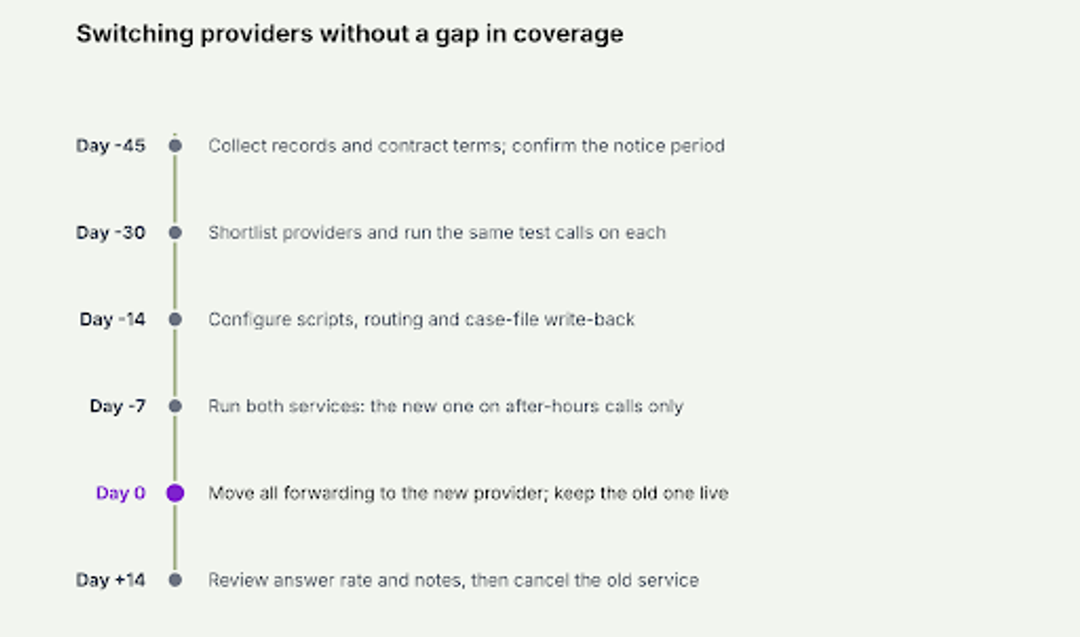
The parallel week does the most to protect callers. Send after-hours calls to the new provider first while the old one keeps business hours, review the new provider's notes each morning against what your team would have written, and fix the script before moving the daytime calls.
Freeze the intake script for the parallel week. Changing questions while two services run makes it impossible to tell whether a problem comes from the new provider or the new script, so collect script changes in a list and make them after the daytime cutover.
Callers should hear the same firm either way. Give the new provider the exact greeting, the attorney names, and the phrases the firm avoids, so a client who calls on Monday and again on Thursday doesn't notice the change.
Tell staff before the change and give them one place to report problems. Case managers notice first when a client mentions a strange call or a message arrives in the wrong format, and a shared log of those reports gives the firm specific items to raise with the new provider during the first two weeks.
Keep the old service live until the numbers hold. Cancel only after the new provider has met your answer standard for two weeks, the notes are landing where your team works, and the records you requested from the old provider have arrived and been filed.
HelloCounsel replaces message-taking with calls finished inside the case file
Firms that switch because messages never reach the matter need more than a new answering service with the same output. HelloCounsel builds AI voice agents for plaintiff personal injury firms, and its agent handles each call inside the firm's workflow instead of passing it back as a message. HelloCounsel is our own product.
- 24/7 answering: HelloCounsel answers in under two rings, day and night, as an AI receptionist, including when several calls arrive at once during a campaign.
- Caller pre-identification: HelloCounsel identifies the caller and any existing matter before the conversation starts, so an existing client's call starts from her file.
- Qualification: HelloCounsel screens new leads through AI intake, in English or Spanish, with mid-call switching, and routes each file to signing, attorney review, or a referral.
- Custom call flows and escalation: HelloCounsel follows separate flows for new callers, existing clients, and attorneys, and transfers calls to a person whenever the flow calls for it.
- Case opening and case management: HelloCounsel opens the case and the insurance claim once the client signs, waits on hold with providers and adjusters, and completes tasks inside the matter.
- Lead follow-up and records: HelloCounsel follows up with leads who haven't signed, runs treatment check-ins, and retrieves and organizes medical records.
- CMS write-back and reporting: HelloCounsel writes every call to the matter through direct integrations with SmartAdvocate, Filevine, Litify, Lead Docket, and Clio, we build custom integrations for other systems, and HelloCounsel reports on call performance.
HelloCounsel has handled more than 25,000 calls and 500 hours of call time and has delivered a 48% improvement in call reception rates. We price on a fixed monthly fee starting at $500, scoped to expected call volume with 20% tolerance either way, with no per-minute billing and no setup fee.
Onboarding takes about an hour and runs on 17 multiple-choice questions, which is where your current scripts and routing rules come in, and agents go live in SmartAdvocate in about a week. HelloCounsel works in English and Spanish only, runs inside your case management system rather than replacing it, and isn't a fit for a firm that tracks cases in spreadsheets.
What should a firm measure in the first 30 days after switching?
The list of failures you started with is also the scorecard for the new provider. Measure the same things before the switch and after it, so the comparison rests on your own calls instead of a vendor's averages.
1. Answer rate and time to answer: Broken out by business hours, evenings, and weekends.
2. Calls that reached the matter: The share of calls with a complete note on the right matter and how long each took to get there.
3. Existing-client callbacks: How many client calls still needed a return call from the case manager.
4. Monthly cost: The full invoice, compared with the old provider's bill in a month of similar volume.
A switch that moves these four numbers in the first month has done its job, and one that changes only the invoice has moved the same problem to a new vendor. Before your next vendor call, pull the three examples of each failure from your log, request the records from your current provider, and put the notice deadline on the calendar. Those three steps settle how to choose a legal answering service that holds up past the first month.
Compare your current service against your own call log
HelloCounsel's founders will review the calls your current provider mishandles and outline what a switch would involve for your firm. Arrange a switch assessment with our founders
Frequently asked questions about switching legal answering services
1. How do I choose a new legal answering service when switching providers?
List the calls your current provider mishandles, turn them into test calls, and run them on every shortlisted vendor. Then compare how each call reaches your case file, how the price changes with volume, and what the contract says about data return.
2. Can I keep my law firm's phone number when I switch answering services?
Yes. Forward calls from your carrier to the new provider, or port the number if it sits on a vendor account you control. FCC rules require simple ports within one business day, and the old company can't refuse over an unpaid balance.
3. What should I get from my old answering service before switching?
Request call recordings in original audio format, transcripts, call logs, intake scripts, and routing rules, plus the contract's notice, renewal, and data-return terms, in writing before giving notice.
4. How long does it take to switch legal answering services?
Plan about two months from collecting records to cancelling the old service, including at least one week of running both services in parallel. The notice period in the current contract often sets the timeline.
5. Should I cancel my old answering service before the new one starts?
No. Keep the old service live until the new one has answered calls on your number for two weeks and met your answer standard, since cancelling early can drop calls or release the number.
6. Does HelloCounsel handle inbound and outbound calls?
Yes. HelloCounsel answers inbound calls 24/7 and makes outbound calls for lead follow-up, client check-ins, and medical records, writing each call to the matter in your case management system.
Share this article