How to Log Call Notes Into Your Case Management System

- CMS call logging means every substantive call becomes a record on the matter, and the standard governing it comes from evidence rules and ethics opinions rather than from software.
- A usable note carries six fields, and the ones firms drop are the year, the medium, the other people on the line, and what was actually decided.
- The business records exception reaches a call note only where a firm can point to a settled habit of writing them, so logging selectively can put the entire log outside it.
- Call recordings and transcripts are not automatically the firm's to keep, because the test for producing them turns on whether they would assist the lawyer who takes over.
- A 30-day auto-delete setting on your phone system becomes a spoliation exposure the moment a duty to preserve attaches under Rule 37(e).
Every plaintiff firm logs calls into its case management system. Few have written down what a logged call has to contain, how consistently it has to happen, or how long the record has to survive.
Those are not preference questions. A call note is evidence, and whether it works as evidence depends on conditions set by the Federal Rules of Evidence.
Whether a departing client can demand it turns on ethics opinions about what belongs in the client file, and how long it has to exist turns on when a duty to preserve attaches.
Guidance published on CMS call logging is mostly written by phone vendors, which is why it reads as a feature comparison. The standard worth working to sit elsewhere, in rules of evidence, bar ethics opinions, and what malpractice insurers tell their own insureds, and it is more specific than most firms realize.
What belongs in a call note and what usually gets left out
The Texas Lawyers' Insurance Exchange, a malpractice insurer rather than a software company, publishes the shortest useful specification. Document important conversations with clients, opposing parties, and others involved, recording the date (including the year), the form of the communication, the list of all persons present, and the substance of what was discussed or decided.
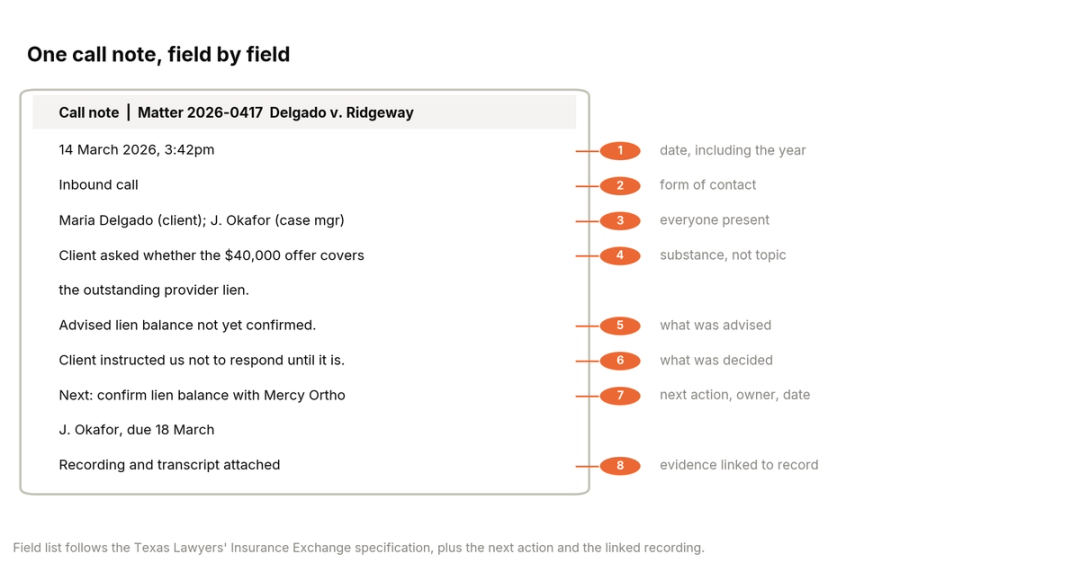
Four of those are commonly missed. The year drops off because the note is written the same day and the year feels obvious, which it is not three years later in a printed file, and the medium drops off because it seems implied, which matters when the dispute is over whether something was said by phone or in writing.
The list of people present shrinks to the client's name, so the adjuster's paralegal who was also on the line disappears from the record. The substance gets compressed into a topic rather than content.
That last one is the difference between a note and a log entry. "Discussed settlement" records that a call happened. "Client asked whether the 40,000 offer covered the outstanding lien, advised the lien balance is not yet confirmed, and client instructed us not to respond until it is recorded what was decided and by whom.
The test for substance is whether a colleague with no memory of the conversation could pick up the matter from the note alone. That is a higher bar than it sounds, and most notes fail it on the same point: they record the topic and omit the instruction.
Instructions are the part that matters most and gets written down least. A client telling you to hold, to accept, to wait for a lien figure, or to stop contacting a particular relative is giving an instruction the firm will be held to, and a note that says "discussed next steps" has recorded none of it.
Two more fields belong in any note that will be read by someone else later. The next action with an owner and a date, so the note carries the matter forward rather than only describing it. And the link to the recording or transcript if one exists, so the record and the evidence sit together.
Why inconsistent logging makes your notes inadmissible
This is the part of CMS call logging that gets treated as diligence when it is really a question of admissibility.
Call notes are hearsay. They come in, when they come in, as business records under Federal Rule of Evidence 803(6), which admits a record of an act, event, condition, opinion or diagnosis on five conditions.
The first is that the record was made at or near the time by, or from information transmitted by, someone with knowledge. That is the contemporaneity requirement, and it is why a note written from memory a fortnight later is worth less than one written the same afternoon.
The two that firms fail are the second and third. The note must have been kept in the course of a regularly conducted activity, and making such notes must have been a regular practice of that activity.
A firm where two case managers log every call, one logs the interesting ones and the attorneys log nothing has no regular practice to point to. Opposing counsel does not have to prove the note is wrong. Under 803(6)(E) they only have to show that the circumstances of preparation indicate a lack of trustworthiness, and inconsistency is exactly that showing.
So the discipline is the substance. A firm that logs every call to a middling standard has a more defensible record than a firm that writes excellent notes when someone remembers, and the second firm usually believes it is doing better.
The corollary is worth stating plainly. Deciding which calls are worth logging is the decision that undermines the log, because the selection itself is what an opponent will point at.
Which call records leave with the client
CMS call logging raises a question of ownership that firms rarely ask themselves. Recordings get kept on the assumption that they belong to the firm, and often they do not.
ABA Formal Opinion 471, issued in July 2015, addresses what a lawyer must surrender to a former client under Model Rules 1.15 and 1.16(d), and it describes two approaches across jurisdictions.
Most states follow an entire-file approach, under which the lawyer surrenders papers and property related to the representation unless a specific exception applies. Others follow an end-product approach, which distinguishes the end product of the lawyer's services from the material that led to it.
Under either approach the client gets correspondence issued or received by the lawyer. Under either approach the lawyer may generally withhold personal notes and internal memoranda generated primarily for the lawyer's own purposes.
Call records sit awkwardly across that line, and one state has drawn it. The North Carolina State Bar's 2013 Formal Ethics Opinion 15, adopted in January 2014, addresses electronic records specifically.
It holds that all correspondence received and generated by the lawyer should be released, along with anything in the file that would assist the lawyer taking over. Backups, voicemail recordings and text messages sit outside that unless they meet the same test.
Read that test the other way around and the consequence is clear. A recording is excludable when it does not matter and producible when it does, because helpfulness to successor counsel is the whole test. The recordings a firm would least like to hand over are the ones most likely to qualify.
There is a drafting consequence here that costs nothing to act on. A note written as a record of a client communication reads as correspondence-equivalent, while one that blends that record with the writer's private assessment of the client mixes producible content with the personal notes a lawyer may withhold.
Nobody separates those cleanly under time pressure years later, so keep the impressions somewhere else. Rules vary by state, so check your own.
Your phone system's retention setting is a legal decision
The last piece of CMS call logging is how long any of it survives. Most phone systems ship with an automatic deletion window of thirty days, ninety days or a year, chosen by somebody in IT or by nobody at all.
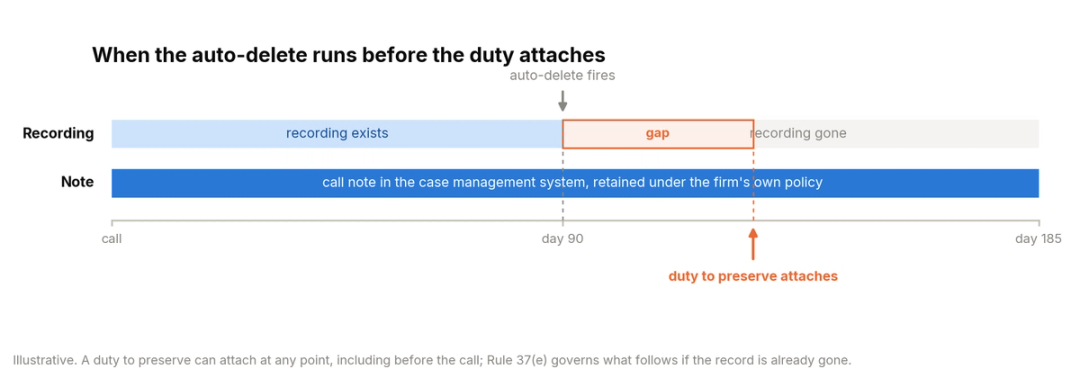
Federal Rule of Civil Procedure 37(e) governs what happens next. Where electronically stored information that should have been preserved in the anticipation or conduct of litigation is lost because a party failed to take reasonable steps to preserve it, and it cannot be restored or replaced, a court may order measures to cure the prejudice. Where the party acted with intent to deprive another party of the information, the court may presume the lost information was unfavourable, instruct the jury to presume it, or dismiss the case.
The exposure is the interaction between two settings nobody reviews together. The duty to preserve attaches when litigation is reasonably anticipated, which in a plaintiff practice can be early. The auto-delete runs on a schedule that knows nothing about it.
Three things follow. The retention window should be a decision the firm makes rather than a default it inherits, and somebody should own the ability to suspend it for a specific matter.
The note itself should outlive the recording, because a note retained under the firm's own policy is what remains once the audio is gone.
Who logs the call and when
The Oklahoma Bar Journal put the operational version of this better than most practice guides. Writing in April 2021, Jim Calloway noted that where staff handle client communications, "if they don't document their communication with the client in the client file, then it is like it never happened."
That is the ownership question in one line. In a plaintiff firm most client contact runs through case managers and intake staff rather than attorneys, so most CMS call logging is done by people whose performance is not measured on it.
The same pattern drives our note on the documentation problem an answering service creates.
Three rules make that work. Log it during the call or immediately after, because 803(6) rewards contemporaneity and memory does not survive a full caseload.
Log it to the matter rather than to an inbox or a personal notebook, since a note nobody else can find is a note the firm does not have. Log declines and non-client contacts too, because those generate conflicts questions later and nobody thinks to record them. Undocumented early contact is one of the ways firms lose cases before they sign them.
Audit CMS call logging the way you would audit anything else that matters. Pull ten matters a month, count the calls in the phone system against the notes in the case management system, and look at the gap.
A firm doing this for the first time usually finds the gap sits with one role rather than spread evenly, which makes it a fixable problem rather than a cultural one. The fix is normally capacity rather than diligence, since the person missing notes is usually the person taking the most calls.
The measure to watch is the share of calls that produced a note, not the quality of the notes that exist. Quality is a judgment call and rate is a number, and it is the rate that the regular-practice test turns on.
What a thin note costs when it is tested
The cost of weak CMS call logging is not abstract, and the mechanism behind it is specific.
Lawyers Mutual of North Carolina, another insurer rather than a vendor, makes the point that written documentation is powerful evidence for defending or resolving allegations of malpractice. The Texas insurer puts it more precisely: contemporaneous notes may be what sways a judge or jury where the attorney and former client give differing testimony about what was said.
Read that mechanism carefully, because it explains why the economics are worse than they look. Where a client and a firm remember a conversation differently and no record settles it, the dispute becomes a credibility contest. Credibility contests are expensive to defend and uncertain to win, so matters that would have been defensible on the facts get settled on the arithmetic instead.
Calloway made the same point from the other direction. A client will have very clear memories of every conversation with their lawyer, and where the firm believes those memories are inaccurate, documentation in the file is the best and sometimes the only defence.
None of this requires more calls than a firm is already having. It requires the ones already happening to leave a record a stranger can read.
There is a second audience worth writing for. A bar investigation responding to a client grievance will look at the file to establish what the firm told the client and when, and a file that shows dated contacts with substance answers that question without anyone having to testify from memory. The same record serves both purposes, which is why it is worth getting right once.
What Counsel writes to the matter
HelloCounsel is our own product, so this section describes what it records rather than arguing it suits every firm.
Counsel answers the main line, identifies the caller and the matter before the conversation starts, and files the call as a structured record rather than a free-text message. The record carries the matter it belongs to, the caller verified against the file, the reason for the call as a structured field, the outcome, the next task, and the full transcript with the recording linked.
That shape exists because of the fields above rather than by coincidence. A structured reason and a logged next task are what make a record readable by someone who was not on the call, and an attached transcript is what makes the substance field unarguable.
The same applies to calls that are not from clients. Provider and records calls generate as much file activity as client ones, which is the argument in our note on handling medical provider calls.
The consistency point matters here too. An agent that handles every call logs every call, which is the regular practice 803(6) asks about.
Our explainer on CMS write-back covers the mechanism behind that.
For the volume that makes manual logging break down in the first place, how many calls a PI case generates has the arithmetic.
Direct integrations cover SmartAdvocate, Filevine, Litify, Lead Docket and Clio, with custom builds for other systems. Pricing is fixed monthly from $500, scoped to expected volume with 20% tolerance either way. Across 25,000 calls and 500 hours of call time, firms working with HelloCounsel have seen a 48% improvement in call reception rates.
Retention stays with the firm. The system writes to your case management system, so your own policy governs how long the record lives rather than a vendor's default.
Check your own logging rate this week
Pull ten matters, count the calls in your phone system against the notes on the file, and see where the gap sits by role. The exercise takes an hour and usually points at one person's queue rather than a firm-wide habit. Book a demo
Turning this into a standard your firm actually follows
CMS call logging becomes a standard when it is built into the tool, and stays an aspiration when it is only written as a policy.
Put the required fields into the note template itself so the structure is the path of least resistance. A template that asks for the form of contact and the next action gets those fields more reliably than a memo asking people to remember them.
Decide the retention window deliberately and write down who can suspend it. That decision belongs with whoever runs the firm rather than with whoever configured the phone system, and it should be revisited when the phone system changes.
Separate the record from the impression, in the template and in the training. Notes that mix the two are the ones that create problems when a file is produced.
Then measure the rate rather than the quality. Quality is hard to audit and rate is not, and a firm logging nearly every call to an adequate standard is in a stronger position than one logging half of them beautifully. Our guide to reducing case manager workload covers where the time for this comes from, since the answer is usually not discipline.
Get a scoped figure against your own call mix
Send last week's call log split and the case management system you run. We will come back with a fixed monthly price, what it covers beyond intake, and a walkthrough on three of your own recordings. Talk to the HelloCounsel founders
Frequently asked questions
1. What should a law firm call note include?
Six things: when it happened with the year stated, how the contact was made, who took part, what was said and settled, what happens next and who owns it, and where the recording sits.
2. Do notes from CMS call logging count as business records in court?
They can, under the business records exception at Rule 803(6), but only where the firm can show that writing them was a regular practice rather than an occasional habit.
3. Does a client get our call recordings if they leave?
Some of them, most likely. North Carolina's 2013 Formal Ethics Opinion 15 lets a firm withhold voicemail recordings only where they would be of no use to the incoming lawyer, which means the substantive ones are the likeliest to go.
4. How long should a firm keep call recordings?
Long enough to satisfy any preservation duty that attaches, which means the default auto-delete window on a phone system should be reviewed rather than inherited. Retention rules vary by state.
5. Who should be doing CMS call logging at a plaintiff firm?
Whoever takes the call, including intake staff and case managers. Notes written by staff carry the same weight in the file, and a gap in one role is what usually breaks the regular-practice test.
6. Is a call summary enough, or do we need the transcript?
A summary records that a call happened, and a transcript records what was said. Where the two differ, only the transcript settles an argument about what was actually said.
Share this article