
- CaptureNow is an AI voice agent built for law firms, founded by intake veterans who previously built the Captorra intake CRM and an intake call center.
- It answers every call on the first ring, qualifies new leads in about two minutes, and recognizes existing clients through its CallerIQ feature.
- Pricing was quoted at $1.95 per call in a 2024 interview, with no per-minute charges, and the website does not publish current rates.
- Independent reviews are scarce, with no listings found on G2 or Capterra as of October 2026.
- CaptureNow focuses on answering calls, while PI firms that also want outbound case work, such as recordfollow-up, need a broader platform.
Every personal injury firm loses some calls after hours and in the minutes when the front desk is already on another line. CaptureNow was built for exactly those calls, and its name says so.
The product comes from people who spent years inside law firm intake. Its co-founders built an intake CRM and ran an intake call center before turning to AI, which shows in how the agent handles legal callers.
This CaptureNow review covers how the agent treats each kind of call a PI firm receives, along with pricing and integrations. It closes with where the product fits and where a firm may need more.
Firms that search for a Capture Now review usually already runs an intake team and wants to stop losing calls outside business hours. That firm is the reader this review has in mind.
What is CaptureNow?
Built as an AI-driven answering service for law firms, CaptureNow picks up every call around the clock. Its website calls it an always-on virtual assistant, and its YouTube channel describes transcripts that improve with each call.
Co-founder Chris O'Brien described the name on the Personal Injury Mastermind podcast in April 2024. He said the "now" stands for "nights, overflow, and weekends," the windows when in-house staff are least likely to answer.
O'Brien previously founded Captorra, an intake CRM for PI firms later sold to Martindale-Avvo, and co-founded the intake call center Intake Conversion Experts with Gary Falkowitz. He co-founded CaptureNow with Falkowitz and Michael Mogill, who founded the legal marketing firm Crisp.
The Crisp link shows up in how the product is sold. A CaptureNow promotional page sits on Crisp's website, which places the product in front of the PI firms that already work with Crisp on marketing.
That history matters for a CaptureNow review because it explains the product's focus. The team knew the staffing limits of human call centers and built an agent to take the calls those centers struggled to cover.
How this CaptureNow review was researched
Public information on CaptureNow is thinner than on most legal intake tools. The company's website lists features and integrations without pricing, so the most detailed account comes from the 2024 podcast interview with O'Brien.
Independent feedback is scarce as well. A search in October 2026 found no CaptureNow review listings on G2 or Capterra, and one AI tool directory showed zero user ratings.
Thin public data shapes how to use this CaptureNow review. It sets out what the company and its co-founder have said, and it flags the questions only a demo or a reference call can answer.
Every claim below is attributed to its source. Figures from CaptureNow's own marketing are labeled as company claims, and firms should confirm current details on a demo.
How does CaptureNow handle each type of call?
A PI firm's calls fall into a few distinct types, and CaptureNow treats each one differently. The table summarizes the flow described on its website and in the 2024 interview, which is the closest thing to a hands-on CaptureNow review available in public.
| Type of call | How CaptureNow handles it | What to confirm on a demo |
|---|---|---|
| New lead | Asks for contact details, case type and qualifying answers in about two minutes | Whether the questions match your case criteria |
| Existing client | CallerIQ greets the client by name and offers an update, a message or a callback | How much case detail the agent can share |
| Qualified lead to transfer | Live transfers to staff, an on-call cell phone or a third-party call center | What happens when nobody picks up |
| Overflow during business hours | Answers when in-house staff do not pick up | How the ring-over timing is set |
| Local Services Ads lead | Uses more open-ended questions to support Google's conversation scoring | How lead scores are reported back |
New leads
New callers hear a short series of intake questions covering contact details and the type of case. O'Brien put a typical new-lead call at about two minutes, after which the caller receives a follow-up text and the firm receives an email transcript.
Leads sync to the firm's CRM through an API, and qualified callers can be transferred live. CaptureNow's routing prioritizes calls by qualification, so a strong car accident lead reaches staff ahead of a caller with a case the firm declines.
Existing clients and CallerIQ
CallerIQ links CaptureNow to the firm's case management system so the agent recognizes a client's number and greets them by name. The client then picks from options that include a case update and a callback from their case manager.
A typical CallerIQ call takes about 25 seconds, according to O'Brien. When a client asks for a callback, CaptureNow adds a task in the case management system for staff to return the call.
After-hours and overflow coverage
Firms usually set CaptureNow up as a backup to in-house staff instead of a replacement. It takes after-hours calls and catches calls that ring past a busy front desk.
Concurrency is one of its strongest selling points. According to O'Brien, the system can handle 100,000 calls at the same time, which removes the hold queues that build after a TV ad airs.
Local Services Ads leads
Google's Local Services Ads score calls by conversation quality, and short scripted calls can score poorly. O'Brien said CaptureNow uses more open-ended questions on these calls to support that scoring. Google charges advertisers for each lead, so a well-handled call protects the firm's ad spend as well as the lead.
How does CaptureNow work with a human call center?
CaptureNow was designed to sit alongside human intake teams. Its integration list names Intake Conversion Experts and Alert Communications, two legal call centers, and qualified leads can transfer live to a third-party center.
That setup lets a firm keep human specialists for signing calls while the AI takes first contact. The agent answers instantly and qualifies the caller, then hands the strongest leads to a person who can walk them through a retainer.
For firms already paying a legal call center, this CaptureNow review sees the hybrid model as the most natural entry point. The AI absorbs volume spikes and after-hours calls, and the call center's agents spend their time on leads worth signing.
Ask how transfers behave when the call center is busy. A qualified lead who reaches a second queue after the AI has already answered can still hang up, which undoes the benefit of a first-ring answer.
Which features and integrations does CaptureNow offer?
CaptureNow's website lists automatic call recording and speech-to-text transcription for every call. Staff receive SMS and case-specific email alerts, and a dedicated web portal holds call records and settings.
The agent speaks English and Spanish, with male and female voice options. O'Brien confirmed in 2024 that those were the only two languages supported.
Integrations cover the case management and intake systems most PI firms run. CaptureNow names Litify and Filevine among the case management systems on its site, and intake CRMs such as Lead Docket and Captorra appear on the same list. Call center partners include Intake Conversion Experts and Alert Communications.
Recordings and transcripts double as a training tool. Intake managers can review how the agent handled a declined case or a confused caller, then adjust the questions, though firms should ask how long recordings are kept.
Setup is described as self-service. The site gives no onboarding timeline, so a CaptureNow review has to leave launch speed as a question for the demo.
What does CaptureNow cost?
CaptureNow does not publish pricing on its website, which directs visitors to book a call. A promotional page offered a limited-time deal with only twelve spots, without stating the terms.
In the April 2024 interview, O'Brien described per-call pricing with no per-minute charge and cited a rate of $1.95 per call. He added that CaptureNow typically comes to about 30% of what a traditional answering service would charge.
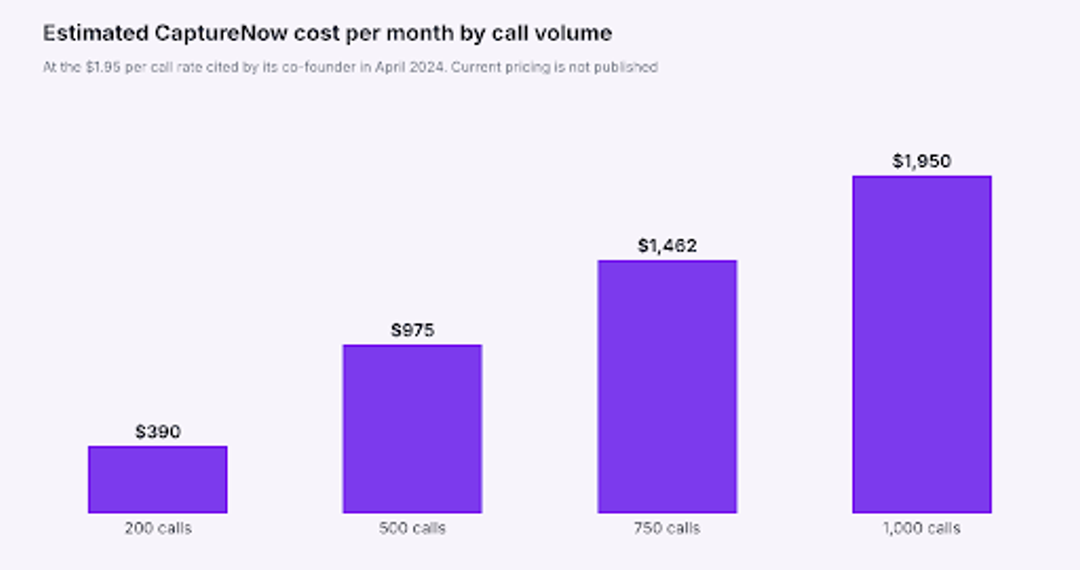
At that rate, a firm sending 500 calls a month to CaptureNow would pay about $975. Per-call pricing suits PI intake well, since a long call with an injured caller costs the same as a short one.
The 30% figure is the easiest claim for a CaptureNow review reader to test. Pull last quarter's invoices from your current answering service, divide by the calls handled and compare the result with the per-call quote.
Ask what counts as a billable call before comparing quotes. Spam calls and hang-ups can make up a share of after-hours volume, and a per-call contract that charges for them raises the effective rate.
Treat the 2024 figure as a starting point for negotiation, since rates may have changed. Our guide to legal answering service cost shows how per-call rates compare across live and AI providers.
What do customers say in CaptureNow reviews?
The customer voice comes almost entirely from CaptureNow's own website. Testimonials from PI firms, including Disparti Law Group and Connecticut Trial Firm, praise the consistency of the answering and the savings that let a firm expand its caseload.
The site also cites a study of 1,000 fast-growing small and mid-sized law firms showing a 14% missed call rate and a 56-second average wait without CaptureNow. The page does not say who ran the study or when, so treat those numbers as company claims.
A trade article in Attorney at Law Magazine lists CaptureNow among legal AI tools for lead generation. It describes the product's purpose without testing it, so it adds little to a CaptureNow review beyond confirming its market position.
The lack of third-party reviews says more about the product's age and sales model than its quality. Firms weighing it should ask for references from practices of similar size and call volume.
A useful reference call covers more than satisfaction. Ask the firm how many calls CaptureNow handled last month and how long setup took, since those numbers add what any CaptureNow review built on public sources leaves open.
Strengths and limitations of CaptureNow
Weighing the published material, CaptureNow's strengths sit in legal-specific intake and pricing, while its limits come from scope and transparency:
| Strengths | Limitations |
|---|---|
| Built by founders with long careers in law firm intake | Few independent reviews or third-party ratings |
| Answers on the first ring with no hold queue | Pricing absent from the website |
| CallerIQ recognizes existing clients from case management data | Existing clients choose from set options instead of a full conversation |
| Integrations with Litify, Filevine and Lead Docket | English and Spanish only |
| Per-call pricing with no per-minute charges | Focused on answering calls, without outbound case work |
The strengths make CaptureNow a credible choice for a firm whose main problem is unanswered calls. The limitations matter more for a firm that also wants its AI agent to work cases between calls. Read together, the two columns of this CaptureNow review describe a focused tool doing one job well.
Who is CaptureNow best for?
Based on how its co-founder describes typical setups, CaptureNow fits a few kinds of firms well:
- Firms with a staffed intake team: CaptureNow covers after-hours and overflow calls while staff handle business hours.
- High-volume advertisers: TV and Local Services Ads campaigns produce call spikes that concurrency absorbs.
- Firms already on Lead Docket or Captorra: Leads sync into an intake CRM the founders know well.
- Overnight call center users: Per-call pricing at the cited rate undercuts most live services.
Solo practices with light call volume may find a simpler setup enough. A forwarding rule to a cell phone covers a handful of after-hours calls, and the value of a dedicated agent grows with volume.
The fit narrows for firms that serve callers in languages beyond English and Spanish. Those practices need a human backup line or a different tool for those callers.
Firms that want one agent to cover intake along with case work such as provider calls and client check-ins should compare broader platforms. Our explainer on the difference between AI intake and AI operations covers that split.
What to ask on a CaptureNow demo
A demo should show the agent on calls that resemble your firm's, instead of a polished sample. Ask the team to run a car accident lead with a Spanish-speaking caller, then an existing client calling about a medical bill.
Pricing questions come next. Confirm the current per-call rate and any setup fees, and ask whether the contract carries a minimum monthly volume.
Integration depth deserves a direct test. Ask to see a CallerIQ callback task land in your case management system, and check what the task includes beyond the caller's name and number.
Test after hours too. Call the demo line at 11 p.m. from a number the system has never seen, and check how quickly the transcript and lead alert reach your inbox.
Close the demo with a question about scope. A CaptureNow review for a PI firm should end with whether the agent covers only the phones or can also take on outbound work, since that answer decides whether a second tool is needed.
How does HelloCounsel compare with CaptureNow?
HelloCounsel also builds AI voice agents for plaintiff personal injury firms, and both products recognize existing clients from case data. The difference lies in how far the work extends beyond the phone call.
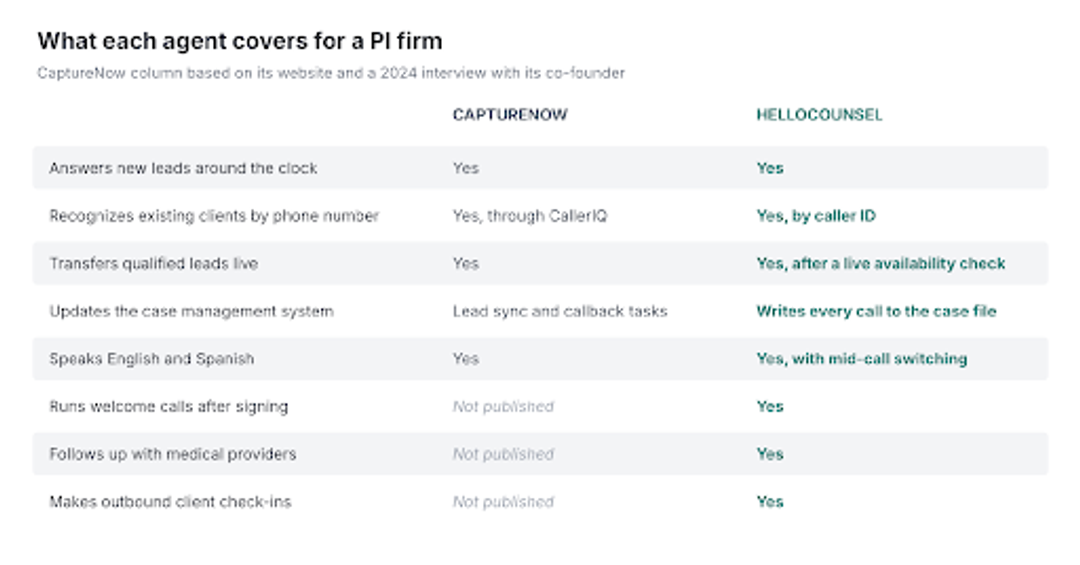
The Receptionist agent answers in under two rings and matches caller ID to the case file. Routing runs on case data with a live availability check, using a warm transfer or a scheduled callback, and every call is written to the case file.
Existing clients get a different experience as well. Instead of picking from a menu, the client reaches the right person through a warm transfer when that person is free, or gets a scheduled callback with the reason already logged in the case.
New callers reach the Intake agent, which works with LeadDocket and Lawmatics. Both agents speak English and Spanish and can switch languages mid-call.
Beyond the phones, HelloCounsel's Medical Records agent calls providers on open requests, and firms using it have seen 15 days cut from records turnaround.
The Client Communication agent has delivered 2x more frequent check-ins with clients.
Firms using HelloCounsel have seen a 48% improvement in call reception across more than 30,000 calls handled. Pricing is custom and based on call and case volume, so firms pay for tasks completed. Once a new client signs, the Case Opening agent runs the welcome call and gets every case moving within 24 hours.
See HelloCounsel answer calls and work cases for a PI firm
Watch HelloCounsel greet an existing client by case, transfer a qualified lead and log both calls to the case file. Book a HelloCounsel demo
The verdict on CaptureNow
Built by people who know intake well, CaptureNow is a legal-specific AI answering agent. Its first-ring answering and per-call pricing solve the problem it was built for, the calls a firm misses at night and in overflow.
The open questions in this CaptureNow review are transparency and scope. Current pricing and independent reviews are hard to find, and the product stops at the call, leaving outbound case work to staff.
Any CaptureNow review written from public sources carries that caveat. A two-week trial on live calls, with transfers and callback tasks checked daily, will settle the open questions faster than more research.
Firms comparing it with other options can start with our guide to AI versus live answering services for law firms. Then run each finalist on a week of real calls before signing.
Talk with HelloCounsel's founders about your call coverage
Tell HelloCounsel's founders where your firm misses calls today, and get a plan for covering intake and client calls with an AI agent built for PI firms. Book a call with HelloCounsel's founders
Frequently asked questions
1. What is CaptureNow?
CaptureNow is an AI voice agent that answers law firm calls 24/7, qualifies new leads and recognizes existing clients through CallerIQ. Its co-founder Chris O'Brien previously built the Captorra intake CRM.
2. How much does CaptureNow cost?
CaptureNow does not publish pricing. In an April 2024 interview, co-founder Chris O'Brien cited $1.95 per call with no per-minute charges, so confirm current rates on a demo.
3. Does CaptureNow integrate with Filevine?
CaptureNow lists Filevine among its integrations, along with Litify and intake CRMs such as Lead Docket. CallerIQ uses that link to recognize existing clients and add callback tasks.
4. Does CaptureNow speak Spanish?
Yes. CaptureNow supports English and Spanish with male and female voice options, and its co-founder said in 2024 that those were the only two languages offered.
5. Where can I find CaptureNow reviews?
Independent CaptureNow reviews are scarce, with no listings found on G2 or Capterra as of October 2026. Testimonials on the company's website and references from similar firms are the main sources.
6. What is a good CaptureNow alternative?
HelloCounsel builds AI voice agents for PI firms that cover intake and existing-client calls, plus outbound work such as medical records follow-up. Pricing is based on call and case volume.
Share this article