
- No rates, plans or tiers appear anywhere on capturenow.com, and the /pricing URL returns a 404.
- Its contract promises that rates are disclosed on the site, which the site does not currently do.
- Charges attach to sessions, a unit the agreement uses without defining in detail.
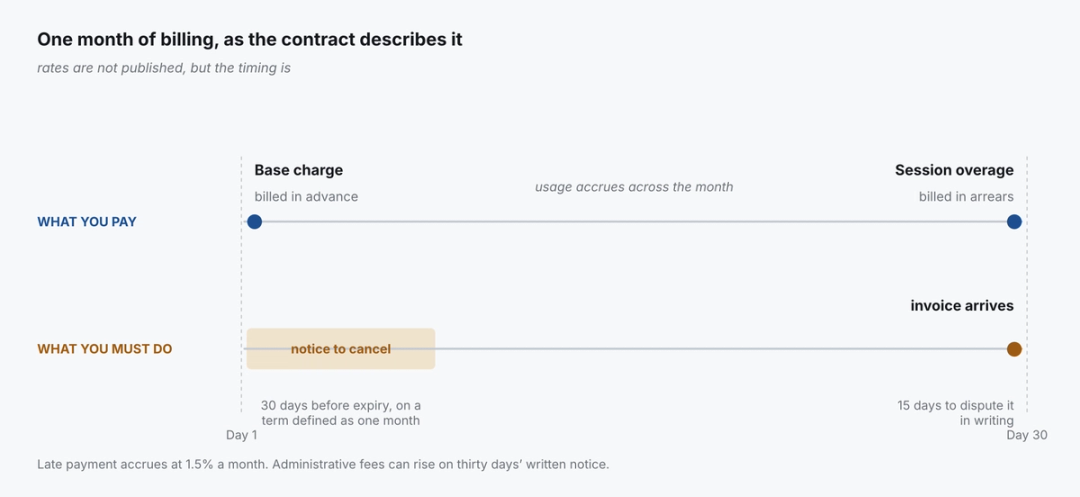
- The base plan is charged forward and usage is charged backward, so an early invoice understates the steady-state cost.
- A one-month term carries a thirty-day notice requirement, which compresses the window for getting out.
- Providers in the category who do publish start around $250 to $300 monthly, with per-call overage from $8.50 to $11.50.
Published rates have quietly disappeared from much of the legal intake market. A firm comparing three vendors will often find three demo booking forms and no numbers, which turns a procurement exercise into a sequence of sales calls.
The company sits at the far end of that pattern. Searching for CaptureNow pricing returns almost nothing about the product, partly because the company publishes no rates and partly because search engines keep substituting other brands with similar names.
The useful material exists, and it sits in a document most buyers skip. This piece covers what the contract reveals about the billing model and what comparable vendors charge, then sets out what to ask before a quote arrives.
What CaptureNow pricing actually looks like on the site
Checked on 28 October 2026, capturenow.com carries no pricing information of any kind. No plan names, no tiers, no per-call or per-minute rates, no setup fee, no minimum commitment.
Both capturenow.com/pricing and capturenow.com/pricing/ return HTTP 404. Pricing appears nowhere in the site navigation, which runs to Overview, Benefits, Features, Blog, Get Started and Login.
The calls to action are "Get Started" and a prompt to book a call. There is no quote form, no starting-at figure and no self-service signup.
That is a legitimate commercial choice and a common one. It does mean anyone researching CaptureNow pricing before a sales conversation has to work from the contract instead.
A CaptureNow pricing clause that points nowhere
CaptureNow's Terms of Service contain a line worth reading closely. Describing how orders work, the document states that "all prices are identified in US dollars on the website."
The website identifies no prices. The clause describes a disclosure practice the site does not currently reflect, which is the kind of mismatch worth raising directly with a salesperson.
Two smaller details sit alongside it. The document carries a last-updated date of August 1, 2022. It also names the contracting party as "CaptureNow, a Georgia corporation" in its preamble, while the site footer reads "CaptureNow, LLC."
Neither point is disqualifying. Both are reasonable things to ask a vendor to confirm before signing, because the entity you contract with and the terms you contract under should be unambiguous.
How the CaptureNow pricing model works
The contract gives away the pricing structure even without the numbers, and the structure matters more than most buyers expect.
The unit is a session: The agreement defines usage as charges incurred "in connection with the number of sessions between CaptureNow Voice." Competitors in this category typically bill per call or per minute, so a session-based meter is worth pinning down precisely.
Recurring charges bill in advance: The document states that "recurring charges are billed in advance in the frequency set forth in the Order Form."
Overage bills in arrears: "Any session overage or usage-based charges are billed monthly in arrears." A firm therefore pays the base forward and the overage backward, and month one looks different from month three.
Payment is by credit card: The agreement requires that services "must be purchased via valid credit card at the time of purchase."
Usage rates float: Usage is "applied based on the rate in effect at the time of use," so the rate quoted at signing governs only until it changes.
Why the session is the number that matters
A meter nobody has defined is the main risk in any CaptureNow pricing conversation, because the unit does more work than the rate attached to it.
Consider the same month under three meters. A firm taking 400 calls, many of them short, pays one way under a per-minute plan and another under a per-call plan. A session meter produces a third figure, depending on whether it treats a transfer as a second session.
Short calls punish per-call pricing, since a thirty-second wrong number costs what a qualified intake costs. Long calls punish per-minute pricing, and a thorough plaintiff intake runs long by design.
Sessions sit outside both conventions, which is why the definition has to come in writing. Find out whether an inbound call that transfers to a paralegal counts once or twice, whether a caller who hangs up during the greeting counts at all, and whether an outbound callback opens a new one.
The answers change the annual figure substantially at any real volume. They also make CaptureNow pricing comparable to a quote from anyone else, which is impossible while the units differ.
Contract terms worth reading before the quote
Anyone evaluating CaptureNow pricing should read the commitment terms alongside the rate, because the terms determine what a rate actually costs over a year.
| Term | What the agreement states |
|---|---|
| Term length | "The Initial Term and all subsequent Renewal Terms shall be defined as a period of one (1) month" |
| Commitment | "All Services are provided on a month-to-month basis" |
| Non-renewal notice | Notice required "at least thirty (30) days before the expiration" |
| Recurring increases | Thirty days' notice, effective "on the first day of the next Renewal Term" |
| Administrative fees | "May be increased on thirty (30) days' written notice" |
| Billing disputes | Written notice "within fifteen (15) days of the invoice date" |
| Late payment | 1.5% per month, or the highest rate allowed by law |
| Early termination | Accrued amounts plus "all sums remaining unpaid for the Services for the remainder of the then-current Term" |
Two of those rows deserve attention together. A one-month term paired with a thirty-day non-renewal notice leaves very little room, since notice must land before a term that lasts about as long as the notice period itself.
Month-to-month language usually signals easy exit, and the notice mechanics here work differently from that expectation. Get the renewal and cancellation mechanics in writing, confirmed against whatever the Order Form says, since the Order Form governs the term in practice.
The administrative fee clause carries similar weight. A fee category that can rise on thirty days' notice sits outside whatever headline rate gets quoted on the call.
Get a straight answer on what intake actually costs you
Send us your monthly call volume and we will price it out line by line, including what a session-based meter would do to it. Price my call volume
What comparable providers publish
Benchmarks help because a quote in isolation sounds reasonable until it sits beside the market. The figures below come from vendor pricing pages checked in October 2026.
Smith.ai publishes per-call plans for its human-first service. Starter is $300 a month for 30 calls, Basic is $810 for 90, and Pro is $2,100 for 300.
Its overage ladder falls as volume rises, moving from $11.50 a call on Starter to $10.50 on Basic and $8.50 on Pro. The page states there are no setup fees.
Ruby publishes per-minute receptionist plans instead. Fifty minutes costs $250 a month, 100 minutes costs $395, 200 minutes costs $720, and 500 minutes costs $1,725.
Overage rates are absent from that page, so the marginal cost of a busy month has to come from a sales conversation.
Worked against the allowances, that puts Ruby between roughly $3.45 and $5.00 a minute. Its own plans land between $7.00 and $11.50 a call before per-call add-ons, which cover things like appointment booking, call recording and a dedicated Spanish line.
Entry tiers across the category therefore start around $250 to $300 a month. CaptureNow pricing well above that range should come with an explanation of what the extra buys.
Questions that make a quote comparable
A quote becomes comparable once the meter is defined, and most of the ambiguity in this category lives in the unit of measurement.
Define a session: Establish what starts one and what ends one, then ask whether a transfer or a dropped call counts twice. A session that covers a two-minute wrong number costs the same as one covering a real intake unless the contract says otherwise.
Ask for the overage rate in writing: The base plan matters less than the marginal rate, because intake volume moves with marketing spend.
Price your actual volume: Take last quarter's monthly call count and ask each vendor to price that number, including overage. A low base with a high marginal rate beats a high base only up to a point.
Confirm what counts as an administrative fee: Request the current list and the current amounts.
Pin the renewal mechanics: Get the notice window and the cancellation method in writing.
Settle what happens to your data: Call recordings, transcripts and contact records should be exportable, and a vendor should be able to demonstrate it during evaluation.
Our guide to evaluating an AI voice agent covers the demo questions in more depth.
For the difference between a staffed service and a software layer, the comparison of legal answering services walks through the trade-offs.
Modelling the cost before you take the call
Walking into a pricing conversation with your own numbers changes it from a pitch into a negotiation.
Pull last quarter's call volume from your phone system, split by month. Separate business hours from after hours, since the after-hours share is usually what justifies buying anything in this category.
Work out the average call length and the share of calls that are genuine new-client inquiries. A firm where half the volume is existing clients chasing updates has a different problem from one missing new leads, and the second is worth more.
Then take the three months and price them under each vendor's meter, including overage. A plan that looks cheap at average volume can cost considerably more in the month a campaign lands, which is exactly the month a firm needs the coverage.
That exercise also surfaces whether the real cost sits inbound at all. Firms that run the numbers often find the larger drain is outbound work nobody is metering.
Where the fit question matters more than the rate
The product markets to small and mid-sized law firms broadly. Its named case management integrations are Litify, Filevine, Lead Docket, Clio, Captorra and CasePeer, alongside intake partners including Alert Communications and Intake Conversion Experts.
Two systems common in plaintiff practices are absent from that list. SmartAdvocate and Neos appear nowhere in it, which matters for any firm running either, because write-back into the case management system is what separates intake software from a phone product.
The feature set is also inbound. Answering, transcription, routing and alerts all describe calls arriving at the firm, and a plaintiff practice spends at least as much phone time calling out.
Medical provider follow-up, records chasing, claim opening and client check-ins generate the call volume that actually consumes case manager hours. A tool priced on inbound sessions leaves that work exactly where it was, which is where a generic receptionist product tends to fall short.
How HelloCounsel prices this
We build HelloCounsel, so read this as a description of our own model and weigh it accordingly.
Where CaptureNow pricing arrives through a sales call, ours is published per completed request instead of per session. Medical records run $10 each, inclusive of every call, email, fax and DataVant check the request takes. Insurance claim opening runs $6, crash report retrieval runs $3 and calls run $1.
That structure exists because a per-minute or per-session meter rewards a vendor for longer interactions, while a per-outcome meter rewards finishing the work. Billing arrives itemized by case, closer to how a records vendor invoices than how an answering service does.
There is no setup fee, agents run inside the firm's existing case management system, and the platform is HIPAA compliant with SOC 2 in observation. A firm comparing CaptureNow pricing against this will be comparing two different meters, which is the comparison worth making carefully.
See the two models side by side on your own numbers
Bring your monthly call volume and records workload and we will show what each pricing model does to it. Talk to the HelloCounsel founders
Frequently asked questions
1. Is CaptureNow pricing published anywhere?
It is not. As of 28 October 2026 the site carries no rates or named plans, and capturenow.com/pricing returns a 404. Figures come through a sales conversation.
2. How does CaptureNow bill?
Its Terms of Service describe a base charge taken up front and usage charges invoiced after the fact, paid by credit card. The meter counts sessions.
3. What counts as a session under CaptureNow pricing?
The agreement never defines it in detail, which is why it is the first thing to pin down on a pricing call. Establish what opens a session and what closes one, then settle how transfers and callbacks are counted.
4. Is the contract month-to-month?
The agreement describes month-to-month service with one-month terms, while also setting a thirty-day notice requirement to stop a renewal. Ask for those mechanics in writing against your Order Form.
5. What should CaptureNow pricing be compared against?
Published rates from comparable providers give the range. Smith.ai starts at $300 a month for 30 calls, and Ruby starts at $250 a month for 50 minutes, so entry tiers across the category cluster around $250 to $300.
6. Does CaptureNow integrate with SmartAdvocate?
SmartAdvocate is absent from its published integration list, as is Neos. Six other systems are named, Litify and Filevine among them. Confirm current support with the vendor if either missing system runs your cases.
Share this article