
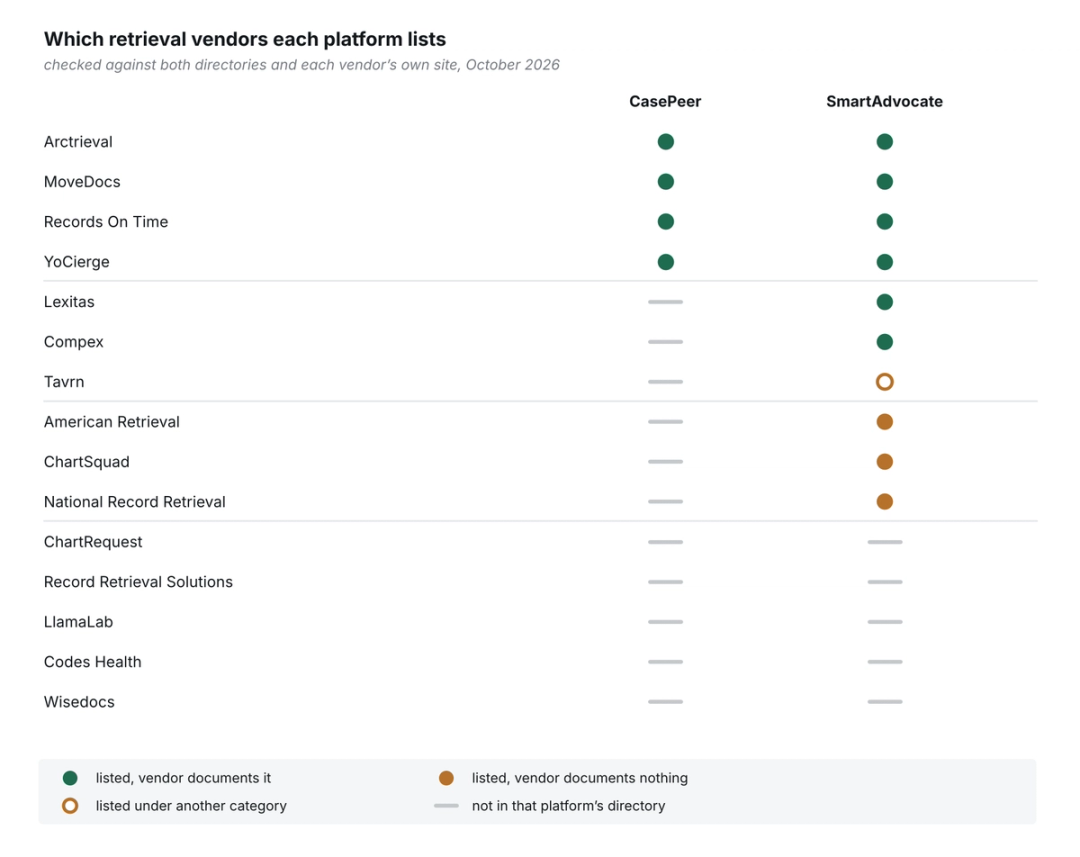
- Only four vendors carry documentation on both platforms, from the platform and from the vendor.
- Anyone shortlisting the best medical record retrieval for CasePeer is choosing among four. Its counterpart names eighteen across two pages.
- Some vendors sit in SmartAdvocate's records category while documenting nothing themselves.
- Several heavily marketed AI retrieval vendors built for Filevine and Litify and published no CasePeer integration at all.
- Integration type goes unstated by both, so a logo and a two-way sync look identical in either directory.
- Every claim below carries the URL it came from, checked in October 2026.
Choosing the best medical record retrieval for CasePeer starts with a question the vendor listicles skip entirely. Nine of the twelve comparison pages ranking for retrieval keywords never mention CasePeer or SmartAdvocate at all, and the three that do take integration claims at face value.
Search either platform name alongside records retrieval and the results are the platform's own property. Their directories, their support centres, their knowledge bases. No independent page answers the question.
We sell intake software here and no retrieval product, so what follows costs us nothing to report accurately. Every entry names the source and flags what nobody documents.
How each entry below was checked
Two sources count when assessing the best medical record retrieval for CasePeer or any other platform, and the distinction matters more than any ranking.
Platform listing means CasePeer or SmartAdvocate names the vendor in its own integrations directory. Vendor listing means the vendor names that specific platform on its own site, ideally on a dedicated page.
Confirmed by both is the standard applied below. Saying it "integrates with leading case management systems" counts for nothing, and several well-known names say exactly that.
The matrix
| Vendor | CasePeer | SmartAdvocate | Documented by |
|---|---|---|---|
| Arctrieval | Listed | Listed | Both platforms and the vendor |
| MoveDocs | Listed | Listed | Both platforms and the vendor |
| Records On Time | Listed | Listed | Both platforms and the vendor |
| YoCierge | Listed | Listed | Both platforms and the vendor |
| Lexitas | Not listed | Listed | Platform and vendor |
| Compex | Not listed | Listed | Platform and vendor |
| Tavrn | Not listed | Listed under AI | Platform and vendor |
| American Retrieval | Not listed | Listed | Platform only |
| ChartSquad | Not listed | Listed | Platform only |
| National Record Retrieval | Not listed | Listed | Platform only |
| ChartRequest | Not listed | Not listed | Neither |
| Record Retrieval Solutions | Not listed | Not listed | Publishes Filevine only |
| LlamaLab | Not listed | Not listed | Publishes Litify only |
| Codes Health | Not listed | Not listed | Publishes Filevine only |
| Wisedocs | Not listed | Not listed | Referral programme, not technical |
Four vendors documented on both platforms
This group appears in both directories and publishes its own documentation, which is the highest standard available without a demo.
Records On Time documents the deepest CasePeer connection publicly. Its integration page describes a request starting from the Medical Treatment tab, records and bills landing in Documents, retrieval costs posting to the Cost tab, and status reaching Notes. It calls the arrangement "a fully bilateral integration." CasePeer announced the partnership on its own blog, and SmartAdvocate lists the company as RecordsOnTime in its Medical Records category.
YoCierge publishes the most detailed SmartAdvocate documentation of any vendor. Expenses register automatically, and invoices upload, with radiology images opening inside the platform. A dedicated page and a support article cover it on CasePeer.
Arctrieval appears on CasePeer's directory with a description of records, updates and provider details syncing into the related case, plus a launch blog. Medical Records is where SmartAdvocate files it. Arctrieval's own integrations page shows eight platform logos including both, though it publishes no description for any of them.
MoveDocs publishes dedicated pages for both platforms describing two-way flow and no charge for the connector. Worth a question on a demo call, since the company's attorney-facing page still names a shorter platform list than its integration pages do. Find out which is current.
Three vendors documented on SmartAdvocate alone
Each of these names SmartAdvocate on its own site and publishes nothing about CasePeer.
Lexitas built a named product for the platform, LexitasConnect for SmartAdvocate, which it describes as integrating directly into SmartAdvocate case menus and pre-populating party and court details. It publishes platform pages for SmartAdvocate, Filevine, Litify, Neos and TrialWorks, with no CasePeer page among them.
Compex publishes a dedicated SmartAdvocate page describing ordering, tracking and receiving records and invoices through a supported integration. Its SFTP option is listed separately and sits outside that connector, which is a distinction worth holding onto when a quote arrives.
Tavrn names Litify, SmartAdvocate, Clio and Smokeball on its integrations page, and describes matters importing so nobody re-types client details, with expenses posting as SmartAdvocate Disbursements. Filed under Artificial Intelligence instead of Medical Records, it stays invisible to any firm filtering the directory by records category.
Vendors a platform claims while publishing nothing
Three companies carry the SmartAdvocate records tag and document nothing of their own.
American Retrieval, ChartSquad and National Record Retrieval each appear in the directory. None publishes an integrations page naming SmartAdvocate, and in two cases the site names no case management system of any kind.
That combination creates a real procurement problem. Evaluating before a demo leaves a firm nothing to read and no description of data flow. Whether the listing reflects a built connector or a commercial relationship stays unanswerable.
Ask these three specifically what the integration does, and ask for it in writing.
Check what your platform's directory is actually telling you Send us the retrieval vendors you are considering and we will show you what each one publishes about your CMS. Have the listings checked
The vendors that skipped CasePeer
Several of the most heavily marketed AI retrieval products publish integrations for other platforms and none for CasePeer.
LlamaLab publishes one integration, Litify. Codes Health announced a Filevine partnership and publishes nothing further. Record Retrieval Solutions maintains a single platform page for Filevine, while its blog mentions others it never documents.
The Tavrn integrations page omits CasePeer and omits Filevine, which is worth noting against the way AI retrieval products tend to be positioned as universally compatible.
Shortlisting from any general retrieval listicle therefore produces candidates with no published CasePeer connector. That outcome traces directly to the listicles, since the ones ranking today rank on turnaround and price and leave integration unexamined.
Where one competitor page gets it wrong
One widely cited retrieval listicle credits National Record Retrieval with integrations across five platforms including "Casepacer," which is a misspelling of CasePeer that the vendor itself never publishes.
National Record Retrieval's own site has no integrations page. That claim's SmartAdvocate half holds up against the directory, while the CasePeer half appears nowhere outside the listicle.
Worth checking any integration claim against two places before it reaches a shortlist. Check the platform's own directory, then the vendor's own site.
What the directories leave out
Integration type stays unstated by both platforms, and that detail decides whether a connector saves any work.
Partner-page logos and bilateral syncs that post costs back to the matter look identical in both directories. Just four vendors document data flowing in both directions, and one of those names the specific platform object that expenses post to.
Categories also mislead. One vendor sits under Artificial Intelligence and another under Technology and Reporting Services, so neither surfaces when a firm filters for Medical Records.
The two CasePeer sources disagree with each other as well, since its support centre lists a records vendor the marketing page omits.
Testing a connector before you commit
Demos show the path a connector handles well. Three tests put it on paths nobody rehearsed, and each takes under an hour.
Request records for a provider with an awkward name. Clinics operating under a billing entity different from their trading name are where provider matching fails, and a connector that fails to resolve one hands the problem back to your staff silently.
Order records and billing from one facility, then look at what lands in the matter. You are checking whether both arrive and separate correctly, and whether the cost posts once or twice.
Cancel a request mid-flight and watch the matter. Status that keeps showing in progress after a cancellation means the sync runs one way for exceptions, which is the direction that produces chase calls.
Run all three on a live matter instead of a sandbox, since sandbox data rarely carries the provider names that break things.
Six questions for a demo
Directory listings answer less than they appear to. These questions close the distance, and the answers rarely appear on any public page.
Does the connector push records into the matter automatically, or does somebody download and upload? This separates a real integration from a portal with a logo.
Do retrieval costs post back as an expense? Four vendors document this and the rest leave it unaddressed, which means somebody is keying costs by hand.
Which object do costs land in? Ask for the platform's own field name. Knowing it signals a vendor that built against the platform.
Does status flow back, or only the finished records? Status in the matter removes a standing source of chase calls.
Is the connector included or charged separately? Two vendors state theirs is free and most say nothing either way.
What happens when the platform updates? Integrations break on release cycles, and nobody publishes a policy on it.
Work out which retrieval tools fit your setup
Tell us which platform you run and we will send back what each candidate vendor publishes about it. Get a shortlist checked
What the four-versus-eighteen split means
CasePeer's directory names four record retrieval partners. Across both pages of SmartAdvocate's directory there are eighteen, and most comparison pages have read only the first.
Bench depth decides how much the best medical record retrieval for the CasePeer question narrows against the same question on SmartAdvocate. Firms on SmartAdvocate have a genuine choice and should compare services instead of availability. A CasePeer firm is choosing among four, which makes the integration question decisive instead of a tiebreaker.
Firms running both platforms across offices face a narrower problem still, since the documented-on-both list runs to four, and a single vendor across the firm means choosing from it.
Platform choice therefore constrains vendor choice more than most firms expect, and the constraint runs in only one direction.
How HelloCounsel fits alongside these
Selling intake software and no retrieval product puts us beside these vendors instead of against them, so read this as a description of where we sit.
Both platforms list us. Their CasePeer description covers the agent syncing directly and posting call notes, records updates, and completed tasks to the related case. On SmartAdvocate we sit under Answering Service and Call Tracking.
Our intake agent asks for facilities instead of physicians, then follows any named doctor with a question about where that doctor practices, because institutions hold records and clients name people. Counting providers as a structured field is what gives your retrieval vendor a complete list to work from.
Whichever vendor you choose from the matrix above, it sends requests against the provider list intake produced. How that record reaches the matter is covered in our note on CMS write-back.
Narrowing the list
Finding the best medical record retrieval for CasePeer or SmartAdvocate starts with the matrix instead of a ranking, since availability eliminates more candidates than price does.
Only four candidates exist on CasePeer, and each one documents its connector publicly. Compare them on data flow and on what posts back.
SmartAdvocate lists eighteen, seven of which document the integration themselves. Starting with those seven is reasonable, and the eleven that publish nothing deserve a direct question before exclusion.
Then price the models properly, since published rates arrive in incompatible units. Our breakdown of medical record retrieval pricing covers converting them to a comparable figure.
Bring us a vendor shortlist you are weighing
Send us the three retrieval vendors on your list and we will tell you what each publishes about your platform. Talk to the HelloCounsel founders
Frequently asked questions
1. Which retrieval vendors integrate with CasePeer?
The CasePeer directory names Arctrieval, MoveDocs, Records On Time and YoCierge. Each publishes the connector itself. Separately, the support centre lists Rob Levine Legal Solutions, which is the same operation as Records On Time under another name.
2. Which retrieval vendors integrate with SmartAdvocate?
Eighteen appear in SmartAdvocate's Medical Records category across both pages of its directory. Seven of those document the integration on their own sites. Tavrn and US Legal Support also appear in the directory under other categories.
3. Why do CasePeer and SmartAdvocate have such different lists?
Neither platform explains it. The directory claims over 175 integrations in total against CasePeer's forty, so the records difference tracks a wider one in how many partners each has signed.
4. Can I trust a directory listing?
Treat it as a starting point. Vendors in SmartAdvocate's Medical Records category sometimes publish nothing about the integration themselves, and neither platform states what kind of connector any partner has.
5. What should I do if my vendor is not listed?
Ask whether an API or a file transfer option exists, since several vendors offer both without publishing a platform-specific connector. Factor the manual handling into the cost comparison, because somebody will be moving files.
6. Does an integration change what retrieval costs?
Not the vendor's rate. What changes is the staff time around each request, and on some connectors the keying of costs into the matter by hand. Price both when you compare.
Share this article