How AI Agents Automate Medical Provider Follow-Ups for Personal Injury Firms

- AI medical provider follow-up covers the calls, holds, portal checks, and status notes that move records, bills, and affidavits from a provider to your case file, while payments and judgment calls stay with your team.
- Before a provider shares anything about a request, HIPAA's verification rule at 45 CFR 164.514(h) requires it to confirm who is asking and on what authority, so give the agent the authorization, request number, and client details for every call.
- Build a provider directory with the records or billing line for each office, because the TCPA restricts artificial-voice calls to emergency lines and patient rooms at hospitals and health care facilities.
- Plan each follow-up around the counterpart that answers, since a hospital's release-of-information vendor, a chiropractor's front desk, and a billing office each need a different channel and a different question.
- Start with the provider whose requests cost your team the most hold time, run 10 to 20 live requests through the agent, and compare days outstanding before expanding.
An AI agent can take over most medical provider follow-up at a personal injury firm. The calls, phone trees, hold queues, portal checks, and the note recording what each provider said are all repeatable, so an agent can work every open request at once while your team keeps the decisions about payments, gaps in treatment, and legal process.
The planning goes into the word "provider." One client's treatment can put the agent on the line with a hospital's outsourced records vendor, an imaging center's fax queue, a chiropractor's front desk and a billing office, and AI medical provider follow-up works when the agent is set up for whichever counterpart answers, starting with the check; every one of them runs first.
Every provider follow-up call begins with HIPAA verification
A provider can't discuss a patient's records with an unknown caller. Under 45 CFR 164.514(h), a covered entity must verify the identity of a person requesting protected health information and that person's authority to have it, and it may rely on documentation that appears on its face to meet the requirements.
The records clerk checks the caller against what the firm sent, and one missing detail turns a status call into a wasted one. A firm setting up AI medical provider follow-up should treat these as required fields on every request:
- Request number: The provider's or vendor's reference for the request, which most clerks search by first.
- Client identifiers: The client's full name and date of birth, matching the authorization.
- Dates of service: The treatment dates the request covers.
- Authorization status: Confirmation that a signed HIPAA authorization is on file and the fax number or portal for resending it when the clerk can't find it.
- Department and extension: The records or billing line for that office, taken from the provider directory.
When the clerk asks for something the agent doesn't have, such as a newer authorization or a different form the provider requires, the right outcome is a clear note and a task for the person who can supply it. A guessed answer can get the request rejected outright, which costs more time than the call saved.
Which provider phone lines can an AI agent call?
The federal limits come from the Telephone Consumer Protection Act. Section 47 U.S.C. 227(b)(1)(A) restricts calls made with an artificial or prerecorded voice, without prior express consent, to any emergency line of a hospital, medical office, or health care facility and to the line of any patient room, and the FCC confirmed in 2024 that AI-generated voices count as artificial.
Records departments, billing offices, and release-of-information vendors take calls on business lines outside those categories. The provider directory should list the right line for every office and flag the numbers the agent must never dial.
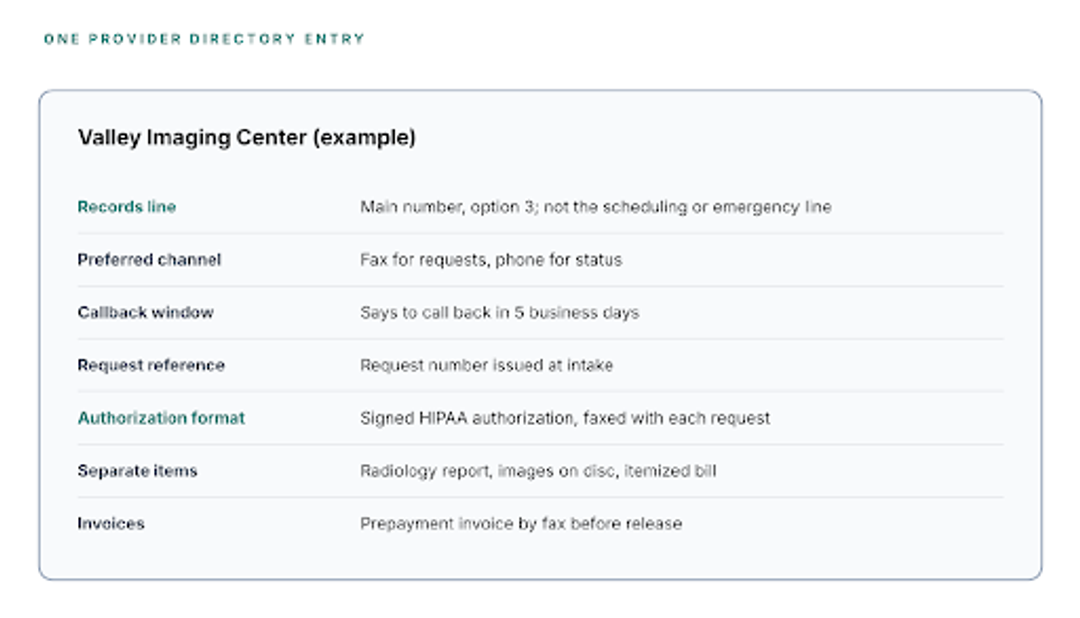
Each call should keep the directory current. When a clerk gives a new extension, fax number or callback window, the agent writes the change to the directory as well as the case note, so the next call to that office starts from accurate details.
How often should an AI agent call each provider?
The interval comes from the deadline behind each request and the processing time the provider states. A patient's own access request, including one directing records to the firm, falls under 45 CFR 164.524, while an authorization request has no federal deadline, and our planning figure of about four calls per open request per month is a working assumption each firm should test against its own provider mix.
Calling more often than the provider's stated window rarely speeds a request and can strain the relationship with the records clerks a firm depends on across many cases. The agent should log each callback window it receives, so the cadence reflects what each office actually says.
| Request type | Deadline | Follow-up rhythm |
|---|---|---|
| Patient access request directed to the firm | 30 days, plus one 30-day extension with written notice | Confirm receipt early, check status before day 30, ask for the written notice if the provider needs more time |
| HIPAA authorization request | No federal deadline | Follow the provider's stated callback window, with a call at least every 10 business days |
| California attorney request under Evidence Code 1158 | Five days | Confirm receipt the same day and call on day 4 if the records are not yet available |
| Request tied to a demand date | Set by the case | Shorten the interval and escalate after a set number of attempts |
Each kind of provider needs its own follow-up
The counterpart that answers decides the channel, the question, and what counts as done.
Hospitals and release-of-information vendors
Many hospitals and health systems outsource record requests to a release-of-information company that processes requests, prepares copies, and issues invoices for the hospital. In that setup, the request's status lives in the vendor's portal, and a call to the hospital's main number can end in a transfer to the vendor's customer line.
- Portal first: The agent checks the vendor portal with credentials your firm provides and calls only when the portal shows no movement past the stated processing time.
- Reference number: On the call, it quotes the vendor's request number instead of the hospital's account number.
- Status and reason: It asks whether the request is in processing, on hold for payment or rejected, and records the reason given.
- Invoice: It obtains any invoice and creates a payment task, so a person approves and pays it and card details stay out of the automated workflow.
Imaging centers
An imaging center can treat the radiologist's report, the images, and the bill as separate items with separate requests and fees, so a follow-up that asks only whether "the request" is done may close on the report while the images are still in a queue. The agent should ask about each item by name, record the status of each, and ask whether the center can share images through an electronic link instead of a disc.
Chiropractic and physical therapy clinics
Smaller clinics often handle records at the same desk that checks in patients, so a call at 9 a.m. on a Monday can compete with morning arrivals. The agent follows the callback window the clinic gives and, after a few weeks of logged attempts, times calls to the hours that the office tends to answer.
These clinics can produce some of the longest treatment records in a PI file, since a client may attend physical therapy two or three times a week for months. Checking the chart's date range against the client's attendance before the request closes catches missing visits early.
Specialist practices and narrative reports
Orthopedic surgeons, pain management physicians, and neurologists produce operative reports and procedure notes, and a narrative report tying treatment to the accident is a separate request that often carries its own fee. The agent can confirm receipt, ask for an expected completion date and record the quoted fee, while the decision to pay it and the questions the narrative should answer stay with the attorney and case manager.
Billing offices and current balances
At many providers, records and billing are separate teams, and a records request doesn't produce the itemized bill. The bill, any billing affidavit, and the current balance come from billing, often through a different number or email address.
The bill needs its own follow-up: confirm the billing office has the request, ask for an itemized statement covering the requested dates of service, and request the affidavit if the case needs one. Shortly before a demand goes out, AI medical provider follow-up can request an updated statement so the figures in the demand match the provider's current ledger.
Letters of protection raise the stakes on that last step. A provider treating on a letter of protection expects payment from the settlement, so the case manager should review the updated balance before the demand goes out rather than discover a gap at disbursement.
Ambulance companies and pharmacies
Ambulance run reports and pharmacy histories are short documents, though each comes from a separate billing contact with its own channel, and the bill for the transport or prescriptions belongs in the damages calculation. The agent tracks each one as its own item so a small request doesn't sit unnoticed behind the larger hospital file.
| Counterpart | What the agent asks for | What it records on the matter |
|---|---|---|
| Release-of-information vendor for a hospital | Request status by vendor reference number and invoice if issued. | Status, rejection reason if any, invoice amount, next check date |
| Imaging center | Report images and bills as separate items. | Status of each item, prepayment invoice, delivery method |
| Chiropractic or physical therapy clinic | Chart for the full date range, bill if handled at the same desk | Date range received, callback window, any missing visits |
| Specialist practice | Operative reports, procedure notes, and narrative reports, if requested | Status of each, narrative fee quoted, expected completion date |
| Provider billing office | Itemized bill, billing affidavit, updated statement before demand | Balance shown, affidavit status, contact used |
| Ambulance company or pharmacy | Run the report or prescription history and the bill. | Items received, billing contact, next action |
Watch an agent work a provider records queue
See HelloCounsel check a release-of-information portal, call a records line and write each status to the case file in a live demo. Book a provider follow-up demo
What one follow-up call looks like from dial to case note
Waiting can take up most of a provider follow-up call. In the illustrative call below, the phone tree and hold queue take 18 of 23 minutes, and the exchange with the records clerk takes about four.
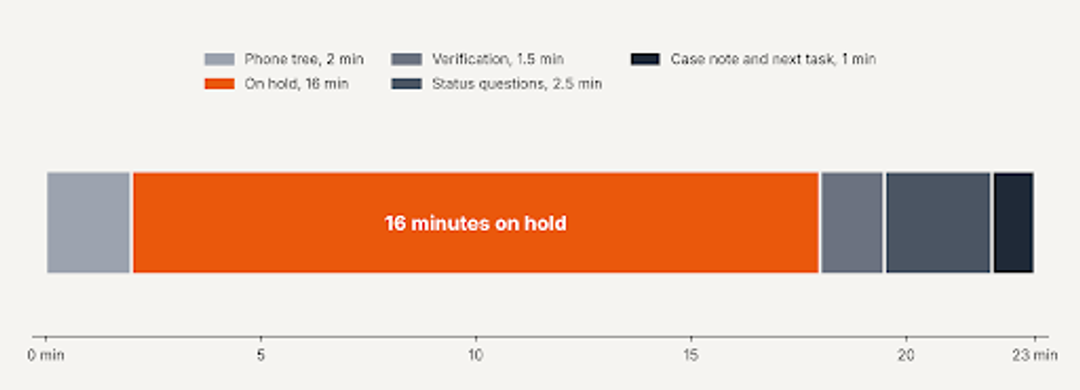
A records specialist on hold isn't reviewing the records that already arrived, while an agent can hold on to several provider lines at once. At the planning figure above, a firm with 150 open requests makes about 600 follow-up calls a month, and at 23 minutes each that is roughly 230 staff hours, an illustration of scale rather than a forecast for any one firm.
The final minute is what makes the rest of the call useful. Each case note should carry the same fields, written to the matter through CMS write-back:
- Who answered: The department and, where given, the clerk's name.
- Status: Received, in processing, sent, on hold for payment or rejected.
- Reference number: The provider's or vendor's request number.
- Open items: Any invoice amount, missing bill, affidavit, or rejected authorization.
- Next action: The next call, resubmission, or escalation, with a date.
How HelloCounsel handles provider follow-up inside the case file
HelloCounsel builds AI voice agents for plaintiff personal injury firms, and provider follow-up is one of the workflows its agent runs. HelloCounsel is our own product.
| Stage | What HelloCounsel does |
|---|---|
| Submission | Submits requests by email, fax, and portals such as Datavant, MRO, and ChartSwap, or picks up requests your team already sent |
| Follow-up | Calls through phone trees, waits on hold, checks portals and inboxes, and follows each provider's callback window |
| Completeness check | Validates the plaintiff, provider, and dates of service, and tracks records, bills, and affidavits as separate items. |
| Invoices | Obtains invoices and creates a payment task for your team without handling card details |
| Case file | Writes every call, status change, and next task to the matter, with recordings and transcripts; Filevine is a confirmed workflow. |
| Escalation | Routes stalled providers, discrepancies, and judgment calls to the named owner at your firm |
The same agent answers your main line, qualifies new leads, opens cases, and runs client check-ins, so a provider follow-up starts from a matter it already knows, a difference our comparison of AI intake and AI operations explains.
For AI medical provider follow-up specifically, HelloCounsel can start with requests your team has already submitted and take over submission later. HelloCounsel has handled more than 25,000 calls across these workflows, and the medical records workflow page shows the records side in detail. It doesn't handle hard-copy mail, portal access depends on credentials your firm provides, and completion times depend on how quickly each provider responds.
What changes for the records team when an agent makes the calls
With AI medical provider follow-up in place, records specialists move from dialing and holding to reviewing records as they arrive, reconciling bills against treatment dates, approving invoices, and working escalations. Case managers stop asking the records team where a request stands and read the last call note on the matter, which removes one of the interruptions our piece on reducing case manager workload identifies.
Five things an agent should never do on a provider call
Clear limits protect the firm, the client, and the provider relationship, and they belong in the agent's call flow before AI medical provider follow-up starts on live requests.
- Dial an emergency or patient-room line: The directory should route every call to a records, billing or vendor line.
- Answer legal or clinical questions: Anything touching fault, case value, or medical treatment goes to the case manager.
- Handle card details: Payments run through a task for a person at the firm.
- Discuss another patient: If a clerk reads out the wrong patient's information, the agent ends that line of conversation and flags the call.
- Expand the request: The agent asks only for the records, bills, and dates the authorization covers.
Where the agent hands a provider call back to your team
| Trigger | Who takes it | What they decide |
|---|---|---|
| The provider rejects the authorization or asks for a new one | Case manager | Fixing the form and getting the client's new signature |
| The provider requires prepayment. | Person who approves invoices | Whether the amount matches the request, then payment |
| Records belong to another patient, the wrong facility, or skip billed dates | Case manager | What to re-request, and what a gap in the dates means for the claim |
| Provider stays silent past its stated timeline despite repeated calls | Records lead or attorney | Whether to escalate, resend or move to a subpoena |
| Provider asks about the claim, liability, or the client's care | Case manager | How to respond, since the agent doesn't answer |
Give each rule a named owner. The same rules are what a supervising attorney reviews under Model Rule 5.3, which makes lawyers responsible for the nonlawyer assistance the firm uses, so recordings and transcripts should open from the matter.
Start with the provider that costs your team the most hold time
Pull the open requests from the last 90 days, sort them by provider and days outstanding, and pick the counterpart whose requests take the longest and the most calls. Run 10 to 20 of those requests through the agent while your team keeps submitting new ones, and record a baseline for each measure below before the pilot starts.
| Measure | Where to find it | What a working pilot shows |
|---|---|---|
| Days outstanding | Request dates on the matter | Fewer days from submission to complete records and bills |
| Staff calls per request | Phone system or call log | Few or no staff calls on requests the agent is working |
| Note completeness | A sample of 20 call notes | Status, reference number and next action on every note |
| Escalations per week | Tasks assigned by the agent | Escalations that reach the named owner the same day |
HelloCounsel's own launch model follows the same shape: a 60-minute workflow and setup call, about three to five days of configuration, and a 30-minute go-live review of real activity before the pilot expands. After 30 days, the four measures show whether to add the next counterpart.
Records summarization and demand drafting work on documents after they arrive, as our guide to AI paralegal platforms for PI firms describes. AI medical provider follow up is the calling work that gets those documents in the door.
Provider calls are also one part of the outbound load at a plaintiff firm, alongside lead follow-up and client check-ins, which we cover in automating outbound calls at a PI firm.
Firms still building a shortlist can start with our comparison of the best AI systems for medical provider calls. A firm that already knows its slowest provider can start with that one queue and a directory entry for every office on it.
Pick the first provider queue to hand off
Review your open requests by provider with HelloCounsel's founders and agree on the queue and request count for a first pilot. Choose a first queue with our founders
Frequently asked questions about AI medical provider follow-up
1. Can an AI agent call a hospital records department for a law firm?
Yes. An agent can call the records line or the hospital's release-of-information vendor, quote the request number, and record the status, provided the firm has a signed authorization on file and gives the agent the request details the provider uses to verify the caller.
2. What does a provider need before sharing request status with an AI agent?
Under 45 CFR 164.514(h), the provider must verify the caller's identity and authority. In practice, that means the request number, the client's name and date of birth, the dates of service, and a signed authorization on file.
3. Do TCPA rules apply to AI calls to medical providers?
The TCPA restricts artificial-voice calls without consent to emergency lines and patient rooms at hospitals and health care facilities. Records and billing departments use business lines outside those categories, so the directory should list those numbers.
4. Who pays provider invoices when an AI agent handles follow-up?
Your team does. HelloCounsel obtains the invoice and creates a payment task, and a person at the firm approves and pays it, so card details stay out of the automated workflow.
5. When does an AI agent stop following up with a provider?
When the request resolves or meets an escalation rule, such as a rejected authorization, a prepayment request, a material discrepancy, or a stalled timeline, the agent hands the request to the named owner at your firm.
6. Does HelloCounsel make outbound and inbound calls?
Yes. HelloCounsel makes outbound follow-up calls to providers and leads and answers inbound calls on your main line, writing each call to the matter in your case management system.
Share this article