How to Build a 24/7 Call Coverage Plan for a Personal Injury Law Firm

- A 24/7 call coverage plan assigns each of the week's 168 hours an owner, decides what that owner can finish on each type of call, and names a backup for when the owner can't answer.
- ABA Model Rule 7.3 bars live person-to-person solicitation, so a plaintiff firm can't call accident victims first, which makes answering every inbound call the main way to reach a new client at the moment they decide to call.
- Set a written answer standard for every window, such as 90% of calls answered within 20 seconds, the way 911 centers work, and the NENA standard of 90% within 10 seconds in the busiest hour.
- Wire one failover chain behind the main number, from the office line to overflowto the after-hours owner, and to a backup route, and test each link on a schedule.
- Make every window write to the same case file, because a plan that answers at 2 a.m. but leaves the call in an inbox until Monday has only moved the gap.
A 24/7 call coverage plan for a law firm decides who answers the phone in every hour of the week, which calls they can finish, and what happens when they can't. A plaintiff firm usually has pieces of one already: staff during the day, an answering service or voicemail at night, and someone's cell phone for emergencies. The difficulty is that the pieces have different owners, scripts, and records, and calls drop in the gaps between them.
Emergency call centers solved the same structural problem with a written standard. The National Emergency Number Association's call-answering standard, NENA 56-005, sets a target of 90% of 911 calls answered within 10 seconds during the busy hour and 95% within 20 seconds, and the standard applies to the center as a whole, whoever is on shift.
A personal injury firm isn't a 911 center, though its phone works the same way at a smaller scale. A caller doesn't know or care which vendor answers at 9:40 p.m., and a 24/7 call coverage law firm plan works when it treats the main number as one system with one standard, then assigns owners to each part of it.
Why does a personal injury firm need 24/7 call coverage?
Plaintiff firms depend on inbound calls for new clients, partly because the professional rules close the most direct alternative. ABA Model Rule 7.3 bars a lawyer from soliciting professional employment through live person-to-person contact when the motive is the lawyer's pecuniary gain, and ABA Formal Opinion 501, issued in 2022, made firms responsible under Rules 5.3 and 8.4 for training staff and others who act for them so they don't solicit either.
States add their own limits on written outreach. The Supreme Court upheld Florida's 30-day ban on targeted direct-mail solicitation of accident victims in Florida Bar v. Went For It, 515 U.S. 618 (1995), so in Florida a firm's first contact with an injured person in the month after a crash can't come from a targeted letter.
Outbound calls have their own federal rule as well. The FCC's February 2024 declaratory ruling treats AI-generated voices as artificial voices under the Telephone Consumer Protection Act, so an AI follow-up call to a lead's cell phone needs the caller's prior express consent, which a coverage plan should capture on the first inbound call.
Inbound is therefore the door, and it stays open only when someone answers. A caller who reaches voicemail at 9:40 p.m. on a Saturday can call the next firm in the search results within a minute, which our analysis of what happens to a PI case when a call goes unanswered follows through to the signed case.
What does a coverage gap look like in a law firm's call log?
Before building the plan, find the gaps the current setup already has. Export one month of call records from your phone system, group the calls by hour and day, and mark every call that reached voicemail, rang out, or hung up before anyone answered.
Three patterns show up in that export. Calls that hit the voicemail cluster in particular windows, often at 8 to 9 a.m., lunch, and the hour after closing; the same number calling twice within ten minutes marks a caller who tried again; and calls under ten seconds that end before an answer are callers who gave up during the rings.
The export also shows the cost side of the 24/7 call coverage law firm decision. Count the voicemails left by new callers in a month, compare them with the new matters opened from those callers, and the difference is the number our analysis of the hidden cost of missed calls at a PI firm puts a dollar figure on.
Map every hour of the week and name a coverage owner for each window
Start the plan with the week as it is today. List each window, such as weekday business hours, the first hour of the morning, lunch, weekday evenings, overnight, weekends, and holidays, and write down who answers in each one and what happens when that person doesn't.
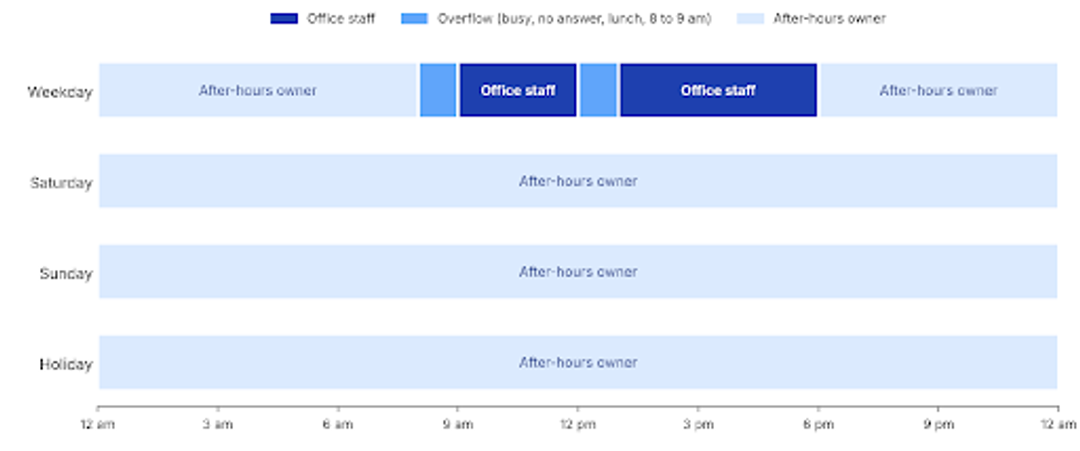
A typical plan has three owners. Office staff answer during business hours, an overflow owner takes calls when every line is busy or nobody picks up, and an after-hours owner takes every call outside the staffed schedule, including office holidays.
| Window | Owner | What the owner can finish | Backup if the owner can't answer |
|---|---|---|---|
| Weekdays, 9 a.m. to 6 p.m. | Office staff | Intake, transfers, client questions with the file open | Overflow owner after three rings |
| Lunch and 8 to 9 a.m. | Overflow owner | Intake screening, messages or transfers by rule | After-hours owner |
| Weekday evenings and overnight | After-hours owner | Intake screening, urgent escalation, messages for the morning | Backup route |
| Weekends and holidays | After-hours owner | Same as evenings, with the on-call attorney list for urgent calls | Backup route |
Shift changes deserve their own line in the plan. The minutes around 6 p.m. and 9 a.m., when the office forwards to the after-hours owner and back, are where a forwarding rule edited during a phone system update shows up first, so name who flips the schedule and who checks it.
Holidays need the same treatment. Put every office closure for the year on the after-hours owner's schedule in January, including the Friday after Thanksgiving and any half-day before a holiday, so the phone system doesn't keep ringing an empty office.
The table should name a person or vendor in every cell. A cell that reads "voicemail" is a gap, and a cell that reads "whoever is free" is a gap that nobody owns.
Decide what each call type needs from the after-hours owner
Coverage means more than a live voice. A new lead at 10 p.m. needs a full screening, an existing client asking whether the firm received her MRI report needs someone who can see the matter, and an adjuster calling at 4:55 p.m. on a Friday needs a message that reaches the case manager first thing Monday.
| Call type | What the caller needs | What the after-hours owner should do |
|---|---|---|
| New lead | A screening and a next step | Run the intake script, collect conflict names, and book or send the next step |
| Existing client | An answer about her case | Identify the caller and matter, answer what the file supports, and log the call |
| Provider or adjuster | A response from the right person | Record who called, about which matter, and route it to the case manager's queue |
| Urgent call | A lawyer, quickly | Follow the escalation rule to the on-call attorney |
| Merits or fee question | A lawyer's answer | Gather the facts and route the question to an attorney |
Language belongs in the same table. A Spanish-speaking caller at 11 p.m. should get the same screening as an English-speaking caller at 11 a.m., so each window's owner needs either bilingual staff on every shift or a defined transfer to someone who is.
The last row reflects ABA Formal Opinion 506, which lets nonlawyers gather facts, run conflict searches, and answer general fee questions while keeping legal advice with an attorney. Any after-hours owner, human or AI, works inside that line.
Write the urgent-call rule down with names and numbers. Typical triggers at a plaintiff firm include a client calling from the hospital after a new injury, an insurer pressing a client for a recorded statement, and a new caller whose limitations period runs out within days, and each one should go to a named on-call attorney with a second name behind it.
Set a call answer standard and staff each window to meet it
A standard turns "we cover the phones" into a number someone can check. A firm might set 90% of calls answered live within 20 seconds in every window, with no call reaching voicemail, which is looser than the 911 standard and still far above what a single receptionist and a voicemail box deliver.
The standard decides staffing. A human-staffed window needs at least two people on the phones, because one break or one long call otherwise drops coverage to zero, and an after-hours vendor should state in its contract how fast it answers and how it measures that.
Shared after-hours teams deserve a specific question. An answering service's night shift covers many clients at once, so ask how many agents are on overnight, how calls queue when several clients' lines ring together, and if the agreement commits to your answer standard.
Campaign weeks test the standard hardest. A mass tort campaign or a TV flight can double volume in an evening, so ask each owner how it handles a spike, whether it adds agents, queues callers, or starts sending calls to voicemail.
Wire one call failover chain behind the firm's main number
The owners only work if the phone system sends calls to them in the right order. Business phone systems generally support conditional forwarding: ring the office a set number of times, then forward on busy or no answer to the overflow owner, and forward on a schedule to the after-hours owner.
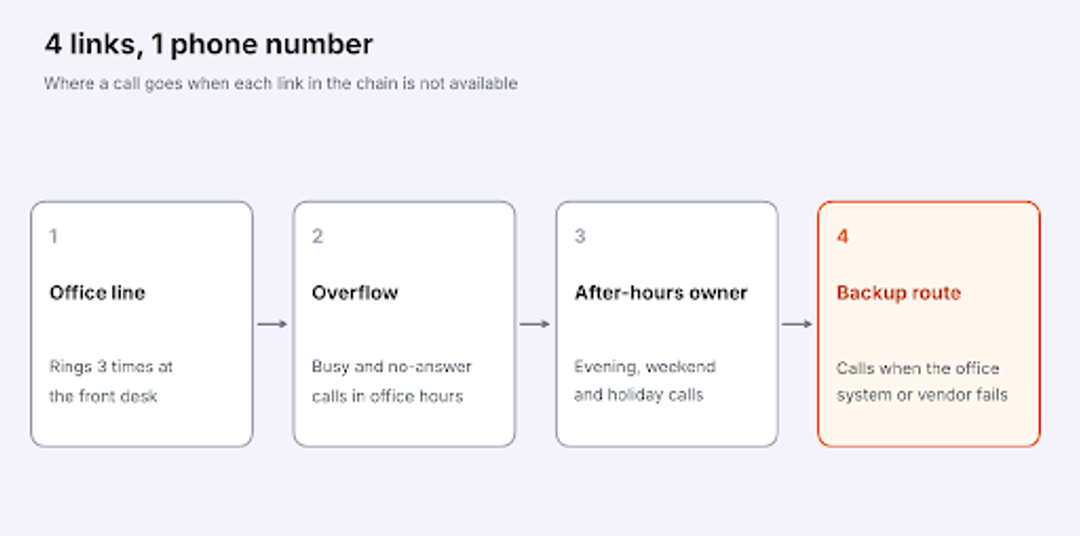
The backup route covers failures in the chain itself. Decide where calls go if the office phone system goes down, the internet fails, or the after-hours vendor has an outage, and set it up with the carrier before you need it, since configuring a failover during an outage leaves callers unanswered while it happens.
Keep the number of links small. Every extra hand-off adds rings before an answer, and a caller who hears eight rings may hang up before the fourth link picks up, so the chain should reach a live voice within the answer standard set for that window.
Every after-hours call answered and logged
Watch HelloCounsel take calls on a firm's main number outside office hours and write each one to the case file. Book an after-hours coverage demo
Make every coverage window write to the same case file
Coverage that answers at 2 a.m. but leaves the call in an email until Monday has only moved the gap. The plan should state, for each owner, how a call reaches the matter in your case management system and how long it takes.
Client communication is where this matters most. Comment 4 to ABA Model Rule 1.4 says a lawyer should promptly respond to or acknowledge client communications, so a weekend message from an existing client should land on her matter with a task for Monday rather than in a shared inbox.
Recordings need a home too. Model Rule 1.6(c) asks a lawyer to make reasonable efforts to prevent unauthorized access to client information, so the plan should state where each owner stores call recordings and messages, who can open them, and how long they are kept.
A shared standard for notes helps every owner. Each call record should show who called, what matter it concerns, what the caller needed, what the owner did, and the next step with a date, which is what CMS write-back produces automatically and what a message-based service leaves for your team to retype.
Test the coverage plan monthly and track four numbers by window
A coverage plan drifts. Holiday schedules change, a forwarding rule gets edited during a phone system update, and a vendor's after-hours team turns over, so the plan needs test calls and numbers the firm reviews.
Place test calls in the windows most likely to fail: 8:05 a.m. on a weekday, 12:30 p.m., 6:05 p.m., 2 a.m. on a Sunday and a public holiday. Use a staff member posing as a new lead in one call and as an existing client in another, and score each call against the answer standard.
Four numbers, broken out by window, show whether the 24/7 call coverage law firm leaders signed off on is working: answer rate, time to answer, calls abandoned before an answer, and time from call to case file. Our guide to after-hours intake for PI firms compares how answering services and AI agents perform on the after-hours numbers.
Review the numbers monthly with whoever owns the phone system. A window that misses the standard two months running needs a new owner, more staff, or a different failover rule.
How much does 24/7 call coverage cost a law firm?
Each owner prices coverage differently, so cost the plan window by window. In-house staff cost the most per covered hour: the Bureau of Labor Statistics puts receptionist pay at $38,010 a year, and covering the 123 hours outside a 9-to-6 weekday schedule with one person at a time takes just over three full-time positions before breaks, sick days, or a second line.
Answering services and virtual receptionists price by the call or the minute, so the after-hours bill rises with volume, including in the campaign weeks when the firm is already spending on media. Our breakdown of legal answering service costs compares those plan structures vendor by vendor.
Some AI agents price differently again, with a monthly fee scoped to expected volume, which our guide to AI receptionist pricing compares across vendors. The fixed fee covers the overnight and weekend windows without a per-call meter, which matters most in the months when volume swings.
Count the follow-up work in the same comparison. A 24/7 call coverage law firm plan that answers every call but turns them into messages still needs staff hours on Monday morning to enter, return and close those calls, and those hours belong in the total.
HelloCounsel can own every after-hours window on one standard
A plan with three owners has three sets of scripts, records, and failure points. HelloCounsel builds AI voice agents for plaintiff personal injury firms, and its agent can take the overflow and after-hours windows on the same main number, so the coverage map has one owner outside office hours. HelloCounsel is our own product.
- 24/7 answering: HelloCounsel answers in under two rings, day and night, as an AI receptionist, including during campaign spikes when several calls arrive at once.
- Caller pre-identification: HelloCounsel identifies the caller and any existing matter before the conversation starts, so an existing client's 2 a.m. call starts from her file.
- Qualification: HelloCounsel screens new leads through AI intake, in English or Spanish, with mid-call switching, and routes each file to signing, attorney review, or a referral.
- Custom call flows and escalation: HelloCounsel follows separate flows for new callers, existing clients, and attorneys, and transfers urgent calls to the on-call attorney on your escalation list.
- Case opening and case management: HelloCounsel opens the case and the insurance claim once the client signs and completes tasks inside the matter.
- Lead follow-up and client check-ins: HelloCounsel follows up with leads who haven't signed and runs treatment check-ins and medical records follow-up.
- CMS write-back and reporting: HelloCounsel writes every call to the matter through direct integrations with SmartAdvocate, Filevine, Litify, Lead Docket, and Clio; we build custom integrations for other systems, and HelloCounsel reports answer rate and call outcomes by window.
HelloCounsel has handled more than 25,000 calls and 500 hours of call time and has delivered a 48% improvement in call reception rates. We price on a fixed monthly fee starting at $500, scoped to expected call volume with 20% tolerance either way, with no per-minute billing and no setup fee, so a busy weekend doesn't change the invoice.
Onboarding takes about an hour and runs on 17 multiple-choice questions, and agents go live in SmartAdvocate in about a week. HelloCounsel works in English and Spanish only, runs inside your case management system rather than replacing it, and isn't a fit for a firm that tracks cases in spreadsheets.
Put the 24/7 call coverage plan on one page
A plan that lives in a vendor contract and a phone system menu isn't one the team can follow. Put the six parts on a single page that the office manager, the on-call attorney, and every vendor can read.
1. Coverage map: Each window of the week, with its owner and backup.
2. Call-type rules: What each owner does with new leads, existing clients, providers, adjusters, urgent calls, and merits questions.
3. Answer standard: The percentage of calls answered within a set number of seconds by window.
4. Failover chain: The ring count, forwarding rules, and backup route behind the main number.
5. Case-file rule: How each owner's calls reach the matter and how quickly.
6. Escalation list and test schedule: The on-call attorneys in order and the dates and times of the next test calls.
Most of the 24/7 call coverage law firm administrators need already exist in pieces, so the work is joining those pieces under one standard. Start with the call-log export from the first section, give every unowned window a name, and schedule the first round of test calls for next week.
Close the gaps in your coverage map
Go through your call log by hour with HelloCounsel's founders and see which windows the agent would take over. Schedule a coverage gap review
Frequently asked questions about 24/7 call coverage for law firms
1. What does 24/7 call coverage mean for a law firm?
It means a live answer on the firm's main number in every hour of the week, with a named owner for each window, rules for each call type, a backup route, and every call recorded in the case file.
2. Can a personal injury firm call accident victims instead of waiting for them to call?
ABA Model Rule 7.3 bars live person-to-person solicitation for pecuniary gain, and some states limit written outreach, so plaintiff firms rely on answering inbound calls whenever new clients decide to call.
3. What answer standard should a law firm set?
A practical standard is 90% of calls answered live within 20 seconds in every window, with no call reaching voicemail. Emergency centers work to a stricter NENA standard of 90% within 10 seconds.
4. Who should answer a law firm's phone after hours?
An after-hours owner, such as an answering service or an AI agent like HelloCounsel, working from your intake script and escalation list, with every call written to the matter.
5. How often should a firm test its call coverage?
Monthly, with test calls in the windows most likely to fail, such as early mornings, lunch, just after closing, overnight, and holidays, scored against the firm's answer standard.
6. Does HelloCounsel handle inbound and outbound calls?
Yes. HelloCounsel answers inbound calls 24/7 and makes outbound calls for lead follow-up, client check-ins, and medical records, writing each call to the matter in your case management system.
Share this article