Why Warm Call Transfers Matter for Law Firm Clients

- A warm call transfer means the person or agent handing off a call introduces the caller and passes along who they are and why they called before the receiver takes over.
- Cold transfers and transfers into voicemail force clients to repeat their story, and 56% of customers in Salesforce research say they often have to re-explain information to different representatives.
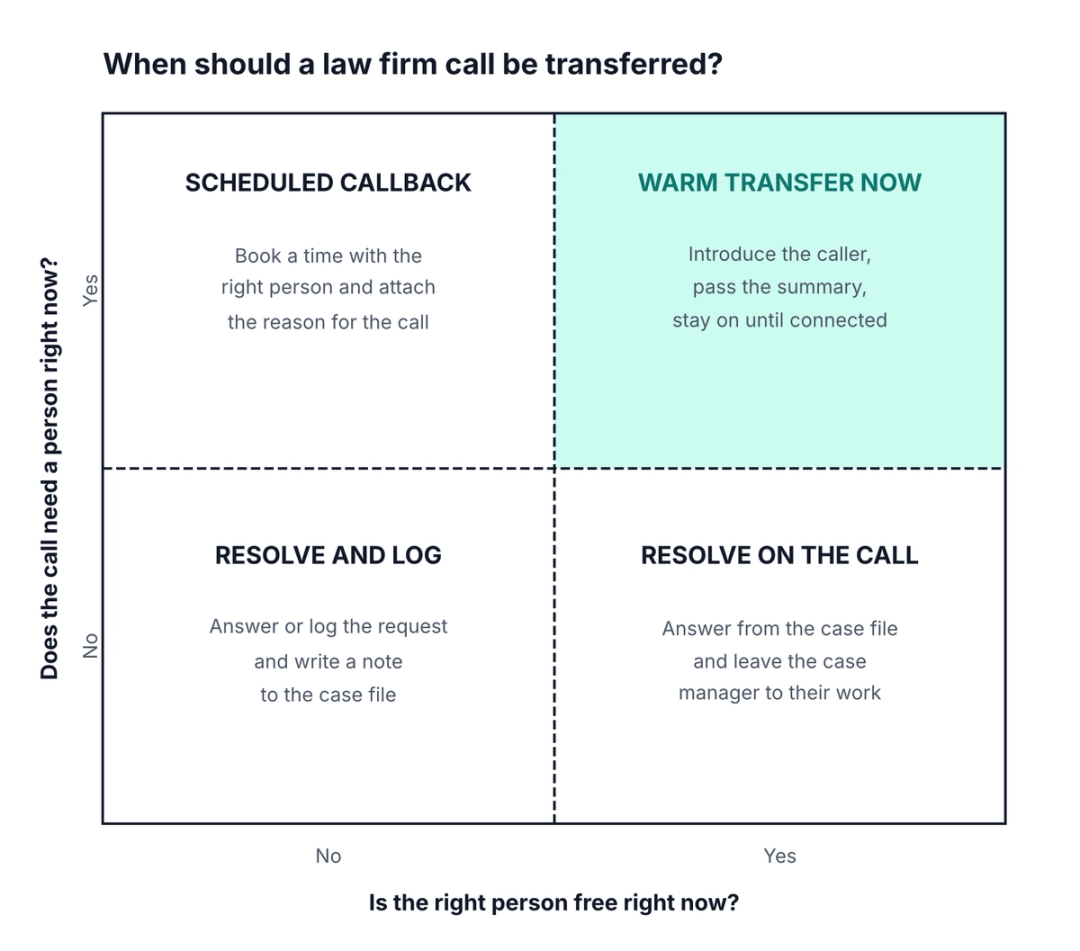
- Two questions decide whether a call should be transferred at all: does it need a person now, and is the right person free now.
- The caller, the person transferring, and the attorney or case manager receiving the call each have a part to play, and the handoff fails when any one of them skips it.
- Measure warm transfers by how often they connect, how fast the receiver picks up and whether callers still have to repeat themselves.
"Let me transfer you" is one of the most loaded sentences a law firm client can hear. Sometimes it leads to the right person, already briefed and ready to help, and sometimes it leads to a minute of ringing, a voicemail greeting, and the sinking sense that the call just started over.
Personal injury clients hear that sentence more than most. They call about treatment, bills, adjusters, appointments, and settlement timing, and many of those calls end up needing someone other than the first person who answered.
Transfers at law firms tend to fail in one of two ways. The first is the cold transfer: the call is passed along with no introduction, the receiver has no idea who is on the line, and the client has to explain their case again, sometimes after waiting on hold or reaching voicemail.
The second failure is quieter. A call that didn't need a person gets transferred anyway, interrupting a case manager in the middle of a demand letter to answer a question the case file already answers, and the firm pays for it in lost focus while the client waits through a transfer they didn't need.
A warm call transfer at a law firm solves the first problem, and a clear rule for when to transfer solves the second.
What is a warm call transfer?
A warm call transfer is a handoff in which the person or agent who answered stays involved until the receiver is ready. They confirm who the caller is, reach the right person, explain the reason for the call, and then connect the caller so the conversation continues instead of restarting.
A cold transfer, sometimes called a blind transfer, simply sends the call to another extension. If the receiver picks up, they start from nothing, and if they don't, the caller usually lands in voicemail.
| Transfer type | What the caller experiences | What the receiver gets |
|---|---|---|
| Cold or blind transfer | Ringing, then a stranger asking for their name and the purpose of the call | No context, unless they ask the caller to start over |
| Transfer to voicemail | A greeting and a request to leave a message, often after a wait | A message to return later, with whatever detail the caller left |
| Warm transfer | An introduction, then a person who already knows the reason for the call | A spoken summary and a caller who doesn't have to repeat themselves |
| Warm transfer with a written note | The same, plus a follow-up that reflects what was discussed | The briefing plus a case file note that records the whole conversation |
The last row is where a warm transfer becomes part of the record. A spoken handoff helps the person who picks up, while a written note helps everyone who opens the file afterwards, including the case manager who wasn't available for this call.
Two questions decide whether a call should be transferred
Not every call deserves a transfer, warm or otherwise. Two questions sort them quickly: does this call need a person right now, and is the right person available right now?
A call that needs a person when that person is free should get a warm transfer. A client reporting a new surgery, an adjuster with a settlement offer, or a new caller with a serious injury and a statute of limitations question all belong here.
When the call needs a person and nobody suitable is free, the better outcome is a scheduled callback, with the reason and a summary attached, rather than a transfer into a ring group that may roll to voicemail. The caller leaves knowing who will call and roughly when.
Calls that don't need a person should be resolved on the spot, whether or not anyone is free. Status questions, appointment confirmations, and document requests can be answered or logged without pulling a case manager away from their work, which our guide to reducing case manager workload treats as one of the biggest sources of recovered time.
After hours, the answer to the second question is almost always no. That makes the overnight rules simpler: resolve what can be resolved, schedule callbacks for the morning with summaries attached, and reserve live transfers to an on-call attorney for the emergencies the firm has defined in advance.
What the caller should experience
From the client's side, a good warm transfer at a law firm is almost invisible. They explain their reason for calling once, hear that they are being connected to someone who can help and then talk to a person who already knows why they called.
That expectation is common well beyond law firms. In Salesforce's State of the Connected Customer research, 79% of customers said they expect consistent interactions across departments, while 56% said they often have to repeat or re-explain information to different representatives.
Reaching a person matters too. In the Clio 2024 secret-shopper study, as reported by the Oklahoma Bar Journal, prospects who reached a real person had a 39% recommendation rate, far above those who dealt with email or voicemail.
A well-run transfer gives the caller four things:
- A clear statement of who they are being connected to and why
- No more than a brief silence while the connection is made
- A receiver who greets them by name and refers to the reason for the call
- A fallback they are told about in advance, such as a callback at a set time, if the transfer doesn't connect
For PI clients, not having to repeat themselves means more than convenience. Retelling how a crash happened or how an injury is affecting their life is tiring and often upsetting, and a firm that makes clients do it on every transfer is asking them to relive it more than necessary.
What the person making the transfer owes the receiver
The person or agent handing off the call is responsible for making sure the receiver can pick up the conversation without starting over. That starts before anyone dials an extension.
First, confirm who is calling. Matching the caller ID to the case file, or asking verifying questions when the number doesn't match, protects client information, since Model Rule 1.6(c) requires reasonable efforts to prevent its unauthorized disclosure, and a transfer to the wrong case manager can share details with someone who shouldn't hear them.
Second, check that the receiver is free before connecting the caller. A transfer into a phone that rings out is a cold transfer with extra steps, and checking availability first is what separates a warm handoff from a hopeful one.
Third, pass along the core details in a sentence or two. The receiver needs the same core details on every handoff:
| Handoff detail | What to pass along | Why the receiver needs it |
|---|---|---|
| Who is calling | Name, relationship to the case, and matched case file | Let the receiver greet the caller by name and open the file |
| Why they called | The reason in the caller's own words | Avoids asking the caller to explain again |
| What has happened so far | Anything already answered or attempted on this call | Prevents repeating questions the caller has already answered |
| How urgent it is | Any deadline, new injury, offer, or complaint | Helps the receiver set priorities for the conversation |
| What the caller was told | The name of the person taking over and any expectations set | Keeps the receiver's first words consistent with what the caller expects |
Finally, stay on until the receiver confirms they have the caller. If the receiver doesn't answer, the person transferring returns to the caller with the fallback, rather than leaving them in a ringing line or an unannounced voicemail box.
What the attorney or case manager owes the caller
The receiver's job starts with picking up. A case manager who lets warm transfers ring because they are busy turns the best handoff into a cold one, so firms that rely on warm transfers need a shared understanding of how quickly transfers get answered and who covers when someone can't.
Once connected, the receiver should use what they were given. Greeting the caller by name, picking up where the first conversation left off, and skipping the questions that were already answered show the client the handoff worked.
The receiver also owns the next step. If the question can't be answered on the call, the client should leave knowing what happens next and when, which is what Model Rule 1.4 expects when it calls for prompt responses to client communications and an acknowledgment, with a timeline, when a full answer has to wait.
Documentation closes the loop. A short note in the case file covering what was discussed means the next person to speak with the client starts informed, whether that is a paralegal, an attorney or an AI agent answering the client's next call.
Where warm transfers break down at law firms
Few firms set out to run cold transfers. The handoffs turn cold because of how the phones and the team are set up, and the causes tend to repeat from firm to firm.
The most common cause is missing availability information. The person answering can't see whether the case manager is on another call, in a meeting, or out for the afternoon, so they transfer and hope, and a transfer made on hope is how warm call transfers for law firms turn into voicemail.
Routing is the second cause. Ring groups that send a transfer to whoever is free first may connect the client to someone who has never seen their file, which is technically a live answer but leaves the client explaining everything to a stranger.
After-hours and overflow coverage is the third. An answering service that takes messages at night can't transfer warmly at all, and a stretched front desk at 9 a.m. may skip the introduction just to get to the next ringing line, which is the same pressure our piece on the hidden cost of missed calls traces back to lost cases.
Records are the last weak point. When the transfer happens by voice and nobody writes it down, whoever handles the client's next call has no idea the call took place, a gap our article on the documentation problem with answering services explains in more depth.
See HelloCounsel make a warm transfer with a case summary
We'll show you how HelloCounsel recognizes a client from caller ID, checks whether the case manager is free, introduces the caller with a short summary and writes the call to your case file. Book a warm transfer demo
When a warm transfer is the wrong move
Warm transfers are the right default for calls that need a person, but a few situations call for something else:
- Questions the case file can answer: Status updates, appointment times and document confirmations should be answered on the call instead of interrupting a case manager.
- Requests for a specific person's voicemail: Some callers want to leave a detailed message for their attorney, and forcing a live handoff they didn't ask for wastes their time.
- Medical or safety emergencies: A caller describing an emergency should be told to call 911 right away, not routed to a case manager.
- Calls when the receiver is unavailable: A scheduled callback with a summary attached serves the caller better than a transfer that will roll to voicemail.
- Vendors and solicitations: Sales calls and unrelated inquiries can be closed out politely or sent to a general inbox.
Our analysis of what happens to a PI case when a call goes unanswered shows why the callback option matters: a call that ends in an unreturned voicemail can affect the case itself as well as the client's mood.
Rules that keep transfers safe
Anyone who transfers calls for the firm, whether a receptionist, an answering service or an AI agent, acts as nonlawyer assistance the firm must supervise. The rules for warm call transfers at your law firm, including who receives which calls and what may be shared before the handoff, should be written down and reviewed by an attorney.
New callers need particular care. Under Model Rule 1.18, a person who consults about possibly hiring the firm becomes a prospective client, so a transfer that passes along a new caller's account should go to intake staff who handle conflict checks, not to whoever happens to be free.
Recording rules apply when a transfer brings a third person into a recorded call. Federal law under 18 U.S.C. 2511 generally permits recording with one party's consent, while states such as California require consent from everyone on the call, so firms that record should confirm their disclosures cover every person a transfer adds.
Why warm transfers matter for clients after they sign
A personal injury case can run for a year or more, and the client's experience of the firm is shaped by dozens of small calls. As per our estimate, a typical PI case generates about 150 calls over its life, and each transfer along the way either reinforces the client's trust or chips at it.
Clients rarely judge the legal work directly; they judge whether the firm seems to know them. A client who is transferred warmly, greeted by name and given a clear next step feels the firm is on top of their case, while a client who repeats their story to a third person in a week starts to wonder who is in charge.
Those impressions show up later in reviews, referrals, and the client's willingness to stay with the firm when an insurer makes a low offer. Our guide to improving client communication covers the update schedules and call habits that build that trust between transfers.
How HelloCounsel handles warm transfers
HelloCounsel builds AI voice agents for plaintiff personal injury firms, and warm transfers are built into how its agents handle calls that need a person.
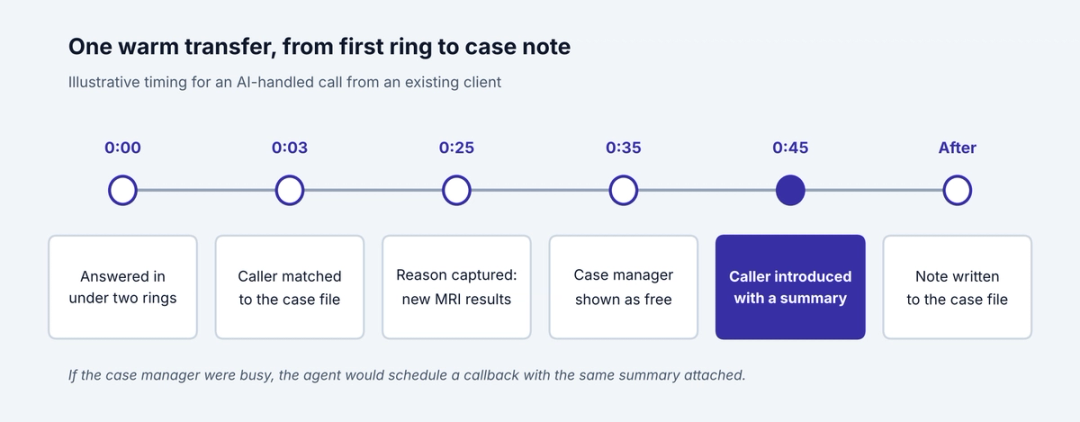
The AI receptionist answers in under two rings and looks up the incoming number in the case management system, so the agent knows who is calling before the caller explains. It resolves what it can from case data, and when a call needs a person, it routes on case data with a live availability check, making a warm transfer when the right person is free or scheduling a callback when they aren't.
Every call is written to the case file as a note in systems such as Filevine, Litify, SmartAdvocate, CASEpeer and MyCase, so the receiver of a transfer and anyone who opens the file later sees the full conversation. Calls are handled in English and Spanish, including callers who switch languages mid-call, and the dashboard reports transfer rates alongside call volume by caller type and clients not yet reached.
New callers follow the same pattern. HelloCounsel's intake agent runs your intake questions, writes the lead to intake systems such as LeadDocket and Lawmatics, and, when your intake team is free, transfers the caller warmly with the details already captured.
Across 30,000+ calls, firms using HelloCounsel have seen a 48% improvement in call reception and 2x more frequent client check-ins. Pricing is custom, based on call and case volume rather than seats, so you pay for tasks completed, and most firms go live in under two weeks.
Measure what happens after the handoff
Standard phone reports stop at whether a call was answered. A firm that cares about warm transfers needs to look one step further at what happened after the first person picked up.
Start with how often transfers connect. Track the share of transfer attempts that reached a person, how many seconds the receiver took to pick up and how many attempts fell back to a callback, then compare those numbers by team and by time of day to see where coverage is thin.
Then listen for repetition. Review a handful of transferred calls each month and note whether the receiver greeted the caller by name and whether the caller had to explain their reason again, because a warm call transfer at a law firm that still makes clients repeat themselves is a cold transfer with a longer greeting.
Finally, check the callbacks that stood in for transfers. A callback scheduled for this afternoon and made tomorrow undoes the goodwill a warm handoff was meant to build, so callback completion against the promised time belongs in the same review.
Review how your firm transfers client calls with HelloCounsel's founders Talk with HelloCounsel's founders about how calls move between your front desk, case managers and attorneys, and where clients end up repeating themselves. Book a call with HelloCounsel's founders about call transfers
Frequently asked questions
1. What is a warm call transfer at a law firm?
It is a handoff in which the person or agent who answered confirms the caller's identity, checks that the right attorney or case manager is free, explains the reason for the call and then connects them so the client doesn't have to repeat their story.
2. What is the difference between a warm and a cold transfer?
A cold transfer sends the call to another extension with no introduction, so the receiver starts from nothing, or the caller reaches voicemail. A warm transfer includes an introduction and a summary, and the person transferring stays on until the receiver picks up.
3. When should a law firm avoid transferring a call?
Avoid transfers when the case file can answer the question, when the caller wants a specific voicemail, when no one is free to take the call or when the caller describes an emergency. A scheduled callback or an answer on the call works better.
4. What information should be passed along in a warm transfer?
Pass along who is calling and their matched case, the reason in the caller's words, anything already answered, how urgent it is, and what the caller was told. A short note in the case file afterwards keeps the record complete.
5. Can an AI receptionist make warm transfers?
Yes. An AI voice agent connected to the case management system can identify the caller, check whether the right person is available, introduce the caller with a summary, and schedule a callback when no one is free, then write the call to the case file.
6. How do you measure whether warm transfers are working?
Track the share of transfers that connect, how quickly receivers pick up and how often transfers fall back to callbacks. Review a sample of transferred calls each month to check whether clients still had to repeat themselves after the handoff.
Share this article