7 Tavrn Alternatives for PI Law Firms (2026)

- HelloCounsel: HelloCounsel is the strongest Tavrn alternative for firms whose case managers are buried in calls, covering provider follow-up, client check-ins, adjuster calls, and inbound calls on fixed pricing from $500 a month.
- What Tavrn does: Tavrn runs the document side of a PI case, from medical records retrieval to chronologies and demand letters, so the right Tavrn alternative depends on which bottleneck you want to fix.
- Tavrn pricing: Tavrn charges $40 per request plus provider fees as of August 2026, or $8,000 a month at 200 requests before those fees.
- Demand platforms: EvenUp, Eve, and Supio suit firms that want AI demand drafting and chronologies, each with some call features attached.
- Retrieval only: YoCierge and Codes Health suit firms that only need retrieval, with Codes Health adding chronologies inside Filevine.
- Outsourced option: Finch fits firms that want an outside team, backed by AI, to run most of pre-litigation.
Tavrn has built a smart pipeline for the paperwork side of a PI case. Send one records request, and its AI agents chase the provider, pull the records, turn them into a chronology within a day, and draft the demand. For a paralegal who used to build chronologies by hand, that is a real change.
Two things still send firms looking for a Tavrn alternative. Some want a different price model than $40 per request. Others notice something more awkward: faster documents did not make the phones any quieter. Clients still call for updates, adjusters still call back at 4 p.m., and new leads still ring after hours, because a records and demand platform does not answer any of those calls.
So name the bottleneck before you compare any Tavrn alternative. If it is the document pipeline, a demand platform or retrieval service is the right purchase. If it is the calls around every case, you need something built for phone work, and that is what HelloCounsel does.
TL;DR: 7 Best Tavrn Alternatives in 2026
1. HelloCounsel: Best for firms whose bottleneck is provider, client, adjuster, and inbound calls & outbound follow-ups
2. EvenUp: Best for AI demand packages with outbound communication agents
3. Eve: Best for one platform across intake, demands, discovery, and calls
4. Supio: Best for chronology and demand quality with AI intake attached
5. YoCierge: Best for flat-fee records retrieval
6. Codes Health: Best for retrieval plus chronologies inside Filevine
7. Finch: Best for AI and paralegals running pre-litigation
| Tool | Handles client and adjuster calls | Medical records follow-up | Published pricing |
|---|---|---|---|
| HelloCounsel | Yes. Inbound, client check-ins, adjuster calls, and hold-time bridge | Yes. Provider calls run from CMS tasks | Yes. From $500 per month, fixed |
| Tavrn | No | Yes. Autonomous agents with saved transcripts | Yes. $40 per request plus provider fees |
| EvenUp | Yes. Communication Agents call clients, carriers, and providers | Yes. Agents request records | No. Quote through sales |
| Eve | Yes. Comms Agent runs check-ins and case updates | Yes. Comms Agent follows up on records | No. Quote through sales |
| Supio | No. Voice agent covers new leads | Yes, through a YoCierge partnership | No. Quote through a demo |
| YoCierge | No | Yes. Flat fee per request | No. Quote through sales |
| Codes Health | No | Yes. Inside Filevine | No. Per-case quote |
| Finch | Yes, with paralegals | Yes. AI plus staff | No. Per work completed |
What Tavrn Does Well, and What It Costs
Tavrn is an AI case preparation platform for personal injury, medical malpractice, SSDI, and workers' comp firms, with three products: medical records retrieval, medical chronologies, and demand letters.
Retrieval with autonomous follow-up
One request starts the process, and Tavrn's agents take it from there across all 50 states. They work provider phone trees, handle objections using notes from earlier calls with that facility, pay required invoices, and keep going on nights and weekends. Every provider interaction is saved as a call transcript, so when a request stalls, your paralegal can read what the records department actually said instead of staring at a "pending" status.
What happens after the records arrive
- Missing bills and records reports: Flags providers, date ranges, or billing records absent from the file
- Medical chronologies: Delivered in under 24 hours, hyperlinked to source pages
- Demand letters: Drafted from the chronology and billing records
- Client intake scoring: Assesses case value when a lead comes in
- eDiscovery support: Helps with document review volume later in the case
Tavrn connects with Litify, Clio, and Filevine. On security, it uses AES-256 encryption and single sign-on with multifactor authentication, and its program is aligned with SOC 2 criteria and HIPAA standards, which is not the same as holding a SOC 2 certification.
Tavrn pricing
Tavrn charges $40 per request plus the provider's own fees (pricing as of August 2026). Requests can be Medical, Billing, or Combined, so a billing-only request does not cost the price of a full package.
| Requests per month | Tavrn service fees |
|---|---|
| 100 | $4,000 |
| 200 | $8,000 |
| 400 | $16,000 |
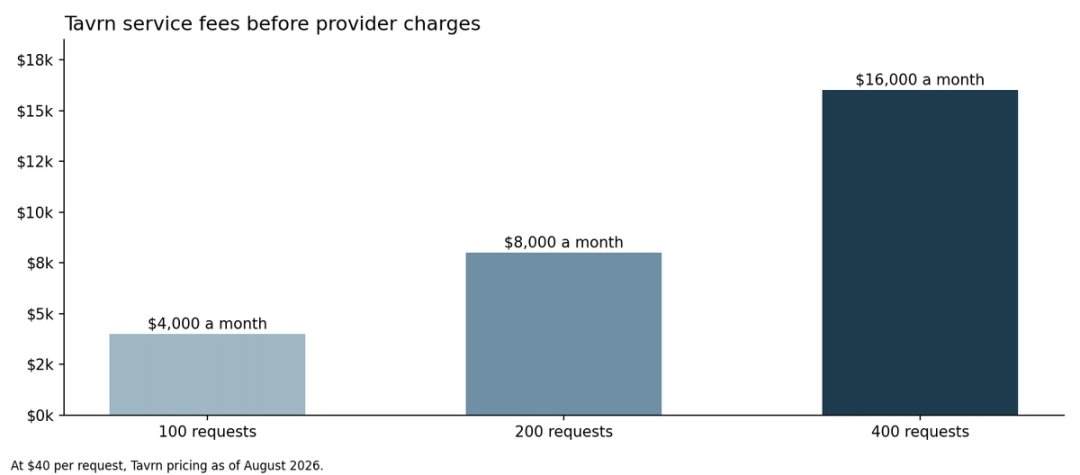
A published rate makes budgeting easy. It also means the bill climbs with every signed case, which is the opposite of what a growing firm wants from its fixed costs, and the number to beat when you price any Tavrn alternative.
Why firms look for a Tavrn alternative
You will not find Tavrn reviews on SoftwareFinder, Capterra, or Reddit yet, so the reasons firms compare a Tavrn alternative come from the product itself:
- Volume cost: $40 per request adds up fast past 100 requests a month
- Integration fit: Three named case management systems
- Security paperwork: Aligned with SOC 2 rather than certified
- Scope: No inbound call handling, client check-ins, or adjuster calls
Note
Under the HIPAA Privacy Rule, a covered entity must act on an access request within 30 calendar days and may take one extension of up to 30 more days with written notice, per 45 CFR 164.524.
That window explains why every serious records vendor competes on follow-up. It does not explain why your case managers still spend their afternoons on the phone, because most of those calls have nothing to do with a records request.
1. HelloCounsel: Best Tavrn Alternative for the Calls Around Every Case
As per our analysis, a typical PI case generates about 150 calls over its life, and provider follow-up is only one slice. The rest comes from clients asking about their case, adjusters returning calls, lien holders, and new leads calling after hours, as our breakdown of how many calls a PI case generates shows.
HelloCounsel builds AI voice agents for personal injury, workers' comp, and mass tort firms to take that call load. Our agent, Counsel, answers inbound calls, places outbound calls, and writes each outcome to your case management system (CMS).
Key features
- Caller pre-identification: The agent checks the caller against the case management system before handling the call, so it knows whether it is speaking with a client, provider, adjuster, or new prospect, which matter is involved, and which case staff to route to
- Custom call flows: Separate flows for new callers, current clients, providers, adjusters, attorneys, and after-hours traffic, each following your firm's SOP
- 24/7 answering: Picks up every call on the main line, including nights, weekends, and campaign spikes
- AI intake: Qualifies intake calls against your criteria in seconds and writes intake notes directly into the case management system
- Bilingual English and Spanish: Handles both languages on one line, including callers who switch mid-conversation, with no transfer
- Lead follow-up: Calls back new leads who did not sign on the first call and logs each attempt
- Medical records retrieval: Works provider phone trees and hold queues, confirms request status, and repeats follow-up until the records arrive
- Treatment check-ins: Places scheduled client calls after each visit, captures updates, and escalates when the case manager needs to step in
- Insurance claim opening: Opens claims with carriers through outbound calls
- Hold-time handling: Works insurer and provider phone menus and waits in hold queues, then connects your staff when a person answers
- Task completion: Each supported call ends with the action done and the case file updated, so staff do not have to act on a forwarded message
- CMS write-back: Direct integrations with SmartAdvocate, Filevine, Litify, Lead Docket, and Clio, with custom integrations available for other systems
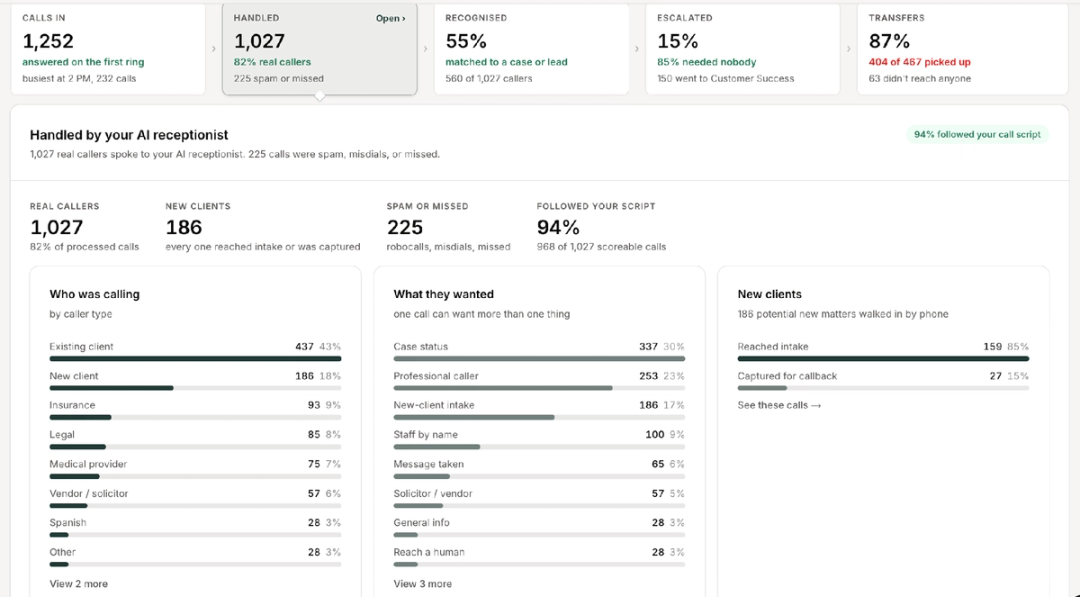
- Call reporting: A dashboard measures call volume, caller type, transfers, and script adherence, so you can size the phone load before and after launch
- Human escalation: Your transfer rules send sensitive, judgment-heavy, or out-of-scope calls to the right person with context loaded
How HelloCounsel covers what Tavrn leaves to your team
Inbound calls answered and routed by case phase
Tavrn today: Inbound calls stay with your staff.
Counsel answers your main line 24/7 and pre-identifies each caller before handling the call. A client in treatment reaches her case manager, an adjuster is verified and helped, and a new lead goes through AI intake using your criteria. Spanish-speaking callers stay on the same line, even when they switch languages mid-sentence, which is where a generic AI receptionist usually falls apart.
Client check-ins and treatment calls
Tavrn today: Client calls are not part of the workflow.
Treatment gaps hurt case value, and clients who hear nothing start calling. Counsel calls clients after appointments to confirm they went, asks about new referrals, and runs scheduled status updates. Anything new lands in the matter while it is current, which keeps client communication steady without adding calls to anyone's list.
Provider follow-up from tasks in your CMS
Tavrn today: Provider follow-up is included, billed per request.
Assign the task in your CMS, and Counsel calls the provider, works the phone menu, waits on hold, confirms the request, sends the follow-up email, and logs the status, with no per-request fee. Your team still sends the request and files what comes back. Our guide to AI on medical provider calls walks through the workflow.
Adjuster calls without the hold music
Tavrn today: Adjuster and lien holder calls stay with your staff.
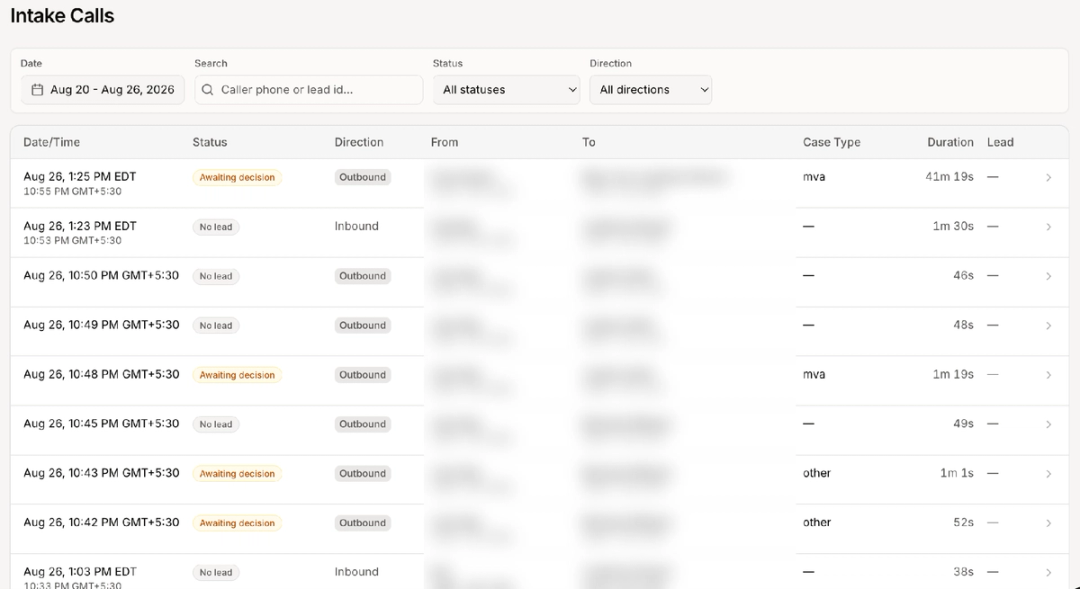
When a paralegal needs a live adjuster, she starts the call and hangs up. Counsel works the insurer's phone menu, waits in the queue, and rings her when a person picks up. It also opens insurance claims as an outbound workflow, part of the case for automating outbound calls.
Notes written straight into the matter
Tavrn today: Integrations cover Litify, Clio, and Filevine.
HelloCounsel writes directly into SmartAdvocate, Filevine, Litify, Lead Docket, and Clio, and our team builds custom integrations for other case management systems. Counsel pulls matter context during the call and writes notes, fields, and summaries back when it ends. That is how CMS write-back keeps the file honest, with guides for SmartAdvocate intake and Filevine voice agents.
HelloCounsel vs Tavrn at a glance
| Capability | HelloCounsel | Tavrn |
|---|---|---|
| Inbound call answering | Yes. 24/7 with caller pre-identification and routing by case phase | No |
| Client check-ins after treatment | Yes. Scheduled outbound calls written to the matter | No |
| Provider follow-up calls | Yes. Run from CMS tasks with every outcome logged | Yes. Autonomous agents with saved transcripts |
| Adjuster calls and hold time | Yes. Counsel waits in the queue and connects your teammate | No. Stays with your staff |
| Fixed monthly pricing | Yes. From $500 with no per-request fees | No. $40 per request plus provider fees |
| Call performance reporting | Yes. Volume, caller types, and transfer rates | Yes. Request status and call transcripts |
| Chronologies and demand drafting | No. Focused on call operations | Yes. Chronologies in under 24 hours, then demands |
What the calls cost your team today
Take a case manager who spends two hours a day on status calls, adjuster callbacks, and provider holds. That is about 40 hours a month. At the BLS median paralegal wage of $30.24 an hour, loaded to about $43.20 with benefits, those calls cost roughly $1,730 a month in staff time, per person. These figures are illustrative, so run the same math on your own call log before you price a Tavrn alternative.
Worth Knowing
The median annual wage for paralegals and legal assistants was $62,890 in May 2025, according to the Bureau of Labor Statistics, and benefits add about 30% on top.
What changes for your team
- Faster speed to answer: Calls are picked up immediately, including nights, weekends, and campaign spikes
- Shorter intake: Qualification happens during the call, and intake notes reach the file without re-entry
- Automated check-ins: Treatment gaps surface before they hold up a demand
- Workflows carried through: Agents work inside your existing CMS and finish supported tasks
- Lower overhead: Routine calls stop pulling case managers off case work, the most direct way to reduce case manager workload
HelloCounsel pricing
Per-request and per-minute pricing both tie your costs to your busiest months. HelloCounsel starts at $500 per month (pricing as of September 2026) on fixed pricing, with no per-request fees, no per-minute billing, and no setup fee. Plans are scoped to your licences and call volume with a 20% tolerance either way, so a month with 50 new cases does not double the bill. That makes HelloCounsel the Tavrn alternative whose cost stays flat as your caseload grows.
HelloCounsel by the Numbers
- 25,000+ calls handled - 500+ hours of call time handled - 93% SOP precision in every call - 48% improvement in call reception rates Figures reported by HelloCounsel.
"Working with HelloCounsel has been an outstanding experience. Their commitment to client service and innovation is evident in everything they do. We've been extremely impressed with our new AI receptionist, Kate, and the impact it's already making for our firm. I'm excited to continue exploring additional solutions that allow our case managers to focus more time on delivering exceptional client care." Anthony Ramos, COO, Pendergast Law
HelloCounsel pros and cons
| Pros | Cons |
|---|---|
| Handles inbound, client, provider, and adjuster calls with one agent | Does not build chronologies or draft demands, so keep your document tool for that |
| Fixed monthly pricing from $500 with no per-request fees | English and Spanish only |
| Direct and custom CMS integrations with notes written at call end | RingCentral is the documented phone integration, and other phone systems are configured during onboarding |
Bring your ten most common case calls to a founder call, and see how Counsel handles each one as a Tavrn alternative in a two-week pilot.
2. EvenUp: Best Tavrn Alternative for AI Demand Packages
EvenUp drafts AI demand packages for personal injury firms, built on a large set of past claims data. Its Communication Agents, launched in January 2026, call and text clients, carriers, and providers to open claims, confirm coverage, check treatment, and request records.
EvenUp key features
- Demand packages: AI-drafted demands, with professional review as an option
- Communication Agents: Outbound voice and text follow-ups
- Medical management: Treatment timelines that flag gaps and missing bills
| Pros | Cons |
|---|---|
| Deep focus on demand quality | Calls are one module inside a drafting platform |
| Outbound agents sit next to demand work | Main-line reception is not the focus, and G2 lists no user reviews |
Pricing and fit: EvenUp quotes pricing through sales. As a Tavrn alternative, it fits firms that care most about the demand itself. These EvenUp alternatives show where a call-focused tool fits beside it.
3. Eve: Best Tavrn Alternative for an All-in-One Plaintiff Platform
Eve runs EveOS, a full-lifecycle platform for plaintiff firms launched in June 2026, covering intake, casework agents for demands and discovery, firm analytics, and a Comms Agent for outbound calls.
Eve key features
- Comms Agent: Opens insurance claims, follows up on records requests, runs treatment check-ins, and sends case updates
- Phone menus: Works automated insurer and provider menus and retries unanswered calls
- Call plans: Reads the matter before each call and builds a plan your team approves
- Intake: A 24/7 intake agent that answers in 28 languages and sends the retainer for signature
| Pros | Cons |
|---|---|
| Outbound call coverage close to HelloCounsel's | Buying Eve is a platform decision across intake, demands, and discovery |
| Broad intake language support | Four products shipped in one June 2026 release, so expect a large change-management project |
Pricing and fit: Eve quotes pricing through sales. As a Tavrn alternative, it fits firms ready to put most casework on one vendor.
4. Supio: Best Tavrn Alternative for Chronologies and Case Analysis
Supio is an AI platform for plaintiff personal injury and mass tort firms. Supio Agent, released in May 2026, works across your case files, records, intake, and inbox, and connects to Westlaw Advantage for legal research.
Supio key features
- Chronologies and demands: Drafted with citations back to source pages
- Litigation drafting: Templates built from your firm's own documents
- Supio Intake: A 24/7 voice agent for new leads, with lead scoring and call coaching
- Records partnership: Retrieval through a January 2026 partnership with YoCierge
| Pros | Cons |
|---|---|
| Strong analysis across entire case files | Records retrieval runs through a partner |
| Intake voice agent built into the platform | Voice covers new leads, not existing-client or provider calls |
Pricing and fit: Supio quotes pricing through a demo. As a Tavrn alternative, it fits firms that want deeper case analysis and litigation drafting than a records-first platform offers.
5. YoCierge: Best Tavrn Alternative for Flat-Fee Retrieval
YoCierge is a medical record retrieval service for plaintiff and defense firms, priced as a flat fee per request with no per-page service charges.
YoCierge key features
- Flat-fee pricing: A volume-based fee per request
- Same-day processing: Orders placed before 4 p.m. go out that day
- AI tools: Chronological reordering, summaries, medical expense tables, and invoice review against state fee rules
- Integrations: Clio, Filevine, GrowPath, Litify, CasePeer, MyCase, Neos, SmartAdvocate, Smokeball, and others
| Pros | Cons |
|---|---|
| One of the widest CMS integration lists for retrieval | The fee is quoted through sales |
| Flags provider invoices above state limits | No demand drafting or client calls |
Pricing and fit: YoCierge quotes a volume-based flat fee per request. As a Tavrn alternative, it fits firms that only need records and already have chronology and demand capacity in-house.
6. Codes Health: Best Tavrn Alternative for Retrieval Inside Filevine
Codes Health pairs medical record retrieval with AI chronologies and case insights, and since a July 2026 partnership it runs inside Filevine projects.
Codes Health key features
- Multi-channel retrieval: Clearinghouses, custodian integrations, provider networks, fax, and patient uploads
- Authorization checks: Catches authorization errors before submission
- Analysis: Chronologies, missing-record review, and breach-of-care flags
- Filevine embed: Submit, track, and receive records inside the Filevine project
| Pros | Cons |
|---|---|
| Retrieval and chronologies from one vendor | Firms outside Filevine need a custom integration |
| Catches authorization errors early | No demand drafting or client calls |
Pricing and fit: Codes Health charges a flat fee per case, quoted through sales. As a Tavrn alternative, it fits Filevine firms that want records and analysis without a separate portal.
7. Finch: Best Tavrn Alternative for Outsourced Pre-Litigation
Finch pairs AI agents with US-based paralegals to run pre-litigation for personal injury firms, from records and claims to intake, police reports, lien tracking, treatment monitoring, and demand drafting. Its staff work inside your CMS and email from firm addresses.
| Pros | Cons |
|---|---|
| Covers most of pre-litigation in one engagement | Case work moves to an outside team |
| Pay-at-settlement options ease contingency cash flow | A managed service rather than software you configure |
Pricing and fit: Finch charges per work completed, with pay-at-settlement options. As a Tavrn alternative, it fits firms that want outside capacity across the whole pre-lit desk.
How to Choose the Right Tavrn Alternative
Start with where your cases actually slow down. A faster chronology will not shorten a week of unreturned client calls, and a voice agent will not draft your demand, so the right Tavrn alternative is the one aimed at your real bottleneck.
| If your bottleneck is | Choose | Why |
|---|---|---|
| Client, provider, adjuster, and inbound calls | HelloCounsel | One agent takes the calls in both directions and logs each outcome |
| Demand quality and settlement data | EvenUp | Demand-first platform |
| Intake, demands, and calls on one platform | Eve | Full-lifecycle platform |
| Chronologies, case analysis, and litigation drafting | Supio | Deep case-file analysis |
| Records only, at a flat fee | YoCierge | Flat fee per request |
| Records plus chronologies inside Filevine | Codes Health | Filevine embed |
| Not enough staff for pre-litigation | Finch | AI plus paralegals |
| Retrieval through demand in one per-request pipeline | Stay with Tavrn | Its core strength |
Did You Know
In the ABA 2024 AI TechReport, 29.5% of attorneys at firms with 10 to 49 lawyers said their offices use AI-based tools. Mid-market firms are still early with these tools, so a pilot on real cases tells you more than a demo.
For a wider view of the category, see our roundup of AI tools for PI lawyers.
What to test before you switch
- Pricing at your volume: Multiply last month's requests or calls by each Tavrn alternative's rate
- CMS depth: Check whether notes and statuses land in the matter or only in a vendor portal
- In-flight requests: Ask each Tavrn alternative how open requests are handed off without restarting the HIPAA clock
- Audit trail: Confirm you can read what was said on each call
- Remaining calls: List which calls still reach your staff after the switch
- Security paperwork: Ask whether SOC 2 is certified or only aligned, and get it in writing
Our guide on how to evaluate an AI voice agent covers the call tests in more depth.
Fix the Bottleneck You Actually Have
Tavrn is a strong choice when the document pipeline is the problem. At $40 per request, though, the cost grows with every case, and the calls around each matter still land on your team, where an unlogged call quickly turns into a documentation problem.
A Tavrn alternative built for demands will not fix a phone bottleneck, and the reverse is also true. If your case managers are losing afternoons to client updates, adjuster callbacks, and provider holds, HelloCounsel will return more hours than a faster document tool, on a fixed monthly price from $500. Count last month's calls by type, then review the HelloCounsel product against that list.
Book a call with HelloCounsel's founders and bring your call list. The team will set up a two-week pilot on those calls.
Frequently Asked Questions
What is the best Tavrn alternative for PI firms?
HelloCounsel is the best Tavrn alternative for firms whose bottleneck is phone work. It handles inbound calls, client check-ins, provider follow-up, and adjuster calls on fixed pricing from $500 a month.
Does HelloCounsel handle inbound calls and outbound follow-up?
Yes. HelloCounsel answers inbound calls and routes them by case phase, and it places outbound calls to providers, insurers, and clients, including records follow-up and claim opening. Each outcome is written to the matter.
How much does Tavrn cost?
Tavrn charges $40 per request plus provider fees as of August 2026, with Medical, Billing, or Combined requests. HelloCounsel starts at $500 a month with no per-request fees.
Which case management systems does HelloCounsel integrate with?
HelloCounsel has direct integrations with SmartAdvocate, Filevine, Litify, Lead Docket, and Clio, and builds custom integrations for other case management systems.
Which Tavrn alternative handles client and adjuster calls?
HelloCounsel answers client and adjuster calls on your main line, runs scheduled client check-ins, and waits in insurer queues so your paralegal joins only when a person answers.
Does Tavrn draft demand letters?
Yes. Tavrn drafts demand letters from its medical chronologies and billing records, alongside records retrieval and chronology generation.
How long do providers have to respond to a records request?
Under the HIPAA Privacy Rule, providers must act on an access request within 30 calendar days, with one extension of up to 30 more days. State rules can add requirements.
Share this article