Front-Desk Burnout at Law Firms: Why It Happens and How AI Prevents It
- The WHO describes burnout as chronic workplace stress that hasn't been managed, marked by exhaustion, mental distance from the job, and reduced effectiveness.
- Front-desk staff at law firms burn out from constant interruption, emotionally heavy calls, blame for delays they can't fix, uncapped call volume, and no backup.
- Burnout costs the firm in turnover, weeks of vacancy, and missed calls, plus a slow decline in how callers are treated before anyone resigns.
- Some fixes need no technology, such as protected breaks, scripts for upset callers, and giving the desk access to case status.
- AI voice agents reduce the conditions behind burnout by answering overflow and after-hours calls, handling status questions from the case file and writing every call to the file.
Nobody quits a law firm front desk over one call. The decision builds over months: the fortieth "has anyone heard from the adjuster?" of the week, the caller crying about a crash that put her son in the hospital, the partner asking why the phones rolled to voicemail during lunch, and the stack of mail that never gets opened because the phone rang again.
By the time the resignation letter arrives, the signs have been visible for a while. Calls get shorter and flatter, messages get thinner, and the person who used to remember every client's name starts letting the second line ring.
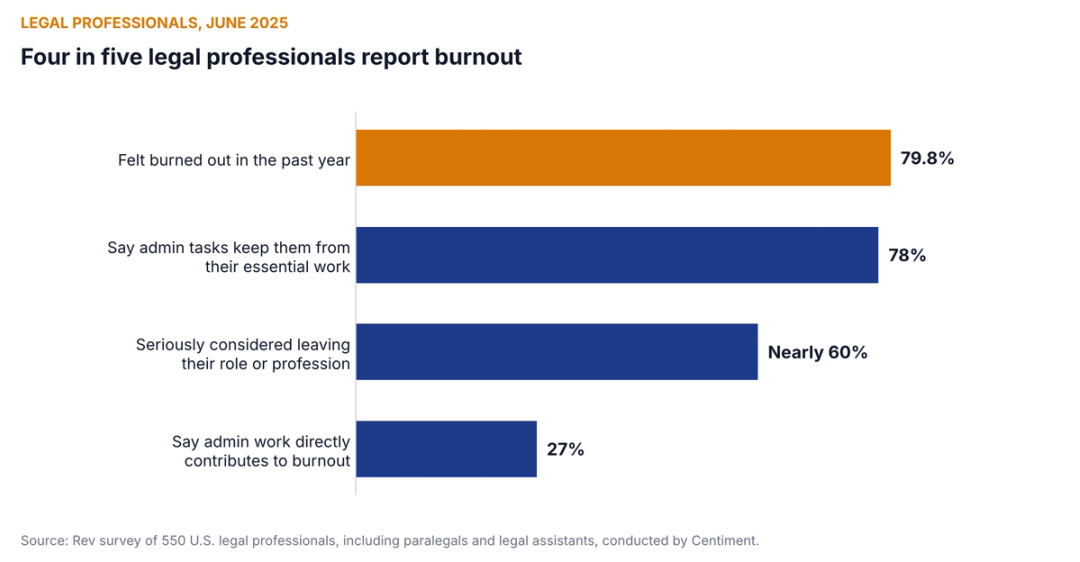
Burnout is common across legal work. In a June 2025 survey of 550 U.S. legal professionals commissioned by Rev, 79.8% reported feeling burned out in the past year, and nearly 60% said they had seriously considered leaving their role or profession because of stress.
Front-desk burnout at law firms has its own causes, though, and they come from how the role is built. The receptionist sits where every unplanned demand on the firm arrives first, by phone, at the door, and by email, and at a personal injury firm, that means absorbing the stress of injured callers and frustrated clients all day without the authority to fix what they are calling about.
That makes it a design problem more than a resilience problem. Wellness programs and pizza lunches don't change how many calls hit one person between 9 and 10 a.m., or how many of those calls ask questions only a case manager can answer.
What burnout looks like at a law firm front desk
The World Health Organization defines burnout in ICD-11 as a syndrome resulting from chronic workplace stress that has not been successfully managed. It classifies burnout as an occupational phenomenon, not a medical condition, and describes three dimensions.
| Burnout dimension | How it shows at the front desk | What the firm notices |
|---|---|---|
| Exhaustion | Dreading the phone, needing the drive home to recover, sick days clustering around busy weeks | More absences, slower answers late in the day |
| Mental distance or cynicism | Clipped greetings, rushing callers off the line, sarcasm about "frequent callers" | Complaints about rudeness: fewer callers converted to consultations |
| Reduced effectiveness | Incomplete messages, wrong routing, forgotten callbacks | Case managers chasing missing details, clients repeating their story |
Each of these can look like a performance problem from the partner's office. The receptionist seems less careful, less friendly, or less reliable, and the natural response is a conversation about standards, which adds pressure without removing any of its sources.
The three dimensions also feed each other. An exhausted receptionist takes shorter messages; the shorter messages produce callbacks that annoy clients, and the annoyed clients call back angrier, which makes the next day more exhausting.
Why law firm front desks burn out
The causes overlap, but each is worth looking at separately because each has a different fix.
The work is built around interruption
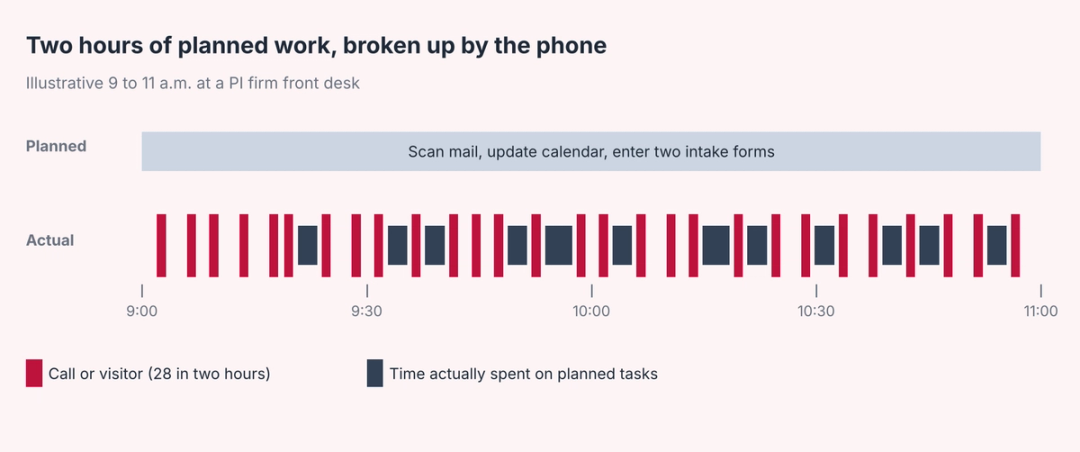
Front-desk work is interruption by design. The receptionist is expected to answer every call, greet every visitor, and also handle mail, scheduling, document scanning, and data entry, all of which get broken into fragments by the phone.
Research on knowledge work shows how costly that is. Gloria Mark of the University of California, Irvine found that once interrupted, workers took an average of 23 minutes and 15 seconds to get back to the original task, as Gallup reported on her research.
A front desk taking a call every few minutes never gets those 23 minutes. Tasks that should take an hour stretch across a whole day, and the receptionist goes home with the same list they arrived with, which is its own source of stress.
Personal injury callers carry heavy emotions
People call a personal injury firm on some of the worst days of their lives. New callers may be in pain, frightened about bills, or still shaken from a crash, and existing clients may be months into treatment, out of work, and anxious about money.
Answering those calls well takes emotional effort, and the receptionist does it dozens of times a day with no break between one caller's distress and the next caller's question. Over weeks, that steady effort wears people down even when each call goes well. Sociologists call this kind of work emotional labor: managing your own feelings to meet the expectations of the job, such as staying calm and warm with a caller who is neither.
The desk gets blamed for delays it can't fix
A large share of calls from existing clients are about progress, and the same few questions come up again and again:
- Has the adjuster called back yet?
- Did my medical records come in?
- When will my settlement check clear?
- Why hasn't anyone called me back?
As per our estimate, a typical PI case generates about 150 calls over its life, and most of the routine ones ask something the case file already answers.
The receptionist often can't see that file or isn't allowed to share what's in it. All they can do is take a message, so the client who called on Monday and calls again on Thursday aims their frustration at the person who answers, who had no way to help either time.
Being blamed repeatedly for something outside your control is one of the faster routes to the cynicism dimension of burnout. Our guide to improving client communication covers how regular updates reduce the volume of these calls at the source.
Volume has no ceiling
A receptionist's workload is set by people outside the firm. A TV campaign, a holiday weekend of accidents or a large mass-tort sign-up can double call volume in a day, and the desk is expected to absorb it with the same staff.
As per our estimate, a case manager with 100 cases fields about 15,000 calls a year, and a large share of that traffic passes through the front desk first. There is no point at which the phone stops ringing because the person answering it is full.
There is no real backup
Lunch, a doctor's appointment, or a sick child can leave the phones uncovered. A receptionist without real backup will skip breaks or work through illness rather than come back to a pile of voicemails and a partner asking what happened.
That guilt about stepping away is a burnout accelerator. A role in which taking a break visibly creates a problem for the firm is a role in which recovery never happens during the workday.
Training covers the software but not the hard calls
New receptionists are usually trained on the phone system, the calendar, and the case management login. Far fewer get guidance on what to say to a client who is shouting about a delayed settlement, how to end a call with someone who wants legal advice, or when it is acceptable to put a caller on hold to get help.
Without that guidance, every difficult call becomes an improvisation, and the receptionist carries the worry about whether they handled it right long after the call ends.
The work is invisible until something goes wrong
Front-desk work rarely has metrics anyone looks at. Nobody counts the 60 calls handled well on Tuesday, but everyone hears about the one that went to voicemail, so the feedback the receptionist gets is almost entirely negative.
What front-desk burnout costs the firm
The most visible cost of front-desk burnout at a law firm is turnover, though the full bill shows up in several places:
- Hiring and training: SHRM's 2025 recruiting benchmarking report put cost-per-hire for nonexecutive roles at $1,200 and median time to fill at about 44 days, and that figure leaves out the weeks a new receptionist spends learning the firm's clients, staff and software.
- The vacancy period: For six weeks or more, someone else covers the phones on top of their own job, calls roll to voicemail more often, and the clients who reach that voicemail are the same ones who were already frustrated.
- Quality before the resignation: A burned-out receptionist still answers the phone, but with less warmth, shorter intake notes, and less patience, and at a PI firm that first conversation often decides whether a new caller signs. Our breakdown of the hidden cost of missed calls shows how to put numbers on calls that don't convert.
- The second-hire fix: Hiring another receptionist can help in a busy office, but it doubles the salary line for coverage that still ends at 5 p.m., and our breakdown of virtual receptionist cost compares outside coverage against an in-house hire.
The pressure is not unique to law firms. Gallup's State of the Global Workplace report found that 50% of employees in the U.S. and Canada experienced a lot of stress during the previous day, based on 2025 data, which means a firm is competing for front-desk staff in a labor market that is already strained.
How to measure front-desk load before it turns into burnout
Burnout is easier to prevent when the firm can see the load building. Most of what it needs is already in the phone system and the receptionist's own memory, and pulling it together takes a couple of weeks.
Start with calls per staffed hour. A phone system report that shows calls answered by the front desk, broken out by hour, reveals the peaks, and comparing those peaks with the staff schedule shows when one person is carrying the entire load.
Next, measure the call mix. Ask the receptionist to mark each call for a week as a new caller, an existing client, a provider, an insurer, or something else, and note which existing-client calls were status questions; our analysis of how many calls a PI case generates gives a benchmark to compare against.
Then check recovery. Count how many days in a month the receptionist took a full lunch with someone else covering the phones and how many voicemails were waiting when they came back from any break. A desk that can't step away without a backlog is a desk on the way to burnout, whatever the person's attitude looks like today.
Fixes that don't need new technology
Some of the conditions behind front-desk burnout at law firms can change with management decisions alone, and these are worth making regardless of what else the firm does:
- Covered breaks: Schedule lunch and short breaks with named coverage, so stepping away doesn't create a voicemail pile.
- Scripts for hard calls: Give the desk approved language for distressed callers, angry clients and questions about case value, plus a clear person to escalate to.
- Access to case status: Let the receptionist see basic status information they are allowed to share, so a "has anything happened?" call can end with an answer.
- Visible metrics: Track calls answered, messages delivered, and callbacks completed, and review them in a way that recognizes good weeks as well as bad ones.
- Protected task time: Block an hour a day when someone else takes the phones, so mail, scheduling, and data entry get finished in one sitting.
These steps help, but most of them depend on someone else being free to cover the phone. In a firm where everyone is already stretched, coverage is the piece that breaks first.
How AI reduces the conditions behind front-desk burnout
An AI voice agent doesn't fix front-desk burnout at a law firm by making the receptionist more resilient. It changes the workload, taking on the repetitive and uncapped parts of the job so the person at the desk handles fewer calls, better ones and calls that need a human.
The agent can answer many calls at once, so a marketing spike or a busy Monday morning no longer stacks callers on hold behind one person. It covers lunch, sick days and after-hours calls without anyone feeling guilty about stepping away.
After-hours coverage changes the morning too. When overnight and weekend calls are answered and logged, the receptionist starts the day with organized records instead of a voicemail box full of messages to transcribe and return, which our comparison of after-hours intake options looks at in more detail.
Status calls are where the change is largest. An agent connected to the case management system can recognize the client from caller ID and answer routine questions from case data, which removes the call type most likely to put the receptionist in the position of being blamed for something they can't fix.
The agent also logs each conversation in the case file. The receptionist no longer has to write message slips or retype summaries, and case managers stop coming back to the desk to ask what a caller actually said.
What stays with people matters as much. Visitors at the door, distressed callers who need a human voice, sensitive conversations, and the judgment calls about who needs an attorney right now remain the receptionist's work, and those are the parts of the job that reward experience and care.
See how HelloCounsel takes routine calls off your front desk We'll show you HelloCounsel answering overflow calls, giving an existing client a status update from your case file and transferring a caller who needs your receptionist. Book a front desk demo
Introducing AI without making the front desk feel replaced
The way AI is introduced decides whether the receptionist experiences it as relief or as a threat. A receptionist who learns about the new system from a vendor email will reasonably wonder whether their job is next.
Involve the person at the desk from the start. They know which calls repeat, which callers need a human and which questions the agent should never answer, and asking them to help write the routing rules turns the rollout into something they shaped.
Be specific about how the role changes. If the agent takes status calls and overflow, say what the receptionist will do with the recovered time, whether that is intake follow-up, client check-ins or the scheduling backlog, and review the first few weeks of call records together so problems get fixed quickly.
Measure the effect after launch with the same numbers used before it: calls per staffed hour at the desk, full lunch breaks taken and voicemails waiting after a break. A short monthly check-in asking the receptionist how the workload feels completes the picture of whether front-desk burnout at your law firm is actually easing.
Generic tools can create new frustrations if they aren't built for this kind of firm. Our piece on why a generic AI receptionist won't work for a PI firm explains what to look for so the agent removes work from the desk instead of adding cleanup.
How HelloCounsel supports a law firm front desk
HelloCounsel builds AI voice agents for plaintiff personal injury firms, designed to work alongside the people at the front desk.
The AI receptionist answers in under two rings, matches caller ID to the case file and answers existing clients' status questions from case data. When a call needs a person, it checks live availability and makes a warm transfer or schedules a callback, so the receptionist only takes the calls that need them.
Calls are handled in English and Spanish, including callers who switch languages mid-call, and every call is written to the case file as a note in systems such as Filevine, Litify, SmartAdvocate, CASEpeer and MyCase. New leads go to intake systems such as LeadDocket and Lawmatics.
Proactive outreach reduces inbound pressure as well. HelloCounsel's client communication agent calls clients with scheduled check-ins, which gives them updates before they feel the need to call the front desk and ask.
Across 30,000+ calls, firms using HelloCounsel have seen a 48% improvement in call reception and 2x more frequent client check-ins. Pricing is custom, based on call and case volume rather than seats, so you pay for tasks completed, and most firms go live in under two weeks.
Ask the person at the desk
Exit interviews come too late to prevent front-desk burnout at a law firm. A stay interview, a short conversation with the receptionist while they are still in the role, gets the same information while there is time to act on it.
Three questions cover most of it:
- Which calls do you dread when you see them coming in?
- What do you never get time to finish?
- When did you last take a full lunch break without worrying about the phones?
The answers point straight at the call types and coverage gaps that are wearing the person down. Some of those can be fixed with schedules and scripts, and the rest point to work that the firm can move off the desk entirely.
Talk through your front desk workload with HelloCounsel's founders Tell HelloCounsel's founders how many calls your front desk handles and which ones repeat most, and see which of them an AI voice agent could answer. Book a call with HelloCounsel's founders
Frequently asked questions
1. What causes front desk burnout at a law firm?
Constant interruptions, emotionally heavy calls, blame for case delays the desk can't fix, and call volume with no ceiling and no reliable backup for breaks. At personal injury firms, repeated status calls from existing clients add steady pressure on the person answering.
2. What are the signs that a receptionist is burning out?
Watch for more sick days, clipped or rushed calls, thinner messages, routing mistakes, and skipped breaks. These match the WHO's three dimensions of burnout: exhaustion, mental distance from the job, and reduced effectiveness at work that used to come easily.
3. How much does receptionist turnover cost a law firm?
SHRM's 2025 benchmarking put nonexecutive cost-per-hire at $1,200 with about 44 days to fill. The larger costs come from the vacancy and training period, when calls go to voicemail more often and other staff cover the phones on top of their own work.
4. Can AI replace a law firm receptionist?
AI voice agents handle routine and overflow calls well, including status questions answered directly from the case file. Visitors, distressed callers, sensitive conversations, and judgment calls still need a person, so AI works best by taking repetitive volume off the desk.
5. How does AI reduce front desk workload?
It answers many calls at once, covers lunch and after-hours calls, answers status questions from the case file and writes each call to the file as a note. The receptionist handles fewer, more meaningful calls and gets uninterrupted time for other work.
6. How should a firm introduce AI to its front desk staff?
Involve the receptionist in setting routing rules, explain what they will do with the time recovered and review early call records together. Staff who help shape the rollout are more likely to see the agent as relief than as a threat.
Share this article