How AI Call Queue Management Works for Law Firms
- Call queue management for law firms is the set of rules that decides who answers each incoming call, in what order, how long callers wait, and what happens when no one is free.
- Traditional queues ring staff in a fixed pattern and send overflow to voicemail, treating a new injury caller, an existing client, and a records clerk the same way.
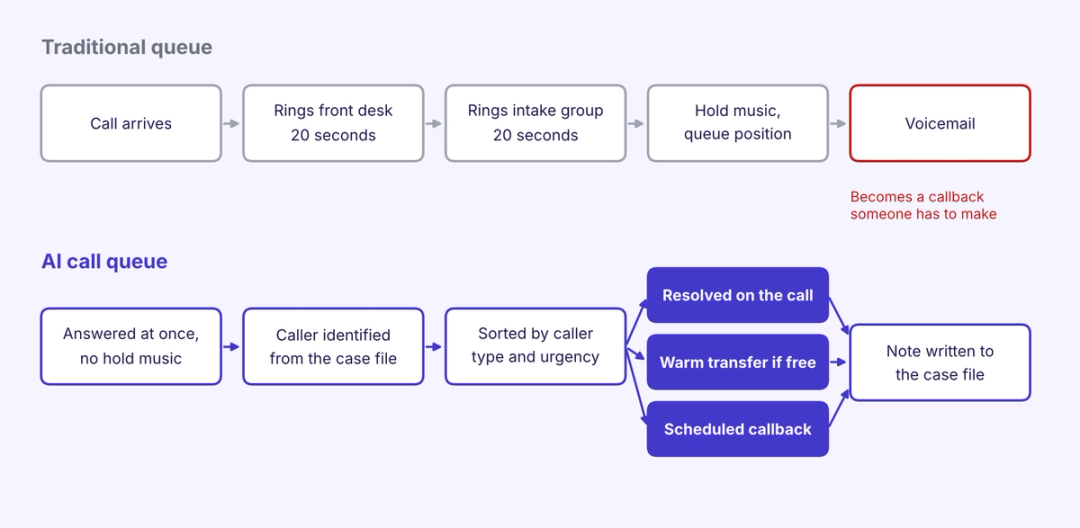
- An AI call queue answers every call at once, identifies the caller from caller ID and the case file, resolves routine requests on the call, and transfers only when a person is free.
- When no one is free, the AI schedules a callback instead of holding the caller, and every call is written to the case file as a note.
- PI firms should write their own caller-type priorities and track answer time, abandonment, transfer success and callback completion once AI is answering.
A law firm's call queue is usually designed once, on the day the phone system goes in, and then left alone. Someone in the office sets the rules in the admin portal: ring the front desk for 20 seconds, then ring the intake group, then send the call to voicemail. Years later, those same rules are still deciding what happens to every caller.
The people who wrote the rules rarely hear them in action. The caller hears them every time, and at a personal injury firm, that caller could be someone hit by a truck an hour ago, a client asking whether her settlement check has cleared, a hospital records clerk returning a request, or an adjuster with a question about policy limits. A traditional queue gives all four the same ring pattern, the same hold music and the same voicemail box.
That sameness is a bigger problem for call queue management for law firms than the length of any single wait. As per our estimate, a typical PI case generates about 150 calls over its life, and the calls that most need a person arrive mixed in with calls that only need an answer from the case file.
Long holds and voicemail are the visible symptoms. The underlying issue is that a standard queue has no way of knowing who is calling, so it can't put the injured caller ahead of the vendor or send the records clerk to the person handling that request.
AI changes the order of operations. Instead of making callers wait for a person to learn who they are and what they need, an AI voice agent answers first, works out who is calling and why, handles what it can and puts only the remaining calls in front of staff. The queue still exists, though it holds fewer calls, and the ones left in it are the ones that need a human.
What is call queue management?
Call queue management is the set of rules a phone system uses to hold and distribute incoming calls when more calls arrive than people are free to answer. On business phone platforms such as RingCentral and Zoom Phone, an administrator configures those rules for each queue.
A Zoom guide to call queuing published in July 2026 describes the settings a queue is built from:
- Distribution method: Ringing everyone at once, ringing in a fixed sequence, rotating through the team, or routing to the person who has been idle longest.
- Maximum wait: The time or queue length after which overflow rules take over.
- Overflow destination: Where calls go when the limit is hit, such as voicemail, another queue, or an external number.
- Announcements and callbacks: Messages telling callers their place in line and the option to request a callback while keeping that place.
Every one of those settings sorts calls by when they arrived and who is free. None of them knows who is calling or why. That blind spot is the central weakness of traditional call queue management for law firms, where several kinds of callers share one line.
Why do law firm call queues back up
Calls don't arrive evenly. They bunch around the start of the day, lunch, late afternoon, and the minutes after a TV ad airs, so a front desk that looks lightly loaded across the day can still have callers stacking up at 9:05 a.m.
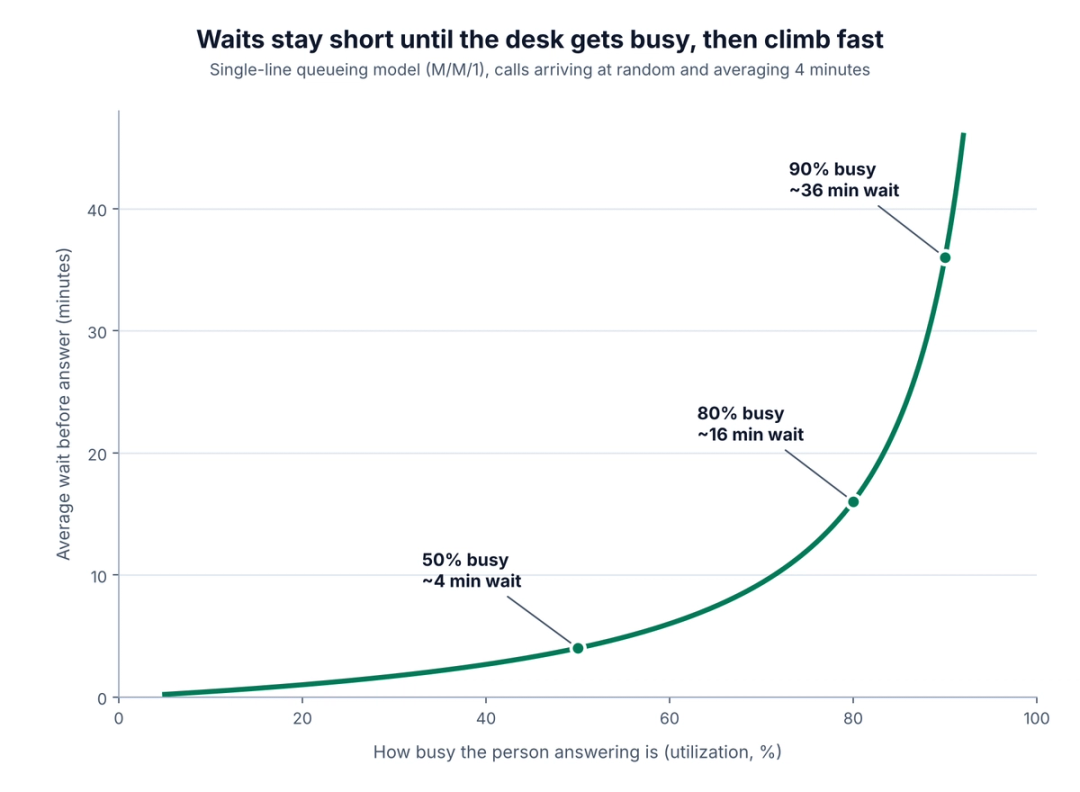
Queueing theory explains why the backup grows so fast. In the standard single-line model, average wait rises with how busy the person answering is, and it climbs steeply as that person nears full capacity instead of rising in a straight line.
With calls averaging four minutes, a receptionist who is busy half the time leaves callers waiting about four minutes on average. At 80% busy, the average wait is about 16 minutes, and at 90% it reaches about 36 minutes.
Callers don't wait that long. In a 2023 Call Centre Helper survey of contact center professionals, about a third said callers abandon within the first minute.
Law firms also carry a caller mix that ordinary queues weren't designed for. Our breakdown of how many calls a PI case generates shows how much daily volume comes from existing clients, providers, and insurers, all competing for the same lines as new injury callers.
Ring settings add delay of their own. A sequential queue that rings each of three staff members for 20 seconds keeps a caller listening to the ringing for a full minute before overflow kicks in, longer than the abandonment time reported by a third of the surveyed contact center professionals.
The overflow destination is usually voicemail, and voicemail moves the work rather than finishing it. Each message becomes a callback someone has to make, and our look at what happens to a PI case when a call goes unanswered traces how those delays reach the case itself.
How an AI call queue handles each call
An AI call queue doesn't replace the phone system's queue settings. It sits in front of them, answering calls before they reach a ring group and deciding which ones need a person at all.
It answers every call at once
A person can take one call at a time, while an AI voice agent can take many calls simultaneously. The line a caller would have joined at 9:05 a.m. never forms, and the first thing they hear is a greeting instead of hold music.
Concurrent answering also changes the queue math. When the agent handles routine calls, the staff behind it run at lower utilization, which is the part of the wait curve that stays flat.
It identifies the caller
The agent matches the incoming number against the case management system. An existing client is greeted by name with the case already pulled up, a known medical provider is matched to the open records request, and an unfamiliar number is treated as a possible new client.
When the number doesn't match, such as a client calling from a hospital phone or a spouse's cell, the agent asks verifying questions before sharing anything about the case. Model Rule 1.6(c), shown here in Minnesota's version, requires lawyers to make reasonable efforts to prevent the unauthorized disclosure of client information, and caller verification is part of meeting that duty on the phone.
It sorts by caller type and urgency
Once the agent knows who is calling, it applies the firm's priority rules. A new injury caller goes straight to intake questions, a client reporting a new surgery is flagged for the case manager the same day, and a vendor's sales call is closed out politely.
This is where AI queueing departs most from traditional queueing. Arrival order stops being the main sorting rule, and the case data and the reason for the call take its place.
Priority rules can also shift with the time of day. At night, the agent might take a full intake from a new caller and book a morning consultation, while a client's urgent update reaches an on-call attorney only for emergencies the firm has defined in advance.
It resolves what it can on the call
A large share of calls can end without a transfer. Status questions are answered from case data, document requests are logged, appointments are confirmed, and provider calls about records are matched to the right request, the kind of volume our guide on AI for medical provider calls covers in detail.
Existing clients make up the biggest part of this group. Answering them from the case file on the first call cuts the repeat calls that come from a client who left a message and heard nothing, a pattern our guide to improving client communication covers from the case manager's side.
It transfers only when a person is free
When a call needs a person, the agent checks live availability before transferring. If the case manager is free, the caller gets a warm transfer with a short summary passed along, so they don't have to repeat their story.
It turns waits into scheduled callbacks
If nobody is free, the agent schedules a callback instead of dropping the caller into a ring group that might roll to voicemail. The caller hangs up knowing when the firm will call and who will be on the line, and the callback lands on the right person's list with the reason attached.
The follow-through is what a voicemail box can't guarantee. In the Clio 2024 secret-shopper study, as reported by the Oklahoma Bar Journal, only 20% of firms that missed a call returned it.
The same callback list can carry outbound work too, such as confirming appointments or checking in with clients who haven't been reached in a while, which our piece on automating outbound calls explores further.
It writes every call to the case file
Every call ends as a note on the matter, covering who called, what they asked, what they were told, and what happens next. A case manager opening the file later sees the full call history without listening to voicemails or digging through message emails.
Setting queue priorities for a PI firm
Priority rules are the core of AI call queue management for law firms, and the firm's own attorneys and case managers should write them. A starting set for a plaintiff firm looks like this:
| Caller type | How the agent identifies them | Default handling |
|---|---|---|
| New injury caller | Unfamiliar number, describes an accident or injury | Run intake questions now, then hand to intake staff or book a consultation |
| Existing client with a routine question | Caller ID matches an open case | Answer from case data and write a note to the file |
| Existing client with an urgent update | Matched client reports new treatment, surgery, police contact or an insurer call | Warm transfer to the case manager if free, otherwise a same-day callback |
| Medical provider or records office | Number or name matches a provider on an open request | Match to the records request and log status and next step |
| Insurance adjuster | Caller names the carrier and claim | Take claim details and route to the assigned case manager |
| Defense counsel or court staff | Caller names a law firm or court | Transfer to the attorney if free; otherwise, an urgent callback |
| Vendors and solicitations | No case match and a sales purpose | Take a message or end the call politely |
Two rules deserve extra care. The first is the list of client statements that always go to a person, such as wanting to change firms, asking about a settlement offer or describing a new injury.
The second is what the agent says to adjusters and defense lawyers. Those calls can touch on settlement positions and case strategy that only attorneys should discuss, so the agent's role there is to take details and route, never to answer substantive questions.
Queue metrics to track once AI is answering
Traditional queue reports measure how long callers waited, and that is where call queue management for law firms has usually stopped. With an AI agent answering first, the useful numbers shift toward what happened on each call:
- Answer time: Seconds from first ring to greeting, which should hold steady at night and on weekends as well as during office hours.
- Abandonment rate: Callers who hang up before reaching the agent or during a transfer.
- Resolved without transfer: The share of calls the agent finished on its own, broken out by caller type.
- Transfer success: The share of warm transfers that reached a person instead of falling back to a callback.
- Callback completion time: Hours from a scheduled callback request to the actual call, measured against the time promised.
- Clients not yet reached: Clients with no contact in a set period, which gives case managers a proactive outreach list.
Read transfer success and callback completion together. A low transfer success rate with fast callbacks points to staff who are free at some hours and buried at others, which calls for a scheduling change more than a phone change.
What to settle before turning on an AI call queue
Start with the availability source. The agent can only transfer to someone it knows is free, so it needs to read presence status from the phone system or staff calendars, and the firm needs a rule for what counts as available during meetings and depositions.
Then decide the fallback for a failed transfer. If the case manager doesn't pick up within a set number of rings, the call should return to the agent for a scheduled callback instead of rolling into voicemail.
Language coverage comes next. Spanish accounted for 61.1% of U.S. residents age 5 and older who spoke a language other than English at home in Census Bureau data for 2018 to 2022, so a queue that handles Spanish only when one bilingual employee is free will keep some callers waiting.
Callbacks deserve a compliance check as well. In 2024 the FCC ruled that AI-generated voices count as artificial voices under the Telephone Consumer Protection Act, so confirm with counsel how your callback flow records that the caller asked to be called back.
Finally, review the confidentiality terms. Ask where call recordings and transcripts are stored, who can access them, and how the vendor's contract supports the firm's duty to protect client information.
Mistakes that undo an AI call queue
One failure is transferring too much. If the agent hands off every call that isn't a simple status question, staff end up with the same volume plus a short delay, and the AI works like an expensive phone menu.
Another is treating every unfamiliar number as a new client. Providers, adjusters, and clients call from new numbers all the time, so the agent should ask a short identifying question before starting intake, or a hospital billing office ends up in the intake pipeline.
A third is callbacks without an owner. A callback assigned to a shared inbox or a general queue repeats the voicemail problem under a different name, so every callback should land on a named person's list with a due time.
The last is setting the rules once and never reading the calls. Review a sample of transcripts each week during the first month, especially transfers and callbacks, and adjust the priority rules wherever the agent's handling doesn't match what a case manager would have done.
How HelloCounsel manages a PI firm's call queue
HelloCounsel builds AI voice agents for plaintiff personal injury firms, and its agents sit in front of the firm's phone system on platforms such as RingCentral and Zoom.
The AI receptionist answers in under two rings and matches caller ID to the case file, so existing clients, providers, and new callers are sorted from the first moment of the call. It routes on case data with a live availability check, making a warm transfer when the right person is free or scheduling a callback when they aren't.
Every call is written to the case file as a note in systems such as Filevine, Litify, SmartAdvocate, CASEpeer, and MyCase. New leads go to LeadDocket or Lawmatics through HelloCounsel's intake agent, and calls are handled in English and Spanish, including callers who switch languages mid-call.
The dashboard reports call volume by caller type, transfer rates, and clients not yet reached, which covers several of the queue metrics a firm needs to track. Across 30,000+ calls, firms using HelloCounsel have seen a 48% improvement in call reception and 2x more frequent client check-ins.
The scheduled callbacks and check-ins on the outbound side run through HelloCounsel's client communication agent, which works from the same case file, so outbound calls reflect what the client asked on their last inbound call.
Pricing is custom, based on call and case volume rather than seats, so you pay for tasks completed, and HelloCounsel costs about a quarter of what virtual receptionists charge. Most firms go live in under two weeks.
Watch HelloCounsel sort a morning call rush
See an AI voice agent answer several calls at once, recognize existing clients from caller ID, transfer an urgent call to a free case manager, and schedule a callback when no one is available. Book a call queue demo
From the waiting line to the sorting step
The settings in a phone system's admin portal were written on the assumption that every call needs a person to find out what it's about. Once an AI agent answers first, that assumption stops holding, and the queue becomes a sorting step instead of a waiting line.
Last week's calls are the practical starting point. Sort them by caller type and write down what each type should have received: an answer, a transfer, or a callback.
Then compare that list with what the current queue actually did. The gap between the two is the working brief for call queue management for law firms moving to AI, and revisiting it each quarter keeps the priorities in step with changes in staff, case volume, and marketing.
Rewrite your call queue rules with HelloCounsel's founders
Bring your current queue settings and a week of call logs, and see which calls an AI voice agent would resolve, transfer, or schedule for a callback. Book a call with the founders to review your queue settings
Frequently asked questions
1. What is call queue management for law firms?
It is the set of phone system rules that decides who answers each incoming call, in what order, how long callers wait, and where calls go when no one is free. AI adds caller identification and priority rules so the queue sorts calls by need.
2. How does an AI call queue decide which calls to transfer?
The agent identifies the caller from caller ID and the case file, then applies the firm's priority rules. Routine requests are resolved on the call, while urgent client updates, attorney-only topics, and complex questions go to a person when one is free.
3. Does an AI call queue work with our existing phone system?
Usually, yes. AI voice agents connect to business phone platforms such as RingCentral and Zoom and sit in front of existing queue settings. Calls that need a person still reach your ring groups or a direct transfer through the same phone system.
4. What happens if no one is available when a call needs a person?
The agent schedules a callback instead of placing the caller on hold or sending them to voicemail. The caller hears when the firm will call back, and the callback request lands on the right person's list with the reason for the call attached.
5. Will an AI call queue replace our receptionist?
It changes the role more than it removes it. The agent handles routine calls, overflow, and after-hours volume, while the receptionist takes on transfers that need judgment, in-office visitors, and the callbacks the queue schedules. Some firms move that freed time to intake follow-up.
6. How should a firm measure an AI call queue's results?
Track answer time, abandonment rate, the share of calls resolved without a transfer, transfer success, and callback completion time. Compare each against the month before launch, and break the numbers out by caller type to see which priority rules need adjusting.
Share this article